When an adult bald eagle appeared in the backyard of a home near Coeur d’Alene in Kootenai County, Idaho, the family who first noticed it did not immediately assume anything was wrong.
Bald eagles are familiar sights across northern Idaho, especially around lakes, rivers and wooded residential areas bordering natural habitat. An adult eagle sitting quietly in a yard could simply be resting after feeding, waiting for favorable wind, or watching the surrounding area before moving on.
So at first, the homeowners gave the bird space.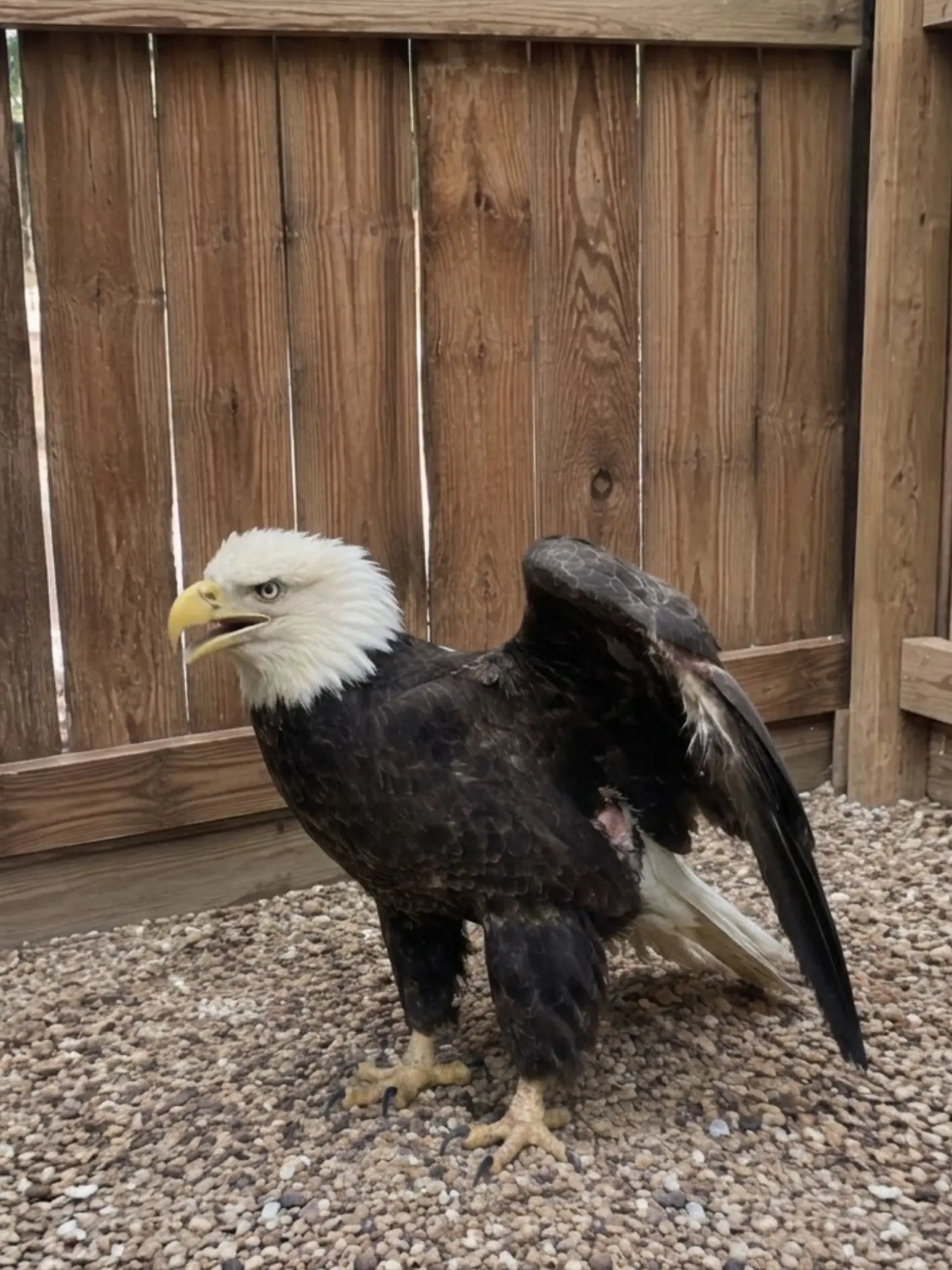
They stayed back.
They kept pets inside.
And they waited.
But after several hours, the eagle was still there.
It had moved only a short distance.
It had not flown into one of the nearby trees.
It had not left the property when people appeared at a distance.
The longer the family watched, the less the situation looked like normal resting behavior.
Then they noticed the wing.
One side of the eagle’s body did not look quite right. The wing was not being held in the same position as the opposite side, and beneath the feathers near the base of the wing, an area of exposed tissue could be seen.
“At first we thought she was just resting,” the homeowner later recalled. “But hours went by and she never left. When we finally noticed the way one wing was sitting, we realized she might not be choosing to stay there.”
That observation prompted a call to a regional wildlife rescue team in northern Idaho.
By the time responders arrived, the adult bald eagle was still alert and capable of standing, but it was not attempting normal flight.
What initially looked like a bird simply lingering in a backyard was now being treated as a potentially serious trauma case.
The eagle was safely contained and transported to a licensed raptor rehabilitation center, where veterinary staff found multiple soft-tissue injuries around the wing and flank.
Radiographs did not reveal a major displaced fracture.
That was encouraging.
But it did not answer the most important question.
If the bones were intact, why could the eagle not fly?
The answer, veterinarians suspected, might lie in the tissues that an X-ray cannot show nearly as well — the muscles, tendons, ligaments and structures responsible for moving the wing through a full, powerful flight stroke.
A Bald Eagle in the Yard Did Not Seem Unusual at First
The property sits in a part of Kootenai County where bald eagles are regularly seen.
Lake Coeur d’Alene and the surrounding waterways attract eagles throughout the year, with especially high concentrations during periods when food is abundant.
Adult bald eagles may perch near homes, roads, docks and wooded properties.
They are highly visible birds.
Their white heads and tails stand out immediately against dark forest and open water.
Because of that, the family initially viewed the backyard visitor as something remarkable but not necessarily concerning.
They watched from indoors.
The eagle appeared conscious.
Its eyes were open.
It remained aware of movement around the property.
Nothing about its behavior initially suggested a bird in immediate collapse.
But time changed that interpretation.
A healthy adult bald eagle normally has options.
If uncomfortable, it can fly.
If approached, it can create distance.
If it wants a higher vantage point, it can move into a tree.
This bird did none of those things.
The Failure to Leave Became the First Major Warning Sign
Several hours after the eagle was first noticed, the homeowners began to realize that the bird was not behaving like an animal choosing to remain in the yard.
It appeared to be staying because it could not leave normally.
That distinction is one of the most important things members of the public can recognize when observing wildlife.
A wild animal does not have to be lying unconscious to be in trouble.
An eagle may still stand.
It may still watch people.
It may even walk.
But if it repeatedly fails to fly despite having obvious reason to move away, an injury may be limiting it.
The homeowners continued observing from a safe distance.
That is when the abnormal wing position became more apparent.
The wing on one side appeared elevated or held away from the body.
The feathers near the base of that wing were disrupted.
A small area of exposed tissue could be seen beneath them.
The eagle also seemed reluctant to use that wing normally.
The family decided not to wait any longer.
They called for professional help.
The Rescue Team Observed Before Approaching
When wildlife responders arrived, they did not immediately rush toward the bird.
They watched first.
That preliminary observation can provide valuable information.
How alert is the eagle?
Is it breathing normally?
Can it walk?
Does it attempt to fly?
Does one wing hang lower?
Does the bird move symmetrically?
Can it use both feet?
The eagle remained responsive.
It was not deeply debilitated.
It could stand.
It could shift position.
But when given the opportunity to leave, it did not produce a normal takeoff.
One wing remained abnormal in its resting position.
That was enough to justify capture.
“She was still alert and very capable of defending herself,” one rescuer said. “But she was not using the wing normally. That told us we were not dealing with a bird that simply needed another hour to rest.”
Capturing an Injured Bald Eagle Requires More Than a Towel
Even an injured adult bald eagle is a powerful animal.
The talons remain the greatest immediate risk to a handler.
A bird that cannot fly may still strike with both feet.
For that reason, the rescue team approached with protective gloves and a large net or towel suitable for controlling a raptor.
The goal was to reduce the amount of flapping during capture.
If the wing contained an unstable injury, vigorous struggling could make the damage worse.
The eagle was contained, the feet were controlled, and the wings were supported against the body.
The bird was then transferred into a secure carrier for transport.
At that stage, the cause of the injury remained unknown.
No one had witnessed a collision.
No one had seen another eagle attack it.
There was no confirmed vehicle strike.
There was only one thing the responders knew for certain.
The eagle could not use the wing normally.
The First Veterinary Examination Found More Than the Homeowners Could See
At the rehabilitation center, staff began a full physical examination.
The feathers surrounding the abnormal wing were gently separated.
Bald eagles have dense plumage.
That plumage protects them from weather and provides insulation, but it can also hide injuries remarkably well.
Underneath the feathers, veterinary staff identified traumatic wounds around the wing base and flank.
Some areas showed bruising.
There was damaged skin.
The surrounding tissue appeared irritated.
The injuries were significant enough to explain why the homeowners had noticed an exposed area beneath the wing.
But the appearance alone did not reveal how deep the damage extended.
That became the next question.
The Image Shows an Eagle That Could Still Stand
Photographs taken during the early period of care show the adult bald eagle standing inside a rehabilitation enclosure.
The bird remains alert.
The white head and tail indicate full adult plumage.
One wing is held noticeably higher and farther away from the body than would normally be expected.
An area of exposed tissue is visible along the body near the base of the wing.
The bird can support itself on both feet.
That is important.
This was not a patient that had lost all mobility.
The primary concern was flight.
A standing eagle can still have a very serious wing injury.
Several Causes Were Possible
The injury pattern raised several possibilities.
One was a territorial encounter.
Bald eagles can inflict deep puncture wounds with their talons during aggressive encounters.
Adult birds may fight over food, territory or nesting areas.
A talon can penetrate through feathers and damage tissue beneath the skin without producing a large external wound.
Another possibility was collision trauma.
An eagle could strike:
- a fence,
- a tree,
- a vehicle,
- a building,
- or another hard object.
A collision could produce bruising and torn tissue without necessarily breaking a major bone.
The bird may also have experienced another traumatic event that was never witnessed.
Because there was no direct evidence establishing the cause, the rehabilitation team did not assign one.
The injuries were treated as trauma of uncertain origin.
The Wing Position Raised Concern for More Than a Skin Wound
A superficial wound by itself does not usually cause a large adult eagle to remain grounded for hours.
The abnormal way the wing was being carried suggested a deeper problem.
Possible explanations included:
- pain,
- muscle injury,
- shoulder trauma,
- tendon damage,
- ligament injury,
- fracture,
- joint injury,
- or nerve involvement.
The wing had to be examined systematically.
Veterinary staff palpated the shoulder.
The humerus was checked.
The elbow was assessed.
The radius and ulna were examined.
The wrist and distal wing were evaluated.
Flight feathers were inspected.
The range of motion was compared with the opposite wing.
The team also assessed the chest and keel for bruising that might indicate a broader impact.
X-Rays Were the Next Major Step
Because the eagle could not fly normally, radiographs were necessary.
The veterinary team wanted to know whether there was a fracture involving:
- the humerus,
- radius,
- ulna,
- shoulder girdle,
- or other skeletal structures.
A fracture would substantially change the treatment plan.
Some wing fractures can heal with external stabilization.
Others require surgery.
Some, depending on location and severity, carry a poor prognosis for release.
The radiographs provided the first major piece of good news.
No major displaced fracture was identified.
The large wing bones remained structurally intact enough that the team did not see a catastrophic skeletal injury explaining the abnormal wing position.
That result improved the prognosis.
It did not solve the case.
No Fracture Does Not Mean No Serious Injury
This is one of the most important distinctions in avian medicine.
An X-ray can show bone extremely well.
It does not show every soft-tissue structure with the same clarity.
A bird can have intact bones and still be unable to fly.
The muscles that power the wing can be bruised or torn.
Tendons can be strained.
Ligaments can be injured.
The shoulder can remain painful even when it is not dislocated.
Nerves controlling part of the wing may be affected.
For a large raptor, any one of those problems can significantly reduce flight.
“Not every eagle that cannot fly has a broken wing,” the veterinarian said. “A major soft-tissue injury around the shoulder or flight muscles can be just as functionally important. The real question is whether normal range of motion and flight strength return as those tissues heal.”
That became the central medical question.
The Wounds Were Cleaned Carefully
The visible wounds were flushed to remove debris and reduce contamination.
Damaged feathers were moved aside only as much as necessary to evaluate the tissue.
The veterinary team examined:
- wound depth,
- tissue viability,
- swelling,
- bruising,
- and evidence of contamination.
Deep puncture-type injuries can be especially deceptive.
The opening at the skin surface may appear small while deeper tissue damage extends farther beneath the feathers.
For that reason, the wound had to be monitored repeatedly rather than judged only during the first examination.
Infection Was a Concern
Traumatic wounds in wildlife often contain environmental contamination.
A bird may fall onto soil.
It may struggle through vegetation.
A puncture from another animal can introduce bacteria deep into tissue.
If a wound becomes infected, healing can be delayed and surrounding muscle or tendon function can deteriorate.
The rehabilitation team therefore monitored for:
- increasing swelling,
- discharge,
- odor,
- tissue discoloration,
- or progressive pain.
Antimicrobial treatment could be used if the depth, contamination or veterinary assessment indicated that it was necessary.
The goal was not to prescribe medication automatically.
It was to respond to the actual risk presented by the wound.
Pain Control Was Also Essential
The eagle’s abnormal wing carriage may have been partly protective.
An injured animal often holds a painful limb in whatever position reduces discomfort.
That does not mean the structure is mechanically incapable of moving.
The bird may simply be avoiding a painful range of motion.
Analgesic and anti-inflammatory treatment was therefore used as appropriate.
Reducing pain allowed the veterinary team to distinguish between a wing that was mechanically restricted and one that was being guarded because it hurt.
But the eagle was not immediately encouraged to fly.
The injured tissues needed rest first.
Early Housing Was Designed to Prevent Further Damage
The bird was initially kept in a smaller medical enclosure where activity could be controlled.
High perches were avoided.
The eagle did not need repeated attempts at flight while the wounds remained fresh.
An adult bald eagle can strike the walls of an enclosure hard enough to worsen soft-tissue damage if given too much space too early.
The objective was to provide enough room for normal standing and repositioning without encouraging powerful takeoffs.
Handling was minimized.
The less the bird struggled against people, the better.
Bloodwork Looked for Problems Beyond the Wing
The rehabilitation team also collected blood.
A grounded eagle may have more than one problem.
Routine bloodwork can provide clues about:
- anemia,
- inflammation,
- dehydration,
- infection,
- and organ function.
Lead screening may also be included in the evaluation of a grounded bald eagle.
Lead exposure can cause weakness and neurological abnormalities, potentially making a bird more vulnerable to trauma.
In this case, however, the visible wing injury remained the central clinical concern.
The team was not looking for an exotic explanation simply because no major fracture had been found.
They were making sure another systemic problem was not being missed.
The First Several Days Were About Wound Stability
The eagle remained under close observation.
Staff monitored how the wing rested.
Was the elevated position becoming less pronounced?
Was swelling decreasing?
Did the wound remain clean?
Was the bird eating?
Did it preen?
Did it begin stretching naturally?
Those behaviors can reveal recovery before a formal flight test is appropriate.
Preening is especially useful.
A bird that reaches back and works through feathers around the injured region is using joints and muscles in coordinated ways.
A normal stretch can show whether the wing is beginning to move through a greater range without obvious discomfort.
The team watched for those subtle changes.
Appetite Was an Encouraging Measure of Stability
The eagle began eating independently.
That was important.
A good appetite supports tissue repair.
Protein and calories are necessary for wound healing and muscle recovery.
Voluntary feeding also suggests that the bird is becoming less affected by the stress of rescue and handling.
Body weight was monitored so that staff could identify any decline during the period of restricted activity.
A bird recovering from a wing injury needs rest.
It also needs enough nutrition to avoid losing excessive pectoral muscle while it rests.
The Wound Began to Look More Stable
As the first phase of rehabilitation progressed, the traumatic areas were reassessed.
Swelling began to decrease.
The exposed tissue remained under observation.
There was no immediate evidence that the injury was progressing into a catastrophic infection.
The wing still did not look completely normal, but the position began to appear less exaggerated.
That was one of the first positive signs.
A wing that gradually returns closer to the normal body line suggests that pain and inflammation may be decreasing.
Again, that is not the same as restored flight.
But it is progress.
Natural Wing Extension Became the Next Milestone
Once the wounds were stable enough, staff focused on range of motion.
They wanted to see the eagle extend the injured wing naturally.
Not because someone forced it.
Because the bird chose to.
Natural stretching provides useful information about:
- shoulder mobility,
- elbow function,
- wrist movement,
- pain,
- and symmetry.
If the injured wing remained consistently restricted, the team would have to consider deeper structural problems.
If extension gradually approached that of the opposite wing, the prognosis would improve.
The early trend was encouraging enough that the rehabilitation plan could move forward cautiously.
The Eagle Was Eventually Moved to a Larger Recovery Enclosure
Once the wounds had stabilized and the bird could use the wing more comfortably, it could be transferred out of the smaller medical environment.
The next enclosure allowed more natural movement without immediately demanding sustained flight.
Low, accessible perches were used initially.
The eagle had room to reposition.
It could stretch.
It could begin rebuilding the muscles that had been resting during the acute phase.
Human contact remained limited.
As medical handling decreased, the bird became increasingly defensive and wary.
That was exactly what rehabilitators wanted.
A releasable bald eagle should behave like a wild eagle.
The Absence of a Fracture Changed the Recovery Timeline
A major bone fracture often creates a relatively clear timeline.
The fracture has to stabilize.
Callus has to form.
Repeat X-rays must document healing.
A soft-tissue injury is less predictable.
Muscles and tendons may improve steadily.
Or they may appear better at rest and then fail under exercise.
That means the next major diagnostic tool would not be another still photograph.
It would be movement.
Eventually, flight itself.
The First Flight Test Could Reveal Problems Hidden at Rest
A bald eagle can look nearly normal while standing.
Flight places enormous demand on the shoulder and pectoral structures.
During takeoff, the wing must move through powerful downstrokes.
If the injured side is painful or weak, the bird may:
- hesitate,
- remain low,
- use asymmetrical wingbeats,
- veer,
- or fatigue quickly.
That is why the first flight assessment would be closely observed rather than treated simply as exercise.
The rehabilitation team would be asking several questions at once.
Could the bird launch?
Could it gain altitude?
Did both wings produce equal power?
Could it maintain a straight line?
Did the abnormal wing begin drooping again after exercise?
One Short Flight Would Not Be Enough
Even if the eagle crossed the enclosure successfully, release would remain premature.
Wild bald eagles require endurance.
They may travel considerable distances between food sources.
They must fly in wind.
They may need to escape other eagles.
They must repeatedly take off and land.
A bird with marginal shoulder function may perform adequately for several seconds and then fail as fatigue develops.
The rehabilitation team would therefore require repeated flights.
Improvement had to be consistent.
Turning Would Provide Another Important Test
Straight flight can sometimes hide subtle asymmetry.
Turning requires each wing to perform differently.
One side may increase or decrease lift.
The tail adjusts.
The body banks.
If the injured wing remains weaker, the problem may become more visible during turns.
Staff would watch whether the eagle could maneuver equally in both directions.
A bird that repeatedly loses altitude or avoids turning toward one side may still have a functional deficit.
Landing Would Complete the Picture
A successful landing requires more than wing strength.
The eagle must judge distance accurately.
Slow down.
Adjust the tail.
Position both wings.
Extend the feet.
Grip the perch.
And stabilize immediately.
That makes landing a useful combined test of vision, wing control and lower-body coordination.
The eagle would need to perform controlled landings repeatedly before release could be considered.
The Cause of the Injury May Never Be Known
Even if the bird makes a complete recovery, the event that caused the trauma may remain a mystery.
There was no witness.
No known collision.
No confirmed territorial fight.
The wound pattern may be consistent with several possibilities, but consistency is not proof.
Wildlife cases often begin after the important event has already happened.
A bird is found afterward.
The injury tells part of the story.
The rest remains uncertain.
The rehabilitation team does not need a perfect reconstruction to treat the patient effectively.
Its job is to determine what is damaged and whether normal function can be restored.
A Territorial Conflict Remains One Possibility
Adult bald eagles sometimes engage in aggressive encounters with other eagles.
Those encounters can occur around food, territory or nesting areas.
Their talons can cause punctures and tearing injuries.
A wound near the wing base could be consistent with that type of event.
But without an eyewitness or a more distinctive injury pattern, it would be inappropriate to state that another eagle caused the damage.
The same caution applies to collision.
The bird may have struck a structure.
It may have hit a fence.
It may have contacted a vehicle.
Each explanation remains possible.
None is confirmed.
The Homeowner’s Observation Was Ultimately the Most Important Clue
The family did not diagnose the wing injury.
They did not need to.
They recognized behavior that did not make sense.
The eagle stayed.
And stayed.
And stayed.
That was the clue.
Wildlife rescue often begins with something subtle.
An animal is in the wrong place for too long.
A bird does not move away.
A wing is held differently.
A head remains tilted.
A normally wary animal allows people to approach.
Those observations can be more important than seeing blood.
The homeowners paid attention to the pattern instead of waiting for the eagle to deteriorate visibly.
Members of the Public Should Not Attempt Similar Captures
A bald eagle that appears unable to fly should still be treated as dangerous.
Do not approach with bare hands.
Do not corner the bird against a fence.
Do not attempt to pick it up by the body.
Do not allow dogs to investigate.
Do not feed it in an effort to make it remain in one place.
The safer response is to contact:
- a licensed wildlife rehabilitator,
- animal control,
- or the appropriate state wildlife agency.
Professionals can determine whether the bird needs capture and how to do it safely.
Feeding an Injured Eagle Can Complicate the Situation
People sometimes believe food will help a grounded eagle.
That can create problems.
Food may encourage the bird to remain near people.
It may complicate capture.
A bird with head trauma or swallowing difficulty could aspirate if inappropriate food is offered.
An animal with a surgical or diagnostic need may also require temporary fasting.
The best first aid for most injured raptors is not feeding.
It is distance and professional help.
The Prognosis Is Cautiously Better Than It Was at Intake
The absence of a major displaced fracture is favorable.
The fact that the eagle remains alert is favorable.
The ability to stand is favorable.
The gradual improvement in wing carriage is also encouraging.
But the prognosis for release cannot yet be considered certain.
Soft-tissue injuries can be deceptive.
A bird may look normal in a small enclosure but fail when asked to generate full flight power.
The team therefore describes the outlook cautiously.
If the wounds continue healing, if the wing regains full range of motion, and if sustained symmetrical flight returns, release remains a realistic possibility.
If the eagle cannot generate normal flight despite healed skin and intact bones, the prognosis would have to be reconsidered.
The Final Answer Will Come From the Wing, Not the X-Ray
Radiographs answered one question.
The major bones are not catastrophically broken.
They cannot answer another.
Can the injured tissues around the wing produce a normal wingbeat again?
That question can only be answered over time.
First through natural movement.
Then controlled exercise.
Then flight.
The rehabilitation team will continue following the wound and observing the bird’s posture, appetite and wing use.
Only after the eagle has demonstrated normal function repeatedly will anyone begin discussing release.
A Backyard Visit That Was Never Really a Visit
The story began with a family looking out into their yard and seeing one of North America’s most recognizable wild birds.
For a while, it seemed almost like an unusual wildlife encounter.
An adult bald eagle had chosen their property.
Then the hours passed.
The eagle remained.
The wing looked wrong.
And the meaning of the scene changed.
The bird was not lingering because it had found a comfortable place to rest.
It was grounded by an injury hidden largely beneath its own feathers.
That realization led to the call that brought wildlife responders to the property.
Their examination led to radiographs.
The radiographs ruled out the catastrophic fracture everyone feared.
But the soft-tissue wounds around the wing created a different challenge.
Those injuries are harder to see.
Harder to measure.
And ultimately judged by function rather than appearance.
The eagle can stand.
It can watch.
It can eat.
Its wing position is beginning to improve.
But none of those things alone make it ready to return to northern Idaho.
The real test will come when that injured wing has to do what it was built to do.
Generate lift.
Match the opposite wing.
Carry a large adult eagle into the air.
Turn.
Brake.
Land.
And do it again.
For now, the rehabilitation team is giving the damaged tissue time to heal and watching for increasingly normal movement.
The same family that first became concerned because the eagle would not leave its backyard may eventually receive the update everyone hopes for: that the reason the bird once stayed on the ground has resolved, and that it no longer needs a backyard, an enclosure, or human care to keep it safe.
It will simply need open sky.