An adult male bald eagle weighing nearly 2.5 kilograms — about 5.5 pounds — and measuring approximately 1.8 meters, or nearly six feet, across the wings is receiving emergency wildlife care in northeastern Wisconsin after authorities believe the bird was struck by a vehicle along State Highway 57 in Brown County.
The eagle was brought to a licensed wildlife rehabilitation facility in the Green Bay area by a wildlife biologist with the Wisconsin Department of Natural Resources after it was found alive beside the roadway but unable to fly normally.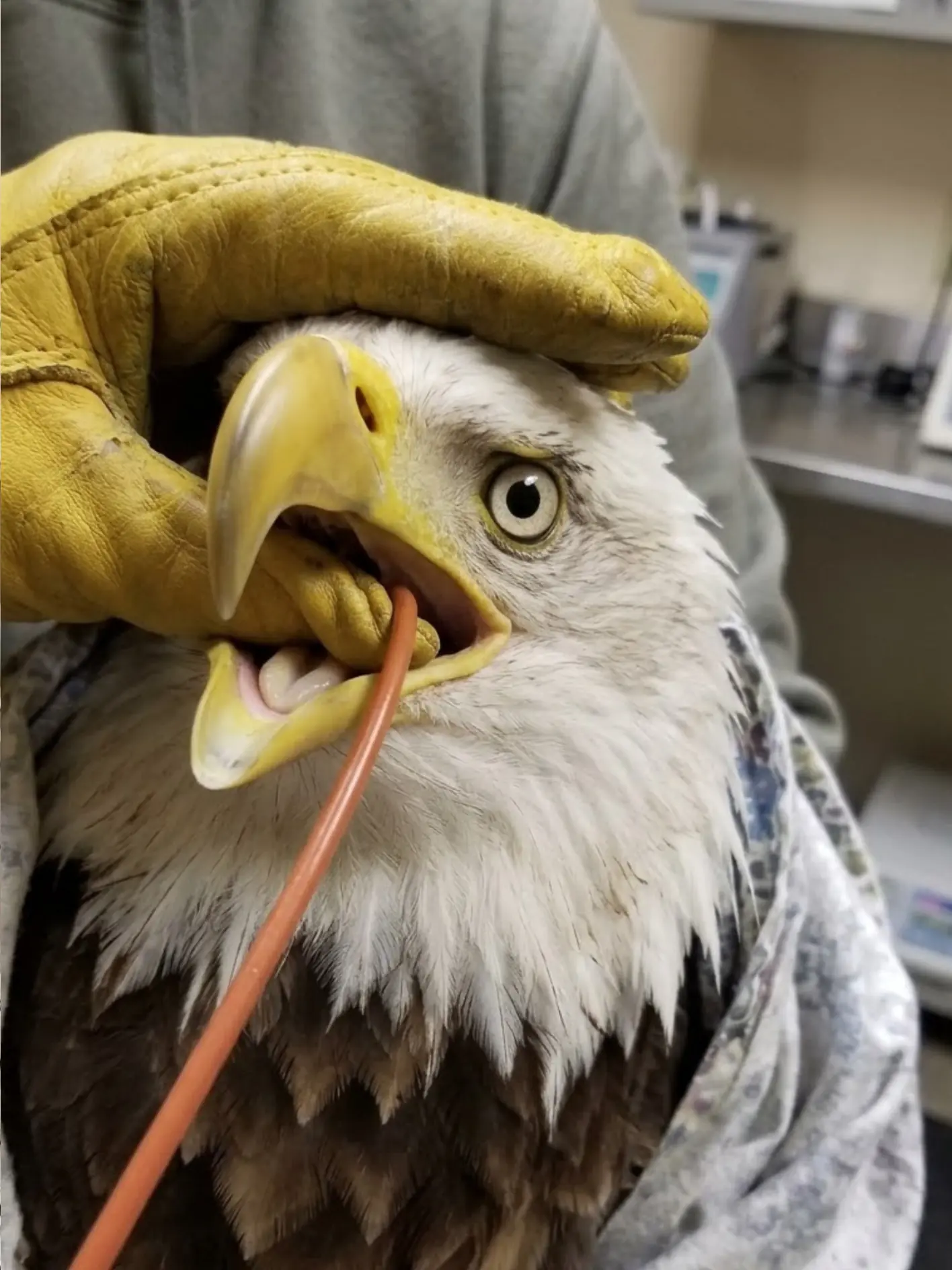
Despite the suspected impact, the eagle remained conscious and responsive during transport and the initial examination.
That was encouraging.
It was not enough to determine how badly the bird had been hurt.
Vehicle collisions can produce injuries that are difficult to see through an eagle’s dense plumage, including concussion, soft-tissue trauma, internal injuries, and damage to the shoulder or chest that may not immediately create an obvious fracture or deformity.
The medical team therefore began treating the eagle as a trauma patient rather than assuming that its alert appearance meant the collision had caused only minor injuries.
Based on where the bird was found and the pattern of its condition, wildlife officials believe a vehicle strike is the most likely explanation, although the collision itself was not witnessed.
For now, the eagle remains under close observation.
Its prognosis is guarded but cautiously hopeful.
The next several days will help determine whether the bird can progress from emergency stabilization to physical rehabilitation — and eventually whether its nearly six-foot wingspan can once again support the powerful, sustained flight required for life in the wild.
Found Beside State Highway 57
The rescue began after the adult bald eagle was spotted near State Highway 57 in Brown County, northeast of Green Bay.
The bird was on or close to the ground and did not leave when people approached.
That immediately raised concern.
Bald eagles are common enough across Wisconsin that seeing one near a roadway is not unusual. They may cross roads while moving between feeding areas, perch in trees near traffic corridors, or descend to open ground when food is available.
But a healthy adult bald eagle normally maintains distance from people.
If approached closely in an open area, it should generally be capable of moving away or taking flight.
This bird was not.
Its inability to leave suggested either significant weakness, trauma, or another medical problem requiring intervention.
The Wisconsin DNR was contacted, and a wildlife biologist responded to assess the eagle.
At the scene, the bird was still alive and aware of activity around it.
But it was not behaving like an eagle capable of safely remaining in the wild.
That distinction was enough to make transport necessary.
A Large Raptor That Could No Longer Use Its Greatest Advantage
An adult bald eagle’s size is one of its greatest advantages in the wild.
The Brown County bird weighed nearly 2.5 kilograms and had a wingspan measuring about 1.8 meters.
Those dimensions allow an eagle to soar efficiently, travel substantial distances, and maneuver through open landscapes with relatively little effort once airborne.
But that same size can become a disadvantage after trauma.
Large wings create large forces.
The shoulders, chest muscles, and wing joints absorb considerable mechanical stress during takeoff and landing.
A bird that has suffered even moderate soft-tissue damage may still appear outwardly intact while being unable to generate the strength necessary for normal flight.
That is one reason the DNR biologist did not simply move the eagle farther from the road and wait for it to leave.
The bird’s behavior already suggested that something was wrong.
Repeatedly forcing it to attempt flight could have made an unseen injury worse.
The DNR Biologist Transported the Eagle for Care
Capturing an injured bald eagle requires specialized caution.
Even a debilitated bird can retain considerable strength in its feet.
The talons are designed to seize and hold prey, and an adult eagle can inflict serious injury on anyone attempting to handle it without appropriate equipment and experience.
The biologist therefore had to protect both the eagle and the people involved in the rescue.
The feet were controlled.
The wings were kept close to the body.
Movement was minimized.
The eagle was then placed into a secure wildlife transport carrier for the trip to the rehabilitation facility.
Reducing movement during transport is especially important after suspected vehicle trauma.
If the bird has a fracture, joint injury, or internal damage, struggling inside a vehicle can worsen the condition before veterinarians have a chance to evaluate it.
The goal was simple:
get the eagle away from traffic and into professional care without adding another injury.
The Bird Arrived Alert
When the eagle reached the Green Bay-area rehabilitation facility, staff found a bird that was still responsive.
Its eyes remained open.
It reacted to handling.
It had enough strength to resist portions of the examination.
That was a meaningful positive sign.
But wildlife veterinarians know that alertness can be deceptive.
Raptors often remain remarkably responsive even after significant trauma.
A bald eagle may continue tracking movement with its eyes while suffering a concussion.
It may attempt to defend itself despite painful soft-tissue injuries.
It can remain conscious while internal bruising develops.
For that reason, the team did not interpret the eagle’s alert appearance as proof that the accident was minor.
Instead, the bird underwent a systematic trauma examination.
A Full Examination, Not Just a Wing Check
Because the eagle was believed to have been struck by a vehicle, clinicians had to consider injuries across the entire body.
The head was examined for swelling, wounds, beak damage, and signs of concussion.
The eyes were evaluated for trauma and normal responses.
The neck was checked for abnormal movement.
Both shoulders and wings were examined carefully.
The major wing bones were palpated for pain, instability, or swelling.
The legs and feet were assessed for fractures or abnormal weight-bearing.
The chest and body wall were also important because blunt impact can injure structures beneath the feathers without producing a dramatic external wound.
Veterinary staff also monitored neurological responsiveness.
Could the eagle hold its head normally?
Was its balance appropriate?
Did both pupils respond?
Did it react symmetrically to movement?
Those details help clinicians distinguish between purely orthopedic trauma and injury involving the nervous system.
Vehicle Trauma Can Be More Complex Than It Looks
A collision between a vehicle and a large bird can transfer considerable force in a fraction of a second.
The visible injury may be surprisingly small.
The internal consequences may be much larger.
Depending on the point of impact, a bird could suffer bruising of the chest, damage to air sacs, soft-tissue trauma around the shoulder, fractures, head injury, or internal bleeding.
Not every problem is obvious immediately.
Swelling can increase over time.
Neurological signs can become clearer after the bird has rested.
Pain may change the way the eagle holds a wing or stands.
That is why the first 24 to 48 hours after admission are so important.
The team is not simply treating what can be seen at intake.
They are watching for what may emerge afterward.
Diagnostic Imaging
Radiographs were used to evaluate the eagle’s skeletal structures and look for injuries that might be hidden beneath feathers and muscle.
The team paid particular attention to the wings, shoulders, legs, and chest.
In this case, the initial imaging did not reveal a catastrophic wing fracture that would immediately eliminate the possibility of recovery.
That was encouraging.
But the absence of a devastating fracture did not mean the bird was uninjured.
Veterinary staff remained concerned about significant soft-tissue trauma and bruising associated with the suspected collision.
Soft tissues — including muscle, tendons, ligaments, and structures surrounding the shoulder — are essential to flight.
A bird can have intact bones and still be unable to generate normal lift.
That distinction is especially important in a bald eagle.
No Major Fracture Does Not Mean “Ready to Fly”
For many people, the absence of a broken wing sounds like good news.
It is.
But it is only part of the picture.
Flight is not produced by bone alone.
The wing must move through a precise range of motion.
Large flight muscles must generate force.
Joints must remain stable.
The shoulder must tolerate repeated loading.
Nerves must coordinate both sides of the body.
Even moderate soft-tissue injury can reduce the strength or symmetry of a wing enough to make release unsafe.
The eagle therefore cannot be judged by whether X-rays look reassuring.
It has to be judged by function.
That test comes later.
Head Trauma Remains a Concern
The medical team is also monitoring the eagle for possible head trauma.
A vehicle strike can produce concussion or other neurological effects even without an obvious skull injury.
Birds with head trauma may show subtle changes.
They may become less responsive.
Balance can be abnormal.
One eye may track differently.
Head position may change.
Reaction time can slow.
Those signs are particularly important in bald eagles because precise neurological coordination is required for safe flight.
A bird may possess full wing strength but still be unable to return to the wild if balance or visual processing remains impaired.
For now, the eagle’s alertness is encouraging, but continued observation is required before neurological injury can be confidently ruled out.
Internal Injury Can Take Time to Declare Itself
Another reason for caution is the possibility of internal trauma.
An eagle’s feathers can conceal bruising and protect the skin from obvious external damage.
They do not prevent force from reaching structures inside the body.
The respiratory system of birds includes delicate air sacs extending through portions of the body cavity.
A strong impact can potentially affect those structures.
Blunt trauma can also damage soft tissues or blood vessels.
An injured eagle may appear relatively stable at first and then deteriorate if internal bleeding, swelling, or respiratory complications develop.
That possibility is one reason the bird remains under controlled observation rather than being moved quickly into a large rehabilitation enclosure.
The Treatment Image Shows the Examination Phase
Images recorded during veterinary care show the eagle alert while staff use protective gloves and towel restraint to control the bird safely.
A handler stabilizes the head while the eagle remains wrapped against the body.
The image illustrates the amount of control required during the examination of a large raptor.
It should not be interpreted as evidence of a particular internal diagnosis.
The photograph cannot reveal a concussion.
It cannot show soft-tissue bruising beneath the feathers.
And it does not establish exactly what any tube or clinical equipment visible near the mouth is being used for.
Those details depend on the veterinary record rather than the image itself.
What the photograph does show is that the eagle remained alive and responsive during active treatment.
Stabilization Before Rehabilitation
The first phase of care is deliberately conservative.
The eagle is being kept in a quiet environment where unnecessary movement can be limited.
Handling is minimized whenever possible.
Pain management is provided according to the bird’s clinical needs.
Hydration and appetite are monitored.
The medical team watches how the eagle holds both wings at rest.
Any change in posture may provide information about discomfort or swelling.
At this stage, encouraging the bird to fly would be premature.
The goal is stabilization.
The body needs time to recover from the initial trauma before clinicians can safely ask it to perform physically demanding activity.
Why Rest Matters After a Vehicle Strike
A wild eagle is naturally inclined to escape confinement.
That instinct is healthy.
Immediately after trauma, it can also be dangerous.
A bird given too much room may repeatedly launch into flight before damaged tissues are ready.
Powerful wingbeats can aggravate shoulder or chest injuries.
An awkward landing can place additional force through the legs.
A bird with subtle neurological impairment may collide with enclosure walls.
For that reason, smaller medical housing can be safer during the acute stage.
Once the team is confident that the eagle is stable, activity can be increased gradually.
Body Weight Is Another Important Measure
The eagle’s intake weight of nearly 2.5 kilograms provides a useful baseline.
Weight alone does not determine whether a bald eagle is healthy.
Sex, body size, muscle mass, hydration, and recent feeding can all influence the number.
But changes over time are valuable.
If the bird maintains or gains appropriate weight while recovering, that suggests adequate nutritional intake.
A continuing decline could indicate pain, stress, systemic illness, or difficulty eating.
Veterinary staff therefore monitor body weight alongside appetite and muscle condition.
A wild bird preparing for release needs sufficient reserves to support sustained activity.
Appetite Can Reveal Progress
Feeding behavior is another important clinical sign.
An injured eagle may initially eat less because of pain, stress, or neurological effects.
As the bird stabilizes, normal interest in food is encouraging.
But staff also need to see that it can handle food appropriately.
A bald eagle in the wild must manipulate and tear natural food without assistance.
That requires coordinated use of the beak, neck, and feet.
Return of normal feeding behavior therefore provides information about several body systems at once.
Again, it is one step.
Not the final step.
Why the Six-Foot Wingspan Matters
The eagle’s approximately 1.8-meter wingspan is more than an impressive measurement.
It helps explain why apparently modest injuries can matter so much.
Large wings create significant leverage around the shoulder.
Every downstroke places force through muscles and connective tissues.
During takeoff, those forces are especially high because the bird must accelerate its entire body upward from a near-stationary position.