An adult female bald eagle is recovering after being struck by a vehicle while feeding on a road-killed raccoon along County Road F36 in rural Jasper County, near Newton, Iowa.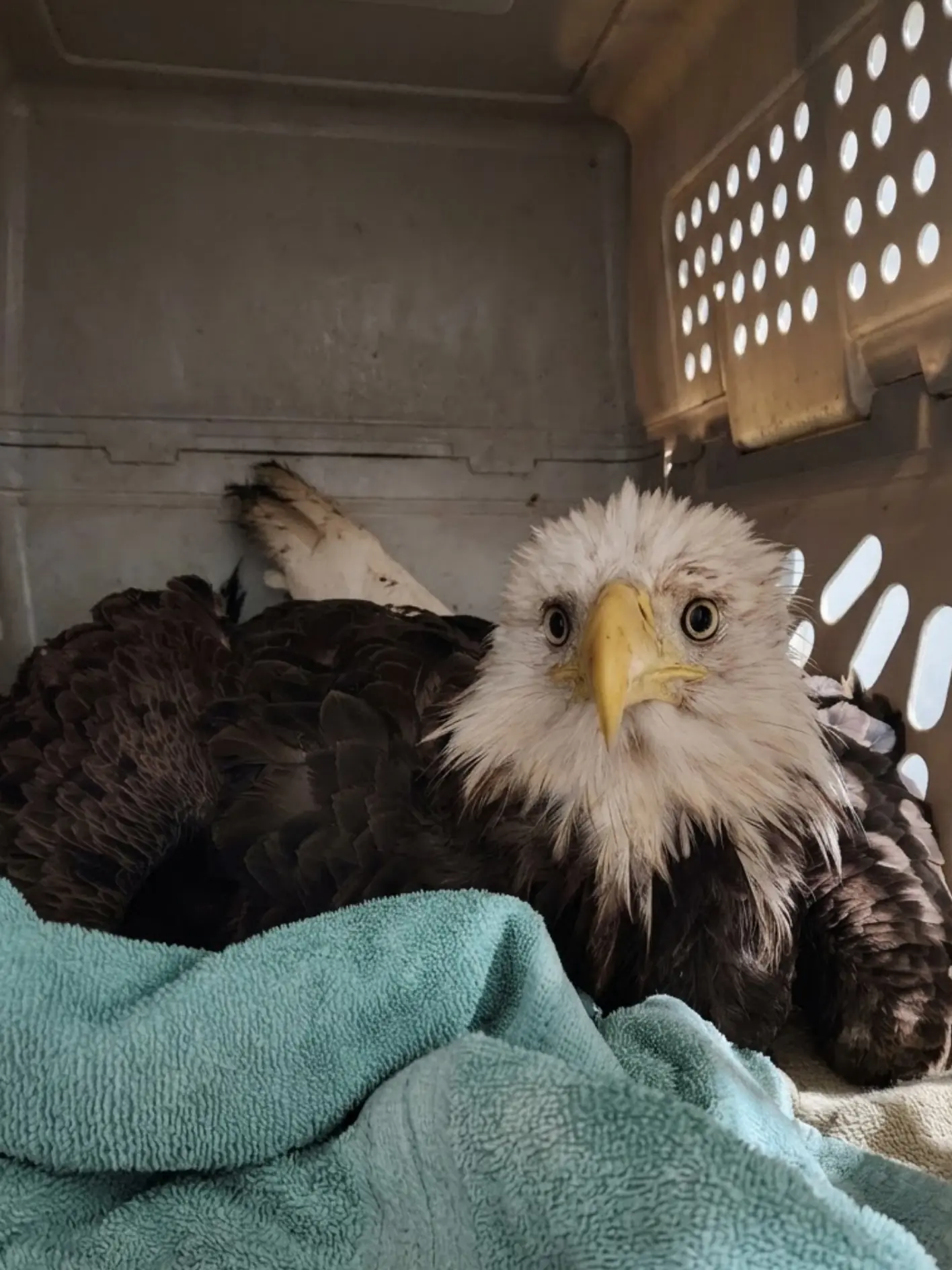
The collision left the eagle unable to move normally and with a serious injury to her left leg. A wildlife rehabilitation volunteer responded quickly, safely contained the bird, and transported her for initial stabilization before she was transferred to a specialized raptor rehabilitation center for longer-term orthopedic care.
Radiographs later confirmed a fracture of the left tibiotarsus, one of the primary weight-bearing bones in a bird’s lower leg. The injury was stabilized with a padded splint and bandage, and the eagle was placed under strict activity restriction while veterinarians monitored swelling, pain, circulation and fracture alignment.
There was one important advantage from the beginning.
The eagle weighed approximately 10.5 pounds, or about 4.8 kilograms, an appropriate weight for a large adult female bald eagle. Unlike many wildlife patients that arrive after days or weeks of declining condition, she entered rehabilitation with good nutritional reserves.
That could become important during a recovery expected to take several weeks.
Although the eagle has been able to stand with the splint in place, staff frequently find her resting low or lying down rather than continuously bearing weight. That behavior is not unexpected during the early phase of a significant leg fracture. The injured tissues are likely still affected by swelling, bruising and discomfort from the original collision.
Nearly four weeks after admission, however, rehabilitators began seeing an encouraging change.
The eagle started placing a small amount of weight through the injured left leg.
She has since been moved out of intensive-care housing and into a larger 10-by-20-foot rehabilitation enclosure, but the medical team is emphasizing that she is only partway through the healing process.
A fracture may require approximately eight weeks before sufficient bone healing is expected, depending on alignment, stability, blood supply and the individual bird’s progress.
And for a bald eagle, a leg is not considered successfully healed simply because the bird can stand.
Before release can even be considered, that leg must eventually tolerate the forces of landing, gripping a perch, securing food and balancing the full weight of a large raptor in the wild.
The Collision Began With a Common Bald Eagle Behavior
The circumstances surrounding the injury illustrate a hazard that wildlife rehabilitators see repeatedly.
Bald eagles are highly capable hunters, but they are also opportunistic scavengers.
A carcass along a roadway represents an easy, concentrated food source.
Deer, raccoons, rabbits and other animals killed by vehicles can draw eagles, hawks, vultures and other scavengers close to traffic.
In this case, the adult eagle had reportedly descended to feed on the remains of a raccoon that had already been struck on County Road F36.
Feeding on the ground places an eagle in a very different position from one soaring overhead.
To escape an approaching vehicle, a large bald eagle must first recognize the threat, release or leave the food, spread wings that can span several feet, accelerate and gain enough altitude to clear traffic.
That process takes space.
A bird feeding directly beside or on a roadway may not have enough.
The circumstances were considered consistent with the eagle being struck while attempting to leave the carcass or while still feeding nearby.
The impact did not produce an obvious catastrophic wing injury.
Instead, the most significant orthopedic damage was to the left leg.
A Volunteer Helped Turn a Roadside Emergency Into a Treatable Case
The rehabilitation team credited the rapid response of a wildlife volunteer with helping move the eagle into professional care without unnecessary delay.
Approaching an injured bald eagle is not simply a matter of picking up a large bird.
Even an eagle with a broken leg can defend itself effectively.
Its talons remain extremely powerful.
An injured bird may also attempt to flap, twist or run when a person closes the distance, potentially worsening an unstable fracture.
The responder approached carefully, controlled the feet, supported the body and secured the eagle for transport.
The bird was first taken to a regional wildlife rehabilitation facility for initial evaluation and stabilization.
Once the seriousness of the leg injury became clear, arrangements were made to transfer her to a center equipped for longer-term raptor rehabilitation.
“We are extremely grateful to the volunteer who responded quickly and was able to get this eagle safely contained,” a rehabilitation staff member said. “With fractures, every additional period of uncontrolled movement creates an opportunity for more displacement and more soft-tissue damage. Getting her stabilized early was important.”
The first facility provided the immediate bridge between rescue and specialized treatment.
That kind of coordinated transfer is common in wildlife medicine.
Not every rehabilitation center has the enclosure space, radiographic equipment or orthopedic resources needed to manage an adult bald eagle for several months.
The goal is to move the patient to the level of care it needs while avoiding delays that could compromise the outcome.
At 10.5 Pounds, She Arrived in Good Body Condition
One of the first measurements taken after admission was body weight.
The eagle weighed approximately 10.5 pounds.
That figure was encouraging.
Female bald eagles are generally larger and heavier than males, and a weight in that range can be appropriate for a large adult female depending on body structure and geographic variation.
Weight alone does not determine sex or health, but combined with body measurements and physical examination, it helped staff identify the eagle as a female in good overall condition.
Her pectoral musculature was preserved.
She was not severely emaciated.
She had useful nutritional reserves.
Those findings matter because fracture healing requires energy.
Bone repair is biologically expensive.
The body must produce new tissue, maintain an inflammatory response, rebuild blood supply and gradually form a stable callus around the fracture.
A bird that enters rehabilitation already severely underweight has fewer resources available for that process.
This eagle did not face that additional disadvantage.
“The fact that she came in at a healthy weight was one of the most encouraging things about the initial examination,” the veterinarian said. “We have a serious orthopedic injury to manage, but we are not simultaneously trying to reverse profound emaciation.”
The Left Leg Immediately Drew Attention
During the physical examination, the eagle showed reluctance to use the left leg normally.
The limb was painful.
Swelling was present.
The bird shifted much of its weight away from the injured side.
For a large eagle, even that behavior has to be interpreted carefully.
A bird may remain able to stand despite a significant fracture by transferring weight to the opposite limb and using the wings or body position for balance.
The fact that an eagle can stand does not rule out a broken bone.
Radiographs were therefore obtained.
The images confirmed the primary injury.
The eagle had fractured her left tibiotarsus.
What Is the Tibiotarsus?
Bird leg anatomy differs substantially from human anatomy, but the tibiotarsus can be described roughly as one of the long bones corresponding to the lower-leg region.
For a general audience, the easiest comparison is the human shin.
It is not anatomically identical to the human tibia, but it performs an important weight-bearing role.
For a bald eagle, that makes the fracture particularly significant.
A wing fracture threatens flight directly.
A leg fracture threatens many of the functions that happen before and after flight.
An eagle must be able to push against a perch during launch.
It must extend its feet during landing.
It must absorb impact when the talons contact a branch or the ground.
It needs enough leg stability to grip prey and hold food while tearing pieces away with the beak.
It must be able to balance in wind.
A bird with excellent wing function but a permanently unstable leg may still be incapable of surviving independently.
The Leg Was Splinted and Bandaged
Once the fracture had been evaluated, the left leg was stabilized.
A padded splint and bandage were applied to limit movement around the injured bone and maintain the best achievable alignment while healing began.
The purpose of the splint is straightforward: reduce motion across the fracture.
The biology behind that goal is more complicated.
Every time unstable bone ends move, nearby tissues can be irritated.
Pain can increase.
Swelling can persist.
Developing repair tissue can be disrupted.
Excessive motion can delay or prevent a strong union.
At the same time, bandaging a raptor leg requires precision.
A wrap that is too loose may not stabilize the injury adequately.
A wrap that is too tight can interfere with circulation.
Swelling can also change over time, meaning a properly applied bandage on one day may need adjustment later.
For that reason, rehabilitators repeatedly inspect the toes and distal limb.
They look for abnormal swelling, discoloration, temperature changes and pressure points.
The splint itself is only one part of the treatment.
Monitoring it is equally important.
She Can Stand — But Often Chooses Not To
One of the first questions people ask after seeing an eagle with a fractured leg is whether the bird can stand.
In this case, she can.
With the leg stabilized, the adult female has been able to rise and maintain an upright position.
That is encouraging.
But she also spends significant periods resting low or lying down.
The rehabilitation team does not interpret that as failure.
The tissues surrounding the fracture experienced trauma during the collision.
Even when the bone itself is stabilized, muscles and other soft tissues can remain swollen and bruised.
Weight-bearing may still be uncomfortable.
Resting reduces mechanical load on the injured limb.
In the early phase, staff would rather see the eagle protect the leg than repeatedly stress the fracture simply because she is physically capable of standing.
The enclosure was therefore arranged to accommodate a bird that needed substantial floor-level rest.
Padded surfaces helped reduce pressure.
High perches were avoided.
Unnecessary climbing and jumping were limited.
The Image Reflects This Early Stage of Recovery
Images from the eagle’s early hospitalization show the adult female sitting low inside a secure enclosure on padded towels.
Her eyes are open and alert.
The characteristic white head and dark brown body plumage identify her as a mature bald eagle.
The photograph does not show the injured leg clearly enough to evaluate the fracture or splint directly.
What it does illustrate is her low resting posture during the period when the rehabilitation team was deliberately limiting activity.
A bird in orthopedic recovery may appear unusually quiet in a photograph even when it remains alert and responsive.
Rest is part of the treatment.
Pain and Inflammation Have to Be Managed Alongside the Bone
A fracture is painful not only because bone is damaged but because the surrounding tissues are also affected.
The collision may cause bruising that extends beyond the fracture itself.
Inflammation develops naturally around injured structures.
Some of that inflammation is part of healing.
Excessive pain and swelling, however, can reduce normal use of the limb and increase stress.
Veterinary staff therefore provided appropriate pain management and anti-inflammatory care based on the eagle’s condition.
The objective was not to eliminate all sensation in the injured leg.
Pain is also a biological warning that helps prevent excessive use.
The goal was to keep the bird comfortable enough to rest, eat and maintain normal physiological function while the fracture remained protected.
Activity Restriction Was Essential During the Early Weeks
For a raptor, the instinct to perch high can create problems during leg-fracture rehabilitation.
A bird may climb even when it should not.
Then it has to come back down.
Landing places substantial force through the feet and legs.
That force is exactly what a healing tibiotarsal fracture is not ready to tolerate during the early stages.
The eagle therefore began recovery in a smaller intensive-care enclosure where activity could be controlled.
Perching opportunities were limited or positioned low.
She was prevented from repeatedly launching, climbing or landing from height.
The enclosure might look restrictive compared with a normal flight pen.
That was intentional.
The priority was fracture stability, not exercise.
Bone Healing Happens in Stages
A fracture does not transition from “broken” to “healed” overnight.
The body begins by organizing the area around the injury.
Inflammatory processes occur.
New blood supply develops.
Early repair tissue forms between the fractured surfaces.
Over time, a callus becomes more mineralized and mechanically stronger.
That new bone is then remodeled.
In this case, staff anticipated that approximately eight weeks could be required before the fracture reached a more advanced stage of healing.
That estimate is not an automatic deadline.
Wildlife patients do not heal according to a calendar alone.
Radiographs determine whether progress is actually occurring.
Healing may be affected by:
- fracture alignment,
- stability,
- blood supply,
- nutrition,
- age,
- activity level,
- and complications such as infection.
The eagle would therefore remain under repeated evaluation throughout the process.
Follow-Up X-Rays Matter More Than Appearance
An eagle can begin looking and behaving much better long before a fracture has regained enough mechanical strength.
That is one of the dangers of orthopedic rehabilitation.
The patient feels better.
Swelling decreases.
Pain improves.
The bird wants to become active.
But the bone may still be vulnerable.
Follow-up radiographs allow veterinarians to see whether callus is developing appropriately and whether alignment is being maintained.
Only when the imaging supports increased stability can activity be expanded safely.
The medical team is therefore resisting the temptation to interpret increasing alertness or movement as proof that the leg is finished healing.
An Encouraging Change Appeared Near the Four-Week Mark
Nearly four weeks after admission, staff began noticing something new.
The eagle was starting to place limited weight through the injured left leg.
Not continuously.
Not with full force.
But enough to suggest that discomfort and instability were beginning to improve.
This was an important milestone.
Partial weight-bearing can indicate that the limb is becoming more comfortable and that basic neurological control remains intact.
It also provides gentle physiological loading that may eventually become useful as rehabilitation advances.
But the team emphasized that four weeks is still early for a significant weight-bearing fracture.
“She is beginning to test that left leg a little more, which is what we hoped to see,” the veterinarian said. “The important thing is not to confuse that progress with complete healing. We still have several weeks of bone repair ahead.”
She Has Now Moved Out of Intensive Care
As the eagle became more stable, the rehabilitation team made another important change.
She was moved from her smaller intensive-care enclosure into a larger rehabilitation space measuring approximately 10 by 20 feet.
That does not mean she has been cleared for unrestricted flight.
The larger enclosure provides more room for natural posture and controlled movement while still allowing staff to manage the environment around the healing leg.
Perches can be arranged to minimize impact.
Wide or padded surfaces can make weight-bearing easier.
Height can be limited so that the bird is not repeatedly dropping from elevated positions.
The transition represents progress from the acute phase toward controlled physical rehabilitation.
The Remaining Four Weeks May Be Just as Important as the First Four
At roughly halfway through the anticipated healing period, it would be easy to focus on how far the eagle has already come.
The rehabilitation team is equally focused on what remains.
The fracture needs additional time to strengthen.
The splint and bandage must continue to be reassessed.
The left foot and toes must maintain normal neurological function and circulation.
The eagle needs to gradually increase weight-bearing without overloading the bone.
Muscle loss from inactivity must eventually be reversed.
And the right leg must be monitored as well.
When a bird avoids one injured limb for weeks, the opposite leg bears an unusually large share of the body weight.
Long-term compensation can create secondary problems.
The goal is not simply to make the left leg stable.
It is to return the entire bird to symmetrical function.
The Foot Will Matter as Much as the Fracture
As healing progresses, staff will pay increasing attention to how the eagle uses the left foot.
Can she flex all of the toes normally?
Is the grip strong?
Does she place the foot squarely?
Can she close the talons around a perch?
Is there any evidence of reduced sensation?
An intact neurological connection from the leg to the foot is essential.
A fracture may heal perfectly on X-ray while nerve damage remains functionally important.
So far, the fact that she is beginning to place weight through the leg is encouraging, but more demanding tests will come later.
One Healthy Leg Is Not Enough in the Wild
Bald eagles can compensate impressively for temporary injury.
That does not mean compensation is acceptable for release.
In the wild, a female of this size must be able to rely on both legs.
When landing on a branch, she needs to absorb force and stabilize immediately.
When handling food, one foot often secures the item while the beak tears portions away.
When defending herself, both feet may be involved.
If one leg remains painful or weak, the eagle may shift excessive demand to the other side.
That is not a sustainable long-term strategy.
A bird being released must demonstrate independence rather than accommodation.
Flight Will Eventually Return to the Rehabilitation Plan
The primary injury is in the leg, but the wings cannot be ignored indefinitely.
Weeks of limited activity can reduce flight-muscle conditioning.
Before release, staff will need to determine that both wings remain normal after the original vehicle collision and that the eagle has rebuilt sufficient endurance.
Flight conditioning will only become appropriate after the fracture has reached adequate stability.
Once veterinarians are satisfied with bone healing, the eagle can gradually begin using larger spaces.
The medical team will watch:
takeoff power,
wingbeat symmetry,
altitude,
turning ability,
endurance,
and landing control.
For this patient, landing may ultimately be the most important part.
Landing Will Put the Left Leg to the Real Test
An eagle can compensate for a leg problem while flying through open air.
The moment of landing removes that option.
The bird must extend the legs.
Position the feet.
Make contact with a perch.
Absorb momentum.
Close the talons.
And immediately stabilize the body.
If the eagle hesitates to use the left leg, repeatedly lands only on the right foot, slips, or appears painful afterward, she will not be ready for release.
Repeated controlled landings will therefore provide some of the strongest evidence that the fracture has healed functionally rather than merely radiographically.
Food Handling Will Also Be Evaluated
The leg must do more than support body weight.
Staff will eventually watch how the eagle uses the left foot when feeding.
Can she secure food normally?
Can she manipulate an item without losing balance?
Does she alternate or appropriately use both feet?
A wild bald eagle cannot depend on humans to position food conveniently.
A release candidate has to manage prey and carrion independently.
The evaluation may appear less dramatic than a flight test, but it is equally important.
The Current Prognosis Is Cautiously Favorable
Several aspects of this case are working in the eagle’s favor.
She arrived at a healthy body weight.
She did not present with severe emaciation.
The primary fracture could be stabilized.
She remains alert.
And she has begun placing at least limited weight through the injured leg.
Those findings allow the prognosis for eventual release to be described as cautiously favorable, provided radiographs continue showing appropriate bone healing and the leg eventually returns to full function.
The word “cautiously” remains essential.
A promising four-week update does not guarantee the eight-week outcome.
Orthopedic complications can appear later.
The final standard will always be function.
Roadkill Creates a Recurring Hazard for Raptors
This eagle’s injury also illustrates a preventable interaction between wildlife and roads.
The raccoon carcass offered food.
From the eagle’s perspective, that was completely normal.
Scavenging is part of bald eagle ecology.
The road was the abnormal component.
Carcasses on traffic corridors create a conflict between food availability and vehicle speed.
Large scavenging birds may be concentrating on the carcass when traffic approaches.
Some launch directly across the roadway.
Others require several wingbeats to gain sufficient altitude.
That creates a narrow window in which a collision can occur.
Drivers in areas with known wildlife activity can help by remaining alert for large birds around roadside carcasses and reducing speed when it is safe and lawful to do so.
Food and Trash Can Draw Wildlife Toward Roads Too
Road-killed animals are not the only attractants.
Discarded food and unsecured garbage can attract wildlife toward traffic corridors.
Food waste may draw mammals directly.
Those animals may then become roadkill themselves, creating an additional food source for scavenging raptors.
For that reason, keeping edible waste out of roadside environments can have benefits that extend beyond litter control.
It can reduce one reason wildlife repeatedly approaches traffic.
People Should Not Risk Their Own Safety Moving Carcasses
It may seem helpful to drag an animal carcass away from a roadway after seeing an eagle feeding nearby.
That can be dangerous.
Members of the public should not enter active traffic or handle large animal carcasses without appropriate authority and equipment.
Where roadkill is creating an obvious wildlife or traffic hazard, the safer option is to notify the appropriate road department, law-enforcement agency, animal-control service or wildlife authority according to local procedures.
Human safety comes first.
The Goal Is Still Release — But Not Yet
Almost four weeks after the collision, the adult female is no longer exactly the same patient that arrived from rural Jasper County.
The most acute swelling has had time to improve.
The injured leg is beginning to accept limited weight.
She no longer requires the same small intensive-care environment.
Her healthy body condition has helped support the recovery process.
But she remains only partway through orthopedic healing.
There is no responsible reason to rush the next stage.
The bone must become stronger.
The splint must eventually come off safely.
The leg must tolerate increasing load.
The foot must grip normally.
The bird must rebuild muscle.
Then she must prove that she can land repeatedly without protecting the injured side.
Only after those steps will release become a realistic conversation.
A Leg Fracture Can Decide the Future of a Bird Built for Flight
It is easy to think of bald eagle rehabilitation primarily in terms of wings.
For this female, the wings may ultimately be the simpler part of the case.
The left leg will determine whether she can use those wings in the real world.
Flight must end somewhere.
Usually on a branch, shoreline, field or feeding site.
The bird must be able to put its full weight back through the injured limb every time that happens.
A successful X-ray is therefore not the final objective.
A successful landing is.
Nearly Halfway Through the Expected Healing Period
The current update is encouraging precisely because it is modest.
The eagle has not suddenly returned to normal.
She is not flying free.
She has not completed rehabilitation.
She has begun to place some weight through the left leg.
That is enough progress to matter.
Nearly four weeks have passed since admission.
Approximately eight weeks may be needed for the fracture to reach a more advanced stage of healing.
The eagle is now housed in a 10-by-20-foot rehabilitation enclosure rather than intensive-care housing, giving her more space while the leg remains protected.
The next several weeks will show whether the early improvement continues.
If follow-up radiographs demonstrate strong healing, if full weight-bearing returns, and if the eagle eventually grips, flies and lands without favoring the injured side, she may still have a realistic path back to the Iowa landscape where she was found.
For now, the rehabilitation team is asking much less of her.
Rest.
Eat.
Heal.
Use the leg a little more when it is comfortable.
And allow the fractured tibiotarsus enough time to become strong again.
The same roadside food source that brought the adult female down beside County Road F36 may have placed her directly in the path of traffic.
If rehabilitation continues in the direction it has begun, the goal is that her next encounter with rural Iowa will look very different — not a bald eagle beside a road-killed animal on the pavement, but a fully recovered bird passing safely above the roadway on two functional legs and its own wings.