An adult female bald eagle transferred from Virginia’s Eastern Shore has produced an encouraging first round of medical findings: no fractures, no major structural injuries, and no obvious condition that would permanently prevent her from flying.
There is only one problem.
She is not yet flying well enough to go home.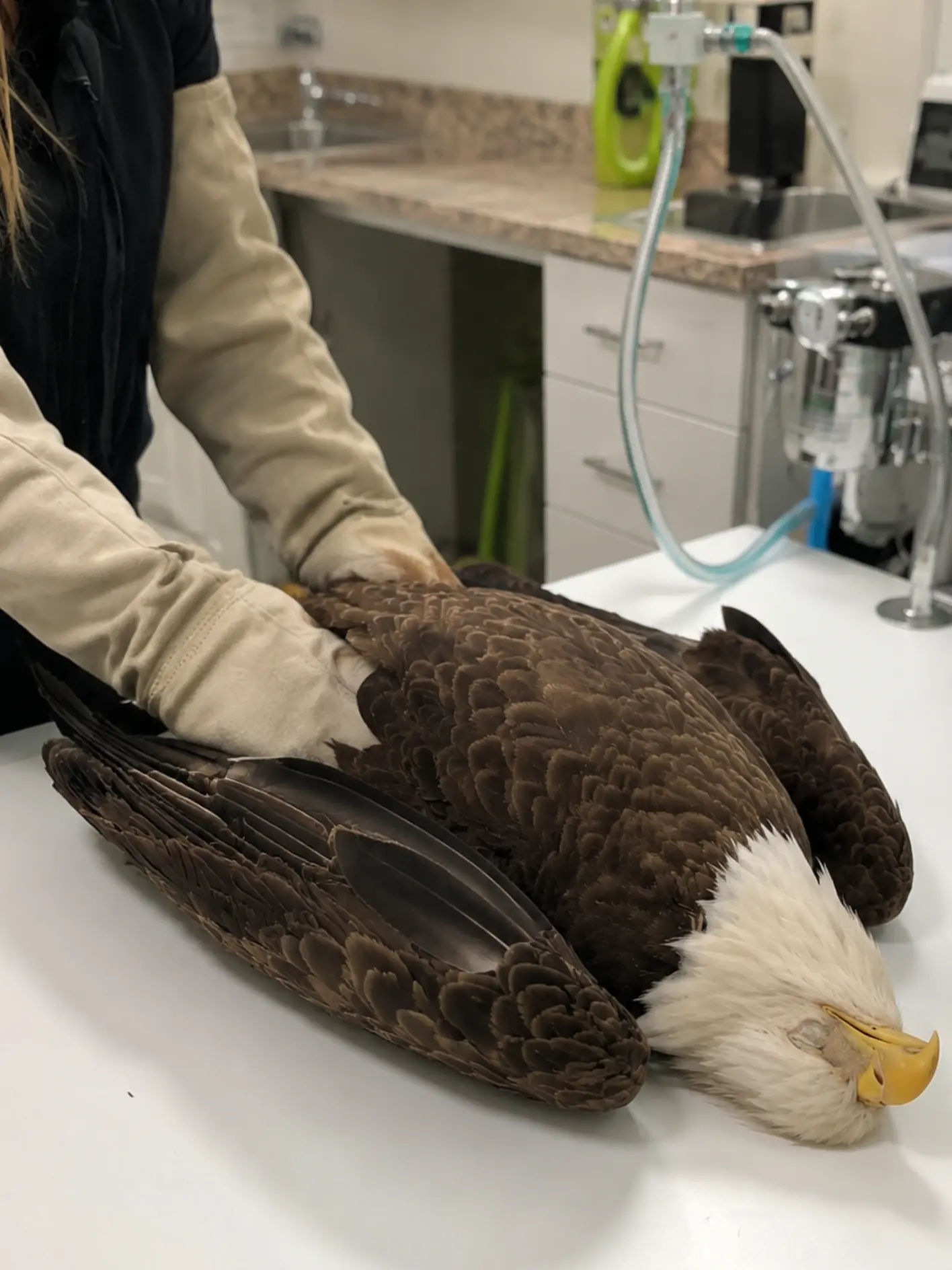
The eagle was transferred from a permitted wildlife rescue organization in Accomack County to a licensed raptor rehabilitation center in central Virginia after caregivers determined that, although she appeared stable, her flight performance remained below the level expected of a healthy adult bald eagle.
A complete physical examination and diagnostic imaging brought welcome news.
Veterinary staff found no broken bones.
The major joints appeared stable.
There was no obvious severe trauma involving the wings or shoulder girdle.
Her legs and feet were functional, her neurological responses were appropriate, and there was no immediately apparent structural explanation for why she was not flying with normal strength and endurance.
That does not mean the medical work is finished.
Blood samples have been submitted for laboratory testing, and the rehabilitation team is waiting for those results before ruling out underlying problems that may not be visible during a physical examination or on radiographs.
In the meantime, the eagle has begun the part of rehabilitation that may ultimately determine whether she can return to the Eastern Shore.
She is exercising in a large flight enclosure.
She is eating exceptionally well.
And, according to her caregivers, she is gradually becoming stronger.
“The structural findings were very encouraging,” a rehabilitator involved in the eagle’s care said. “We did not identify any fracture or major injury that would immediately prevent release. What she needs now is conditioning, and we still want to see the blood results before we say she is completely in the clear.”
If the laboratory results remain reassuring and the eagle continues improving in flight, staff hope the final stage of her rehabilitation will be a return trip to Accomack County.
There, she would be released back into the region where she was originally found.
The Eagle Arrived With One Major Question
The adult female had already received initial care before arriving at the central Virginia rehabilitation center.
The organization that first received her on the Eastern Shore had stabilized the bird and determined that she did not appear to require immediate emergency surgery.
But one concern remained.
Her flight was not normal.
She could move.
She could use her wings.
She could become airborne.
But she did not show the power, endurance, and efficiency that rehabilitators expect from an adult bald eagle preparing to return to the wild.
That difference is important.
A bird does not have to be completely flightless to require rehabilitation.
Sometimes the most significant deficits are subtle.
An eagle may cross a short enclosure and still lack the strength required to travel across open water.
It may reach a nearby perch but tire too quickly.
It may take off with both wings yet fail to gain altitude efficiently.
A bird can therefore look capable in a small space while remaining unprepared for the demands of an uncontrolled environment.
That was the reason for the transfer.
The eagle needed a more extensive medical evaluation and access to a flight enclosure where her performance could be observed over time.
The First Examination Was Reassuring
Once the eagle arrived at the rehabilitation center, veterinary staff performed a thorough physical examination.
The bird’s head and eyes were evaluated.
The beak was inspected for damage or abnormal alignment.
The neck and shoulders were palpated carefully.
Both wings were extended and compared for range of motion, swelling, pain, instability, and asymmetry.
The legs and feet were examined.
Body condition and hydration were assessed.
Neurological responses were also evaluated to make sure the eagle could coordinate movement normally.
The findings were largely reassuring.
There was no major external wound.
No obvious joint instability.
No severe swelling suggesting a fresh catastrophic injury.
The eagle remained responsive during the examination and did not show an obvious neurological deficit.
Those findings narrowed the list of possible explanations for the reduced flight performance.
But they did not eliminate all of them.
The Examination Image Represents a Diagnostic Moment, Not a Critical Collapse
Images recorded during the initial veterinary workup show the adult bald eagle lying on an examination table while a trained handler controls the wings and body.
The bird’s eyes are closed in the photograph, and the posture may make her appear severely weak.
That image should be interpreted in context.
The eagle was undergoing controlled veterinary handling.
Large raptors often need to be restrained carefully during examination so clinicians can assess their bodies without allowing sudden wing movements or talon strikes.
The photograph itself does not indicate that the bird was critically ill, unconscious, or incapable of recovery.
It also cannot reveal the reason for reduced flight performance.
Those questions require physical examination, imaging, laboratory testing, and functional assessment.
The photograph documents one stage of that process.
Radiographs Found No Fractures
Because the bird’s flight remained abnormal, radiographs were an important next step.
Veterinary staff needed to rule out injuries that might be hidden beneath muscle and feathers.
The major wing bones were evaluated.
The shoulders were examined.
The radius and ulna were checked.
The humerus was reviewed.
The shoulder girdle and other skeletal structures were assessed for evidence of fracture, previous trauma, or abnormalities that could interfere with flight.
No fractures were identified.
No major skeletal injury was found that would explain the reduced flight capacity.
For the rehabilitation team, that was one of the most encouraging findings of the case.
A severe fracture can dramatically alter the prognosis for a wild raptor.
Some fractures heal well.
Others leave permanent changes in alignment or range of motion that prevent sustained flight.
This eagle did not appear to be facing that problem.
Her bones were intact.
The remaining question was why the flight system as a whole was still underperforming.
A Normal X-Ray Does Not Mean a Bird Is Ready for Release
Radiographs are powerful diagnostic tools, but they do not evaluate every structure involved in flight.
Muscles.
Tendons.
Ligaments.
Cardiovascular fitness.
Neurological function.
Blood oxygen-carrying capacity.
Metabolic health.
All can influence flight without producing an obvious skeletal abnormality.
A bird may also simply be deconditioned after a period of illness, confinement, exhaustion, or reduced activity.
That is why the team did not interpret the normal radiographs as permission to release the eagle immediately.
Wildlife release is based on function, not appearance.
The bird still had to demonstrate that it could perform like a healthy adult bald eagle.
At the moment, it could not.
She Can Fly — Just Not Well Enough Yet
Once the eagle was stable enough for controlled exercise, she was introduced to the flight enclosure.
That space allows rehabilitators to evaluate movement under conditions that are much closer to the physical demands of the wild than a small treatment room can provide.
The eagle was capable of flight.
That was an important distinction.
She was not completely grounded.
But her performance remained below release standard.
She did not consistently show the combination of acceleration, altitude gain, endurance, and efficiency that would allow staff to describe her as fully conditioned.
In simple terms, she could fly.
She could not yet fly well enough.
For a wild eagle, that difference can determine survival.
Why Short Flight Is Not Enough
A bald eagle does not survive by moving from one nearby perch to another.
A free-ranging adult may travel significant distances between feeding areas, roosts, and other important locations.
It may cross open water.
It may need to climb against wind.
It may have to leave the ground rapidly when threatened.
It may compete with other birds around food.
It must be able to maneuver through trees and around structures.
And it has to do these things repeatedly, not once.
A bird that becomes fatigued after a short flight could be left vulnerable far from shelter or food.
That is why rehabilitators evaluate endurance carefully.
The question is not simply whether an eagle can become airborne.
It is whether it can remain effective in the air.
Female Bald Eagles Require Considerable Power
Adult female bald eagles are generally larger than males.
That larger body size comes with advantages, but it also requires substantial muscular power.
Takeoff from the ground can be physically demanding.
The bird has to accelerate its body upward while generating enough lift through coordinated, forceful wingbeats.
When conditioning is poor, weakness may become especially obvious during takeoff or climbing.
A bird may look strong while standing and still lack the flight-muscle condition necessary for sustained performance.
This is one reason a female eagle can appear healthy in an examination room while still requiring additional time in a flight enclosure.
The problem is not that she has forgotten how to fly.
The problem is whether her body is ready to do it at the level wild survival demands.
Rehabilitation Is Not Teaching Her to Fly Again
The eagle already knows how to fly.
That distinction matters.
The rehabilitation team is not training a captive animal to perform a new behavior.
They are giving a wild bird enough time, space, nutrition, and controlled exercise to regain normal physical capacity.
“The goal is not to teach her to fly,” the rehabilitator said. “She already knows exactly how to do that. The goal is to make sure her body is strong enough to do it normally again.”
That means increasing activity gradually.
Too little exercise will not rebuild strength.
Too much exercise too quickly can create fatigue or aggravate a subtle soft-tissue problem.
The bird’s response determines the pace.
The Flight Enclosure Is Both a Gym and a Diagnostic Tool
Every flight provides information.
Staff watch how the eagle launches.
Does she push away strongly from the perch?
Are both wings fully extended?
Are the first wingbeats symmetrical?
How quickly does she gain height?
They watch the middle of the flight.
Can she maintain altitude?
Does one wing begin to droop?
Does the amplitude of the wingbeats decrease?
Does she tire?
Then they watch the landing.
Is the approach controlled?
Does she reduce speed appropriately?
Are both feet extended?
Does she grip the perch securely?
Does she maintain balance immediately?
Each part of that sequence reveals something different about the bird’s condition.
Symmetry Is Particularly Important
A healthy eagle should use both wings in a coordinated, symmetrical pattern.
Subtle asymmetry can indicate pain, weakness, or a soft-tissue problem that was not visible during imaging.
Rehabilitation staff therefore compare both sides throughout exercise.
If one wing consistently produces less force or fails to extend fully, additional evaluation may be needed.
They also watch what happens after exercise.
A wing that looks normal during the first few flights may begin to droop when the bird becomes tired.
That can be an important sign of weakness.
So far, the team’s goal is to see greater consistency from one session to the next.
Endurance Must Improve Over Time
One strong day is not enough to establish release readiness.
The bird needs to perform well repeatedly.
Rehabilitation staff look for a trend.
More distance.
More sustained flights.
Better altitude.
Improved recovery between flights.
Consistent landing control.
Less visible fatigue.
Those changes show that the bird’s cardiovascular and muscular conditioning is returning.
If performance plateaus or worsens, clinicians may have to investigate again.
If it continues steadily upward, the case becomes increasingly encouraging.
Bloodwork Is the Missing Medical Piece
While the eagle exercises, the team is waiting for laboratory results.
Blood testing is important precisely because outward appearance and radiographs can both look normal while a systemic problem remains.
A complete blood count may provide information about anemia, infection, or inflammatory processes.
Biochemistry testing can help evaluate metabolic and organ function.
Depending on clinical judgment, additional screening may be considered for toxins or other problems known to affect raptors.
For bald eagles, lead exposure is one potential concern in appropriate cases, but no such diagnosis should be assumed without laboratory evidence.
At this point, the important fact is simply that the tests are pending.
The team is waiting to see whether anything in the blood explains why the eagle’s flight performance has lagged behind its otherwise encouraging examination.
Why Anemia Would Matter to Flight
A bird with anemia may appear surprisingly normal while resting.
During exercise, the limitation can become much more apparent.
Flight muscles require significant oxygen.
If the blood cannot carry enough oxygen efficiently, the bird may tire rapidly even when the wings themselves are structurally normal.
That is one reason blood testing can be useful in a case where radiographs show no fracture but endurance remains poor.
If anemia is present, staff would need to determine why.
If the blood count is normal, that explanation becomes less likely.
The laboratory results help narrow the possibilities.
Inflammation Can Also Reduce Performance
Systemic inflammation or infection can affect stamina.
A bird recovering from illness may retain a normal-looking skeleton while its body is still diverting energy toward healing.
It may eat well and appear alert yet lack peak physical performance.
Again, bloodwork does not provide every answer.
But it can reveal whether the body is dealing with a process that has not produced obvious external signs.
That information could determine whether the eagle simply needs more conditioning or requires additional medical treatment first.
The Eagle’s Appetite Has Been Excellent
One of the most encouraging parts of the case is the bird’s appetite.
According to her caregivers, she is eating extremely well.
For a wildlife patient, appetite is valuable information.
A bird that refuses food can quickly lose condition.
An eagle that eats normally has a much better opportunity to maintain or rebuild the large flight muscles needed for recovery.
“She is certainly doing her part,” the rehabilitator said. “She is using the flight enclosure, she is getting stronger, and she is eating exceptionally well.”
Food intake is monitored alongside body weight and muscle condition.
The goal is not simply to make the eagle heavier.
Excess weight would make takeoff more demanding.
The goal is appropriate body condition with strong pectoral musculature capable of supporting repeated flight.
Weight Is Only One Part of Conditioning
A bird can gain weight without becoming fitter.
That is why rehabilitators do not use the scale alone to judge progress.
They evaluate the musculature around the keel.
They watch the eagle during exercise.
They observe how quickly the bird recovers afterward.
They look at posture.
They monitor feather condition.
Body weight provides useful data.
Flight performance determines what that data means.
The ideal outcome is an eagle carrying enough healthy muscle and energy reserves to support sustained wild activity.
Feeding Behavior Is Also Part of Release Readiness
Eventually, the eagle must do more than consume food placed in rehabilitation.
It should handle natural food normally.
The feet must secure it.
The beak must tear and manipulate it.
The bird must remain behaviorally appropriate around people.
A wildlife patient that becomes overly comfortable with caregivers may face additional release concerns even if physically healthy.
For that reason, unnecessary human interaction is minimized.
The goal is a strong eagle that remains a wild eagle.
Landing May Be as Important as Takeoff
People often focus on whether a rehabilitating bird can get into the air.
Landing deserves equal attention.
A bald eagle approaching a perch must coordinate wings, tail, eyes, and feet within seconds.
The bird has to judge distance accurately.
Reduce speed.
Control body position.
Extend the legs.
Grip the perch.
Maintain balance.
Weakness or subtle neurological problems may become apparent during landing before they are obvious during straight flight.
The rehabilitation team therefore watches each landing carefully.
A bird that repeatedly overshoots, loses balance, or lands awkwardly is not ready for release.
The Tail and Feet Are Part of the Flight System Too
Flight is a whole-body activity.
The wings provide lift and propulsion.
The tail contributes to steering and braking.
The feet become critical during takeoff and landing.
Vision guides the entire process.
Neurological coordination synchronizes everything.
That is why a normal wing X-ray cannot establish release readiness by itself.
The eagle must demonstrate that all of these systems are working together.
So far, there has been no major structural finding that would prevent that.
Now the team is waiting for performance to catch up with anatomy.
Improvement Is Measured Across Multiple Days
A rehabilitation team generally does not make a release decision from one observation.
Conditions can vary.
A bird may be more energetic one morning than another.
Weather can influence activity.
Stress can alter performance.
Repeated evaluation creates a more reliable picture.
The eagle needs to demonstrate sustained improvement rather than an isolated strong effort.
That means the coming days and potentially weeks will matter.
If she continues flying farther and more efficiently, the release conversation becomes more realistic.
If progress stops, the medical team will need to ask why.
Normal Blood Results Would Be Good News — But Not the Final Clearance
If the pending laboratory work comes back within acceptable limits, it would remove several possible concerns.
That would be encouraging.
But it would not automatically mean the bird can go home the same day.
She would still have to meet functional criteria.
Strong flight.
Endurance.
Accurate landing.
Normal feeding.
Appropriate body condition.
Normal vision and neurological function.
Bloodwork supports a release decision.
It does not replace one.
Abnormal Blood Results Could Delay the Process
If testing identifies a problem, the rehabilitation plan would change.
Anemia might require additional investigation.
Evidence of inflammation could prompt further examination.
Abnormal organ values might lead to additional diagnostics.
If toxic exposure were identified, targeted treatment could be necessary.
In that situation, the eagle might remain in rehabilitation longer even if flight performance improved.
The team wants more than a bird that can temporarily compensate for an untreated medical problem.
It wants a medically stable animal prepared for long-term survival.
No Surgery Is Currently Part of the Plan
One of the major advantages in this case is the absence of an injury requiring orthopedic repair.
There is no fracture to stabilize surgically.
No major structural lesion has been identified that would automatically require prolonged immobilization.
That allows the rehabilitation team to concentrate more directly on conditioning while the laboratory work is completed.
It also means the bird can use the flight enclosure rather than spending weeks restricted while bone heals.
That difference substantially improves the rehabilitation pathway.
The Prognosis Is Cautiously Favorable
Because no major structural injury has been found and the eagle is actively exercising and eating, the outlook for eventual release is better than it would be in a severe trauma case.
The appropriate wording, however, remains cautious.
The prognosis is cautiously favorable, provided blood testing does not identify an important underlying problem and flight strength continues to improve.
That phrasing reflects the actual stage of rehabilitation.
The team has reasons for optimism.
It does not yet have final proof.
Why Returning Her to the Original Region Matters
If the eagle reaches release criteria, staff intend to return her to the region of Virginia’s Eastern Shore where she was originally found.
Wildlife rehabilitators generally try to return adult animals to appropriate habitat connected with their original range whenever circumstances allow.
An adult bald eagle may already know the local landscape.
It may have established feeding areas.
There may be familiar roosting habitat.
The bird may even have occupied a territory before entering care.
Releasing the eagle back into the same broad area avoids unnecessarily relocating an established adult to unfamiliar habitat.
For this bird, that means Accomack County and the wider Eastern Shore landscape.
The Eastern Shore Offers Suitable Bald Eagle Habitat
Virginia’s Eastern Shore contains a mixture of coastal marshes, agricultural land, creeks, wooded areas, and waters associated with Chesapeake Bay and the Atlantic coast.
These environments provide feeding and roosting opportunities for bald eagles.
Fish are important.
Waterfowl and carrion can also provide food.
Mature trees offer elevated perches and potential nesting habitat.
For an adult eagle returning to the area, strong flight is especially important because open water and broad landscapes may require substantial movement between suitable locations.
That is precisely why rehabilitation staff will not lower the flight standard simply because the bird otherwise appears healthy.
Release Will Be a Medical Decision, Not a Calendar Date
There is no fixed date yet.
The eagle determines the schedule through her recovery.
If she improves quickly, release may become possible sooner.
If endurance remains low, she will continue conditioning.
If laboratory testing reveals an abnormality, treatment may extend the timeline.
Wildlife rehabilitation cannot responsibly operate around a predetermined release day.
The bird must be ready.
What “Ready” Will Look Like
Before the eagle is approved to return to the wild, staff will want to see a complete pattern of normal function.
Strong takeoff.
Full wing extension.
Symmetrical wingbeats.
Rapid altitude gain.
Sustained flight.
Controlled turns in both directions.
Accurate landings.
Good grip.
Normal vision.
Appropriate body condition.
Normal feeding.
No evidence of significant pain or fatigue.
Appropriate avoidance of people.
And laboratory findings that do not reveal an unresolved medical condition.
Meeting all of those standards provides confidence that the eagle can survive without the safety net of rehabilitation.
The Carrier Door Will Be the Final Test
If the bird reaches that point, there will be no more flight enclosure.
No scheduled exercise.
No staff-provided recovery period after each effort.
The eagle will return to an environment where every movement is its own decision.
That is why the release itself is not the achievement.
The preparation for release is.
Opening the carrier matters only if the bird inside is fully capable of using the freedom offered on the other side.
A Different Kind of Rehabilitation Story
Many bald eagle cases begin with a dramatic injury.
A fractured wing.
Lead poisoning.
A vehicle collision.
A gunshot wound.
This case is quieter.
No bone is broken.
No major structural injury has been identified.
There is no current indication that surgery will be needed.
Instead, the challenge is one of function.
The eagle appears medically reassuring in many respects while still falling short in the area that matters most for a free-ranging raptor.
Flight.
That makes this case a useful reminder that rehabilitation is not simply about treating visible injuries.
Sometimes the work begins after the obvious medical problems have been ruled out.
The Bird Is Already Showing the Behaviors Staff Want
She is eating.
She is active.
She is using the flight enclosure.
She is participating in her own recovery simply by behaving like a wild eagle whose body is gradually regaining strength.
Those are encouraging trends.
There is still a gap between improvement and release readiness.
But the direction is positive.
The Remaining Unknown Is Becoming Smaller
At intake, the central question was broad:
Why is this eagle not flying normally?
The first medical assessment has narrowed that considerably.
There is no fracture.
No major skeletal injury.
No obvious catastrophic wing problem.
That leaves conditioning, subtle soft-tissue issues, and possible systemic factors among the remaining considerations.
The bloodwork will help narrow the picture further.
Flight performance will provide the final answer.
For Now, Her Routine Is Simple
Fly.
Rest.
Eat.
Repeat.
It is not dramatic medicine.
It may be exactly what she needs.
Each flight helps rebuild muscle and cardiovascular capacity.
Each meal provides the energy required to support that work.
Each day allows the rehabilitation team to compare her performance with the day before.
Progress in a case like this may come quietly.
A stronger takeoff.
One more lap.
A higher perch.
A cleaner landing.
Less fatigue.
Those small improvements accumulate until the bird either meets the standard for release or reveals a reason that further investigation is necessary.
The Best Outcome Would Be a Short Final Chapter
If the bloodwork returns without a significant concern and flight conditioning continues to improve, the remaining story could become pleasantly simple.
The eagle would receive a final assessment.
Staff would confirm normal body condition and flight performance.
Transport arrangements would be made.
She would be driven back to Virginia’s Eastern Shore.
The carrier would be placed in suitable habitat near the region where she was originally found.
Then the door would open.
No additional training.
No further treatment.
No attempt to direct where she goes.
A rehabilitated wild eagle makes that decision for herself.
The Goal Is to Make the Rehabilitation Center Unnecessary
That is the best measure of success.
The staff helping her now do not want her to need them.
They do not want her to depend on predictable food or controlled exercise.
They want her strong enough to leave.
A wildlife rehabilitation center succeeds when the animal no longer requires rehabilitation.
For this eagle, that moment appears possible.
It just has not arrived yet.
One Last Standard Remains
The absence of fractures answered an important question.
The pending laboratory tests will answer another.
But the flight enclosure will provide the most important evidence of all.
The eagle has to prove that she can do more than appear healthy.
She has to function as a wild adult female bald eagle.
If she continues gaining strength, maintains an excellent appetite, produces reassuring blood results, and reaches full flight endurance, staff believe her prognosis for release is good.
For now, her days remain straightforward: exercise, recover, eat, and build strength again.
And if everything continues moving in the right direction, the final stage will not involve another treatment table or another X-ray.
It will involve a vehicle traveling east toward Accomack County, a transport carrier positioned in suitable habitat, and a door opening toward the landscape she came from.
At that point, the rehabilitation team will no longer be watching to see whether she can fly across an enclosure.
They will be watching to see her leave it behind.