When a conservation officer reached the side of a rural Minnesota roadway, the adult female Bald Eagle was still alive.
That was the first piece of good news.
The second was that she was conscious.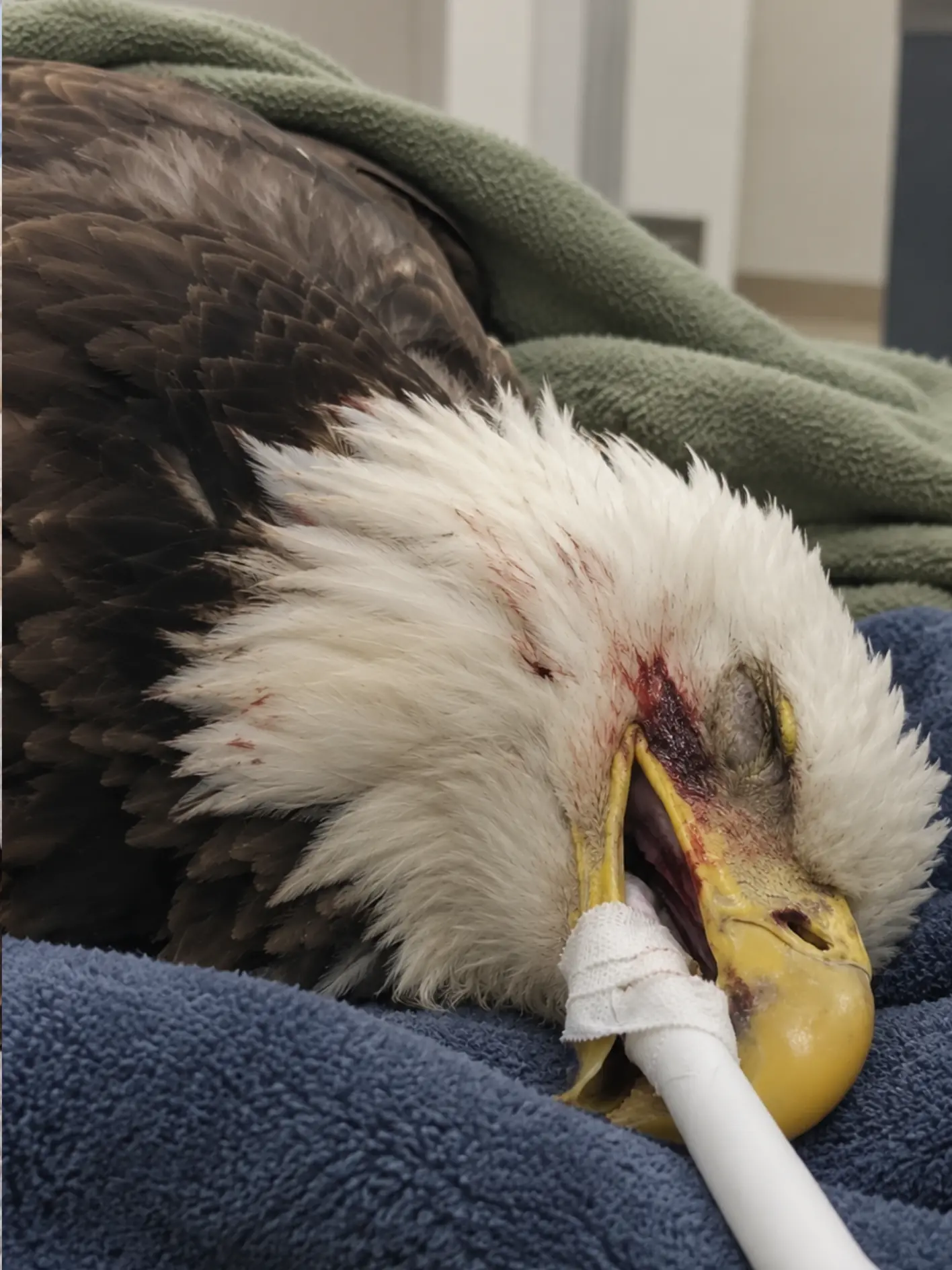
Her eyes were open, she reacted to movement, and she still had enough strength to defend herself when someone approached.
But the evidence of trauma was immediately visible.
Blood stained feathers around her face. Several flight feathers were dirty and disordered. She remained on the ground instead of flying away, and witnesses reported that she had been struck by a passing vehicle only a short time earlier.
The eagle would later be given the temporary rehabilitation name Willow.
At that moment, however, Minnesota Department of Natural Resources Conservation Officer Mark Ellison was concerned with only one question:
Could the bird be moved without worsening injuries that had not yet been identified?
Ellison secured the eagle carefully, controlling the powerful feet first and keeping both wings close to the body. No one attempted to make her fly.
She was transported to the fictional Riverbend Veterinary Clinic, where the immediate priority was stabilization.
The facial wounds were cleaned.
Her breathing and neurologic responses were evaluated.
Pain and hydration were addressed as clinically indicated.
Once veterinarians determined that she was stable enough to travel, volunteer wildlife transporter Susan Parker carried Willow to the fictional North Lakes Wildlife Center for a complete raptor examination.
What the veterinary team found there was unexpectedly complicated.
Willow was in reasonably good body condition.
She was alert.
There was no obvious catastrophic wing fracture.
But the collision had left behind a collection of smaller injuries that could not be dismissed.
Several primary wing feathers and tail feathers were dirty, frayed, or damaged.
There were superficial abrasions around the face and on both feet.
Several talons had been blunted.
Feather lice were visible among portions of the body plumage.
And one finding was particularly concerning:
one toe on Willow’s right foot would not flex and extend normally.
It looked like a small injury compared with the blood around her face.
For a wild Bald Eagle, it might become one of the most important.
The Collision Happened Quickly
The report received by Ellison described an adult Bald Eagle that had been hit along a rural roadway and remained grounded afterward.
When he arrived, Willow was no longer in the active lane of traffic, but she was still dangerously close to the road.
Her posture was low.
The white feathers around her head were marked with blood and road debris.
She watched the officer carefully.
A healthy Bald Eagle generally does not tolerate a close human approach when open escape space is available.
Willow did not leave.
That alone suggested significant trauma.
Ellison did not try to determine the full extent of the injuries at the roadside.
Wildlife trauma can be deceptive.
An eagle can remain conscious despite fractures.
A bird can stand despite internal injury.
A wing may look normal while a shoulder or soft-tissue structure has been damaged.
Head trauma may not become obvious until later.
The safest approach was containment and transport.
An Alert Eagle Can Still Be Seriously Injured
Willow reacted defensively during capture.
Her feet moved toward the handler.
Her head turned rapidly.
The beak opened.
Those behaviors were reassuring in one sense because they indicated that she remained responsive.
They also demonstrated why an injured eagle should not be approached casually.
The talons of a Bald Eagle remain dangerous even when the bird is compromised.
Ellison controlled the feet and supported the body while limiting unnecessary wing movement.
If an unseen fracture had been present, repeated flapping could have worsened it.
Willow was transferred into a padded carrier and taken to Riverbend Veterinary Clinic.
The clinic was not intended to provide long-term raptor rehabilitation.
Its role was immediate stabilization.
That first stage mattered because wildlife patients often require several organizations to move them from the place of rescue to specialized care.
The First Veterinary Examination Focused on Stability
At Riverbend, clinicians evaluated whether Willow could safely undergo continued transport.
The facial trauma was the most obvious injury.
There were abrasions and small lacerations around the head, including the tissue near one eye and around the cere and beak.
The bleeding was controlled.
The eye was evaluated for obvious rupture or major penetrating injury.
The beak remained aligned.
Willow continued responding visually.
Her breathing was monitored.
No dramatic respiratory deterioration was observed.
The staff also assessed her overall responsiveness and looked for major limb deformities.
Once the eagle was considered sufficiently stable, the rehabilitation center was contacted.
Susan Parker volunteered for the transport.
By the time she arrived, Willow was more alert than she had been immediately after the collision.
That was encouraging.
It was not proof that she was medically clear.
“She was watching everything by the time we moved her,” Parker later recalled. “But with wildlife, being alert doesn’t mean the examination is finished. It just means you have a stronger patient to examine.”
The Transfer to Specialized Wildlife Care
Parker transported Willow to North Lakes Wildlife Center in a secure, padded carrier.
The journey was kept quiet.
Handling was minimized.
No attempt was made to encourage the eagle to stand, perch, or fly during transport.
At the center, veterinarian Dr. Katherine Monroe and the rehabilitation team performed a more extensive intake examination.
Willow’s size suggested that she was likely female.
Female Bald Eagles are generally larger than males, although sex cannot always be established with certainty from appearance alone.
Her overall body condition was better than the team might have expected from the dramatic roadside history.
The breast muscles were reasonably developed.
She was not severely emaciated.
Her physical condition suggested that the collision had probably occurred before prolonged starvation or chronic debilitation could develop.
That was favorable.
But the complete examination began revealing multiple smaller consequences of the accident.
The Flight Feathers Had Taken a Beating
Several primary wing feathers were dirty and frayed.
Some feather vanes were disrupted.
The tail feathers also showed contamination and damage.
This may have occurred during contact with the roadway, the vehicle, or the bird’s attempts to regain control after impact.
Veterinarians could document the damage.
They could not determine exactly which moment produced each broken or abraded feather.
That distinction was important.
The feathers of a large raptor are not cosmetic.
Primary feathers are fundamental to propulsion and control.
Tail feathers contribute to braking, turning, and stability.
A bird may have perfectly intact bones but still be unable to fly normally if too many flight feathers are severely damaged.
Willow’s plumage therefore had to be evaluated as part of the release prognosis.
Fortunately, the damage did not appear extensive enough at intake to rule out future flight.
The team would reassess once she became strong enough for rehabilitation.
The Team Found Feather Lice
During the plumage examination, staff observed external parasites consistent with feather lice.
The finding was documented but kept in perspective.
Feather lice can occur on wild birds and do not necessarily explain why an otherwise active eagle became grounded.
In Willow’s case, the parasites were considered a secondary issue rather than the cause of the emergency.
The team treated the ectoparasite problem with an avian-appropriate management plan and improved enclosure hygiene while continuing to monitor the feathers.
The presence of lice did, however, reinforce the importance of conducting a complete examination even when one obvious traumatic event already seems to explain the case.
Wild animals often arrive with more than one medical issue.
Some are urgent.
Others are incidental.
The clinician’s job is to distinguish between them.
The Facial Wounds Looked Worse Than Some of the Deeper Injuries
A photograph from Willow’s stabilization period shows her resting on thick towels.
Blood is visible around the eye and facial feathers.
Her head lies low.
One eye is closed.
A tube or piece of medical equipment is positioned near the beak during supportive treatment.
The photograph makes the facial injuries appear severe.
But visual appearance alone could not determine prognosis.
Monroe carefully examined the eye.
The eyelids were bruised and irritated.
There were superficial abrasions around the surrounding tissues.
The globe itself remained intact.
Pupil responses were appropriate.
There was no obvious catastrophic injury to the beak.
Those were important findings.
The wounds required treatment and monitoring, but the structures essential for vision and feeding still appeared potentially functional.
The team then moved down the body.
That was when they found the more subtle abnormality.
Both Feet Had Signs of Contact Trauma
Willow had minor abrasions on both feet.
Several talon tips appeared dulled or superficially damaged.
This could have been consistent with scraping against pavement or another hard surface during or after the collision, although the exact mechanism could not be confirmed.
The pads of the feet remained viable.
No major open wound was present.
At first, the injuries appeared relatively minor.
Then Monroe compared movement of the toes.
One digit on the right foot did not behave normally.
When Willow gripped, most toes flexed.
One did not participate fully.
When the foot was manipulated carefully, active flexion and extension remained reduced compared with the other digits.
The abnormality was easy to overlook beside the much more visible facial trauma.
It immediately caught the veterinary team’s attention.
“The smallest finding on the examination was potentially one of the most important,” Monroe said.
Why One Toe Can Matter to an Eagle
A Bald Eagle does not use its feet merely for standing.
The feet are central to almost every part of survival.
They secure perches.
They absorb and stabilize landings.
They grasp fish and other prey.
They hold food while the beak tears it apart.
They help the bird defend itself.
They allow the eagle to maintain balance in wind and on uneven branches.
A single dysfunctional toe does not automatically prevent release.
But its importance depends on which digit is affected, how much strength is lost, whether the remaining toes compensate effectively, and whether the bird can perform normal behaviors without pain or instability.
A wild eagle does not need a foot that simply looks acceptable.
It needs a foot that works under load.
Willow’s right foot therefore required a more detailed evaluation.
Radiographs Looked for a Hidden Fracture
The team obtained radiographs of the affected foot and other areas of concern.
The goal was to determine whether the abnormal toe movement could be explained by a fracture, joint injury, or dislocation.
No major fracture was identified in the affected digit.
There was no obvious major displacement.
That was encouraging.
But it also meant the problem might involve structures that are less easily evaluated on routine radiographs.
A tendon could be strained.
Soft tissue could be swollen.
A peripheral nerve could have been temporarily injured by impact or stretching.
Pain alone could reduce active movement.
The veterinary team therefore avoided labeling the toe permanently paralyzed.
The appropriate description was simpler:
reduced active flexion and extension of one digit on the right foot following trauma.
The cause remained under investigation.
A Normal X-Ray Does Not Mean Normal Function
This principle became central to Willow’s case.
Radiographs are valuable for identifying many skeletal injuries.
They cannot show every type of tendon, ligament, muscle, or nerve problem.
That means clinical function matters enormously.
The team assessed passive range of motion.
They evaluated whether the toe could be positioned normally when moved gently.
They looked for swelling.
They watched for a withdrawal response.
They monitored sensation and grip.
The presence of some response suggested that complete permanent neurologic loss was not established.
That gave the toe time to recover.
Meanwhile, the rest of Willow’s injuries required treatment.
The First Days Were About Rest and Observation
Willow was placed in a quiet enclosure with padded footing.
There was no immediate reason to provide a high perch.
The bird had recently experienced a vehicle collision, facial trauma, and possible soft-tissue injury.
Falls were unnecessary risks.
The facial wounds were cleaned and monitored.
Pain management was provided as clinically indicated.
Hydration was supported.
The feather-louse problem was treated separately.
The feet were inspected repeatedly.
During the first day, Willow remained alert but rested frequently.
She stood intermittently.
The right foot could bear weight, although the abnormal toe did not close normally.
Her appetite was watched closely.
A wild eagle may refuse food temporarily after capture and treatment.
That alone is not always unexpected.
What mattered was whether appetite returned as stress decreased.
It did.
Eating Was the First Broad Sign of Improvement
Willow began accepting food independently.
The eagle could target food visually.
The beak closed correctly.
She tore pieces normally.
The facial trauma did not appear to prevent feeding.
That was an important functional milestone.
Her posture also improved.
The eagle began spending more time upright.
As strength returned, she became increasingly resistant to staff.
The feet struck more forcefully during necessary handling.
She watched the door.
She moved away from people.
For wildlife rehabilitators, those behaviors were encouraging.
An adult eagle should remain wary of humans.
The objective was never to make Willow cooperative.
It was to make her healthy enough that cooperation would no longer be necessary.
The Facial Swelling Began to Decline
Over the following days, the injuries around Willow’s head became less dramatic.
Bleeding did not recur.
Inflammation decreased.
The tissue around the eye improved.
The eye remained responsive.
The beak continued functioning normally.
The white facial feathers remained stained and somewhat disordered, but that was no longer the important issue.
The tissue beneath them was healing.
That allowed the veterinary team to devote more attention to the foot.
The right toe still lagged behind the others.
But then there was a small change.
The First Movement Was Easy to Miss
During one examination, Monroe noticed slightly stronger flexion in the affected digit.
The movement was not normal.
It was barely dramatic enough to notice.
But it was voluntary.
Later, the toe participated again when Willow attempted to close the foot.
“The first movement was small,” Monroe said, “but it told us that we should not assume the dysfunction was permanent.”
The staff continued monitoring rather than aggressively manipulating the toe.
Time can be important in some post-traumatic soft-tissue or peripheral nerve injuries.
The goal was to observe whether function progressed naturally while preventing secondary complications.
The toe did not deteriorate.
Gradually, movement improved.
A Low Perch Became the Next Examination Tool
Once Willow was medically stable and consistently standing, the rehabilitation team introduced a very low perch.
The height was deliberately limited.
If the right foot failed to grip properly, the eagle would not fall far.
Willow stepped onto the perch.
The left foot closed firmly.
The right followed.
Most of the right toes wrapped around the branch immediately.
The affected digit closed more slowly and less completely.
Willow compensated by shifting weight.
She remained upright.
For the team, this was useful information.
The toe was not fully functional.
But the foot as a whole could already contribute to balance.
The question became whether that contribution would continue improving.
Repeated Perching Revealed Progress
Over the following days, Willow spent progressively longer periods on the perch.
The right foot began wrapping more naturally around the branch.
The affected toe joined the grip more consistently.
The bird repositioned its feet without falling.
Balance became more symmetrical.
Grip endurance improved.
The team also watched whether the foot became swollen after use.
It did not show a concerning pattern of post-exercise deterioration.
Those observations supported continued rehabilitation.
No single measurement determined success.
Progress came from a series of ordinary behaviors becoming normal again.
Standing.
Closing the toes.
Gripping.
Shifting weight.
Holding position.
For a wild raptor, those details are the foundation of much more demanding movements.
Feather Condition Had to Be Considered Before Flight
With the facial injuries healing and foot function improving, Willow’s damaged flight feathers became increasingly relevant.
The veterinary team inspected the primaries and tail again.
Some remained frayed.
Others were dirty but structurally serviceable.
The bird had resumed preening, which helped restore feather alignment.
There was no evidence that the plumage damage alone would prevent a controlled flight assessment.
That did not mean flight would automatically be normal.
Willow had spent time resting.
Muscle strength had to be reassessed.
The feet had to handle landing.
And the right toe had to perform under much greater force than it experienced on a low stationary perch.
The First Flight Tested the Entire Animal
Willow was moved into a larger rehabilitation enclosure when the veterinary team judged her ready.
She was allowed to leave the perch voluntarily.
No one threw her into the air.
After watching the enclosure for a short time, Willow opened her wings.
The eagle launched.
Both wings generated lift.
She crossed the space and approached another perch.
That was when the team focused on the legs.
The feet extended.
The talons opened.
Both feet contacted the perch.
Willow remained upright.
But the landing was not completely symmetrical.
The right foot appeared slower to establish a secure grip.
The eagle shifted weight immediately after contact.
She did not fall.
The flight itself had been encouraging.
The landing showed that rehabilitation was not finished.
“The wings had passed the first test,” one staff member said. “The right foot still had work to do.”
A Bird Can Fly Well and Still Be Unreleasable
That is particularly important in raptor rehabilitation.
People understandably focus on whether an injured eagle can fly.
But surviving in the wild requires a successful landing at the end of every flight.
A Bald Eagle may land on narrow branches.
Wet shoreline structures.
Uneven trees.
Rock.
Ice.
The feet must react instantly.
A weak toe may not matter during one easy landing in a protected enclosure.
It may matter greatly during a windy landing after a long flight.
Willow therefore remained in care.
The team increased activity gradually.
She moved between perches.
Flight distance increased.
Landings were repeated.
The right foot was assessed after exercise.
The affected toe continued participating more strongly.
Food Handling Added Another Functional Test
The rehabilitation team also observed how Willow used her feet while eating.
Initially, she favored one foot when stabilizing food.
That was not surprising.
As the right digit improved, she began using both feet more normally.
She could press food against the surface.
Grip.
Adjust the toes.
Maintain control while tearing with the beak.
That mattered because feeding in captivity offered a practical test of the same mechanics required for prey handling.
Again, the question was not whether the toe appeared anatomically perfect.
The question was whether the eagle could perform necessary behaviors.
Function was becoming increasingly normal.
The Talons Were Reassessed
Several talon tips had been blunted during the traumatic event.
Fortunately, none of the claws had been destroyed at the base.
The feet remained structurally useful.
Surface wear alone does not necessarily prevent release if grip and prey-handling ability remain adequate.
The rehabilitation team continued checking both feet for abnormal pressure points.
A dysfunctional digit can sometimes cause an animal to shift load onto the remaining toes.
That redistribution can produce secondary problems if it persists.
Willow increasingly spread pressure more normally across the foot.
That was another positive indication.
The Feather Lice Were No Longer the Main Concern
As trauma recovery progressed, the external parasite issue became comparatively straightforward.
Treatment reduced the parasite burden.
The plumage was monitored.
Willow continued normal preening behavior.
The lice had never been considered the cause of her inability to fly after the collision.
They were simply one more health problem identified because the eagle received a thorough examination.
This distinction is important in wildlife medicine.
Finding an abnormality does not automatically mean that abnormality explains the presenting problem.
The collision remained the primary event.
The parasite infestation was managed as a secondary finding.
Willow Became More Difficult to Approach
The longer she recovered, the more clearly Willow behaved like a wild adult eagle.
She avoided people.
She moved to distant perches when staff entered.
Her defensive responses strengthened.
This was exactly what the rehabilitation team wanted.
Human habituation can complicate release.
A wild eagle needs to regard people as something to avoid, not as a predictable source of food or comfort.
Handling was reduced to what remained medically necessary.
Food presentation minimized human association.
The eagle was given space to behave independently.
Clinical improvement and behavioral normalization progressed together.
Repeated Landings Became More Symmetrical
Willow’s later flights showed a gradual change.
The right foot stopped lagging as noticeably during landing.
Both legs extended at similar times.
Both feet contacted the perch.
The affected toe closed more quickly.
The eagle no longer made an immediate compensatory shift after every landing.
Flight itself remained strong.
Wingbeats were symmetrical.
The damaged feathers did not appear to create a major functional deficit.
Turns were controlled.
Altitude gain was appropriate.
The bird could repeat flights without abnormal fatigue.
For the first time, the medical team could begin discussing release as a realistic near-term possibility.
The Final Decision Would Not Be Based on Appearance
By this stage, Willow looked much better.
The face had healed.
The blood was gone.
The feathers around the head were settling.
She stood strongly.
From a photograph alone, someone might assume the case was finished.
The rehabilitation team required more.
Before release, Willow needed to demonstrate that the entire sequence of normal eagle behavior had returned.
She had to fly strongly.
Land accurately.
Grip securely.
Hold food.
Use both feet effectively.
Maintain body condition.
Show normal vision.
Remain wary of humans.
And perform all of those behaviors consistently rather than once.
That standard is intentionally demanding.
A released eagle will not have a second chance to ask for medical support after a poor landing.
Why the Toe Could Not Be Dismissed
The right digit had never looked as dramatic as the facial wound.
There was no large open fracture.
No obvious bleeding.
No severe deformity.
But release medicine is not based on which injury looks worst.
It is based on which injury limits survival.
A small neurologic or tendon deficit can matter more than a superficial facial laceration if it prevents a bird from gripping.
That was the lesson of Willow’s case.
The most visually disturbing injury was not necessarily the most important one.
Her face healed predictably.
The toe required functional proof.
The Vehicle Strike Left More Than One Kind of Damage
A collision can produce direct impact injuries.
It can also create secondary abrasions as a bird contacts pavement or vegetation afterward.
Feathers can become frayed.
Talons can scrape hard surfaces.
Soft tissues can stretch.
Nerves may be compressed.
Different injuries may appear unrelated when they are actually consequences of the same event.
Willow arrived with this kind of mixed trauma.
No single catastrophic injury dominated the case.
Instead, successful rehabilitation required the team to identify and manage several smaller problems simultaneously.
That type of case can be less dramatic than surgery.
It is not necessarily simpler.
Roadside Eagles Need Complete Evaluation
Willow’s survival also provides a public reminder.
A Bald Eagle that remains conscious after a vehicle collision should not be assumed to be unharmed.
Wild birds can mask injury remarkably well.
A bird may stand despite significant trauma.
It may react defensively despite pain.
It may even attempt a brief flight.
Anyone who sees a grounded eagle after a collision should contact wildlife authorities rather than trying to determine the severity of the injury independently.
Do not force the bird to fly.
Do not approach closely.
Do not attempt to pick it up without training.
Keep pets and unnecessary bystanders away.
Provide responders with the exact road, direction of travel, mile marker, or nearby landmark whenever possible.
Rapid professional assessment can identify injuries that are impossible to see from the roadside.
The Rescue Required Several People Doing Different Jobs
Officer Ellison removed Willow from immediate danger.
Riverbend Veterinary Clinic stabilized the bird.
Susan Parker transported her to specialized care.
North Lakes Wildlife Center performed the detailed examination and rehabilitation.
Each part of the chain mattered.
Without the initial capture, the bird remained vulnerable beside traffic.
Without stabilization, a longer transport might have carried unnecessary risk.
Without the complete wildlife examination, the toe dysfunction might have been overlooked.
Without rehabilitation, no one could determine whether the injury actually prevented normal landing.
The rescue was not one dramatic act.
It was a sequence of appropriate decisions.
The Final Flight Would Need a Final Landing
If Willow met all clinical criteria, she would eventually be transported to a suitable release location within the same general region.
The site would provide open airspace and appropriate habitat while avoiding immediate traffic hazards.
The carrier would be positioned toward a clear route.
People would step back.
The door would open.
Willow would decide when to leave.
Most people watching would naturally look at the wings.
The rehabilitation staff would also look at the feet.
A strong takeoff would matter.
So would the flight.
But when Willow eventually approached a tree or other landing point, the most important movement might be almost invisible from the ground.
The right foot opening.
The toes spreading.
Contact.
Then that once-dysfunctional digit closing around the perch.
The Final Perspective
Willow survived the vehicle collision without the catastrophic fractures that rescuers initially feared.
She arrived in reasonably good body condition and became increasingly alert after stabilization.
But a complete examination revealed the less obvious consequences of the accident.
Dirty and damaged primary feathers.
Frayed tail feathers.
Facial abrasions.
Minor wounds on both feet.
Blunted talons.
Feather lice.
And one toe on the right foot that did not flex and extend normally.
Radiographs showed no major fracture in the digit.
That shifted attention toward soft-tissue, tendon, or neurologic trauma.
The team did not call the toe permanently paralyzed.
They watched.
And gradually, movement returned.
First a small flexion.
Then participation in the grip.
Then a low perch.
Then longer periods of weight bearing.
Eventually, Willow flew.
Her first landing showed that the right foot was still behind the rest of her recovery.
So rehabilitation continued.
More flights.
More landings.
More grip.
More food handling.
The small movement that had seemed almost insignificant during the first examination became one of the final measures of whether the eagle could return to the wild.
That is what Willow’s case ultimately demonstrates.
Wildlife medicine is not simply about saving an animal’s life.
It is about restoring enough function for that animal to survive without continued human help.
For an eagle, that means more than a beating heart.
More than clean X-rays.
More than healed skin.
It means wings strong enough to leave the ground.
Eyes precise enough to judge the distance.
Feet strong enough to receive the landing.
And toes capable of closing around the branch when the flight is over.
The blood around Willow’s face was the first thing rescuers noticed.
In the end, one quiet movement in her right foot may be what matters most.