The Part Staff Started Watching More Closely
The meeting room was empty again.
A few minutes earlier, a family had been sitting on the floor with a senior Beagle mix between them, offering treats, scratching gently behind his ears, and asking the questions people often ask when they are trying to imagine an older dog in their home.
How far can he walk?
Does he manage stairs?
Is he house-trained?
How much medication does he need?
Does he get along with other dogs?
When the visit ended, the family left through the front lobby. A staff member clipped the leash back onto the dog’s harness and started toward the kennel hallway.
But the dog did not follow.
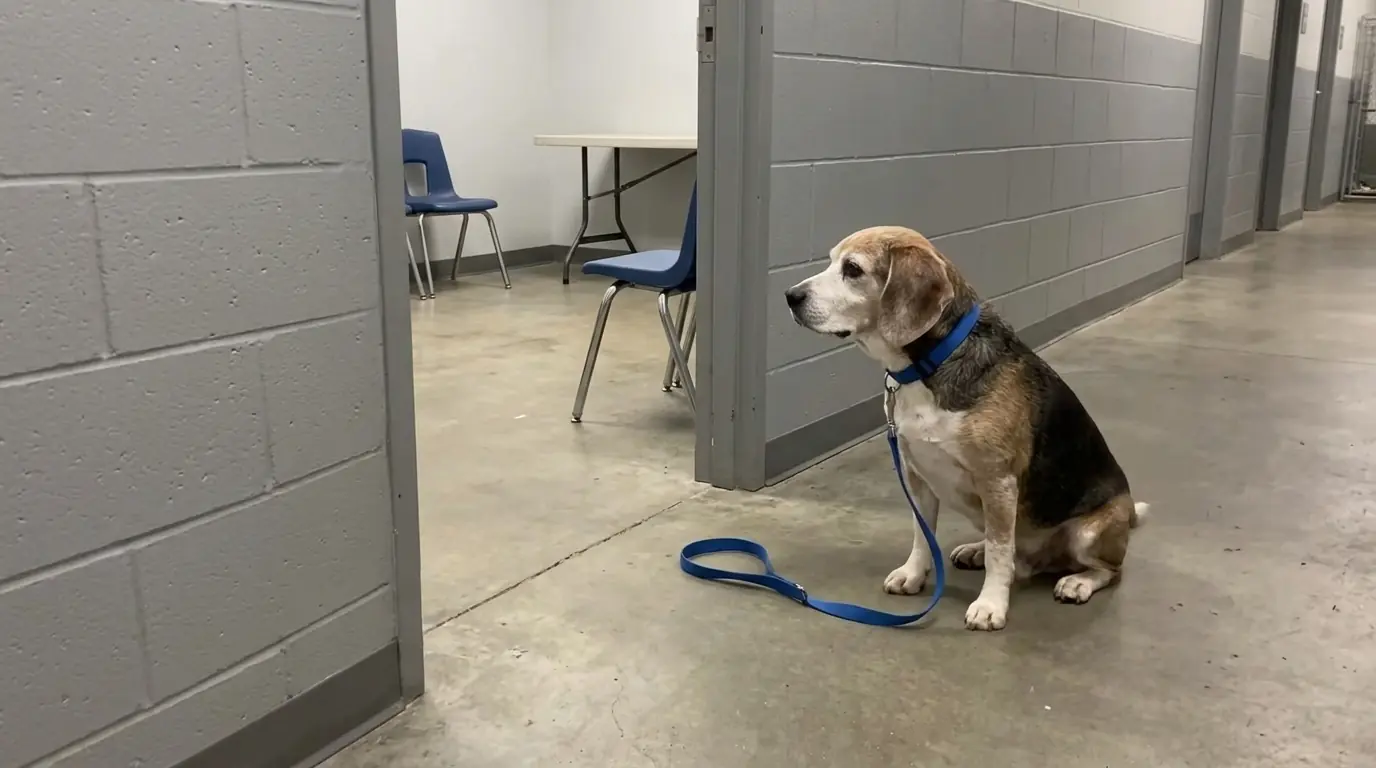
He took several slow steps out of the meeting room, turned around, and lowered himself onto the floor just beside the doorway.
Then he stayed there.
His body faced the room the visitors had just left. His front paws rested close together. The leash fell loosely between them.
He did not bark.
He did not pull toward the lobby.
He did not scratch at the door or become frantic.
He simply sat beside the now-empty room.
The first time it happened, nobody thought much of it.
Senior dogs move slowly. Shelter floors can be slick. A dog with stiff hind legs may stop because turning or standing becomes uncomfortable.
But then it happened again.
And again.
After enough meetings, staff began to realize that the pause was not random.
Whenever this particular Beagle mix came out of an adoption meeting and the visitors were gone, he repeatedly stopped in nearly the same place.
Right beside the empty room.
An Older Dog With a Slower Body
He had arrived at the shelter as an older dog whose exact history was not fully known.
Based on his teeth, body condition, muscle tone, and general appearance, the veterinary team considered him a senior. He was a Beagle mix, medium-sized, with a graying muzzle and the soft, slightly drooping expression common in older hounds.
He was gentle with handling.
He accepted a leash without resistance. He allowed staff to examine his ears, paws, mouth, and abdomen. He tolerated being touched around his hips, although his posture became noticeably guarded when his rear legs were manipulated too far.
What stood out most was the way he moved.
His front end still carried him with reasonable confidence, but his hindquarters were stiff.
When he first stood after resting, he sometimes needed an extra second before taking a step.
His stride behind was shorter than it should have been.
He did not drag his paws or collapse, and staff did not observe the kind of sudden neurologic deficits that would immediately suggest a severe spinal emergency.
Instead, his movement looked chronically uncomfortable.
The veterinary examination supported that impression.
His hips and knees had reduced comfortable range of motion, and he showed signs consistent with age-related degenerative joint disease.
Radiographs were obtained because of the persistent stiffness and because staff wanted to distinguish ordinary senior arthritis from other orthopedic problems.
There was no evidence of a fresh fracture.
There was no obvious injury requiring emergency surgery.
The changes appeared chronic.
That meant his care would be less dramatic than an operation, but no less important.
He needed pain management.
He needed controlled activity.
He needed traction on slippery surfaces.
He needed a healthy body weight.
He needed a sleeping area that supported aging joints.
Most of all, he needed people to understand that moving slowly did not mean he had stopped wanting to participate in the world around him.
He Still Wanted to Go Everywhere
Inside the kennel, he was quiet.
He did not spend the day throwing himself against the gate or barking whenever someone passed.
Most of the time, he rested on his bed or stood near the front when he heard familiar footsteps.
But when a leash appeared, his entire posture changed.
His head came up.
His ears shifted forward.
He leaned toward the kennel door.
He still wanted to go.
Walks had to be short because of his joints, but he took them seriously.
He stopped often to smell fence posts, patches of grass, the base of shrubs, the edges of curbs, and anywhere another dog had recently passed.
For a Beagle mix, scent remained one of the richest parts of his environment.
He did not need to travel far to have a meaningful outing.
Sometimes ten slow minutes of sniffing seemed to satisfy him more than a younger dog’s long lap around the property.
That same willingness to participate made him easy to introduce to potential adopters.
When someone specifically asked about older dogs, staff often considered him.
He was manageable on leash.
He did not overwhelm visitors.
He could settle in a room.
And once he became comfortable, he would occasionally rest his chin near someone’s knee or lean gently into a hand.
He was not theatrical.
He did not perform for attention.
He simply stayed close.
For some visitors, that was exactly what they were looking for.
The Adoption Room Was Different From the Kennel
Shelter meeting rooms are designed to be neutral spaces.
They are quieter than kennel runs.
There may be a washable rug, a few chairs, toys, a water bowl, and enough floor space for a dog to move around without feeling crowded.
For a senior dog, that kind of room can feel significantly different from a noisy kennel corridor.
The Beagle mix usually entered slowly.
He would sniff the corners first.
Then the chair legs.
Then the floor near the visitors.
If treats were offered, he accepted them carefully.
He did not jump on people.
He rarely climbed into laps.
Instead, he tended to stand near someone for a few seconds, move away, circle back, and eventually settle.
During longer visits, he sometimes lay down.
That required effort.
Older dogs with painful joints often do not simply fold neatly onto the floor. He would first plant his front paws, shift his weight, lower one elbow, pause, reposition a hind leg, and then gradually bring the rest of his body down.
Getting back up took even longer.
Staff made sure meetings were not rushed.
Nobody wanted him repeatedly standing and lying down because visitors expected more interaction.
He was allowed to choose.
And most of the time, after several minutes, he chose proximity.
That was what made the moment after each meeting so noticeable.
During the visit, he could settle.
When it was over, he did not immediately want to leave.
At First, Staff Considered the Simple Explanations
It was important not to assign a human story to behavior just because the scene looked sad.
A dog sitting beside an empty room can easily invite speculation.
Maybe he thought the people were coming back.
Maybe he believed he had been rejected.
Maybe he remembered another home.
Maybe he was waiting for someone specific.
There was no evidence for any of those conclusions.
Staff could only document what they observed.
The pattern was consistent.
After certain adoption meetings, especially calm ones where visitors spent significant time sitting with him, he exited the room and then stopped beside the doorway.
His body often remained oriented toward the room.
The leash went slack.
If the handler gently encouraged him forward, he usually stayed seated for several seconds before eventually rising.
Nobody knew exactly what the room represented to him.
But there were several realistic possibilities.
One was physical.
Sitting may simply have been a way to pause after the effort of standing and walking.
Another was environmental.
The quiet room may have been more comfortable than the kennel hallway.
Another involved social behavior.
He might have learned that the room predicted prolonged human attention, treats, touch, and low noise.
Dogs are very good at recognizing patterns.
A location that repeatedly contains pleasant, predictable interactions can quickly become valuable.
Whatever the reason, staff began giving him time.
They stopped treating the pause as something that needed to be corrected.
The Leash Between His Paws
One staff member began noticing the same detail nearly every time.
After a meeting ended, the dog would sit with the leash dropping from his harness and collecting between his front feet.
It was not pulled tight.
He was not straining against it.
That distinction mattered.
A dog actively trying to follow departing people might pull toward an exit, vocalize, pace, or repeatedly orient toward the lobby.
He did not usually do those things.
Instead, he became still.
Sometimes he looked into the room.
Sometimes he looked down the hallway.
Sometimes he simply remained there while staff stood beside him.
The moment could last less than a minute.
Occasionally it lasted several.
Then, eventually, he would rise.
The process of standing told its own story.
He shifted forward first.
His front legs pushed.
His hindquarters came up more slowly.
Once he was balanced, he took a few stiff steps, then began walking normally for him.
The staff member holding the leash never pulled him upright.
There was no reason to.
If the shelter had learned anything from caring for him, it was that rushing an arthritic dog rarely improves anything.
His Medical Plan Was Built Around Comfort
His veterinary plan focused on long-term management rather than a cure.
Arthritis does not disappear because a dog enters rescue.
Degenerative joints do not become young joints again.
The goal was to make movement less painful and daily life more manageable.
His pain medication was adjusted based on his response and follow-up examinations.
Staff monitored appetite, stool, energy, and mobility.
Because some medications used for chronic pain can affect the gastrointestinal tract, kidneys, or liver in certain dogs, appropriate bloodwork was part of his senior evaluation and ongoing care.
His weight was also important.
Even a few unnecessary pounds can increase strain on painful hips and knees.
Fortunately, he was not severely overweight.
His meals were measured rather than free-fed, and treats used during visits were counted as part of his daily intake.
His kennel was modified.
Rubber-backed mats were placed where possible to reduce slipping.
His bedding was thick enough to cushion his joints but firm enough that he could push himself upright without sinking deeply into it.
Staff avoided forcing him into long walks.
Instead, his exercise came in several shorter outings.
Movement was encouraged because complete inactivity can worsen stiffness, but activity had to stay controlled.
On colder mornings, he often needed more time.
After resting for long periods, the first few steps were usually the hardest.
The Meetings Kept Happening
There was no dramatic rush of applicants for him.
That was not unusual.
Senior dogs can be overlooked for many reasons.
Some families want a dog who can run, hike, or play for hours.
Some worry about future veterinary expenses.
Some have stairs.
Some want many years with a new pet and struggle emotionally with choosing an older animal.
Those concerns are real.
The shelter did not shame anyone for them.
Their job was to make appropriate matches, not force emotional decisions.
So the Beagle mix continued meeting people who specifically wanted to consider senior dogs.
Some visits lasted ten minutes.
Some lasted almost an hour.
One couple sat on the floor and spent most of the meeting letting him sniff around them without trying to touch him constantly.
Eventually, he placed himself beside one person’s leg and stayed there.
Another visitor brought questions about joint supplements, medication schedules, and whether he could handle three porch steps.
A family with another dog asked for a controlled dog-to-dog introduction before deciding whether the household was appropriate.
Not every meeting led anywhere.
And after many of them, the same thing happened.
He came out.
He stopped beside the doorway.
And he sat.