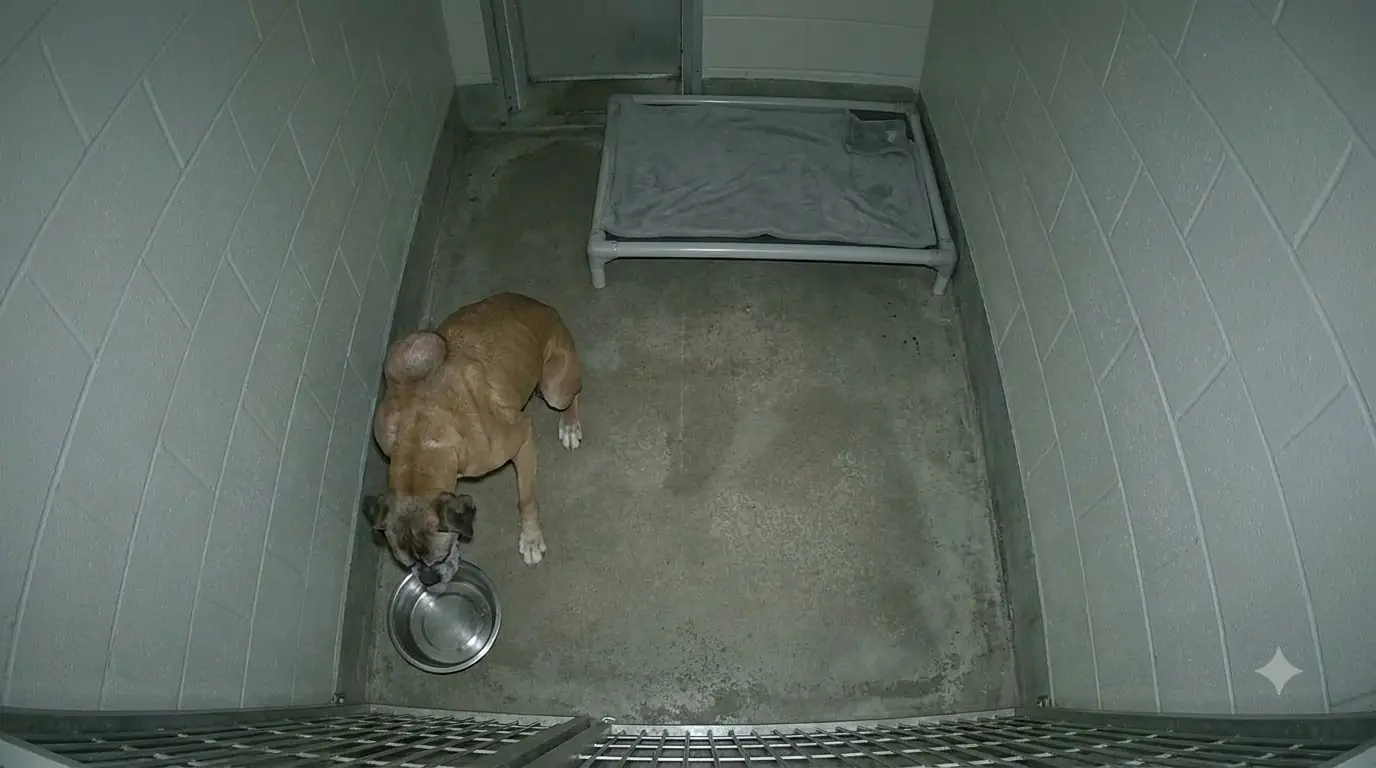
The food bowl was less than six feet from the bed.
For most dogs, that distance would barely count as movement.
For the senior Boxer, it had become the longest part of every meal.
He had arrived at the shelter severely underweight.
His ribs were visible.
Muscle had disappeared from the hindquarters and shoulders.
A large mass protruded from one side of his body near the shoulder, changing the way he carried himself when he tried to stand.
He could still walk.
But every trip took planning.
Stand.
Pause.
Take several slow steps.
Reach the bowl.
Eat.
Then somehow make the same journey back.
That last part was becoming harder.
After one of his first recovery meals, staff watched him finish the measured portion.
The Boxer kept licking the stainless-steel bowl after the food was gone.
Around the edge.
Across the bottom.
Again.
And again.
Eventually, his front legs lowered.
His chest touched the floor.
The shelter worker assumed he was resting for a moment before getting up again.
He did not.
Instead, the dog shifted his head.
Placed his chin directly onto the rim of the empty bowl.
And fell asleep.
The orthopedic bed remained several feet behind him.
He simply did not have enough energy left to reach it.
The First Time Staff Saw It, They Thought He Had Just Overdone the Meal
The Boxer had eaten more eagerly than his body could support physically.
Not too much food.
The portion itself was intentionally small.
But even standing over the bowl had cost him energy.
His legs trembled slightly when he first approached it.
His shoulders worked harder than they should have.
The large mass near one side made balance more awkward.
By the time the bowl was empty, he was exhausted.
A caregiver helped him back to the bed after he woke.
The next meal, the same thing happened again.
Then It Became a Pattern
Small measured meal.
Long licking.
Body lowering beside the dish.
Chin on the rim.
Sleep.
Again and again.
That was what turned the behavior into something staff could not ignore.
The bowl itself was not the medical problem.
The distance was.
The weakness was.
The dog had enough appetite to finish each meal.
He did not have enough endurance to get back to the bed afterward.
Severe Weight Loss Changes More Than Appearance
A thin dog does not simply “look skinny.”
When body condition drops far enough, the body begins losing muscle.
That affects standing.
Balance.
Heat regulation.
Recovery after activity.
Ability to support joints.
Even a few steps can become more expensive.
The Boxer’s visible ribs were only the easiest part to see.
The real issue was how little reserve he had left.
The Shelter Did Not Give Him a Large Meal
That was important.
A severely underweight dog should not automatically be offered a huge amount of food.
If malnutrition has been significant or prolonged, aggressive refeeding can create medical complications.
So the veterinary team used controlled nutritional rehabilitation.
Small meals.
Carefully increased calories.
Monitoring of stool.
Hydration.
Appetite.
Body weight.
Laboratory values when appropriate.
The goal was not to fill him as quickly as possible.
The goal was to rebuild safely.
His Appetite Was Stronger Than His Body
This mismatch shaped the early days.
He wanted the food.
He ate the entire portion.
He continued licking after the food was gone.
The body, however, did not have enough energy to support prolonged standing.
By the time the meal finished, the Boxer often looked physically spent.
That did not mean the meal was hurting him.
It meant the act of getting there and remaining upright was too demanding.
The Bowl Was Moved Closer to the Bed
That was the first obvious adjustment.
If the dog could not reliably make the return trip, there was no reason to place the meal farther away.
The shelter shifted the feeding area.
The bowl now sat beside the orthopedic mattress.
The Boxer only needed a few steps.
That helped.
But the behavior continued.
Finish.
Lick.
Lower body.
Chin on bowl.
Sleep.
Even when the bed was close enough to touch.
That Changed the Interpretation
The first explanation had been pure exhaustion.
It was still part of the story.
But once the bed moved closer, the Boxer sometimes remained beside the bowl anyway.
He could have turned his head and rested on the mattress.
Instead, he placed his chin on the metal rim.
Staff could not know exactly why.
Maybe the bowl had become strongly associated with food.
Maybe the cool surface felt good.
Maybe he simply stopped moving once the meal ended.
Maybe it had become habit.
The shelter did not need to choose one explanation.
The Behavior Was Repeated and Observable
That was enough.
The Boxer ate.
Licked.
Lowered himself.
Used the empty bowl as a headrest.
That happened often enough to document.
The emotional impact came from what the behavior showed about his body.
The dog still cared deeply about food.
He simply ran out of strength immediately afterward.
The Large Shoulder Mass Needed Careful Assessment
It was not ignored just because the dog was underweight.
A visible mass in an older dog can have many possible causes.
Some benign.
Some malignant.
Some painful.
Some not.
The veterinary team examined its size.
Location.
Mobility.
Skin condition.
Whether it affected movement.
Whether the dog reacted when it was touched.
Whether it altered his ability to lie on one side.
That information helped determine what diagnostics were appropriate.
Not Every Large Mass Should Be Treated the Same Way
The team did not assume the worst by appearance alone.
Sampling or imaging could be considered if results would meaningfully change the plan.
The Boxer was already physically fragile.
Any procedure had to be weighed against his overall condition.
Would the information lead to treatment he could tolerate?
Would surgery improve his quality of life?
Would sedation create additional risk?
Those questions mattered.
His Weakness Had More Than One Possible Cause
Malnutrition was obvious.
But the veterinary team looked for other contributors.
Chronic disease.
Pain.
Anemia.
Organ dysfunction.
Cancer-related effects.
Dental problems.
Parasites.
Other gastrointestinal issues.
The Boxer’s body condition demanded a full medical picture rather than a single assumption.
Bloodwork Helped Guide the Plan
Where appropriate, the medical team reviewed red and white blood cell counts.
Kidney and liver values.
Protein levels.
Electrolytes.
Blood sugar.
Other parameters relevant to refeeding and chronic illness.
The exact results mattered because safe nutritional rehabilitation depends on more than appearance.
He Was Hydrated Carefully
A dog this weak cannot be managed by food alone.
Hydration status was assessed.
If fluid support was needed, it was given according to his condition.