An Orphaned Squirrel Arrived Before His Eyes Had Even Opened — A Few Weeks Would Completely Change the Tiny Animal in This Nest
When the newborn Eastern gray squirrel arrived at our wildlife rehabilitation center, there was very little about him that resembled the squirrels people see racing across suburban lawns.
His body was still almost entirely pink.
An extremely fine layer of gray fur had only begun appearing over his head and in a narrow line along his back. His belly remained nearly bare. His ears were still folded close to his head, his eyes were completely sealed, and the tail that would eventually become one of his most recognizable features was little more than a thin extension behind him.
It looked more like a mouse's tail than a squirrel's.
After being warmed and fed appropriately, the baby spent most of his first hours with us curled inside a small fleece nest.
He was so tiny that the folds of the fabric seemed enormous around him.
Every few minutes, his body shifted slightly.
A paw moved.
His nose twitched.
Then he tucked himself deeper into the warmth and became still again.
At this stage of development, that was exactly where he needed to be.
The baby had been found earlier near the base of a mature tree on a residential property.
There was no obvious nest within easy reach, although squirrel activity had been seen in the area. No one had witnessed him fall, and we couldn't know precisely how he had ended up on the ground.
That uncertainty is important with young wildlife.
Finding a baby squirrel alone doesn't automatically mean that its mother has died or abandoned it. Healthy displaced babies can sometimes be reunited with their mothers when circumstances are appropriate and the process is guided by someone experienced with wildlife.
But a newborn this young is extraordinarily vulnerable.
He couldn't climb back to a nest.
He couldn't regulate his body temperature effectively.
He couldn't find food.
He couldn't protect himself.
And as the situation unfolded, a safe reunion with his mother was not achieved.
By the time he came into care, he needed help.
Our first priority wasn't feeding him.
It was warming him.
A chilled neonatal squirrel shouldn't simply be given formula because feeding is what seems most obvious. Temperature, hydration, responsiveness, and swallowing ability all matter, and feeding an unstable baby can create additional risks.
So for a while, the little squirrel simply rested in controlled warmth.
Only after his condition was appropriate did nutritional support become part of his care.
Those first feedings were tiny.
Everything about him was tiny.
His stomach capacity.
His mouth.
His paws.
Even small changes in his weight mattered.
At this developmental stage, appropriate milk replacement had to stand in for the nutrition he should still have been receiving from his mother. Feeding technique also mattered because liquid delivered too quickly or incorrectly can enter the respiratory tract.
There was no rushing him.
Feed.
Rest.
Monitor.
Warmth.
Then repeat.
That became the rhythm of his earliest days.
One of the overnight caregivers eventually started calling him Bean.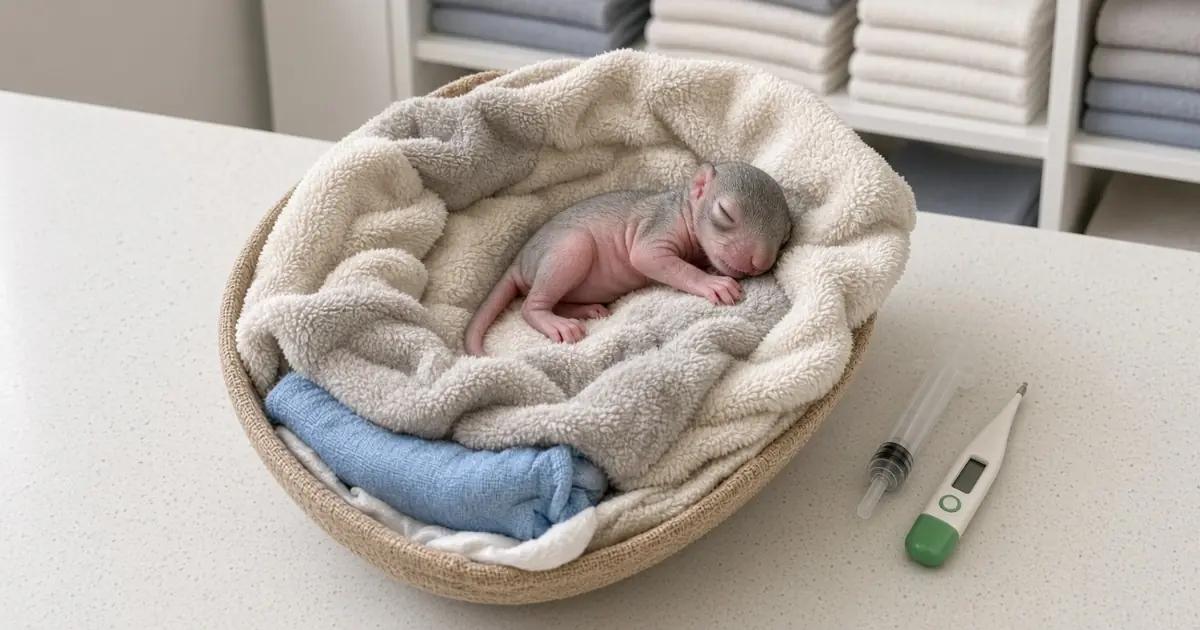
There wasn't much mystery behind the name.
Curled tightly in the fleece after a feeding, that was exactly what he looked like.
The name stayed.
Bean spent most of his first week doing two things extremely well: eating and sleeping.
But beneath that apparently uneventful routine, his body was changing every day.
The first obvious change was his fur.
The faint gray dusting over his head became easier to see.
The narrow stripe along his spine thickened and began spreading down his sides.
His belly remained pink longer, creating a clear contrast between the upper and lower portions of his body.
Then his ears started changing.
They gradually separated from the sides of his head and became more recognizable.
His paws strengthened too.
At first, Bean's movements consisted mostly of pushing against the fleece and searching instinctively when hungry.
Soon he could crawl with considerably more purpose.
He still couldn't see where he was going.
That didn't stop him from going there.
During routine checks, Bean began wriggling out of the neat little nest caregivers had arranged for him.
We would settle him into the center.
Bean would push.
Turn.
Crawl.
And eventually end up pressed against one side as though he had made a very important decision about where he wanted to sleep.
Those small movements were encouraging.
They showed increasing strength.
His weight was also moving in the right direction.
For neonatal wildlife, growth isn't something we judge simply by looking at whether the animal seems larger. Regular monitoring helps show whether the nutritional plan is actually supporting development.
Bean gradually began filling out.
His shoulders became less delicate.
His abdomen looked more appropriately rounded after feeding.
The fragile pink animal from intake was beginning to acquire the proportions of a young squirrel.
Then came one of the milestones everyone had been waiting for.
His eyes began to open.
It didn't happen dramatically.
One morning, there was simply the narrowest opening where a completely sealed eyelid had been the day before.
Soon the other followed.
For the first time since arriving, Bean could begin seeing the world that had been caring for him.
And that was also when our role needed to start changing.
A newborn requires intensive hands-on care because there is no alternative.
A developing wild squirrel needs something different.
He needs increasing independence.
Bean wasn't supposed to grow up believing that human hands, voices, and faces were simply part of normal squirrel life.
The goal of rehabilitation was never to turn him into a friendly squirrel.
It was to help him become a wild one.
As Bean became stronger, unnecessary interaction was minimized.
His surroundings became more important.
His enclosure changed as his physical abilities developed.
The tiny fleece nest that had once contained nearly his entire world eventually became far too small to satisfy him.
Bean started climbing.
At first, “climbing” was generous terminology.
He would hook his front paws into a fold of fabric, pull himself upward, and awkwardly drag the rest of his body behind him.
Sometimes he made it.
Sometimes he slowly rolled back down.
But each attempt strengthened muscles he would eventually need outside.
His tail was changing at the same time.
The thin, almost naked tail from intake began developing fur.
For a while, it looked comically undersized compared with an adult squirrel's.