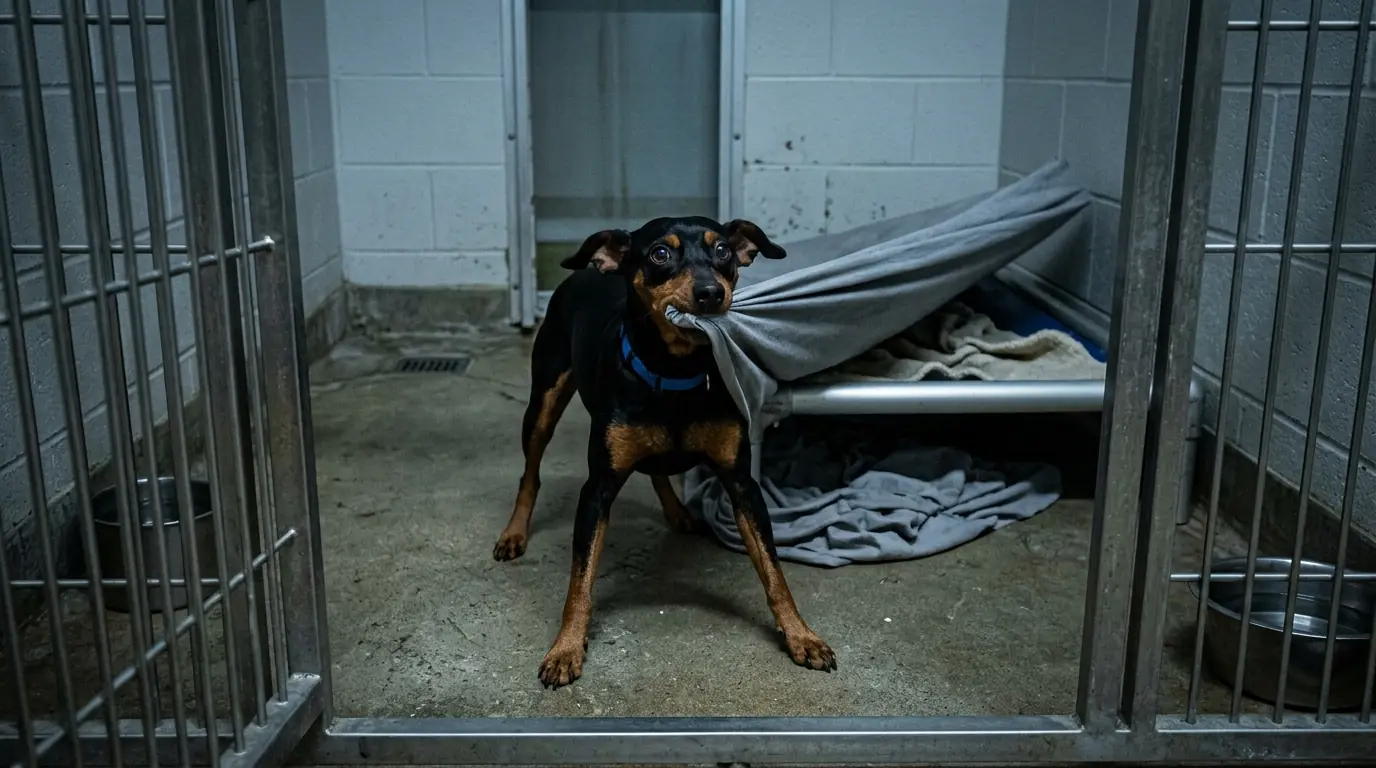
During the day, Archie sleeps on the bed without a problem.
That is what makes nighttime so difficult to understand.
The five-year-old Miniature Pinscher lies stretched across a raised cot inside his shelter kennel. He can nap there for an hour without touching the mattress with his teeth.
Staff walk past.
Other dogs bark.
Doors open and close.
Archie occasionally raises his head, watches the hallway, then settles again.
The cot seems completely ordinary to him.
Then evening comes.
The kennel lights go out.
Archie changes almost immediately.
His head shoots up.
He stands.
Within seconds, his teeth are buried in the edge of the mattress.
Archie pulls.
The bedding slides several inches across the cot frame.
He bites again.
Pulls harder.
The mattress drops onto the floor.
But Archie does not lie on it.
He leaves it behind and begins circling the kennel.
Around the cot.
Past the door.
Along the wall.
Back around again.
And again.
The dog who could sleep peacefully on the same bed all afternoon suddenly seems unable to stop moving once the room becomes dark.
The Timing Is Too Consistent to Ignore
If Archie destroyed his bed throughout the day, the explanation might be different.
Some dogs simply chew bedding.
Others shred fabric when bored.
Young or energetic dogs may turn a mattress into entertainment.
That is not Archie's pattern.
During daylight hours, he uses the cot normally.
Darkness is the change.
The lights switch off.
Archie gets up.
The mattress comes off the cot.
The pacing begins.
When one environmental event repeatedly precedes the same behavior, that pattern matters.
Archie's History Makes the Darkness Especially Important
Before entering the shelter, Archie had been removed from a home where he had reportedly spent prolonged periods confined alone in a dark room.
That history provides a plausible reason to take his nighttime behavior seriously.
It still does not tell anyone exactly what Archie is thinking.
It would be tempting to say that darkness makes him “remember” the room.
That cannot be known from observation alone.
Dogs cannot describe memories in that way.
What can be said is that darkness appears to be a powerful trigger for Archie now.
His body reacts to it almost immediately.
He Doesn't Wait for Something Bad to Happen
Nothing enters the kennel.
No one touches him.
There is no new object.
The bed is exactly where it was moments earlier.
The change is simply that the lights disappear.
Archie responds before anything else occurs.
That suggests the darkness itself—or something closely associated with the nighttime environment—is enough to change his behavior.