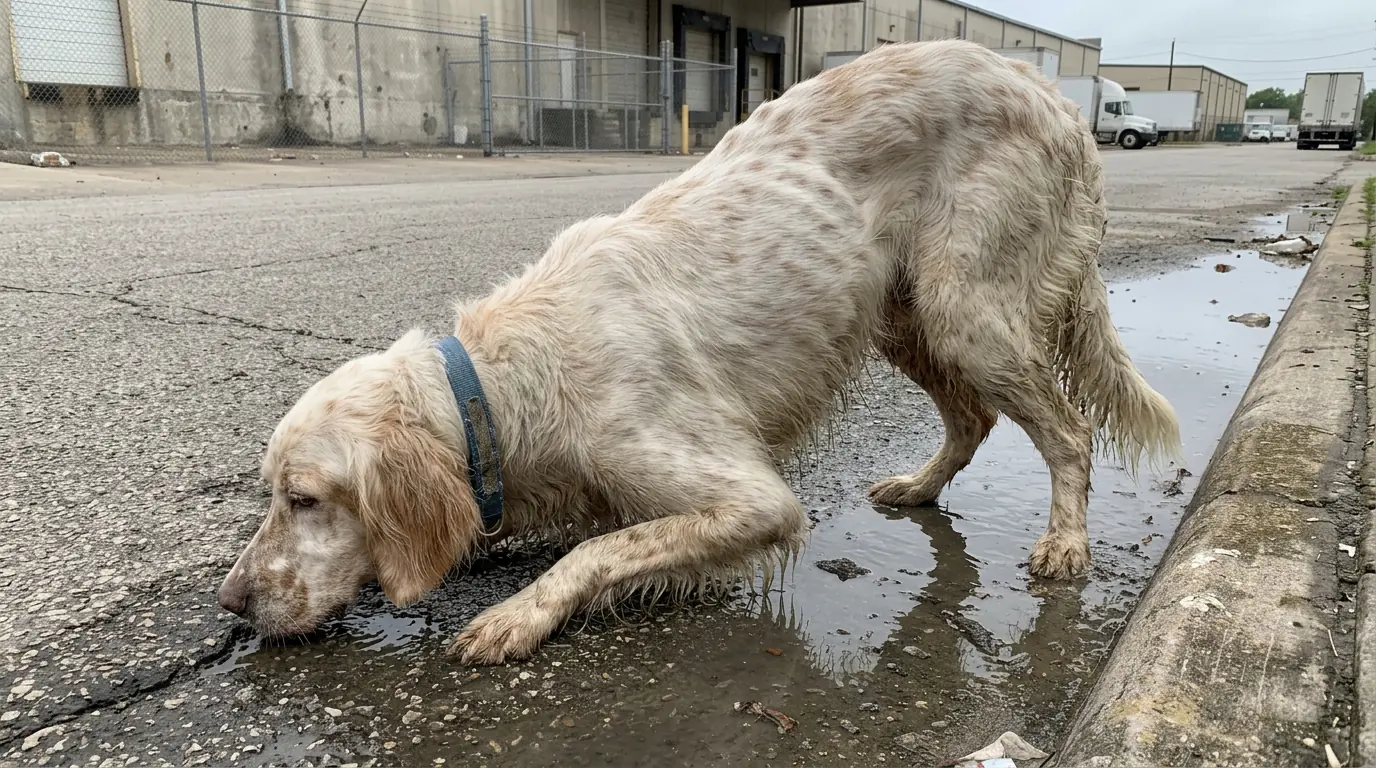
Every morning, Archie returns to the same place.
It is not a food bowl.
It is not a water station.
It is not a shaded porch where someone has been waiting for him.
The roughly six-year-old English Setter walks along the edge of a Houston industrial area until he reaches a shallow puddle beside the curb.
Rainwater has collected in a low section of pavement.
Dust and debris surround it.
Cars and work vehicles move through the area nearby.
But Archie stops there because, for now, it is one of the only places where he seems to know he can find water.
He lowers his head.
Then his front legs begin to bend.
Instead of remaining upright while he drinks, Archie sinks onto his elbows until his chest is almost against the pavement.
His face hovers just above the water.
Then he drinks.
For several minutes, he barely changes position.
When he finally lifts his head, water drips from the long hair around his muzzle.
Archie rests before trying to stand again.
The next morning, he comes back.
For people who began noticing his routine, the puddle quickly became more than an unusual place for a stray dog to drink.
It became a warning.
Because Archie was no longer simply thirsty enough to drink roadside water.
He looked too exhausted to stay standing while he did it.
Archie Had Been Appearing Along the Same Industrial Roads for Days
No one had a complete history for Archie.
Workers in the area had noticed a long-haired dog moving between buildings, lots, and stretches of roadside over several days.
Sometimes he appeared in the morning.
Sometimes someone caught sight of him later in the day.
He did not seem attached to any one business.
He simply kept moving through the industrial area.
His appearance suggested that life outside had already taken a toll.
Archie was underweight.
His once-elegant Setter coat had become tangled and matted.
Dirt clung to the long fur along his legs and underside.
And around his neck was an old collar.
The fur beneath and around it had been compressed so deeply that the collar seemed almost buried in the coat.
Whether Archie had recently belonged to someone, had been missing for a long time, or had some other history was unknown.
The collar proved only that at some point, someone had put it on him.
It could not explain what happened afterward.
The Puddle Was the Most Predictable Part of His Routine
Archie wandered during much of the day.
But the puddle kept bringing him back to the same curb.
That consistency was important.
Water is one of the most basic survival needs, yet reliable clean water can be surprisingly difficult for a stray animal to find in a developed industrial area.
There may be drainage ditches.
Temporary runoff.
Leaking fixtures.
Rain-filled containers.
But those sources can disappear.
A puddle that exists today may be dry tomorrow.
Archie had apparently discovered one that lasted long enough to become part of his routine.
So he remembered it.
And each morning, he returned.
The Water Wasn't Necessarily Safe Just Because It Was Available
Standing roadside water can contain contaminants.
Runoff may carry dirt, oils, chemicals, waste, microorganisms, or other material from surrounding surfaces.
Exactly what was in Archie's puddle could not be determined simply by looking at it.
That was the problem.
A thirsty stray dog does not evaluate water quality the way a person can.
The immediate need is thirst.
If the available option is questionable water or no water, the animal may drink.
Archie's repeated return suggested that availability mattered more than quality.
For a dog living outside, it may have been the only choice he knew he had.
Then People Noticed How He Drank
At first, seeing Archie at the puddle could almost look ordinary.