Staff First Thought She Was Trying to Steal His Dinner
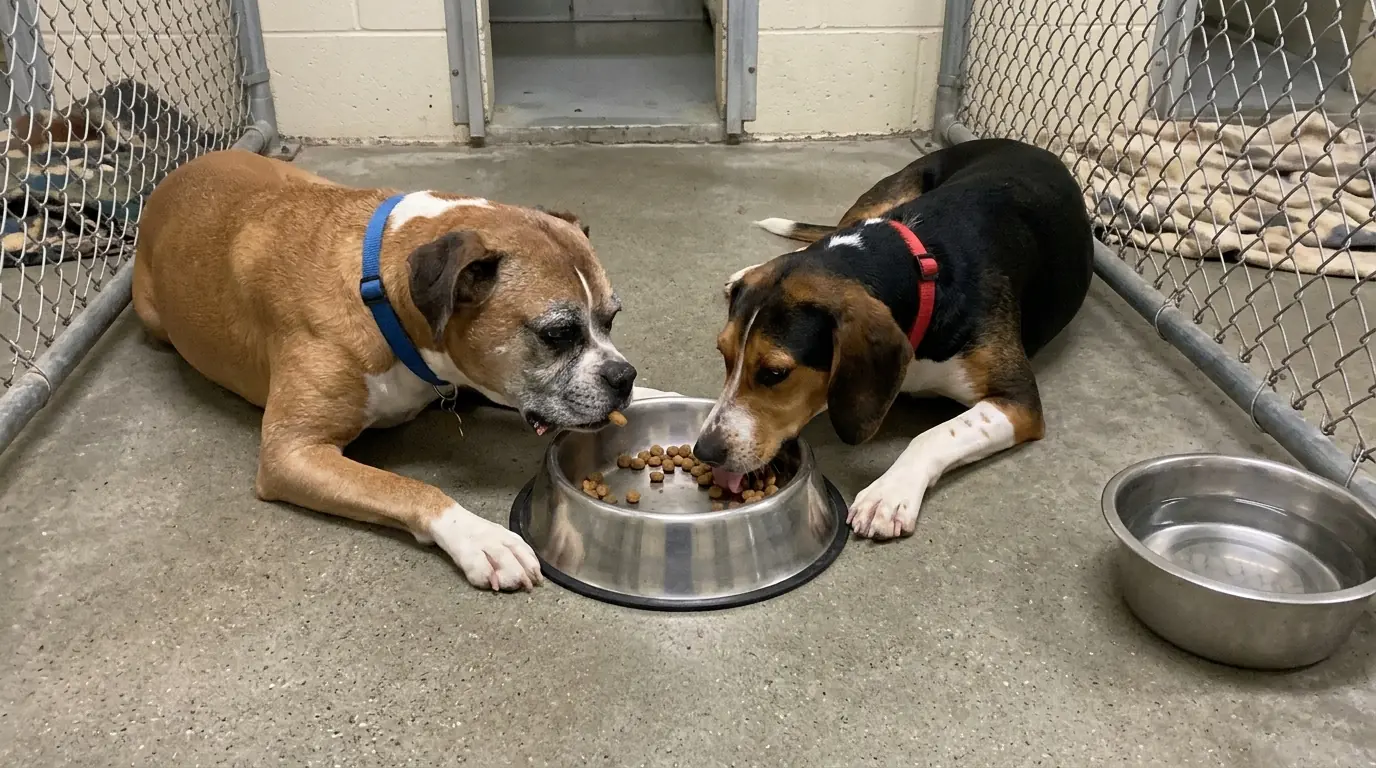
The Boxer mix had already been eating for several minutes when a staff member looked into the kennel and realized the second bowl was untouched.
The hound mix had been given her own meal several feet away.
She had sniffed it.
She had taken a few bites.
Then she walked away from it.
Instead of finishing her own food, she crossed the kennel, lowered herself onto the floor opposite the Boxer, and placed her head near the far side of his bowl.
The Boxer continued eating.
Slowly.
Painfully slowly.
He picked up several pieces of kibble.
One slipped from the side of his mouth.
Then another.
His jaw moved with visible effort.
The hound did not reach across him or push his face away.
She simply began eating from the opposite edge.
One piece at a time.
When the Boxer stopped chewing, she slowed too.
When he resumed, she did the same.
By the time the bowl was empty, her own dinner was still sitting several feet away.
Staff separated them at the next meal.
The hound ate normally.
The Boxer struggled through his food alone.
At the meal after that, they were given two bowls again.
And once again, the hound left hers.
She walked across the kennel.
She lay down opposite him.
And she began eating beside the dog who could no longer eat the way most dogs do.
They Had Entered the Shelter Together
The two mixed-breed dogs arrived through the same intake.
The Boxer mix was the larger of the pair, broad-chested but thinner than ideal, with an older injury that had left a visible asymmetry around his muzzle.
The hound mix was leaner and more mobile, with long ears, a narrow face, and the kind of constant environmental awareness common in scent-driven dogs.
Their exact history before entering the shelter was incomplete.
Staff could confirm that they had been living together.
They could not confirm how long.
They could not verify where the Boxer's original injury happened or exactly how it had been treated.
There was no responsible way to invent that part.
What staff could document was what they saw now.
The Boxer could open and close his mouth.
He could drink.
He could swallow.
But chewing took longer than it should have.
Food frequently slipped from one side.
His lower jaw seemed weaker on that side, and his tongue worked harder to move pieces back into position.
The hound, meanwhile, appeared physically healthier.
She ate normally when fed alone.
She did not have obvious difficulty chewing.
But from the beginning, she repeatedly oriented toward the Boxer during meals.
Staff did not immediately call them bonded.
They simply started taking notes.
His Eating Problem Was More Than Messiness
A dog dropping kibble can look almost harmless.
Some dogs are sloppy eaters.
Some gulp too quickly.
Some simply scatter food.
This did not look like that.
The Boxer was trying.
He would lower his head, pick up several pieces, and begin chewing.
Then his mouth would shift slightly.
A piece would fall.
Sometimes two or three.
He often paused before trying again.
His jaw movement was asymmetrical.
His chewing was slower on one side.
When staff gently examined his face, he tolerated touch but showed reduced muscle bulk along part of the jaw.
That made the veterinary evaluation important.
A previous facial injury can affect teeth, nerves, bone alignment, muscle function, or the temporomandibular joint.
The shelter team needed to determine what was painful, what was permanent, and what could be improved.
The Boxer underwent a careful oral and neurologic examination.
Because examining the mouth of a painful or anxious dog while fully awake can be both stressful and incomplete, sedation was used when appropriate so veterinarians could evaluate him safely.
His teeth were checked.
His jaw alignment was assessed.
The muscles responsible for chewing were compared from side to side.
His ability to close his mouth, move his tongue, swallow, and respond to facial sensation was evaluated.
Imaging was used to better understand the old injury.
There was no fresh fracture.
There was no unstable bone requiring emergency repair.
What they found was consistent with a healed previous injury that had left residual weakness and altered mechanics rather than an actively worsening orthopedic emergency.
The injury was old.
Its consequences were not.
He Could Eat, but Every Meal Took Work
The good news was that the Boxer could nourish himself.
He did not need a feeding tube.
He did not require hand-feeding every meal.
His swallowing remained functional.
But the way food was presented made a significant difference.
Dry kibble alone was difficult.
Pieces rolled away from his tongue.
Some slipped through the weaker side of his mouth.
The veterinary and animal-care teams began experimenting with texture.
Moistened food was easier to control.
Softening kibble reduced the amount that bounced away when it fell.
A wider, shallower bowl made it easier for him to reposition food without pressing his face into high sides.
Small meals reduced fatigue.
Staff also began watching his body weight closely.
Dogs with chronic oral weakness can slowly lose weight even when they appear to be eating because the physical work of finishing a meal becomes exhausting.
His intake had to be measured rather than guessed.
How much went into the bowl mattered.
How much actually reached his stomach mattered more.
The Hound's Behavior Complicated Feeding Plans
Initially, the obvious solution seemed simple.
Feed the dogs separately.
The Boxer needed time.
The hound ate faster.
Separate meals would prevent her from taking his food.
That is standard, sensible management.
So staff tried it.
The hound was placed in an adjacent area with her own bowl.
The Boxer remained in the kennel.
She finished quickly.
He did not.
Without her nearby, the Boxer still ate, but he stopped more often.
He picked up food.
Dropped some.
Looked toward the divider.
Returned to eating.
There was nothing dangerous about his behavior.
He was not refusing food.
But the contrast was noticeable.
During meals together, he often maintained a steadier rhythm.
That observation did not prove that the hound was emotionally helping him eat.
It did give staff a reason to observe the pair under controlled conditions rather than assuming all shared feeding was problematic.
She Did Not Eat Like a Typical Food Thief
Food sharing between dogs can become risky.
Even dogs that normally get along may guard resources.
A dog that crowds another animal's bowl can create stress.
A faster eater can consume too many calories while the slower dog gets too little.
The shelter did not want a touching visual to override basic safety.
So staff watched carefully.
The hound's body language was unusually restrained.
She did not stand over the bowl.
She did not shoulder the Boxer away.
She did not hover above his head.
She approached from the opposite side and often lowered her entire body to the floor.
That posture reduced her ability to push forward.
She took small bites.
If the Boxer moved his muzzle deeper into the bowl, she shifted back.
If he paused, she often paused too.
The Boxer, for his part, did not stiffen.
He did not guard.
He did not rush.
He continued eating.
The interaction was calm enough that staff began recording how often it happened.
It happened often.
The Same Pattern Repeated
At breakfast, two bowls went down.
The hound ate several bites from hers.
Then she moved to his.
At dinner, the same thing.
Sometimes she ignored her own bowl almost entirely.
Other times she ate half before joining him.
She nearly always approached the Boxer only after he had already started.
And she nearly always lowered herself opposite him.
The positioning became one of the strangest details of their intake.
Two dogs.
One bowl.
Facing each other.
The larger dog's jaw moving with visible effort.
The hound matching his pace from the other side.
It would have been easy to describe the behavior as sympathy.
Staff did not.
Dogs do not need human motives assigned to them in order for their behavior to matter.
What staff could say was that the hound repeatedly chose to eat near him despite having her own food available.
The Boxer tolerated and appeared comfortable with her presence.
And the interaction changed the pace of his meals.
That was enough to take seriously.
Staff Had to Make Sure He Was Getting Enough
The next challenge was nutritional accuracy.
Shared eating made it impossible to know exactly how much the Boxer consumed unless meals were carefully managed.
That mattered because he was already slightly underweight.
So staff changed the setup.
The Boxer received his measured portion in the shared bowl.
The hound received her own measured meal first.
She was allowed to eat most of it separately.
Only after her caloric needs had largely been met was she allowed to join him under supervision.
That prevented her from consuming too much of his food.
It also preserved the behavior both dogs appeared comfortable with.
Sometimes staff added a very small amount of her remaining food to the far side of his bowl.
That way, she could still lie opposite him without reducing his intake.
The goal was not to create a cute ritual.
The goal was to make sure both dogs were nourished safely.
His Jaw Weakness Required Adaptation, Not a Miracle
Over the next several weeks, the Boxer's eating improved somewhat.
Not because his old injury disappeared.
It did not.
Residual muscle weakness remained.
His muzzle stayed slightly asymmetrical.
Food still occasionally slipped from the weaker side.
The improvement came from changing the environment.
Softer food was easier.
Shallow bowls were easier.
Eating at a comfortable height helped reduce awkward head positioning.
Smaller, more frequent meals reduced fatigue.
Staff also paid attention to his dental health.
A dog already struggling with chewing cannot afford additional oral pain from untreated dental disease.
Any diseased teeth that were contributing to discomfort were addressed appropriately.
But staff were careful not to attribute every feeding problem to his teeth.
The old structural and muscular changes were still there.
The realistic goal was function.
Not perfection.
The Hound Had Her Own Evaluation
Because she appeared healthier, it would have been easy to treat the hound as simply the companion dog.
That would have been a mistake.
She received her own full examination.
She had mild age-related wear in several joints and some dental tartar, but no major condition explaining the feeding behavior.
Her appetite was normal.
Her swallowing was normal.
Her weight was appropriate.
She could finish a meal quickly when fed alone.
Behaviorally, she was more confident than the Boxer in new environments.
She explored first.
She approached unfamiliar rooms sooner.
She was more likely to follow a scent trail outside.
But she also returned to him repeatedly.
When staff took the Boxer for a medical recheck, the hound noticed his absence immediately.
She did not panic.
She could be redirected.
She accepted treats.
But she often positioned herself near the gate until he returned.
Likewise, the Boxer could function without her.
He could walk.
He could rest.
He could eat.
He simply seemed to do some things differently when she was present.
They Were Not Allowed to Share Everything
Staff were careful not to turn the pair's relationship into constant forced togetherness.
They had separate beds.
Separate water bowls.
Separate high-value chews.
They received individual walks.
They spent short periods apart.
The hound needed opportunities to move at her own pace instead of always matching an older dog who tired more easily during meals and quiet time.
The Boxer needed chances to build confidence without relying on her presence for every routine.
That balance mattered.
A strong social relationship is not the same as healthy dependence in every situation.
The dogs were allowed to choose proximity.
They were not required to share every resource.
The meal ritual remained the exception.
The Boxer's Weight Became a Better Measure Than the Mess
At first, everyone noticed the dropped food.
Later, staff focused more on what really mattered.
Was he maintaining weight?
Was his body condition improving?
Was he finishing a predictable percentage of each meal?
Was he staying hydrated?
Was chewing causing visible pain?
Was he coughing or gagging?
Was there any sign that food was entering the airway rather than being swallowed normally?
Fortunately, he did not show concerning signs of aspiration.
He did not repeatedly cough during meals.
He did not develop nasal discharge associated with eating.
His lungs remained clear on examination.
That allowed the team to continue oral feeding safely.
His weight began increasing gradually.
Not dramatically.
A small amount at a time.
That was exactly what they wanted.
The Hound Began Changing How She Ate Too
One of the more interesting observations came several weeks into care.
When eating alone, the hound still finished quickly.
When eating opposite the Boxer, she did not.
Her bites became smaller.
She chewed longer.
She sometimes lifted her head and waited.
Then she resumed when he did.
Again, no one could know whether she was intentionally matching him.
But the pattern was consistent enough to document.
There was also a practical effect.
Because she slowed down, the Boxer was not pressured by rapid movement across the bowl.
He could continue at his own pace.
The staff member supervising meals rarely had to intervene.
The dogs seemed to have established their own spatial rule.
His side.
Her side.
No pushing through the middle.
A Foster Home Tested Whether the Pattern Was Shelter-Specific
Eventually, both dogs moved into foster care.
The goal was to learn how they functioned in a quieter environment where feeding could be observed without kennel noise and interruptions.
The foster caregiver received detailed instructions.
The Boxer needed softened meals.
The hound needed her own portion.
Shared eating could be allowed only under supervision.
Weight and appetite had to be monitored.
The first meal in the foster home was uneventful.
Two bowls were placed several feet apart.
The hound ate from hers.
The Boxer started slowly.
Then the hound stopped.
She walked across the kitchen.
The foster caregiver expected her to stand beside him.
She did not.
She lowered herself onto the floor.
Opposite the bowl.
Exactly as she had in the shelter.
The Boxer continued chewing.
A piece of softened kibble fell from his mouth.
The hound ignored it until it landed on her side.
Then she ate it.
The pattern had followed them home.
The Quieter Environment Helped the Boxer
Outside the shelter, the Boxer ate with fewer interruptions.
There were no kennel doors slamming nearby.
No neighboring dogs barking during every meal.
No constant movement in the hallway.
He still ate slowly.
His jaw weakness was still visible.
But he seemed less likely to stop and scan the room.
His meals became more predictable.
He gained a little more weight.
He also began taking breaks when he needed them.
Sometimes he would stop halfway through, drink water, and return.
The foster caregiver learned not to rush him.
The hound learned the routine too.
She usually finished most of her own meal first.
Then she waited.
If the Boxer continued eating, she sometimes joined him.
If he walked away, she did not always follow.
That was important.
Their behavior was flexible.
It was not a rigid compulsion.
Staff Learned More About the Old Injury
Follow-up evaluation confirmed that the Boxer's jaw weakness was likely to be long-term.
The old injury had healed in a way that left altered muscle function.
There was no simple surgery that would return him to normal chewing.
Aggressive intervention was not justified given that he could swallow, maintain nutrition with adaptation, and live comfortably.
That answer was not dramatic.
It was useful.
His future home would need to understand that some meals would always take time.
He might always drop food.
He might always need softened textures.
His face might always move differently.
The correct outcome was not making him look normal.
The correct outcome was making sure he could eat without pain, exhaustion, or weight loss.
The Hound Did Not Need to Be His Nurse
The foster caregiver continued giving the hound independent experiences.
She went on longer sniffing walks.
She spent time in the yard without him.
She learned to settle in another room.
She received treats and enrichment separately.
Those opportunities mattered because the relationship worked best when it remained a choice.
She was not responsible for his medical care.
She did not need to attend every meal.
Some mornings she finished her own bowl and walked away.
The Boxer ate alone.
Nothing bad happened.
Other evenings, she followed the old routine.
Across from him.
Head low.
Eating slowly.
Both versions were healthy.
Their Relationship Became Clearer Over Time
By then, staff felt more comfortable describing the dogs as strongly attached.
The conclusion did not come from a single touching feeding video.
It came from weeks of repeated behavior.
They chose to sleep near each other.
They looked for one another after separation.
They could function independently.
They reunited calmly.
And at meals, the hound repeatedly abandoned a faster, easier way of eating in favor of joining the Boxer at his pace.
There was no evidence that she was frightened to eat without him.
There was no evidence that he refused food without her.
That distinction made their relationship more believable.
They preferred each other.
They did not cease to function as individuals.
Adoption Planning Had to Include the Meal Routine
A future home would need to understand both dogs separately.
The Boxer required a feeding plan.
His food texture mattered.
His portion had to be monitored.
His weight needed routine checks.
Any sudden decline in chewing ability, increased drooling, refusal to eat, coughing during meals, or new facial pain would justify veterinary reassessment.
The hound needed ordinary senior care and continued individual activity.
Because shared bowls can create resource conflict in some households, the adopter would need to maintain supervision rather than assuming the dogs would always remain conflict-free.
The safest routine was simple.
Feed both dogs separately first.
Let the hound finish most of her meal.
Then, if both dogs chose it and body language remained relaxed, allow the familiar shared finish.
That preserved both nutrition and choice.
The Boxer Slowly Became Less Fragile Around Food
Over time, meals stopped feeling like a medical event.
They were still slow.
But staff no longer hovered over every bite.
The Boxer learned the bowl.
He learned the texture.
He became more efficient at moving food toward the stronger side of his mouth.
His tongue compensated.
His posture improved.
He still dropped pieces.
That never completely stopped.
But he no longer seemed frustrated by every mistake.
If kibble fell, he often picked it back up.
If it rolled too far, the hound sometimes got it first.
He did not react.
Then both returned to eating.
The scene looked almost ordinary.
That was progress.
The Most Important Change Was Not Speed
People sometimes assumed recovery would mean the Boxer eventually eating as fast as the hound.
That was never the goal.
His old injury had changed how his jaw worked.
Speed was not a useful measure of success.
Comfort was.
Weight stability was.
Ability to finish meals was.
Willingness to eat was.
Good hydration was.
Normal stool was.
Maintaining muscle was.
Enjoying food without repeated signs of pain was.
By those measures, he was doing better.
The hound's presence was part of the routine.
Not the treatment.
Not a cure.
Just part of the environment in which he seemed comfortable eating.
They Still Have Two Bowls
Months after staff first noticed the behavior, the dogs still receive separate meals.
Nothing about their care changed that basic principle.
Each dog deserves an appropriate portion.
Each dog needs individual monitoring.
Each dog's health matters separately.
The hound still has her own bowl.
The Boxer still has his.
Most days, she starts at hers.
He starts at his.
Her meal disappears much faster.
His takes time.
Then, every so often, she stops with food still left.
She lifts her head.
She looks across the room.
And she walks toward him.
The Boxer does not hurry when she approaches.
He keeps chewing.
Slowly.
A piece slips from the weaker side of his mouth.
He works it back in.
The hound lowers herself to the floor on the opposite side.
She does not push.
She does not reach across him.
She takes one piece.
Then another.
The Boxer chews.
She waits.
He takes another bite.
She does too.
There are still two bowls in the room.
But sometimes, until the last piece is gone, only one of them matters.
And just as staff first saw in the shelter, they finish the meal facing each other from opposite sides.