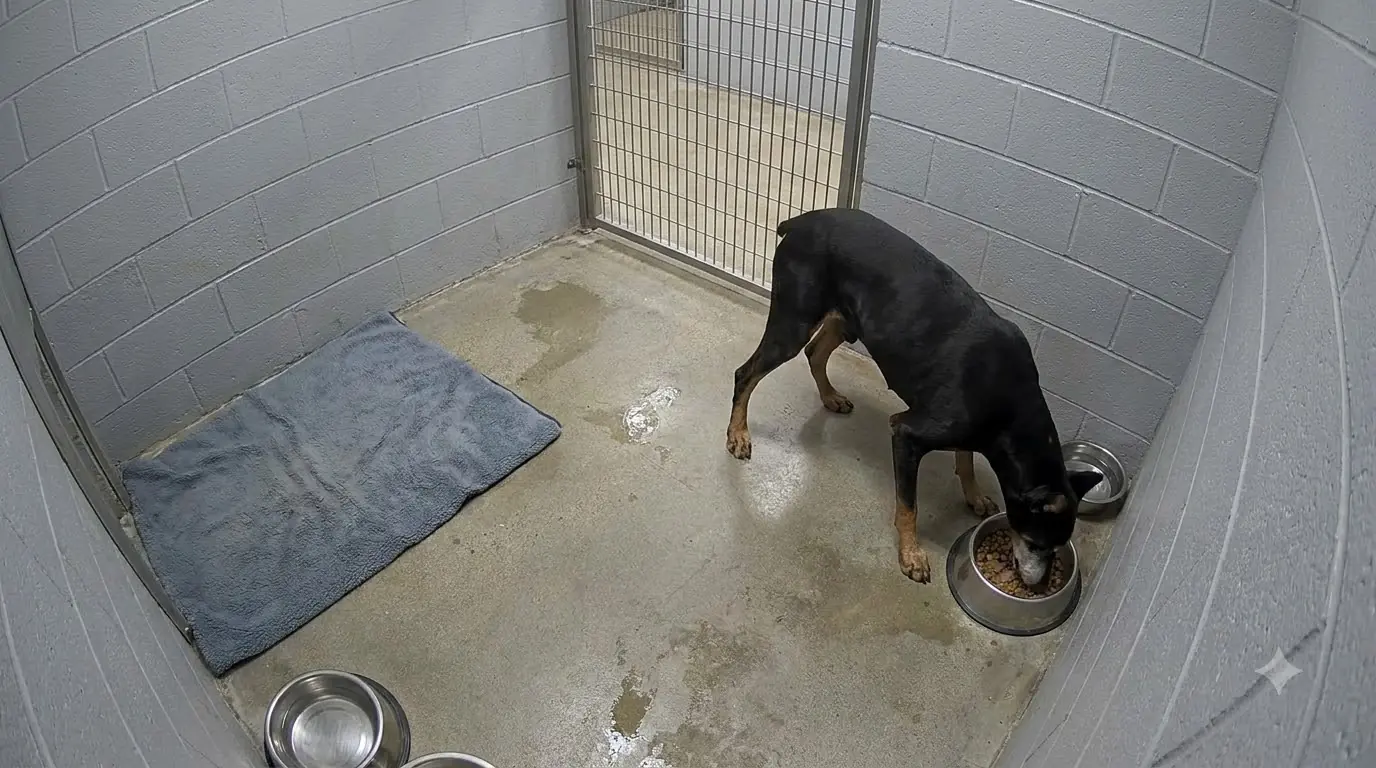
At first, he looks like he is going to eat normally.
The senior Doberman walks to the stainless-steel bowl on long, narrow legs and lowers his head toward the food.
His front feet stay planted.
His back is slightly rounded.
His shoulders tremble almost immediately, but he remains standing.
For the first several bites, nothing about the position looks especially unusual.
Then his elbows begin to soften.
His chest drops an inch.
He pauses.
Takes another bite.
His front legs bend farther.
The muscles around his shoulders start to shake.
He keeps eating.
A few seconds later, his chest touches the rim of the stainless-steel bowl.
That is where he stops lowering.
The bowl catches part of his weight.
His head stays elevated just enough to reach the food.
His front legs slide forward.
His abdomen settles onto the kennel floor.
Eventually, the entire Doberman is lying down.
But his chest remains draped over the edge of the bowl.
And he keeps eating from that position.
The first time shelter staff saw it, they thought he had simply decided lying down was more comfortable.
Then they watched the transition more carefully.
He was not casually choosing to lie down.
He was losing the strength to remain standing.
He Came In With Very Little Muscle Left
The Doberman had spent a prolonged period with very limited physical activity before entering shelter care.
Exactly why his movement had become so restricted could not be reconstructed in perfect detail.
Staff knew that he had not been receiving the kind of regular exercise and conditioning a large adult dog normally needs.
What they could see was the result.
His legs looked too narrow for his frame.
The muscles over his shoulders and thighs were reduced.
His hindquarters lacked the fullness expected in a healthy Doberman.
The long lines of his body made the muscle loss especially obvious.
He was not severely emaciated.
This was different.
His greatest physical problem was weakness.
A dog can have enough body fat and still lack the muscle needed for ordinary movement.
That was what staff were seeing.
Standing Was Possible — Just Not for Long
During intake, the Doberman could rise without complete assistance.
That was encouraging.
He could walk several steps.
He could turn.
He could go outside for a short bathroom break.
His feet placed appropriately.
There was no obvious paralysis.
But endurance disappeared remarkably fast.
After a short period standing, the front limbs began to tremble.
His shoulders dropped.
The hindquarters became less stable.
If staff did not give him a chance to rest, his posture deteriorated quickly.
That distinction helped guide the medical evaluation.
He could generate movement.
He could not sustain it.
The Veterinary Team Needed to Know Why
Severe weakness in a senior dog can come from many sources.
Pain.
Neurologic disease.
Muscle disease.
Cardiac or respiratory problems.
Systemic illness.
Electrolyte abnormalities.
Prolonged inactivity.
Age-related muscle loss.
Or several things at once.
The veterinary team did not assume that every weak senior dog simply needed more exercise.
They performed a full examination.
His gait was observed.
Muscle mass was assessed.
Joint movement was checked.
Spinal pain was evaluated.
Paw placement and basic neurologic responses were considered.
Heart and lungs were examined.
Bloodwork was appropriate to assess overall health and look for metabolic or systemic contributors.
The goal was to separate what staff could see from what medicine could actually confirm.
His Pattern Was Most Consistent With Severe Deconditioning
There was no single catastrophic injury explaining his movement.
No obvious acute fracture.
No sudden spinal event.
No immediate evidence that the front legs were neurologically disconnected from the body.
Instead, the picture fit profound muscle deconditioning and age-related loss of strength after prolonged inactivity, with the possibility of ordinary senior orthopedic changes contributing as well.
That was both good news and difficult news.
Good because there was not necessarily one irreversible event preventing movement.
Difficult because muscle rebuilds slowly.
There is no injection that restores months or years of lost conditioning overnight.
The Food Bowl Revealed His Limit Better Than a Walk Did
During a short walk, staff could control the pace.
They could turn around early.
They could use a support harness.
They could stop before obvious fatigue.
Mealtime was different.
The Doberman wanted to keep eating.
That motivation made him stay standing longer than his body could comfortably manage.
He would begin upright.
Then the front end started to sink.
The bowl became a support surface almost by accident.
Once his chest reached the rim, he seemed to discover that he could continue eating without holding the entire front of his body up.
So he stayed there.
Staff Initially Tried Raising the Bowl
A higher bowl seemed like an obvious solution.
If bending the neck was difficult, bring the food up.
They experimented carefully with height.
Too low required more downward reach.
Too high made the dog lift his head and shift balance backward.
That did not solve the central problem.
His neck was not the main issue.
Standing was.
Even with the bowl elevated, the Doberman's shoulders tired.
His elbows bent.
His body lowered.
Eventually, he leaned into whatever support was available.
Then They Tried Feeding Him Lying Down From the Beginning
That was much more successful.
Instead of asking him to stand until fatigue forced the position change, staff brought the meal to a supportive mat.
The Doberman was encouraged to settle first.
Then the bowl was placed at a height and angle that let him eat without excessive neck strain.
The difference was immediate.
No trembling front legs.
No slow collapse.
No chest pressing hard into a thin metal rim.
He could simply eat.
The behavior that had looked strange at first turned out to be an environmental problem with a practical solution.
He Still Tried to Stand for Meals
Habit and excitement were stronger than the new routine at first.
Food appeared.
The Doberman pushed himself upright.
Staff guided him toward the mat.
Sometimes he insisted on standing for the first few bites.
Then the trembling began.
Rather than waiting for him to sink, caregivers intervened early.
A hand at the chest.
A support harness if needed.
A cue toward the mat.
Let him lie down before the body reached failure.
That became the safer pattern.
The Bowl Rim Had Been Taking Too Much Pressure
A stainless-steel bowl is not designed to support the chest of a large dog.
The rim can concentrate pressure in a small area.
Repeated leaning could irritate skin or create discomfort over the sternum.
Staff began checking the fur and skin where his chest contacted the bowl.
No major injury had developed, but the pattern was not something they wanted to preserve.
The emotional image was strong.
The medical goal was to make it disappear.
His Meals Became Part of Rehabilitation
Not through complicated exercises.
Through posture.
A properly supported eating position reduced unnecessary fatigue.
That conserved energy for controlled physical therapy later.
It also prevented every meal from becoming a test of how long he could remain standing.
Food should help recovery.
It should not become another task that exhausts the patient.
Nutrition Still Mattered
The Doberman needed enough high-quality protein and overall calories to support muscle rebuilding.
But nutrition alone could not restore function.
Protein provides building material.
The body still needs appropriate activity to signal and rebuild muscle.
The veterinary team monitored body weight carefully.
There was no benefit in making a weak senior dog heavy.
Extra body weight would create more work for already deconditioned legs.
The goal was healthy lean condition while strength returned.
Rehabilitation Started Smaller Than Most People Expected
The first exercises did not look impressive.
A few seconds of supported standing.
Weight shifts.
Slow controlled transitions.
Very short walks on nonslip flooring.
Rest.
The goal was not distance.
It was quality.
Could he stand with his feet placed correctly?
Could he hold the position without rapidly shaking?
Could he shift weight safely?
Could he take several steps without his posture deteriorating?
If the answer became no, the session ended.
He Had Better Mornings
After a full night's rest, the Doberman often looked stronger.
He could stand longer.
Take smoother steps.
Sometimes he ate several bites upright before the shoulder tremor appeared.
That made it tempting to believe he was rapidly improving.
Staff resisted that interpretation.
By afternoon, fatigue usually told a different story.
His endurance remained poor.
A good morning was useful.
It was not a cure.
His Front Legs Were Not the Only Concern
The mealtime behavior made the shoulders easiest to notice.
The hindquarters were weak too.
When standing, he sometimes shifted forward because the rear legs were not contributing enough support.
That increased the load through the front.
So rehabilitation could not focus only on shoulder strength.
The whole body needed rebuilding.
Hips.
Thighs.
Core.
Postural muscles.
Balance.
The Long Doberman Frame Made Weakness More Visible
Dobermans are naturally athletic, deep-chested dogs.
When strong, their bodies look efficient and balanced.
This senior dog still had the recognizable outline.
Long legs.
Deep chest.
Narrow waist.
But the muscular support underneath that structure was missing.
The contrast made even small tremors obvious.
His body looked like it remembered how to stand longer than his muscles could deliver.
Staff Avoided Exhaustion Training
More is not always better.
A severely deconditioned senior dog can be pushed into soreness, fatigue, and setbacks if exercise increases too quickly.
So sessions ended while he still had something left.
That was sometimes difficult for volunteers to understand.
“He looks like he could do more.”
Maybe.
The goal was not to discover the exact point of failure.
The goal was to avoid reaching it.
The Food Bowl Became a Daily Measure
Not an official diagnostic test.
A useful observation.
How long before the front legs trembled today?
Did he choose to lie down immediately?
Could he maintain a comfortable sternal position while eating?
Did his head remain steady?
Was swallowing normal?
Did fatigue appear sooner after rehabilitation?
Those patterns helped staff understand how the rest of his day had affected him.
He Never Lost Interest in Food
That helped.
His appetite stayed reliable.
A dog willing to eat gives caregivers options.
Meals could support nutrition.
Small portions could be used during low-intensity rehabilitation.
Food could reward calm positioning.
The Doberman did not need to be coaxed through every bite.
The problem was never willingness.
It was posture.
He Began Learning That Lying Down Was Allowed
That sounds simple.
Some dogs strongly associate meals with standing at a bowl.
The Doberman repeatedly tried to return to that posture.
Staff did not correct him harshly.
They simply made the alternative easier.
Mat.
Bowl placed correctly.
Food accessible.
No pressure.
Over time, he began settling before the meal arrived.
That was a major improvement.
He no longer had to experience muscular failure before choosing rest.
His Chest Stopped Landing on the Bowl
Not all at once.
Some meals still began standing.
Sometimes fatigue came faster than expected.
The chest would lower.
Staff repositioned him.
But the frequency decreased.
Eventually, the stainless-steel rim stopped functioning as a makeshift support.
That was a success.
Even though it made the story less visually dramatic.
He Started Using a Wider, Stable Feeding Setup
A bowl that slid was dangerous.
When his chest or muzzle pushed against it, a moving dish could destabilize him.
So the feeding station was made secure.
Nonslip base.
Appropriate height.
Enough clearance around the front legs.
Nothing that could tip suddenly.
Simple environmental engineering can prevent falls in weak dogs.
That mattered more than fancy equipment.
Standing Practice Happened Away From Meals
This was important.
Food time became recovery time.
Physical therapy became controlled work.
The two were separated.
When he practiced standing, staff could focus on posture and fatigue without the Doberman trying to keep eating through discomfort.
When he ate, he could focus on eating.
The body did not have to perform two tasks at once.
His First Noticeable Improvement Was Ten Extra Seconds
That was all.
During a supported stand, he held posture longer before the shoulders trembled.
Ten seconds.
To most people, nothing.
To the rehabilitation team, useful progress.
The next week, his transitions looked smoother.
Then his walking distance increased slightly.
Small improvements accumulated.
He Still Had Weak Days
One morning, he stood worse than he had the previous week.
The front legs trembled early.
His body dropped toward the mat.
Staff did not immediately assume the rehabilitation had failed.
They checked the whole dog.
Was he sore?
Had the previous day been more active?
Was appetite normal?
Temperature?
Pain?
Any new neurologic sign?
Recovery trends matter more than one performance.
After rest and adjustment, he returned to baseline.
Rest Days Became Part of the Program
Muscle rebuilding requires recovery.
Especially in a senior dog.
A day after more active rehabilitation might include only short bathroom walks and gentle positioning work.
No guilt.
No attempt to “keep momentum.”
The body repairs during rest too.
That principle helped prevent boom-and-bust cycles.
The Doberman Began Standing Voluntarily for Other Reasons
At first, food was the strongest motivation.
Later, staff saw him stand to watch someone enter.
Then to move toward a sunny spot.
Then to follow a familiar caregiver several feet.
Those choices suggested that standing was becoming less expensive.
The important thing was not that he was doing more because people asked.
He was doing more because he had enough capacity to choose it.
He Started Reaching His Bed Without Looking Exhausted
That was another practical milestone.
Earlier, after a short walk, he would return and lower himself quickly.
Later, he could walk in.
Turn.
Position himself.
Then lie down with more control.
That kind of movement requires coordination and strength through the whole body.
It told staff more than a longer straight-line walk.
His Lying-Down Transition Improved Too
The Doberman had never had the same severe lowering pain as an arthritic dog might, but weakness made descents clumsy.
Early on, the front end sometimes dropped faster than the rear.
Later, he bent the elbows.
Lowered the chest.
Brought the hips down.
Controlled.
That smoother sequence reduced impact and gave him more confidence.
The Bowl Behavior Briefly Returned After a Busy Day
He had completed a slightly longer rehabilitation session that morning.
At dinner, he insisted on standing.
Several bites in, the shoulders began trembling.
His chest descended.
The rim touched him.
Staff immediately helped him settle.
That episode reminded everyone that improved strength did not mean unlimited endurance.
The old behavior remained a warning sign.
The Plan Was Adjusted
The next day's rehabilitation was lighter.
Meals were given entirely lying down.
His response improved.
Good care is flexible.
A rehabilitation schedule should follow the dog, not force the dog to follow a calendar.
Foster Care Became the Next Step
The shelter environment was workable.
A home could offer more.
Longer quiet periods.
Better control of flooring.
Beds in multiple rooms.
A predictable routine.
More opportunities for tiny natural movements throughout the day rather than one larger exercise session.
A foster with senior-dog experience stepped forward.
The Foster Home Was Prepared for Weakness
Rugs covered slick floors.
The food station sat beside a supportive mat.
No unnecessary stairs.
A rear-support harness was available.
A low bed allowed easy access.
The distance to the yard was short.
Furniture was arranged so he did not have to squeeze through narrow spaces or make tight turns.
These details mattered.
His First Foster Meal Looked Familiar
The Doberman saw food.
Stood.
Walked to the bowl.
Started eating.
The foster had been warned.
They watched the shoulders.
Within less than a minute, the tremor appeared.
Before his chest reached the rim, the caregiver guided him onto the mat.
He settled.
Finished lying down.
No struggle.
The foster understood immediately why the shelter had emphasized the behavior.
By the End of the First Week, He Walked to the Mat Before Meals
That was a major behavioral change.
Food appeared.
The Doberman approached.
Instead of stopping over the bowl, he turned toward the mat.
Lowered himself.
Waited.
Then ate.
The body no longer had to fail before he accepted support.
That reduced fatigue substantially.
Household Movement Became Rehabilitation
Walking from the bed to the water bowl.
Several controlled steps toward the yard.
Standing while a harness was clipped.
Turning to follow the foster.
These were ordinary actions.
Together, they rebuilt function.
The foster did not need to turn the house into a gym.
Daily life, appropriately managed, provided repetition.
His Endurance Grew Slowly
A little more standing.
A little farther walking.
Fewer tremors.
More controlled turns.
The changes were visible across weeks, not days.
That was exactly what the rescue expected from severe deconditioning.
No miracle.
Muscle rebuilding.
The Foster Kept Him Lean
His appetite could easily have led to overfeeding.
People often want to “build a dog back up” with extra food.
But more weight would have increased the amount of work required from every weak muscle.
The feeding plan supported recovery without creating a second mobility problem.
Body condition was reviewed regularly.
Protein Was Important, but Not Magical
The diet provided adequate high-quality protein appropriate to his medical needs.
That supported muscle maintenance and rebuilding.
But staff remained clear.
Protein does not replace rehabilitation.
A dog cannot eat his way back to functional muscle while remaining inactive.
Nutrition and movement had to work together.
He Began Standing Through Entire Short Meals
Eventually, on stronger days, the Doberman could eat a small meal standing without sinking.
That looked like the obvious milestone.
Staff did not immediately change every meal back.
The lying-down feeding option remained available.
Why make him work when he did not need to?
The goal was not to prove he could stand over a bowl.
It was to give him enough strength for meaningful life.
Some Meals Stayed on the Floor by Choice
The Doberman seemed to enjoy eating from the resting position.
There was no reason to train that away.
If the posture was safe for swallowing and comfortable for his body, it was acceptable.
Recovery restored options.
It did not have to restore every old habit.
He Began Showing More Interest in the Yard
The foster noticed him standing at the doorway.
Not collapsing.
Not immediately looking for a place to lie.
Just looking outside.
A short sniffing session followed.
Then another.
The Doberman could spend several minutes investigating scents without rapid muscular failure.
That was a much more meaningful outcome than eating upright.
His Front Legs Started Looking Different
Muscle definition returned gradually around the shoulders.
Not dramatic.
Not bodybuilder-like.
Enough that the limbs no longer looked as narrow beneath the chest.
His posture improved too.
He stood less heavily on locked joints.
The body could support itself through muscle rather than relying as much on rigid positioning.
The Hindquarters Took Longer
That was expected.
Senior dogs often lose substantial muscle through the rear.
The thighs remained narrow longer.
Controlled walking and weight shifting helped.
No high-impact work.
No jumping.
No forced stairs.
Strength came slowly.
He Had to Learn Confidence Again
Physical weakness can change behavior.
A dog that has slipped or collapsed may become cautious about certain surfaces.
The Doberman hesitated at smooth flooring even after rugs were added nearby.
The foster did not drag him.
They created clear traction pathways.
He learned where his feet could grip.
Confidence followed repeated success.
His Medical Rechecks Stayed Important
The rescue did not assume every improvement confirmed the original assessment forever.
Senior dogs change.
If weakness suddenly worsened, the veterinary team would need to reassess.
If one limb became asymmetrical.
If neurologic signs appeared.
If breathing changed.
If exercise tolerance suddenly dropped.
Deconditioning was the major problem.
It did not make him immune to other senior issues.
His Bowl Became Ordinary
That happened gradually.
The stainless-steel dish stopped being a piece of mobility equipment.
It went back to being what it was supposed to be.
A container for food.
He could eat lying down.
Standing.
Or transition between the two without collapsing onto the rim.
The strange behavior that had made staff worry became less common.
One Afternoon, the Foster Sent a Video
The Doberman walked into the kitchen.
Saw the bowl.
Stopped.
Looked toward the mat.
Then remained standing.
He ate several bites.
Paused.
Shifted his feet.
Continued.
The foster was ready to intervene.
They did not need to.
He finished.
Lifted his head.
Walked away.
The bowl remained behind.
No chest on the rim.
No body on the floor.
It looked completely ordinary.
That was why the shelter watched the video twice.
Ordinary Movements Had Become the Milestones
Stand.
Eat.
Turn.
Walk away.
For a healthy dog, nothing.
For him, those actions showed that months of deconditioning no longer controlled every task.
That was the kind of rehabilitation staff wanted.
He Still Lies Down to Eat Sometimes
That needs to stay part of the story.
Especially after activity.
Or late in the day.
If the shoulders begin to tire, the foster does not wait for failure.
The meal moves to the mat.
The Doberman settles.
Eats comfortably.
No shame.
No insistence that recovery means doing everything upright.
His Body Still Has Limits
He is senior.
Muscle takes longer to maintain at his age.
If activity decreases dramatically again, he could lose conditioning.
The foster understands that.
His routine includes regular low-impact movement.
Not intense exercise.
Consistency.
That is the long-term plan.
The Shelter Never Wanted Him to Keep Using the Bowl That Way
The image was memorable.
A tall senior Doberman standing over food.
Shoulders shaking.
Chest gradually sinking.
Metal rim catching his weight.
Whole dog eventually lying on the floor while his head stayed elevated by the bowl.
It explained the weakness instantly.
But it was a symptom.
Not a charming habit.
That Is Why They Changed It
Supportive feeding position.
Rehabilitation.
Nutrition.
Traction.
Rest.
Medical monitoring.
The goal was not to make the story more dramatic.
It was to make the image stop happening.
The Foster Learned the Same Lesson
If the chest begins dropping, help before it lands.
If standing becomes shaky, allow rest.
If one day is weaker, adjust.
The dog does not have to reach failure to deserve support.
That principle now guides everything.
Recently, He Ate Breakfast Standing
The bowl was in its stable nonslip base.
The Doberman walked over.
All four legs positioned normally.
He lowered his head.
Ate.
Halfway through, his front legs shifted.
The foster watched.
No tremor.
He continued.
Finished.
Raised his head.
Then did something staff once could not imagine him having enough energy to do after a meal.
He walked to the living room.
He Did Not Go Straight to Bed
He stopped near a window.
Looked outside.
Stayed standing for several more seconds.
Only then did he walk to the bed and lie down.
The physical reserve that once ended halfway through eating now lasted beyond the meal.
That was the real change.
His Chest Still Bears the Memory in a Small Way
The fur where it repeatedly rested against the bowl once looked slightly flattened after meals.
That no longer happens.
There is no scar.
No dramatic injury.
Just a behavior everyone remembers.
That is enough.
He Has Not Become a Young Doberman Again
He never will.
His gait is slower.
He rests more.
He needs ongoing conditioning.
He may always lose muscle more quickly than a younger dog if his routine changes.
That is the reality of senior care.
The goal is maintenance and quality of life.
Not reversal of age.
The Ending Is Not That He Can Stand Forever
It is that he no longer has to.
He can eat on a mat when tired.
Stand when stronger.
Walk when interested.
Rest before collapse.
The environment now responds to his body instead of waiting for his body to fail.
Staff Still Remember the First Meals
He would begin upright because that was what he knew.
Then the tremor.
The slow lowering.
Chest on stainless steel.
Head held just high enough to reach food.
Body flat underneath.
He kept eating because the appetite was there even after the strength was gone.
That was the detail that made his condition impossible to miss.
Now the Bowl No Longer Holds Him Up
Sometimes he stands beside it.
Sometimes he lies near it.
Sometimes staff or the foster place it directly in front of him while he rests.
All three are acceptable.
What no longer happens routinely is the slow collapse until a thin metal rim becomes the only thing keeping his head above the floor.
That Is What Recovery Looks Like for Him
Not running.
Not jumping.
Not becoming muscular overnight.
A senior Doberman with enough strength to choose his posture.
Enough endurance to finish a meal without his legs giving out.
Enough confidence to walk away afterward.
And enough support around him that on the days when his body is tired, nobody waits for his chest to sink onto the food bowl before giving him permission to lie down.