What initially looked like a single sick Bald Eagle near a landfill in western Wisconsin quickly became something much more serious.
Wildlife officers responding to a report of one grounded eagle soon began receiving information about additional birds in the same general area. Several were lethargic, unable to fly, and unusually easy to approach. Some could barely remain upright. Others sat low to the ground with their eyes closed for long periods, showing little of the defensive behavior expected from healthy wild Bald Eagles.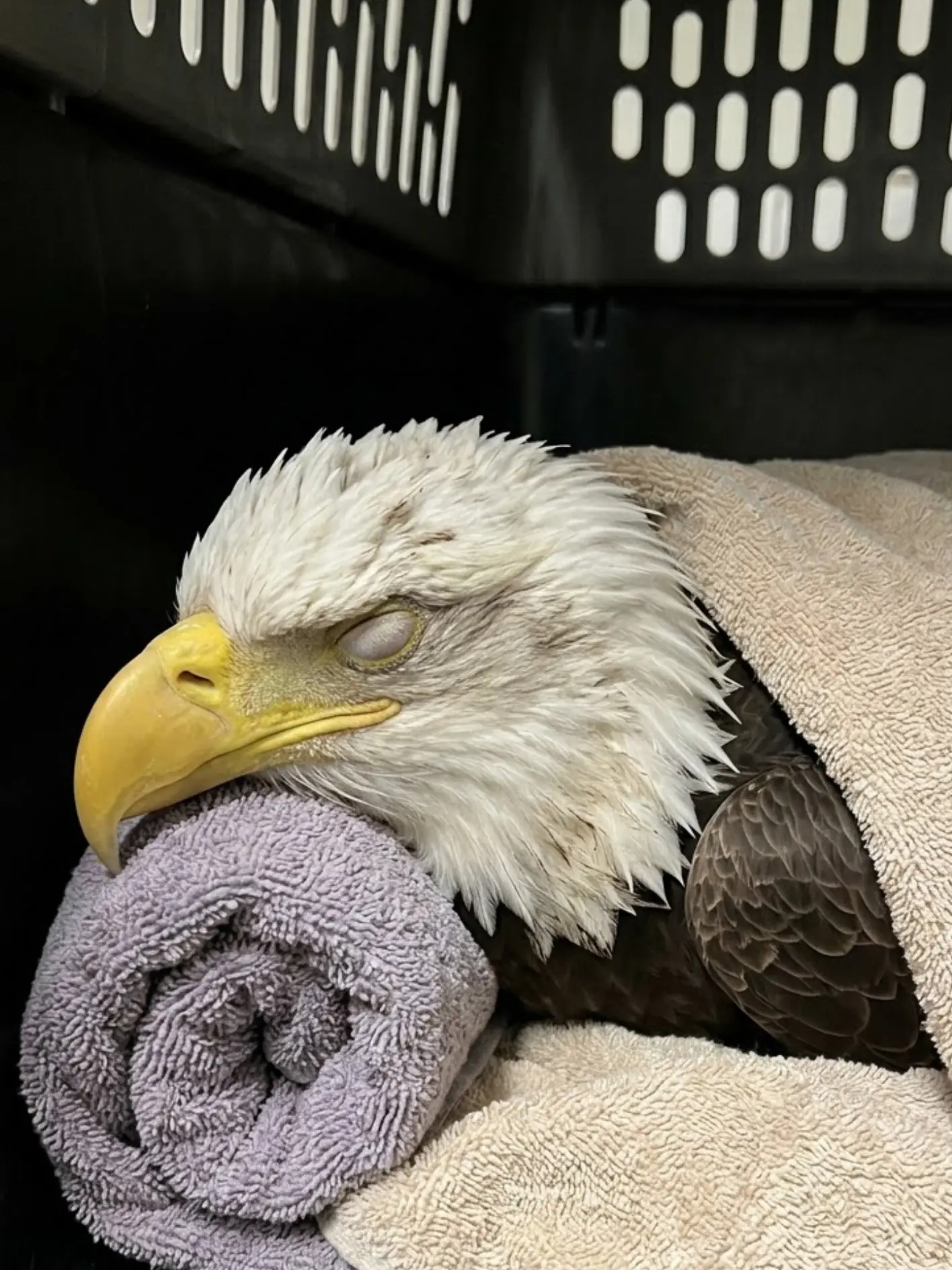
By the time the full scope of the incident became clear, at least 10 Bald Eagles were believed to have been affected.
One of them has died.
The surviving birds were transported for emergency veterinary care while state wildlife officials and environmental investigators began examining a possible common source of exposure.
Among the leading concerns is that animal carcasses that had been chemically euthanized may have been discarded or managed in a way that allowed scavenging wildlife to reach them.
If that suspicion is confirmed, the eagles may have ingested residues of a euthanasia drug still present in the tissues of those animals.
For wildlife veterinarians, that possibility immediately raises concern for compounds such as pentobarbital, a powerful barbiturate commonly used in veterinary euthanasia. The drug can remain biologically active in animal tissues after death. If a carcass is left where scavengers can access it, the chemical intended to humanely euthanize one animal can potentially poison another.
“The concern is not simply that these eagles found something unusual to eat,” one wildlife veterinarian involved in the response said. “Bald Eagles are natural scavengers. The concern is that they may have encountered animal remains that contained a drug capable of profoundly depressing the nervous system.”
Toxicology testing is required before investigators can confirm the exact substance involved.
But with multiple eagles found in the same region displaying similar signs, staff no longer view the situation as an isolated medical emergency.
They are treating it as a possible cluster exposure.
The First Eagle Looked Almost Asleep
One of the adult Bald Eagles involved in the incident arrived for transport wrapped in towels inside a dark carrier.
Its eyes were closed.
Its head rested heavily against the padding.
It made little effort to reposition itself.
At first glance, the bird might have looked as if it were simply sleeping.
That is not how wildlife staff interpreted the scene.
A healthy adult Bald Eagle should be extremely alert during capture and transport. Even an injured eagle may attempt to strike with its feet, spread its wings, or resist restraint.
A bird that remains profoundly subdued can be showing serious neurological depression.
Images taken during the response show one adult eagle resting low in a padded carrier, with the body supported by towels and the head positioned carefully to reduce stress during transport.
The photograph does not reveal the cause of the illness.
But it illustrates the degree of weakness rescuers were dealing with.
Then More Eagles Were Found
The first grounded eagle might have been explained by trauma, disease, or an individual toxic exposure.
The second made the situation more concerning.
Then additional eagles were reported.
When multiple Bald Eagles from the same area begin displaying similar clinical signs within a short period, wildlife professionals immediately consider the possibility of a shared environmental source.
That source could include:
- contaminated food,
- a toxic chemical,
- disease,
- or another hazard affecting multiple animals using the same location.
In this case, many of the birds showed signs consistent with central nervous system depression rather than traumatic injury alone.
They were weak.
Some could not fly.
Several appeared profoundly sedated.
Their normal escape responses were reduced.
That pattern pushed toxic exposure higher on the list of possibilities.
One Eagle Has Already Died
One of the affected eagles did not survive.
Its body can provide investigators with information that may be critical to understanding what happened to the entire group.
A necropsy can help determine whether the bird had:
- traumatic injuries,
- underlying disease,
- internal abnormalities,
- aspiration,
- organ damage,
- or evidence consistent with toxic exposure.
Tissue samples can also be submitted for toxicology.
Depending on the investigation, samples may include:
- liver,
- kidney,
- stomach contents,
- blood,
- or other tissues.
If a euthanasia drug is detected in the deceased bird, the finding could strengthen the connection between the clinical signs and improperly accessible animal remains.
However, investigators still need to determine whether all affected eagles were exposed through the same source.
That distinction matters.
Ten sick birds in one area suggest a cluster.
They do not automatically prove that every eagle ate the same carcass or consumed the same amount of toxin.
Why Bald Eagles Visit Landfills and Disposal Sites
Bald Eagles are highly efficient opportunistic feeders.
They hunt.
They steal food from other birds.
They catch fish.
And they scavenge.
Carrion is a normal part of their diet.
During winter in particular, an animal carcass can provide a large amount of energy without requiring the eagle to spend calories hunting live prey.
Landfills, transfer sites, carcass disposal locations, and other human-managed areas can sometimes provide concentrated food opportunities.
To an eagle, the difference between a naturally dead animal and a chemically euthanized animal may be invisible.
Both are simply meat.
That is what makes improper disposal of euthanized carcasses potentially dangerous.
Euthanasia Drugs Do Not Disappear When an Animal Dies
Pentobarbital and related barbiturates are used because they strongly depress the central nervous system.
At sufficient doses, they cause unconsciousness and ultimately stop vital functions.
But after the euthanized animal dies, the drug does not immediately vanish from the body.
Residues may remain in tissues.
A scavenger eating those tissues can then ingest the medication secondarily.
This phenomenon has been documented as a hazard to scavenging animals.
The effect on a Bald Eagle depends on how much drug is consumed and how rapidly the bird receives help.
A smaller exposure may cause:
- unusual sedation,
- loss of coordination,
- weakness,
- or inability to fly.
A larger exposure may cause:
- profound neurological depression,
- inability to stand,
- reduced swallowing reflexes,
- respiratory depression,
- unconsciousness,
- and death.
The wildlife team investigating the Wisconsin cluster has not yet publicly confirmed a specific toxicant in every bird.
For now, the signs are considered compatible with exposure to a potent sedative or euthanasia agent, and laboratory testing is necessary to determine exactly what happened.
These Birds Were Not Simply Tired
A lethargic eagle may superficially resemble an exhausted bird.
The difference becomes clearer during examination.
A tired eagle still normally retains coordinated movement and strong defensive responses.
A neurologically depressed eagle may behave very differently.
It may:
- fail to stand,
- keep its eyes closed,
- respond slowly to touch,
- hold its head low,
- lose normal balance,
- or show minimal resistance during handling.
“These birds were not simply exhausted,” a rehabilitation staff member said. “Several were so neurologically depressed that they could barely maintain normal posture. One did not survive.”
That clinical pattern is one reason the incident quickly drew concern beyond routine wildlife rehabilitation.
Transporting a Sedated Eagle Requires Extra Care
Even when a Bald Eagle appears barely responsive, rescuers must still handle the bird carefully.
Talons remain capable of causing serious injury.
At the same time, staff must avoid unnecessary stimulation.
The birds were transported in secure carriers with padded interiors.
Towels helped support the body and prevent injuries if a bird lost balance.
Low light reduced visual stimulation.
The goal was to get the animals to professional care without forcing them to use energy they did not have.
Stabilization Comes Before Diagnosis
At the rehabilitation hospital, the first priority was keeping the surviving eagles alive and physiologically stable.
Veterinary staff monitored:
- breathing,
- heart rate,
- body temperature,
- hydration,
- neurological responsiveness,
- pupil reactions,
- and ability to stand.
Fluids could be administered when needed.
Supplemental oxygen could be provided to birds with compromised breathing.
Body temperature could be supported if an eagle was becoming hypothermic.
Because severely sedated birds may swallow poorly, staff had to be cautious about giving food or fluids by mouth.
A bird with an impaired swallowing reflex can aspirate material into the respiratory tract.
That can create a second, potentially life-threatening problem.
There May Be No Immediate Antidote
If pentobarbital or another barbiturate is involved, treatment generally centers on supportive care while the bird metabolizes and eliminates the drug.
That can mean hours of close observation.
In severe cases, much longer.
The veterinary team’s role is to keep vital functions stable during that period.
That may include:
- oxygen support,
- fluid therapy,
- thermal support,
- careful positioning,
- respiratory monitoring,
- and prevention of secondary complications.
The bird’s own metabolism ultimately has to clear the drug.
That is why the amount ingested matters so much.
Different Eagles Can Look Very Different After the Same Exposure
Even if several eagles fed from the same contaminated source, they may not all show identical signs.
One bird may have eaten a small amount.
Another may have consumed much more.
A larger eagle may tolerate a dose differently from a smaller bird.
The timing between exposure and rescue also matters.
One bird may be found soon after becoming weak.
Another may remain on the ground for hours before anyone notices.
That can explain why one eagle might begin recovering while another deteriorates.
Early Improvement Can Be Subtle
For a profoundly sedated eagle, the first signs of recovery are rarely dramatic.
The bird may begin holding its head up.
Then it may keep its eyes open for longer periods.
The feet may start gripping.
The eagle may reposition itself without assistance.
Later, it may begin standing.
Only after swallowing is clearly normal would regular feeding become safe.
These small changes are closely documented because they show whether neurological function is returning as the suspected toxin leaves the body.
The Dead Eagle May Help Explain the Surviving Birds
The bird that died is especially important to the investigation.
Living birds can provide blood samples, but a deceased eagle allows more extensive testing.
Veterinarians can examine the gastrointestinal tract.
They can look for food remains.
They can assess organs.
They can collect tissues for toxicology.
If the suspected compound is detected at significant concentrations, investigators may be able to compare those findings with samples from surviving birds and from any discarded carcasses recovered from the area.
That could help establish whether a single disposal event caused the cluster.
Investigators Are Looking at How Animal Remains Were Disposed Of
The medical treatment is only one part of the response.
The larger question is environmental:
How did multiple federally protected Bald Eagles become exposed in the same place?
Investigators are examining whether animal carcasses had been disposed of in a manner that allowed scavengers to access them.
That may involve questions such as: