An adult Bald Eagle found grounded near the Mississippi River in western Wisconsin is undergoing treatment after rescuers discovered that the bird was unable to bear normal weight on one foot.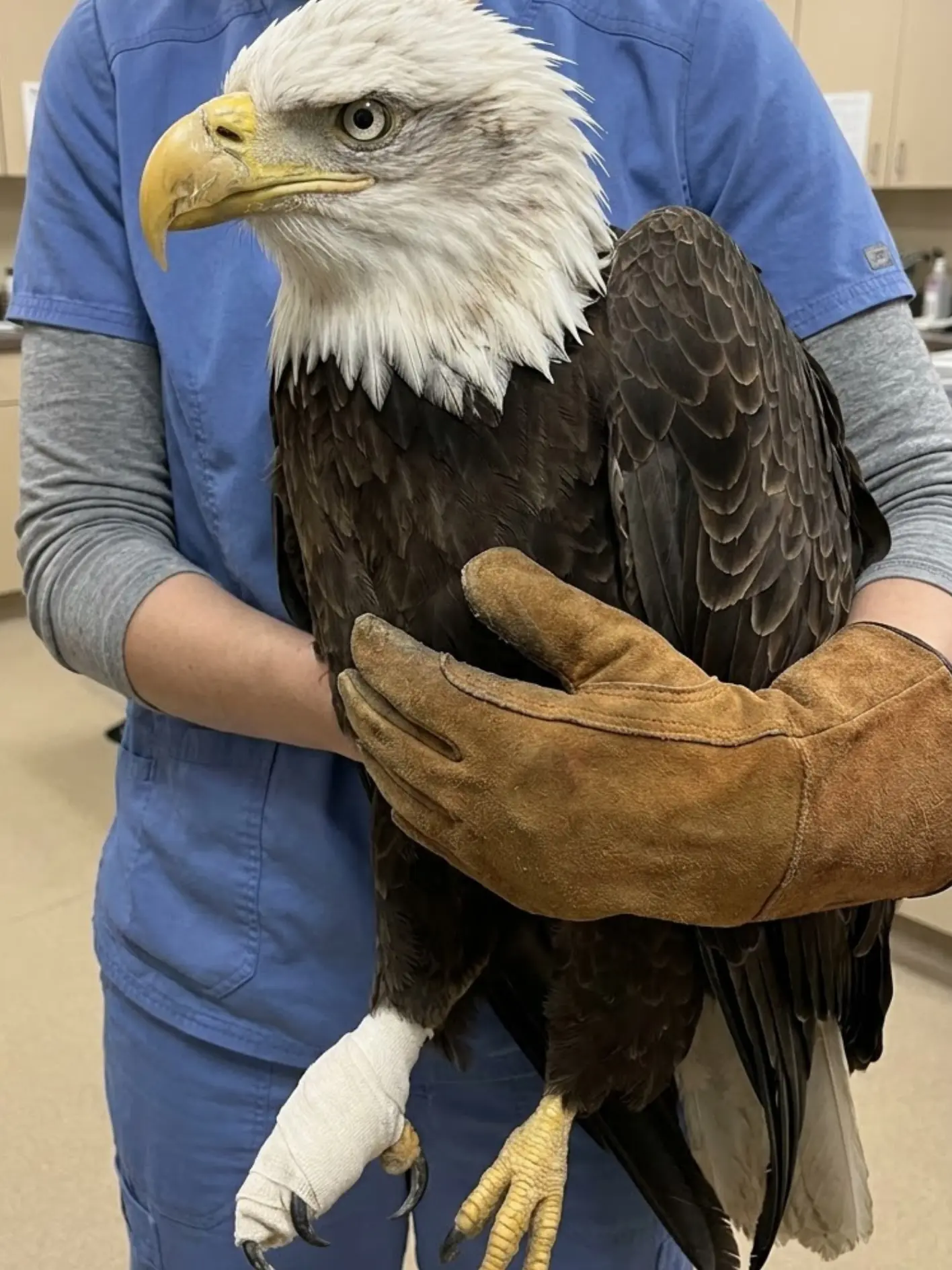
At first, there was no obvious explanation for why the eagle remained on the ground.
Both wings appeared intact.
The bird was alert.
Its eyes tracked movement normally.
And there was no immediate sign of the kind of major wing injury that typically leaves a Bald Eagle unable to leave an area.
But when wildlife responders watched the bird more closely, one problem became increasingly apparent.
The eagle was avoiding the use of one foot.
It repeatedly shifted its weight onto the opposite leg, held the injured foot partially elevated, and appeared reluctant to grip or stand normally.
The bird was safely captured and transported to a licensed wildlife rehabilitation center in western Wisconsin, where veterinarians found significant swelling and soft-tissue trauma involving the affected foot and lower leg.
Radiographs did not reveal a major displaced fracture, but the tissues surrounding the foot were sufficiently damaged that movement needed to be restricted while the injury healed.
The foot was cleaned, treated, and placed inside a thick padded veterinary bandage.
Recent images show the Bald Eagle awake and highly alert while rehabilitation staff restrain it safely for continued treatment. One foot remains protected beneath the large white dressing.
For the medical team, the bandage represents only the beginning of the recovery process.
The real question is whether the eagle will eventually regain enough strength and control in that foot to grip a perch, secure food, and absorb the force of landing.
“For a Bald Eagle, a serious foot injury can be every bit as limiting as an injured wing,” the attending wildlife veterinarian said. “This bird may eventually be able to fly perfectly well, but if it cannot grip securely or use the foot normally during landing, it cannot safely return to the wild.”
The eagle is currently stable and showing encouraging progress.
But its release prognosis will depend on function, not simply on whether the wound closes.
The Eagle Was Found Remaining on the Ground
The first report came from a river corridor near La Crosse, Wisconsin, where Bald Eagles are commonly seen throughout much of the year.
The area provides abundant opportunities for feeding.
Fish, waterfowl, carrion, and other food sources can attract eagles to both riverbanks and nearby agricultural areas.
A Bald Eagle standing on the ground is therefore not automatically a sign of trouble.
What concerned the observer was that this bird remained in roughly the same location and did not leave even after being given considerable space.
It appeared capable of moving.
But its movements were uneven.
The eagle repeatedly favored one leg.
When it attempted to reposition itself, the affected foot barely contacted the ground.
That behavior suggested pain or instability.
Wildlife authorities were contacted.
A Grounded Eagle With Healthy Wings Can Still Have a Serious Injury
When responders arrived, they watched the bird from a distance before attempting capture.
Its wings appeared folded symmetrically.
There was no obvious wing droop.
The eagle remained mentally alert and watched the responders carefully.
But the foot problem was unmistakable.
The bird shifted almost all of its body weight to one side.
The opposite foot was intermittently lifted.
The toes did not flex as confidently as those of the healthy foot.
Although the eagle may still have had the physical ability to flap and potentially become airborne, taking off from the ground while unable to push effectively with one leg can be difficult.
More importantly, landing safely with a painful or unstable foot would be dangerous.
The responders decided the bird required a hands-on medical assessment.
Capture Had to Be Performed Carefully
Even when a Bald Eagle is injured, its feet remain the primary danger to anyone handling it.
The talons are designed to restrain struggling prey.
A compromised bird can still cause serious injury in a fraction of a second.
Heavy protective gloves were used.
The feet were controlled first.
The body and wings were then supported to prevent unnecessary struggling.
Because the injured foot was already painful, responders avoided pulling or twisting the toes.
The eagle was placed into a secure transport carrier with padded flooring and taken to the rehabilitation center.
The transport environment was kept dark and quiet.
Wild raptors generally experience less stress when visual stimulation is reduced.
The Foot Injury Became the Focus of the Examination
At intake, the veterinary team performed a complete physical examination rather than assuming the foot was the only problem.
The wings were palpated.
The shoulders were checked.
The keel and pelvis were examined.
The head and eyes were assessed.
Both legs were compared.
No catastrophic injury was found elsewhere.
The affected foot, however, showed obvious swelling and traumatic change.
The team carefully examined:
the toes,
talons,
foot pad,
lower leg,
joints,
and circulation.
Grip strength on the injured side was markedly reduced.
The eagle reacted when specific areas were touched, confirming that the region remained painful.
There were also areas of soft-tissue trauma that required cleaning and protection.
X-Rays Were Needed Before the Foot Could Be Treated Properly
A swollen raptor foot can hide small fractures.
The bones of the lower leg and toes are relatively compact but must tolerate tremendous force during hunting and landing.
Radiographs were obtained to determine whether the injury included:
a displaced fracture,
joint damage,
bone fragmentation,
or another structural abnormality.
The images did not reveal a major fracture that required surgical stabilization.
That was encouraging.
But it did not mean the injury was minor.
The soft tissues surrounding the foot had suffered significant trauma.
Swelling alone can compromise circulation.
Pain can prevent normal weight-bearing.
A deep laceration or puncture can introduce bacteria.
And damage around a joint can eventually reduce movement even when the bone itself remains intact.
The medical team therefore treated the case seriously.
The Wound Was Cleaned and the Foot Protected
The injured area was cleaned thoroughly.
Any visible debris was removed.
The tissues were examined for evidence of deeper damage.
The team evaluated whether the skin remained viable and whether blood flow to the toes appeared adequate.
A padded bandage was then applied around the affected foot and lower leg.
The dressing served several purposes.
It protected the injured tissue from contamination.
It limited excessive movement.
It reduced additional mechanical stress.
It provided cushioning.
And it allowed the eagle to rest without repeatedly placing direct pressure on the traumatized area.
The thick white bandage visible in recent photographs reflects this stage of treatment.
A Bandage Does Not Necessarily Mean the Leg Is Broken
To people viewing the image, the large amount of wrapping may suggest a major fracture.
That is not always the case.
Veterinary bandages are used for many reasons beyond broken bones.
A foot can require substantial protection because of:
soft-tissue damage,
deep bruising,
puncture wounds,
swelling,
joint injury,
or damage to the skin and foot pad.
In this case, the purpose of the dressing is to protect healing tissue and reduce strain while the medical team monitors how the foot responds.
The eagle’s progress will be judged partly by how the limb looks when the bandage is removed for rechecks.
Daily Bandage Changes Provide Critical Information
The foot cannot simply be wrapped and ignored.
Staff regularly remove and replace the dressing so they can inspect the tissue directly.
Each recheck provides valuable information.
The team looks for:
decreasing swelling,
healthy skin color,
normal warmth,
reduced drainage,
absence of odor,
and adequate blood supply to the toes.
They also examine whether the bird is beginning to flex the digits more normally.
A dressing that is too tight can create new problems.
If swelling changes beneath a fixed wrap, pressure may increase around the foot.
That can affect circulation.
For that reason, careful bandage management is essential.
Circulation to the Toes Is One of the Most Important Things to Protect
Raptor feet depend on good blood supply.
A compromised toe can deteriorate quickly if circulation is interrupted.
Veterinarians therefore monitor:
color,
temperature,
capillary response,
and tissue condition.
They also watch the talons.
A claw that initially appears intact may later reveal damage to the underlying nail bed.
The goal is to preserve as much normal anatomy as possible.
For an eagle, every functional digit contributes to grip strength.
Pain Management Helps the Eagle Use the Limb Normally
Pain control is an important part of recovery.
Wild animals do not always display pain dramatically.
A raptor may simply stop using the injured body part.
It may remain unusually quiet.
It may refuse food.
It may shift its weight away from the painful side.
Appropriate analgesia allows the bird to rest more comfortably and reduces unnecessary stress.
Anti-inflammatory medication may also be considered when clinically appropriate.
The objective is not merely comfort.
Reducing pain can help the eagle begin using the foot again gradually as healing progresses.
The Eagle Was Initially Kept on Padded Flooring
During the early stage, staff avoided placing the bird on a high perch.
That decision protects the foot.
A Bald Eagle landing on a perch generates considerable force through the legs and toes.
If the injured foot cannot absorb that force, the bird could worsen the trauma or fall.
Instead, padded flooring provided a stable surface.
The eagle could stand when it chose without having to maintain a continuous grip.
This also allowed staff to observe how much weight the bird voluntarily placed on the injured side.
The First Improvement Was Reduced Swelling
Over the following days, the medical team began seeing changes.
The swelling gradually decreased.
The tissue looked cleaner during dressing changes.
There was no evidence of rapidly spreading infection.
The eagle also appeared more comfortable.
It began resting with the affected foot closer to the ground rather than keeping it continuously elevated.
These were small changes.
But in foot rehabilitation, they matter.
A bird that gradually begins trusting the limb again is often showing that pain and inflammation are decreasing.
The Eagle Became Increasingly Difficult to Handle
Another encouraging sign came from the bird’s behavior.
At admission, the eagle was tired and relatively subdued.
As its condition improved, that changed.
It began watching staff more intensely.
It reacted earlier when someone entered the room.
Its healthy foot gripped more aggressively.
The bird became less willing to tolerate restraint.
Wildlife rehabilitators generally consider that good news.
The goal is not to create an eagle that accepts human handling.
A healthy wild Bald Eagle should want nothing to do with people.
“The bird is definitely showing more attitude now,” a rehabilitation staff member said. “That is exactly what we like to see.”
The Current Image Shows a Bird That Is Alert Despite Ongoing Treatment
Recent photographs taken during a medical recheck show the eagle held securely by veterinary staff wearing heavy protective gloves.
The bird’s eyes are wide open.
Its head is upright.
Its attention is focused on the people around it.
One foot remains heavily bandaged.
The contrast is important.
The eagle is clearly stronger systemically.
The foot, however, still needs protection.