When rescuers carried the injured Bald Eagle into Northern Prairie Wildlife Hospital, Dr. Rebecca Collins immediately understood that this would not be a simple trauma case.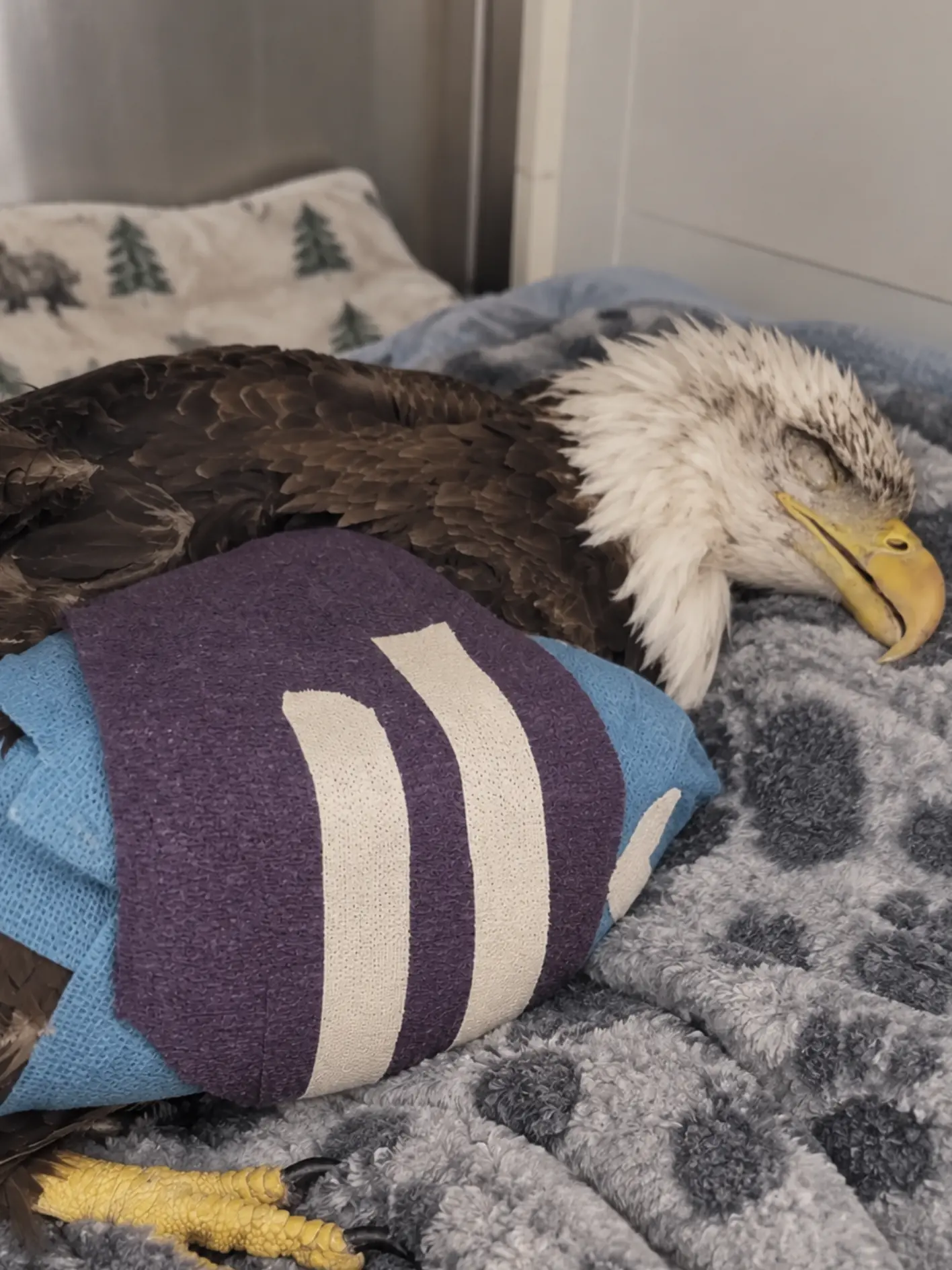
The bird could barely remain upright.
One wing was held abnormally against the body. Its breathing was fast and visibly labored, and every attempt to shift position appeared to require more effort than it should have. The eagle remained conscious, but its posture reflected profound exhaustion.
Collins and the veterinary team began emergency stabilization before trying to determine the full extent of the injuries.
Within hours, radiographs revealed multiple fractures involving the injured wing.
Blood testing uncovered another problem that no one could see from the outside:
the eagle was also carrying a clinically significant concentration of lead in its bloodstream.
Suddenly, the team was treating three problems at once.
The bird had suffered severe orthopedic trauma.
It was struggling to breathe normally.
And it was dealing with lead toxicosis that could weaken the nervous system, reduce appetite, and complicate an already difficult rehabilitation.
“This was not a bird that needed a few days of rest,” Collins said. “It needed stabilization immediately, and we knew from the beginning that surviving the first night would only be the first step.”
The eagle, later given the temporary rehabilitation name Maverick, had arrived in critical condition.
But it had arrived alive.
That gave the team something to work with.
Found Grounded and Unable to Fly
Maverick was first reported in Douglas County, Minnesota, after a resident noticed an adult Bald Eagle sitting unusually low near the edge of an open field.
At first, there was nothing obviously dramatic about the scene.
The eagle was upright.
Its head moved.
Its eyes were open.
But it did not fly away.
That became more concerning as the observer watched.
A healthy adult Bald Eagle will usually maintain considerable distance from people. If approached, it typically launches quickly or moves to a safer perch. Maverick remained on the ground.
When it tried to reposition, one wing appeared to hang lower than the other.
The bird attempted a short movement but could not achieve normal lift.
Then the eagle settled back down.
Wildlife authorities were contacted.
By the time responders arrived, Maverick was visibly struggling. The bird’s breathing was elevated, and its defensive response was weaker than expected.
Even so, rescuers approached cautiously.
A debilitated eagle can still strike with powerful talons.
The feet were controlled first. The damaged wing was supported close to the body, and the bird was transferred into a padded carrier.
Responders did not attempt to throw the eagle into the air to see whether it could fly.
That kind of “test” can worsen fractures and soft-tissue injuries.
Instead, Maverick was transported directly to veterinary care.
The First Priority Was Breathing
At Northern Prairie Wildlife Hospital, the team initially focused less on the wing than on Maverick’s respiratory status.
The eagle was breathing with more effort than normal.
In a trauma patient, that can have many explanations.
Pain alone can increase respiratory rate.
Stress can do the same.
But veterinarians also have to consider chest trauma, internal bleeding, air-sac injury, pulmonary contusion, and other complications that may not be obvious externally.
The bird was placed in a quiet treatment environment.
Supplemental oxygen was provided as clinically indicated.
Handling was minimized.
Analgesia and fluid support were initiated once the team had enough information to proceed safely.
Collins said restraint itself can become a problem in severely compromised raptors.
“An eagle is not a cooperative patient,” she explained. “Every examination costs energy. When a bird is already struggling to breathe, you have to decide what information you need immediately and what can wait until the patient is more stable.”
That meant the veterinary team worked in stages.
First, stabilize.
Then diagnose.
Then decide whether the wing could realistically be saved.
Radiographs Reveal Multiple Fractures
Once Maverick was stable enough for imaging, full-body radiographs were obtained.
The images confirmed serious orthopedic trauma.
The injured wing had sustained multiple fractures, including damage involving the radius and ulna, the paired long bones of the forearm portion of the wing.
The exact configuration mattered enormously.
A Bald Eagle does not simply need the bones to heal.
They must heal with sufficient alignment to restore the geometry of the wing.
A subtle change in length, rotation, or angle may permanently alter flight mechanics.
That is why orthopedic injuries in wild birds present a unique challenge.
A dog may live comfortably after healing with mild limb deformity.
A wild eagle may not survive if one wing produces even moderately less lift than the other.
“For a Bald Eagle, a healed wing is not necessarily a successful wing,” Collins said. “The real question is whether that wing can eventually support controlled, symmetrical flight.”
Fortunately, the fractures were severe but not automatically hopeless.
The elbow and shoulder had not been catastrophically destroyed.
The team believed there was a possible surgical pathway.
That possibility changed everything.
The Chest Imaging Brought Some Relief
The radiographs also helped evaluate Maverick’s breathing difficulty.
There was no obvious catastrophic injury to the thoracic region that would make treatment futile.
The team did not identify a major skeletal injury of the chest or spine sufficient to explain the respiratory distress.
That suggested pain, physiologic stress, exhaustion, and soft-tissue trauma were likely contributing substantially to the abnormal breathing.
The finding was encouraging.
But the eagle was still critically compromised.
Then the blood results returned.
Lead Was the Second Hidden Injury
As part of the intake examination, the veterinary team screened Maverick for lead exposure.
That is commonly considered in Bald Eagles because these birds frequently consume carrion and can ingest lead fragments from animal remains.
The test showed a clinically elevated blood lead concentration high enough to require treatment.
The team now had an eagle with multiple fractures and a toxic metal burden at the same time.
“The fractures were obvious once we took the X-rays,” Collins said. “The lead was invisible. Without blood testing, we could easily have underestimated how much this bird was dealing with.”
Lead toxicosis can cause a range of problems in birds.
Affected eagles may become weak.
Their appetite may decrease.
Grip strength can decline.
Neurologic function may become abnormal.
Some become unable to stand or fly even without major skeletal injury.
In Maverick’s case, there was no way to determine exactly how much of the overall weakness came from trauma and how much came from lead exposure.
Both were real.
Both required treatment.
The Source of the Lead Could Not Be Confirmed
Like many wildlife cases, the exact source of Maverick’s lead exposure remained unknown.
Bald Eagles often travel large distances and may feed at multiple sites.
They hunt fish and other prey, but they also scavenge carcasses.
When game animals are shot with lead ammunition, the projectile can fragment on impact. Tiny pieces may remain within tissue or in gut piles left behind in the field.
An eagle consuming those remains may swallow fragments too small to detect.
Once lead enters the digestive tract, it can be absorbed and circulate through the body.
The veterinary team could not say that this was definitively how Maverick was exposed.
But scavenging lead-contaminated animal remains is a well-recognized route of exposure in Bald Eagles.
For Maverick, the timing could not be reconstructed.
The lead might have been ingested before the traumatic injury.
It might have contributed to weakness before the bird was injured.
Or the two problems could have been entirely separate.
The clinicians did not speculate beyond the evidence.
Their job was to treat what they had found.
Surgery Could Not Be Delayed Indefinitely
The wing fractures required stabilization.
But surgery on a critically ill wild bird is never a casual decision.
Maverick had to be stable enough to tolerate anesthesia.
The team first worked to improve hydration, control pain, and reduce respiratory stress.
Only once the bird’s condition was considered adequate did Collins and the surgical team proceed.
The operation focused on restoring functional alignment.
The fractures were reduced as precisely as possible, the damaged tissues were evaluated, and the wing was stabilized to give the bones the best opportunity to heal in a position compatible with future flight.
The objective was not cosmetic perfection.
It was biomechanics.
An eagle must extend the wing fully.
Both sides must generate balanced lift.
The elbow and wrist must move through functional ranges.
The primary and secondary flight feathers must remain properly oriented.
A repair that keeps the bird alive but leaves a permanently dysfunctional wing does not accomplish the ultimate rehabilitation goal.
The procedure went as planned.
But no one considered the case won.
The Photograph Shows the Beginning of the Hard Part
After surgery, Maverick was placed in a padded recovery space.
A photograph from this period shows the eagle lying quietly on thick blankets, eyes closed, with a broad purple-and-blue body wrap securing the injured wing against the torso.
The image captures the contrast between the strength normally associated with Bald Eagles and the reality of intensive wildlife medicine.
Maverick is not standing majestically.
It is not spreading its wings.
It is not looking toward the sky.
It is simply resting.
The wrap is doing critical work.
It limits sudden movement.
It protects the surgical repair.
It helps maintain alignment.
It reduces stress on the injured wing during the earliest stage of bone healing.
For a bird that may eventually need that wing to support years of wild flight, those first days matter enormously.
The First Night Was Guarded
Maverick remained recumbent for much of the early post-operative period.
Respiration continued to be monitored closely.
The bird spent long periods with its eyes closed.
It was not placed on a high perch because a fall could have caused further injury.
Appetite was limited.
Grip strength remained below normal.
The veterinary team continued fluid support and pain management while watching for complications associated with both trauma and anesthesia.
Infection was another concern.
Any significant wound associated with a fracture carries the possibility of bacterial contamination.
Staff monitored the surgical and soft-tissue sites for increased swelling, discharge, abnormal heat, or tissue deterioration.
Every small change mattered.
Chelation Therapy Began for the Lead Exposure
At the same time, treatment for lead toxicosis was initiated.
Chelation therapy uses medications that bind lead and help the body eliminate it.
Treatment requires monitoring.
Removing lead is not as simple as administering one dose and assuming the problem is over.
Blood concentrations can change over time, and some birds may need repeated courses depending on the severity and response.
Maverick’s blood lead levels would therefore be reassessed during recovery.
Neurologic function was also watched closely.
The veterinary team paid attention to grip strength, posture, responsiveness, and coordination.
A wing fracture may explain why an eagle cannot fly.
It does not necessarily explain profound generalized weakness.
The lead burden complicated every interpretation.
Nutrition Became Part of the Medical Treatment
Maverick had endured trauma, surgery, toxic exposure, and the stress of capture and hospitalization.
The eagle needed nutrition to repair bone and tissue.
But large meals were not introduced abruptly while the bird was still debilitated.
Instead, staff provided small, frequent feedings.
This allowed Maverick to receive calories and protein without overwhelming a stressed digestive system.
The feeding plan also gave the team useful information.
Was the eagle interested in food?
Could it swallow normally?
Was the gastrointestinal tract functioning?
Was body weight stable?
Was the bird beginning to rebuild muscle rather than continuing to lose it?
Each meal was part of the recovery.
“People sometimes think food is just supportive,” one rehabilitator said. “In a trauma patient, nutrition is treatment. You cannot rebuild bone, muscle, and damaged tissue without energy.”
Breathing Improved First
One of the earliest encouraging signs was the normalization of Maverick’s breathing.
Over the next day, the bird’s respiratory effort became less pronounced.
The rate decreased.
The eagle was able to rest more comfortably.
Supplemental oxygen could be reduced as the clinical situation allowed.
That change gave the team confidence that the respiratory distress had been largely associated with trauma, pain, stress, and exhaustion rather than a catastrophic thoracic injury.
Still, the bird remained weak.
There was a long distance between breathing normally and being ready for the wild.
Then the Attitude Started to Return
Another positive sign came when Maverick became increasingly resistant to handling.
A wild Bald Eagle should not enjoy veterinary examinations.
As the eagle’s strength returned, restraint became more challenging.
Grip improved.
The eyes stayed open longer.
The bird tracked staff closely.
Eventually, Maverick attempted to use its feet more forcefully during an examination.
To the people caring for it, that was excellent news.
“The first time Maverick really tried to grab the glove, we were relieved,” Collins said. “That tells you the bird is getting stronger, more aware, and more like itself.”
Wildness is an important part of rehabilitation.
The team did not want Maverick to associate humans with comfort.
They wanted a patient that, when healthy enough, would prefer to be anywhere else.
Repeat Radiographs Became the Next Test
Approximately one to two weeks into recovery, follow-up imaging was obtained.
The team wanted to know whether the repaired bones were maintaining alignment.
The images showed early healing.
The fractures remained stabilized.
There was developing bone callus, the body’s natural response to fracture repair.
No major displacement had occurred.
Soft-tissue swelling was also improving.
That was the orthopedic progress the team needed to see.
But it was still early.
Bone healing in a raptor must be matched by return of motion and muscle strength.
Too much movement too soon can disrupt a repair.
Too little movement for too long can cause stiffness and severe deconditioning.
Finding the correct balance is one of the hardest parts of avian rehabilitation.
Lead Levels Were Falling, but Monitoring Continued
Repeat blood testing also showed improvement in Maverick’s lead burden.
The concentration began moving downward after chelation.
That was encouraging.
But the team continued surveillance.
One lower result did not automatically mean the bird was ready to move on.
They wanted to see sustained clinical improvement and no reappearance of neurological weakness after treatment.
Maverick’s grip was getting stronger.
Appetite improved.
Posture was more stable.
These findings supported the blood results.
The eagle was beginning to recover from both injuries at once.
The Wrap Could Not Stay Forever
The body-and-wing wrap had protected the fracture during the most vulnerable period.
Eventually, however, the wing needed movement.
Muscles weaken rapidly during immobilization.
Joints become stiff.
Tendons and soft tissues lose normal flexibility.
That can be dangerous in a bird whose entire future depends on flight.
Once imaging showed enough stability, the rehabilitation team gradually reduced external support.
Each change was monitored carefully.
Did the wing droop?
Did swelling return?
Did Maverick show pain?
Could the bird hold the wing in a natural position?
The answer became increasingly positive.
That allowed physical rehabilitation to begin.