A family in rural La Crosse County, Wisconsin, expected an ordinary morning when they looked across their property and noticed something unusually large hanging from a fence line.
At first, it was difficult to tell what they were seeing.
Then the shape moved.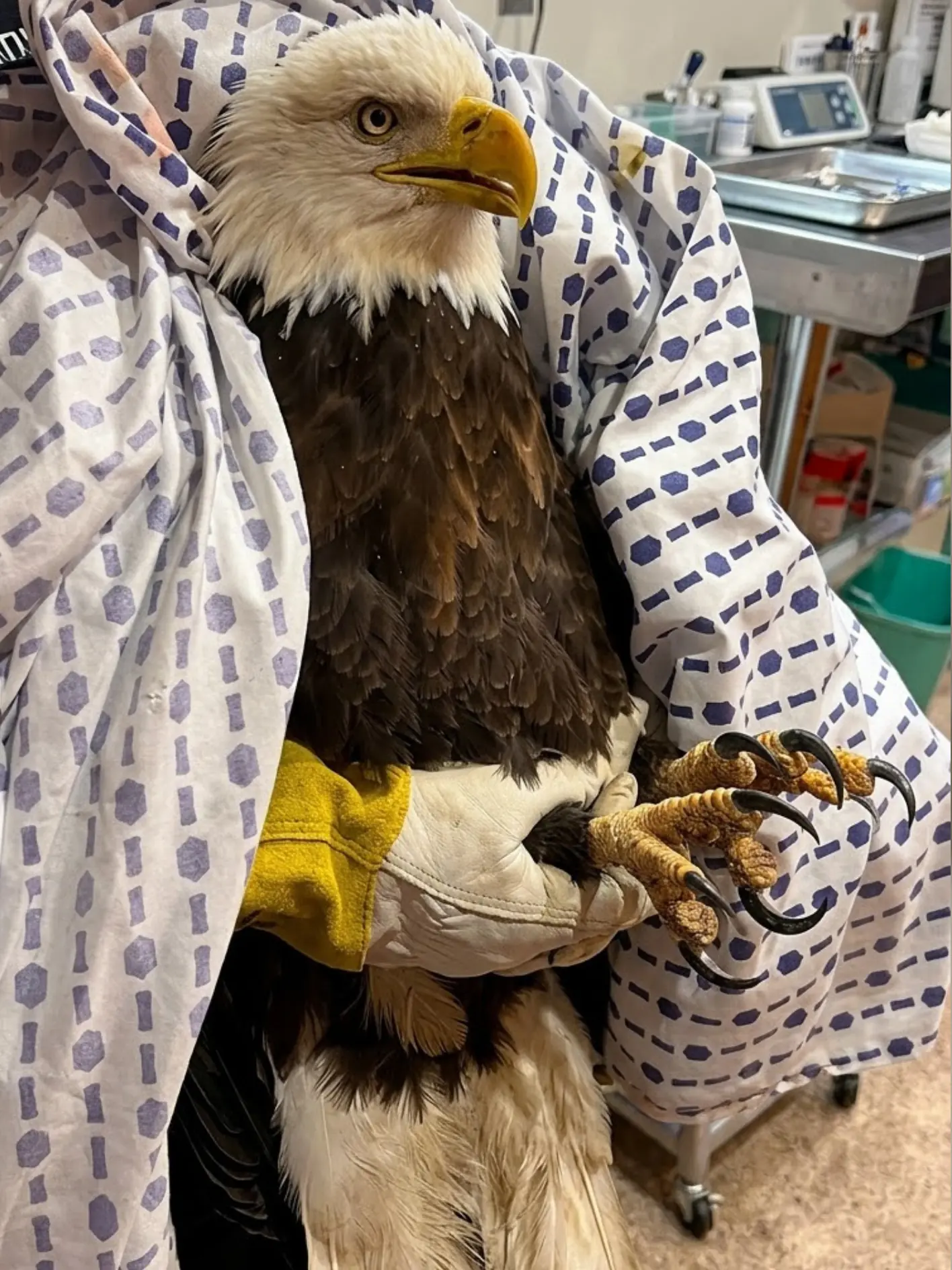
The family realized an adult bald eagle was suspended upside down from the fence, apparently caught by one leg and unable to free itself.
The bird was alive and alert, but its position immediately raised concern. Its body hung below the trapped limb while the eagle attempted to stabilize itself with its wings. Each movement risked placing additional torque on the leg and foot already caught in the fencing.
Rather than attempting to pull the eagle free themselves, the family kept their distance and contacted a licensed wildlife rehabilitation center in western Wisconsin.
Wildlife responders later said they believe the eagle may have become trapped while descending rapidly toward prey in the grass. No one witnessed the moment it happened, so the exact sequence cannot be confirmed. But the position of the bird, the location of the fence, and the way the foot had become caught were consistent with an accidental entanglement during a low hunting approach.
“No one saw the actual moment it became trapped,” a rehabilitator involved in the case said. “But based on the location and the way the eagle was suspended, our best suspicion is that it was coming down toward prey and caught a foot or talon on the fence.”
Getting the bird off the fence was only the beginning.
Once the eagle was free, veterinary staff still had to answer a far more important question: whether the leg and foot that had supported the bird’s entire hanging body weight had retained enough circulation, nerve function, and grip strength for the eagle eventually to return to the wild.
A Familiar Bird in an Unfamiliar Position
Bald eagles are no longer an unusual sight along the Mississippi River corridor in western Wisconsin.
La Crosse County contains an extensive mixture of river habitat, wetlands, wooded bluffs, agricultural fields, and open land that can support both prey and scavenging opportunities for eagles.
During portions of the year, residents may see bald eagles perched in large trees along waterways or crossing open country between feeding sites.
What the family saw that day was entirely different.
The eagle was not perched.
It was not feeding.
It was hanging head-down from a fence.
One leg appeared trapped while the rest of the bird’s body was suspended below it.
The animal was clearly unable to solve the problem on its own.
A bald eagle’s body is not designed to remain in that position for prolonged periods.
The trapped leg may be forced to support much of the bird’s body weight.
The joint can twist.
Soft tissues can stretch.
Blood circulation can become compromised.
And every instinctive attempt to escape may worsen the injury.
That is why the family’s decision not to approach became important.
An Injured Eagle Can Still Be Dangerous
A bald eagle in distress may look helpless.
It is not harmless.
The species possesses powerful feet equipped with long talons designed to seize and hold prey.
Even an exhausted or injured eagle may react defensively when someone reaches toward it.
The danger is especially significant when a bird is trapped and cannot retreat.
People trying to help may unintentionally place themselves within range of the free foot or beak.
They may also worsen the animal’s injuries by pulling on the wrong part of the fence or allowing the eagle to twist while struggling.
The family therefore kept people and pets away while they waited for trained help.
That decision also reduced unnecessary stress.
A wild eagle does not understand that approaching humans intend to rescue it.
From the bird’s perspective, additional people near the fence may simply represent another threat.
Responders Had to Support the Eagle Before Releasing the Foot
When wildlife personnel reached the property, the first priority was not to pull the trapped limb free.
The eagle’s body had to be supported first.
If the fence were simply cut while the bird remained hanging, the sudden release could cause the eagle to fall, potentially worsening trauma or creating a new injury.
Responders approached carefully, using appropriate covering and restraint to reduce visual stimulation and control the wings.
The free foot remained a handling concern.
Once the body was supported, the trapped leg could be examined and the fencing removed without allowing the bird’s full weight to continue pulling downward.
The rescue required patience.
An eagle that begins flapping while one foot remains fixed can generate substantial force.
Those movements can injure tendons, ligaments, joints, skin, or blood vessels even if no bone breaks.
Eventually, responders were able to free the foot and lower the bird safely.
The eagle was no longer attached to the fence.
But it was not immediately released.
Freedom From the Fence Did Not Mean the Eagle Was Ready to Leave
Once the bird was on the ground and no longer suspended, responders evaluated how it used the injured limb.
The eagle remained conscious and responsive.
That was encouraging.
But the affected leg and foot did not appear completely normal.
There was swelling and evidence of soft-tissue trauma from the entrapment.
The bird was not considered safe for an immediate flight attempt.
Wildlife staff therefore made the decision to transport the eagle for a full veterinary evaluation.
That choice is important in entanglement cases.
A bird may appear substantially better the moment pressure is removed from a trapped limb.
The true extent of the injury may not become apparent for hours.
Swelling can increase.
Circulatory damage may become more obvious.
Nerve function may be temporarily or permanently impaired.
A tendon injury may not be visible through the skin.
For a bald eagle, any of those problems can affect release eligibility.
The First Examination Focused on the Entire Bird
At the rehabilitation center, veterinary staff did not assume that the leg was the only area injured.
The eagle underwent a complete examination.
The eyes were evaluated.
The head and beak were checked for trauma.
Both wings and shoulders were compared.
The legs and feet were examined for swelling, abrasions, instability, abnormal temperature, and range of motion.
Staff also assessed hydration, body condition, breathing, and neurological responsiveness.
The eagle remained alert during the examination.
Images recorded later in care show the adult bird upright and attentive while wrapped securely in towels and carefully restrained.
One foot is supported during the examination, allowing staff to control the talons and assess limb function safely.
The bird’s alert appearance is encouraging, but it does not by itself prove that the injured foot is ready for normal use.
That determination requires more detailed testing.
No Catastrophic Fracture Was Immediately Apparent
Radiographs were obtained to evaluate the bones of the affected foot, lower leg, and associated joints.
One of the first pieces of good news was that the imaging did not reveal a major displaced fracture that would automatically create a poor orthopedic prognosis.
That was reassuring.
It did not mean the injury was minor.
The team remained concerned about substantial soft-tissue trauma and swelling.
A fence entanglement can injure structures that do not appear on an X-ray as clearly as broken bone.
Tendons can be stretched.
Ligaments may be strained.
Nerves can be compressed.
Blood vessels can be damaged.
The tissues may also suffer from prolonged pressure if the limb was caught tightly for an unknown amount of time.
Those injuries can have serious functional consequences even when the skeleton remains intact.
The Most Important Question Was Circulation
When an animal remains suspended by one limb, blood flow becomes a major concern.
Pressure from fencing may compress vessels.
Swelling can further reduce circulation after the bird has been freed.
A foot deprived of adequate blood flow for too long can develop tissue injury even when the bones are normal.
Veterinary staff therefore monitored the affected foot carefully.
Was it warm?
Was the tissue color appropriate?
Did the toes respond?
Was swelling improving or worsening?
Were the skin and pads viable?
Could the bird move the digits?
Those observations can change over time.
A foot that looks acceptable immediately after rescue may swell considerably several hours later.
Conversely, a bird with temporary reduced movement may improve as swelling decreases and circulation normalizes.
That is one reason the eagle needed hospitalization rather than a same-day release.
Nerve Function Was Another Major Concern
The foot of a bald eagle is a remarkably specialized structure.
Its usefulness depends not only on strong muscles but also on precise neurological control.
Each toe must close and open in coordination.
The bird must sense the surface beneath its feet.
It must know how much pressure it is applying.
During landing, those movements happen in fractions of a second.
A trapped limb that has been stretched or compressed can temporarily affect nerve function.
In more serious cases, damage may be permanent.
The rehabilitation team therefore watched for voluntary toe movement and changes in grip strength.
A bald eagle might eventually fly normally while still having an unusable foot.
That bird would not necessarily be safe to release.
Why Grip Strength Matters So Much
Flight tends to receive most of the attention in raptor rehabilitation.
For an eagle, the feet are just as important.
An adult bald eagle uses its feet to secure itself on branches and other perches.
The talons hold food while the beak tears it apart.
They may be used to capture fish or other prey.
The feet also absorb force during landing.
A bird with weak grip may slip from a perch.
It may fail to hold food.
It may be unable to secure prey effectively.
A severe deficit can turn an otherwise strong flyer into an animal unable to survive independently.
That is why rehabilitation staff will not judge this eagle’s recovery solely by whether its wings work.
The trapped foot must recover too.
The Eagle’s Initial Alertness Was Encouraging
One positive feature of the case was the bird’s general responsiveness after rescue.
The eagle remained visually attentive.
It held its head upright.
It did not appear profoundly neurologically compromised.
Those findings suggested that the entanglement had not caused obvious severe head trauma or systemic collapse.
But raptors often conceal weakness.
Wild birds are adapted to avoid appearing vulnerable.
An eagle may remain alert even while experiencing substantial pain or soft-tissue injury.
For that reason, the medical team continued to rely on objective findings rather than appearance alone.
Swelling.
Toe movement.
Circulation.
Grip.
Weight-bearing.
Those were the measures that would determine whether the limb was truly improving.
Treatment Began With Rest
During the first phase of care, the eagle was kept in a controlled environment.
The purpose was to reduce unnecessary movement while the injured tissues settled.
Pain management could be provided when clinically indicated.
Any superficial wounds were cleaned and monitored.
Supportive bandaging could be used if necessary to protect affected tissues.
The enclosure remained small enough to discourage repeated flight attempts.
This is important.
An eagle that feels stronger may try to escape before the leg is ready.
A hard landing could place significant force through the injured foot.
If circulation, tendon function, or joint stability remains compromised, that impact could reverse progress.
The rehabilitation team therefore allowed the bird’s medical condition — not its eagerness to move — to determine the pace.
Swelling Became an Important Daily Measure
Soft-tissue injuries often change significantly during the first several days.
The team monitored whether swelling was decreasing.
That trend matters.
Persistent or increasing swelling may indicate ongoing inflammation, compromised circulation, or deeper injury.
Decreasing swelling can allow better evaluation of joint movement and toe function.
As the tissues settled, the veterinary staff could begin obtaining a clearer picture of whether the foot was structurally and neurologically intact.
The bird’s willingness to place weight on the injured side also became valuable information.
Weight-Bearing Was a Good Sign to Watch For
An eagle that continually lifts one foot may be protecting it because of pain or weakness.
Some temporary lifting can be expected after trauma.
Persistent refusal to bear weight is more concerning.
Rehabilitation staff watched how the bird stood when undisturbed.
Did it distribute weight evenly?
Could it shift from one side to the other?
Did it repeatedly lift the injured foot after a few seconds?
Was balance normal?
These observations are less dramatic than radiographs, but they are essential to wildlife rehabilitation.
The goal is function.
A bird has to use the limb normally when no one is encouraging it to do so.
Toe Movement Could Determine the Prognosis
As swelling decreased, movement of the toes became increasingly important.
A healthy eagle should be able to flex its digits strongly around a perch.
The toes should also reopen normally.
Any persistent weakness could indicate nerve or tendon injury.
The rehabilitator summarized the concern this way:
“The most concerning part was not simply that the eagle was caught. It was the amount of force that had been placed on one leg while the entire body was hanging below it. Even after the bird was free, we still had to determine whether the foot had retained normal circulation, nerve function and grip.”
That assessment explains why a rescue that appeared successful at the fence still required days or weeks of medical follow-up.
The Eagle Could Not Simply Be Tested With a High Perch
Early in recovery, rehabilitation staff have to avoid creating unnecessary fall risk.
If they immediately place an injured eagle on a high natural-style perch and the foot fails to grip, the bird may fall and injure itself.
A safer progression begins lower.