Several children playing in the woods near Cedar Creek in Waupaca County, Wisconsin, stopped when they noticed something unusual high among the trees.
At first, they were not sure what they were looking at.
Then they realized it was a bald eagle.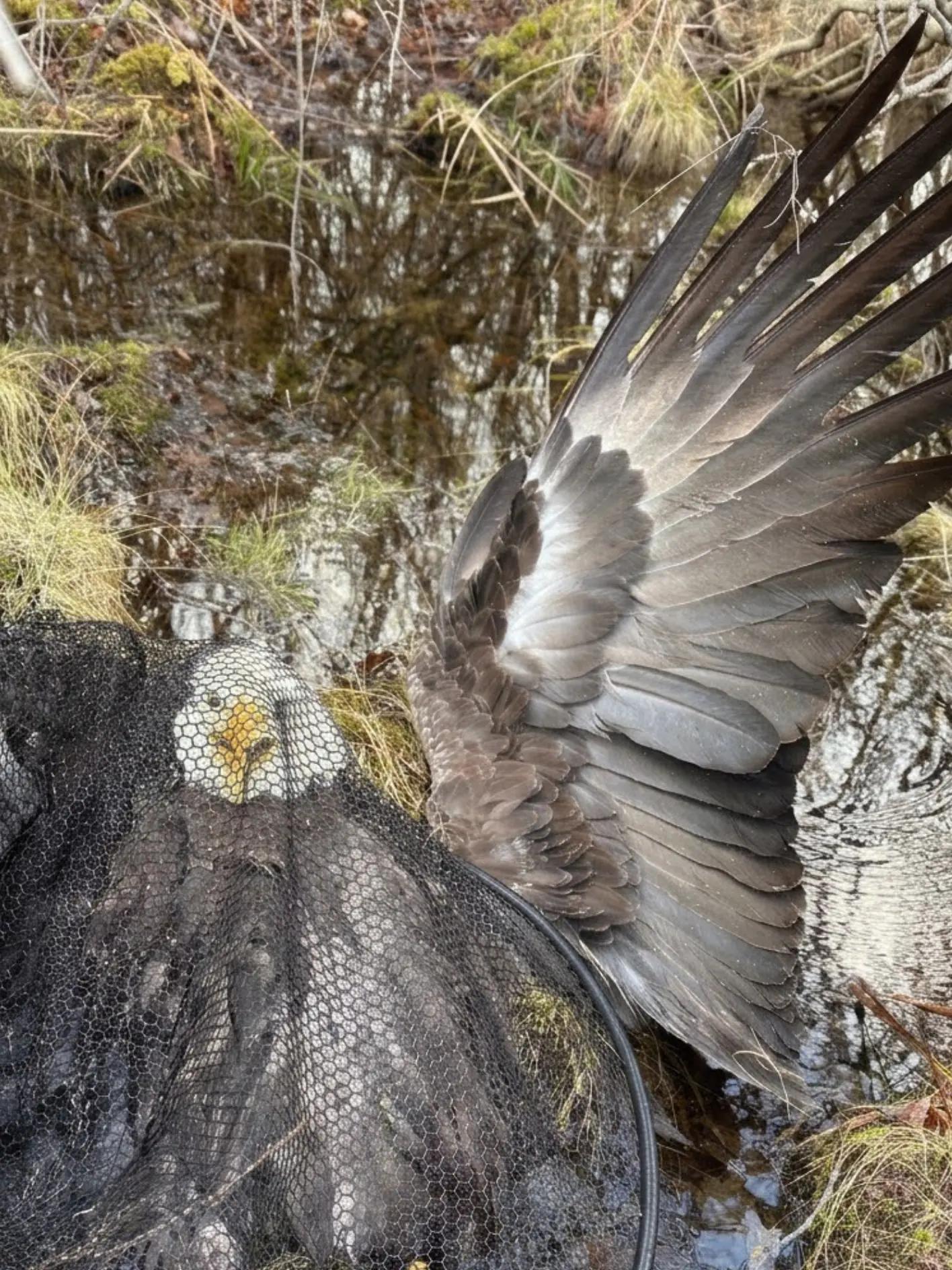
The adult bird was hanging upside down from a tree, apparently caught by one of its legs or feet and unable to pull itself free.
The children began recording from a distance while trying to understand what had happened. Before anyone could reach the bird, the eagle suddenly struggled hard enough to release itself.
It dropped from the tree.
But instead of spreading its wings and flying away, the eagle fell into the marshy ground below.
It landed among shallow water, wet grass, mud and brush, then began moving deeper into the wooded wetland.
The bird could run.
It could flap.
But it could not fly.
By the time the children and the property owner realized the eagle was still in serious trouble, it had already retreated far enough into the swamp that approaching it safely was no longer realistic.
Rather than attempting to capture a powerful raptor without training or equipment, the family contacted a local wildlife rehabilitation network for help.
That decision would eventually lead to an unusually difficult rescue involving near-freezing water, submerged logs, a wildlife volunteer soaked to the waist, and an adult bald eagle that repeatedly moved deeper into the swamp before finally being secured.
Two days later, the case produced an unexpected piece of good news.
Veterinary radiographs found no broken bones.
Testing for West Nile virus and avian influenza was also negative.
The mystery of why the eagle had initially been unable to fly was not completely resolved, but several of the most serious possibilities had been ruled out.
A Strange Discovery Near Cedar Creek
Bald eagles are not unusual in central Wisconsin.
Rivers, wetlands, lakes and forested areas provide abundant opportunities for feeding and roosting, particularly in landscapes where open water and mature trees occur close together.
An adult eagle perched over a creek would attract attention, but it would not necessarily be considered unusual.
An eagle hanging upside down from a tree was another matter entirely.
The children who first saw the bird recognized immediately that something was wrong.
The eagle’s white head and tail identified it as an adult, but its position was unnatural. Its body was suspended below the branch while the wings shifted as it attempted to free itself.
No one could determine exactly what had trapped the bird.
Fishing line was one possibility.
Wire or vegetation could have been another.
There was not enough evidence to identify the material with confidence, and by the time rescuers later reached the site, the eagle had already freed itself.
What happened next was more important.
The bird fell.
A healthy bald eagle dropping from a branch would normally extend its wings and recover immediately.
This one did not.
It came down into the marsh and remained on the ground.
That was the first clear indication that whatever had happened in the tree might have left the bird exhausted, injured, or otherwise unable to function normally.
The Eagle Escaped the Tree but Not the Problem
The children continued watching as the eagle moved through the wetland.
It did not remain motionless.
In fact, the bird was alert enough to put distance between itself and the people nearby.
It moved through water and vegetation, using its legs and occasionally spreading the wings for balance.
But it never achieved normal flight.
That distinction mattered.
A bald eagle does not need to be completely immobile to require help.
Wild animals can remain remarkably defensive even when injured.
They may run.
Strike.
Flap.
Or use their final energy reserves to avoid a person approaching them.
The absence of flight remained the key concern.
The family recognized that following the bird deeper into the swamp without protective equipment could create danger for both the eagle and the people involved.
They stopped the pursuit and contacted experienced wildlife responders.
By then daylight and difficult terrain made immediate capture impractical.
The location where the eagle had last been seen was noted so that another attempt could be made under safer conditions.
The Rescue Continued the Following Day
The next day, property owner Mark Ellison met wildlife rescue volunteer Laura Jensen along the roadside near the entrance to the property.
Ellison led her through the woods toward the flooded area where the eagle had disappeared.
The route became increasingly difficult.
The ground was saturated.
Small pools and channels cut through the vegetation.
Moss-covered logs and branches were partly submerged beneath dark water.
Tall grasses obscured footing.
When Jensen finally spotted the eagle, it was still in the wetland.
The adult bird was alive and alert.
It was also still unable to leave by flight.
That meant a field capture would have to be attempted.
Jensen carried protective gloves and a large wildlife net.
The gloves were essential.
Even a debilitated bald eagle can strike with enough force to cause serious puncture injuries.
The net would allow her to secure the wings before reaching for the feet.
But reaching the bird required entering the swamp first.
The Water Was About 36 Degrees
The water temperature was approximately 36°F — roughly 2°C.
At the edge, it was already deep enough to cover the lower portion of Jensen’s boots.
Farther in, the water reached close to two feet.
The temperature created a safety concern not only for the eagle but for the rescuer.
Cold water pulls heat from the body rapidly.
Wet clothing adds weight.
Uneven ground makes balance difficult.
And a person attempting to restrain a large eagle has to remain stable enough to control the talons while avoiding unnecessary pressure on the bird’s body and wings.
Jensen entered slowly.
She had made only a few steps when one of her shoelaces caught beneath a submerged log.
“I had barely gotten into the water when my boot snagged underneath something,” she later recalled. “I went straight down onto one knee. At that temperature, you feel the cold immediately.”
Water soaked through her clothing.
But the eagle was still several yards away.
The Eagle Moved Deeper Into the Swamp
The bird saw her coming.
Despite whatever had kept it from flying, its instinct to avoid humans remained intact.
The eagle began moving farther into the wetland.
Jensen followed carefully.
The goal was not to chase the bird until it collapsed.
Prolonged pursuit can be dangerous for an injured animal, particularly one already stressed by cold exposure and a previous fall.
She needed to close the distance gradually while keeping the eagle from reaching even deeper water.
The bird moved another 10 to 12 feet — roughly 3 to 4 meters.
Jensen followed.
At that point, the water reached her waist.
The terrain became increasingly unstable.
Branches pulled against her clothing.
Her boots sank into mud.
Each step had to be placed carefully because another fall could injure her, frighten the bird into a more dangerous position, or cause the net to be lost.
The eagle continued trying to stay just beyond reach.
It could not fly.
But it was not giving up.
The Capture Came Down to One Opportunity
Eventually, Jensen reached a position where she had enough control to attempt the net.
She waited until the eagle paused.
Then she moved.
The net came down over the bird, containing the wings before the eagle could turn or move farther into the marsh.
Capturing a bald eagle is not complete when the net touches the bird.
The feet are the next priority.
The talons must be controlled before the eagle can be safely lifted.
Jensen worked through the net to secure the legs while making sure the bird could breathe freely and that neither wing was twisted underneath the body.
Once the eagle was controlled, the situation changed immediately.
The bird no longer had to continue exhausting itself through the swamp.
Now Jensen had to get both of them out.
The Photograph Shows the Moment the Eagle Was Secured
A photograph from the rescue shows the adult bald eagle lying partly in the flooded woodland beneath a large black capture net.
One wing is extended.
The white head is visible through the mesh.
The bird is surrounded by shallow water, wet grass, mud and branches.
The image captures the environment in which the rescue occurred, but it does not show the earlier incident in the tree.
By the time the photograph was taken, the eagle had already fallen, escaped farther into the wetland and been pursued through the cold water.
The net in the image was the rescue equipment used to secure the bird.
It was not the material believed to have trapped the eagle in the tree.
Getting Back Out Was Almost as Difficult as the Capture
The eagle was wet and heavy.
So was Jensen.
She had already spent considerable energy moving through cold water and unstable footing.
Now she had to carry an adult raptor while maintaining control of the feet and protecting the wings.
The trip back toward dry ground was slow.
The soaked clothing made each step more difficult.
The muddy bottom repeatedly pulled at her boots.
Branches and submerged wood remained hazards.
“The hardest part wasn’t necessarily getting close enough to use the net,” Jensen said. “It was getting both of us back out. The eagle was wet, I was soaked from the waist down, and by the time we reached the road I had almost nothing left in my arms.”
Once back near the vehicle, the eagle was placed into a secure carrier.
Jensen was exhausted enough that the next examination would need to wait until both rescuer and bird had been given time to recover from the ordeal.
A Temporary Examination Took Place in an Unusual Setting
Later that afternoon, Jensen and another experienced wildlife rehabilitator performed a preliminary assessment on the property.
The location was unusual.
The property owner had a small children’s playhouse in the backyard — essentially a large enclosed dollhouse.
It provided a quiet contained space where the eagle could be examined without being brought into the family’s main living area and without risking an escape outdoors.
The structure was not a veterinary clinic.
It was simply the safest enclosed space available at that moment.
The eagle was brought inside, the door was secured, and the two rehabilitators began examining the bird.
Considering what it had reportedly experienced, the first findings were surprisingly reassuring.
There Was No Obvious Major External Injury
The rehabilitators checked both wings.
Neither appeared to contain an obvious open fracture.
The shoulders did not show dramatic asymmetry.
The legs and feet were examined carefully because the bird had reportedly been hanging upside down before falling.
The talons remained intact.
There was no immediately obvious severe leg injury.
The eyes were checked.
The eagle did not show the kind of unmistakable neurological abnormalities that might suggest severe head trauma.
There was no persistent head tilt.
No obvious loss of consciousness.
No major external wound that explained the lack of flight.
That did not mean the eagle was healthy.
It meant the examination had failed to reveal a catastrophic injury visible without additional diagnostics.
Given the circumstances, that was already encouraging.
The Bird Was Identified as an Adult Male
The eagle had a fully white head and tail along with the yellow bill characteristic of mature bald eagles.
Bald eagles generally develop full adult plumage at approximately five years of age, although plumage alone cannot provide a precise birth year.
The bird was therefore considered at least approximately five years old or older.
Measurements and overall size were consistent with a male.
Female bald eagles are typically larger than males, though there can be overlap.
Identifying sex in a rehabilitation setting generally relies on body measurements rather than simply looking at a photograph.
For the team, the more important finding was that this was an established adult bird whose flight ability should have been fully developed.
Its failure to fly after falling from the tree remained abnormal.
No One Was Ready to Release Him Yet
It would have been tempting to interpret the absence of a visible fracture as proof that the eagle simply needed to dry off.
The rehabilitators did not make that assumption.
The bird had reportedly:
- hung upside down from a tree,
- struggled hard enough to free itself,
- fallen into a swamp,
- remained unable to fly,
- moved through near-freezing water,
- and spent a prolonged period under severe physical stress.
Soft-tissue injuries may not be visible externally.
Muscle strain.
Shoulder trauma.
Ligament injury.
A mild concussion.
Exhaustion.
Hypothermia.
Or underlying disease could still interfere with flight even when the bones appeared intact by palpation.
The eagle needed rest and veterinary evaluation.
The Weekend Became a Period of Observation
The bird was kept warm and dry.
Handling was minimized.
Wet feathers were allowed to dry naturally in a controlled environment.
The eagle’s breathing was monitored.
So were posture, alertness, appetite and wing carriage.
Cold-water exposure had been another concern.
Bald eagles are well insulated when their plumage is functioning normally, but prolonged immersion can overwhelm even a large bird’s ability to conserve heat — particularly if that bird is already exhausted or medically compromised.
The rehabilitation team wanted to see whether the eagle would regain normal strength after being warmed, dried and allowed to rest.
The early signs were encouraging.
The bird remained alert.
No rapidly progressive neurological signs appeared.
But the inability to fly still required a medical explanation.
Monday Brought the Veterinary Examination
After the weekend, the eagle was transported to a veterinarian for a more comprehensive evaluation.
The examination included assessment of:
- the wings,
- shoulder girdle,
- legs,
- feet,
- eyes,
- neurological responses,
- body condition,
- and general health.
Radiographs were obtained.
This was particularly important because fractures in birds can be difficult to detect by external examination.
Dense feathers conceal swelling.
Wing anatomy is complex.
Some fractures remain relatively stable even though they prevent normal flight.
The radiographs answered one of the largest questions.
Nothing major was broken.
X-Rays Showed No Fractures
The major bones of the wings appeared intact.
There was no obvious fracture of the humerus, radius or ulna.
No major skeletal injury of the shoulder girdle was identified.
The legs also did not show an obvious fracture that could explain the circumstances of the rescue.
Considering that the eagle had reportedly fallen from a tree and then spent time struggling through a swamp, that result was unexpectedly good news.
“Considering what this bird had reportedly been through — hanging upside down, falling and then spending time in near-freezing water — seeing no fracture on the radiographs was extremely encouraging,” one rehabilitator said.
But veterinarians still had to explain why the eagle had been unable to fly.
Normal X-Rays Do Not Mean Every Tissue Is Normal
Radiographs are excellent for evaluating bones.
They are less definitive for many soft-tissue injuries.
An eagle can have a strained muscle without a fracture.
A shoulder can be bruised without producing a dramatic radiographic abnormality.
Tendons and ligaments can be painful even when skeletal alignment remains normal.
The bird may also have been profoundly exhausted after struggling while suspended and then moving through cold water.
Any of those possibilities could temporarily interfere with flight.
“Normal radiographs tell us the bones are intact,” the veterinarian explained. “They do not automatically tell us that every muscle, tendon or joint is functioning normally. Flight assessment is still essential.”
Disease Testing Was Also Important
The team did not stop at trauma evaluation.
A bird that becomes grounded may be injured because it is sick rather than sick because it is injured.
That distinction matters.
West Nile virus can produce neurological abnormalities in birds.
Avian influenza can also cause weakness, neurological signs or inability to fly in affected wildlife.
If an underlying infection had caused the eagle to become compromised before it became trapped, simply treating the physical consequences would not be enough.
Samples were submitted for testing.
The results were reassuring.
The eagle tested negative for West Nile virus.
Testing for avian influenza was also negative.
That removed two significant infectious-disease concerns from the case.
The Negative Tests Were Good News — Not a Complete Diagnosis
Finding no fracture and receiving negative disease tests substantially improved the outlook.
But it still did not provide a perfect explanation for the original inability to fly.
Several possibilities remained.
The bird may have experienced temporary soft-tissue strain while hanging from the tree.
It may have exhausted itself trying to escape.
The fall could have produced bruising without breaking bone.
Cold-water exposure could have further reduced strength.
The eagle may have simply required enough time for inflammation and exhaustion to resolve.
Those explanations were reasonable.
None could be proven with certainty.
The rehabilitation team therefore shifted its attention from diagnosis to function.
Flight Would Have to Provide the Final Answer
An adult bald eagle cannot be considered ready for release simply because laboratory tests are normal.
The bird must demonstrate normal behavior.
That means flight.
Once the eagle was dry, eating, alert and medically stable, staff could begin evaluating wing movement more carefully.
Natural stretching was an early sign.
Both wings needed to extend fully.
There could be no persistent droop.
No obvious pain.
No asymmetry suggesting hidden shoulder injury.
If those movements remained normal, the next stage would be a controlled flight assessment.
Takeoff Is an Important Test for a Large Eagle
A bald eagle requires substantial force to leave the ground.
The first wingbeats after launch demand strong pectoral muscles and coordinated shoulder function.
A bird recovering from muscle strain or exhaustion might still fly but struggle to gain altitude.
Rehabilitators therefore watch takeoff closely.
Does the bird hesitate?
Does it launch cleanly?
Do both wings move symmetrically?
Does the eagle rise immediately, or remain low?
These details reveal injuries that can be almost invisible when the bird is simply standing on a perch.
Flight Endurance Matters More Than One Successful Attempt
A single short flight would not be enough.
Wild bald eagles may travel considerable distances between feeding, roosting and nesting areas.
They encounter wind.
They cross water.
They compete with other birds.
They may need to take off repeatedly during the course of a day.
The rehabilitated eagle therefore needs to demonstrate sustained flight rather than a brief burst of movement.
If the bird becomes exhausted after one pass through an enclosure, additional conditioning is required.
If it repeatedly flies strongly and maintains altitude, the outlook becomes much better.
Turning and Landing Are Also Part of the Examination
Straight flight is only one component.
Turning tests whether both wings can adjust independently.
Landing tests vision, coordination, leg function and balance.
An eagle approaching a perch has to:
slow its forward motion,
adjust the wings,
extend both feet,
make contact,
grip securely,
and balance immediately.
A bird recovering from subtle neurological or soft-tissue injury may reveal abnormalities during those final seconds even when straight-line flight appears normal.
That is why release decisions depend on the entire sequence.
The Story Could Have Ended Much Earlier
When the children first saw the eagle hanging from the tree, they could have attempted to climb toward it.
After the bird fell, someone could have chased it immediately into the swamp.
Either action might have created more injury.
Instead, the family contacted people with appropriate equipment and experience.
Even then, the rescue was physically difficult enough to demonstrate why untrained people should not attempt similar captures.
Near-freezing water.
Unstable footing.
A large net.
An adult eagle with powerful talons.
And a rescuer already exhausted before the bird was safely back on dry ground.
The successful outcome did not make the approach safe for casual imitation.
The Cold Water Was a Serious Risk to the Rescuer
Approximately 36°F water is only a few degrees above freezing.
Even brief immersion can make hands and legs painful and less coordinated.
Longer exposure can become medically dangerous.
Jensen’s fall early in the rescue meant she became wet before she had even reached the bird.
By the time the water reached her waist, she was operating with much of her clothing soaked.
Carrying the eagle back added physical effort at exactly the point when cold exposure and fatigue were accumulating.
Wildlife rescue always has to account for human safety.
A successful animal rescue is not successful if the responder becomes another emergency patient.
The Eagle’s Behavior Also Told the Team Something
Although the bird could not fly initially, it repeatedly moved away from people.
That was frustrating during capture.
Clinically, it was also meaningful.
The eagle remained alert enough to recognize a threat and attempt escape.
It had not become accustomed to people.
That wild avoidance behavior would later be one of the characteristics staff wanted to preserve during rehabilitation.
Human contact was therefore minimized once medical handling was no longer necessary.
A releasable eagle should not become comfortable around people.
The Adult Plumage Made the Situation More Significant
This was not a fledgling that might still be developing flight skills.
The fully white head and tail indicated adult plumage.
The bird should have been an experienced flyer.
Its initial inability to leave the swamp therefore could not be explained by juvenile inexperience.
Something had temporarily prevented normal flight.
The remaining possibilities — exhaustion, soft-tissue trauma or stress associated with being suspended and falling — became increasingly plausible as major fractures and infectious disease were ruled out.
Sometimes Rest Is Part of the Diagnosis
Not every wildlife case requires surgery.
Not every grounded eagle needs aggressive intervention beyond stabilization and observation.
When diagnostic tests eliminate major structural disease, clinicians sometimes learn most by watching how the bird responds to time.
Does the eagle stand more strongly?
Does it begin preening?
Does it stretch normally?
Does its appetite improve?
Does it become more defensive?
Does wing movement return?
Improvement with rest can help support the interpretation that the problem was temporary rather than permanently disabling.
That was the direction everyone hoped this case would take.
Release Would Require Proof, Not Optimism
The normal X-rays and negative viral testing were excellent news.
They were not release criteria.
Before returning the eagle to the wild, rehabilitators would still need to see:
- normal wing extension,
- strong takeoff,
- symmetrical flight,
- sustained endurance,
- controlled turns,
- accurate landings,
- normal vision,
- strong grip,
- appropriate body condition,
- and normal avoidance of humans.
A bird that looked healthy but could not perform those tasks would remain in care.
That is one of the central principles of wildlife rehabilitation.
The goal is not simply survival.
The goal is independent function.
The Cause of the Initial Incident May Never Be Known
One unanswered question remained.
Why was the eagle hanging upside down in the tree in the first place?
Without the trapping material available for examination, the exact mechanism could not be established.
The bird may have become entangled.
It may have caught a foot while landing.
It may have encountered fishing line or another object.
It may have become trapped by vegetation.
Responsible reporting has to leave that question open.
What can be stated is what the children saw:
the bird was hanging upside down,
it struggled,
it freed itself,
it fell into the wetland,
and afterward it could not fly normally.
Everything beyond that requires caution.
The Good News Came in Stages
First, the eagle survived the initial incident.
Then it survived the fall.
Then it survived the swamp.
Then it was successfully captured.
The preliminary examination found no catastrophic external injury.
The veterinary examination found no broken bones.
West Nile testing was negative.
Avian influenza testing was negative.
Each result removed another serious concern.
What remained was the question of function.
Could the eagle fly normally after enough rest and recovery?
That answer would ultimately matter more than any laboratory result.
A Rescue That Began in a Tree Ended With a Flight Question
Only days earlier, the eagle had been hanging upside down over a wooded wetland.
Minutes later, it was on the ground, moving through mud and water but unable to fly.
The following day, a rescuer entered approximately two feet of water at about 36°F, fell when a boot caught on submerged wood, continued deeper until the water reached her waist, and eventually secured the adult eagle in a net.
By the time she carried the bird back toward the road, she was soaked, exhausted and struggling to maintain enough strength to complete the transport.
That afternoon, an improvised examination in a backyard playhouse found no obvious major external injury.
On Monday, veterinary diagnostics provided even better news.
No fractures.
No evidence from testing of West Nile virus.
No positive avian influenza result.
For a bird that had reportedly hung upside down, fallen into a swamp and spent time in near-freezing water, those findings were far better than rescuers had expected.
The Next Answer Had to Come From the Eagle Itself
Radiographs could show that its bones were intact.
Laboratory testing could rule out several infectious concerns.
A veterinarian could evaluate the joints.
A rehabilitator could watch the bird stand and stretch.
But none of those things could fully answer the final question.
Only flight could.
If the eagle could launch powerfully, use both wings symmetrically, maintain altitude, maneuver, land accurately and repeat the performance without abnormal fatigue, the team would have the evidence needed to consider release.
If it could not, the investigation would continue.
The normal X-rays were good news.
The negative disease tests were good news.
But for a bald eagle, the most important diagnostic test would always be whether the sky was available to it again.
And after one of the strangest rescue sequences the team had encountered — from hanging upside down in a Wisconsin tree to a waist-deep pursuit through near-freezing swamp water — that was exactly what everyone was waiting to see.