When a bald eagle was discovered lying motionless in a roadside ditch in Snohomish County, Washington, the first people to see it believed they were looking at a dead bird.
Its body was stretched almost completely flat against the damp ground. Its head and neck extended forward, the white crown feathers dirty and disordered from contact with soil and vegetation. Its eyes remained closed. There was no attempt to stand, spread its wings, or react to people approaching nearby.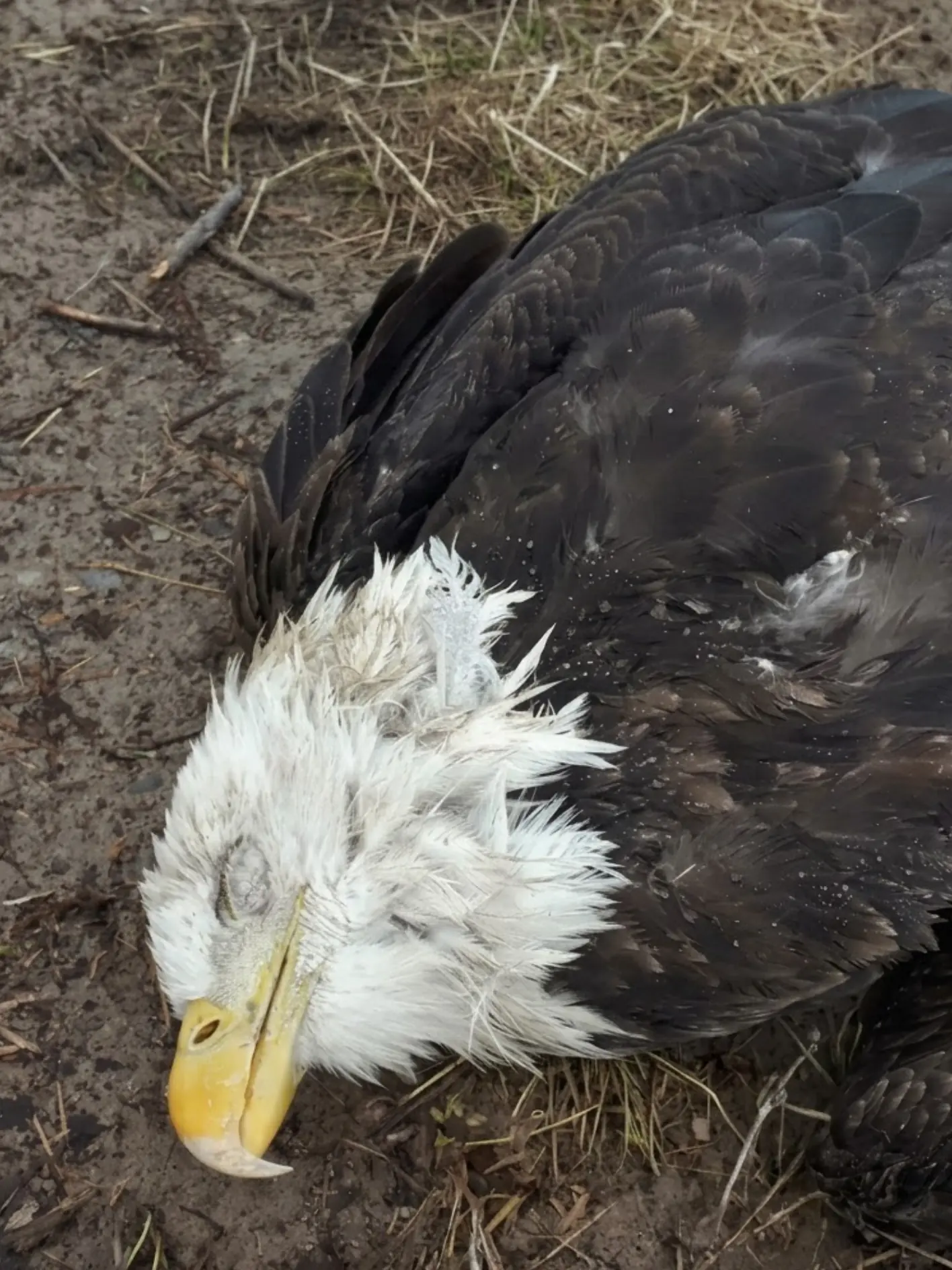
For several moments, there appeared to be no movement at all.
Then someone looked more closely.
“The eagle was lying in the ditch and looked completely dead,” one of the rescuers recalled. “There was nothing that immediately suggested it was still alive. Then we noticed the faintest movement in the feathers over its chest. They were barely rising with each breath.”
That almost imperceptible movement changed everything.
The adult bald eagle was still alive, but only marginally responsive. A wildlife responder was contacted, and the bird was transported to a licensed wildlife rehabilitation and raptor care center in western Washington, where veterinarians began emergency stabilization for what they believed could be severe blunt-force trauma.
Based on the location where the eagle was found and the profound neurological depression observed at admission, a collision with a vehicle became the leading suspicion.
No one had witnessed an impact, however, and clinicians were careful not to call the cause confirmed.
What they could say with certainty was that the eagle had arrived in critical condition.
It was unconscious or nearly unconscious.
It could not stand.
It did not lift its head.
It showed almost no voluntary movement.
Its breathing was shallow.
And aside from limited responses to painful stimulation, the powerful wild raptor appeared almost completely unresponsive to the world around it.
The bird was immediately placed in an oxygen-supported enclosure, intravenous access was established through a leg, fluids were administered, and treatment was initiated for suspected head trauma.
At that point, the rehabilitation team was not thinking about release.
They were trying to determine whether the eagle would survive the first night.
Found Motionless Beside a Rural Road
The eagle was discovered near a rural roadway east of Everett, where open fields, wetlands, forest edges, and waterways create productive habitat for bald eagles.
Adult bald eagles are common throughout much of western Washington.
They move between rivers, lakes, shoreline habitat, agricultural areas, and wooded roosting sites, sometimes flying across busy transportation corridors as they travel between feeding areas.
They may also descend near roads to investigate carrion.
That behavior can place large raptors dangerously close to moving vehicles.
In this case, the bird was found down in a ditch close enough to the roadway that collision trauma immediately had to be considered.
But location alone could not establish what had happened.
A sick eagle might also become grounded near a road.
Lead exposure, neurological illness, infection, severe exhaustion, or another medical problem could potentially cause a bird to lose control or become unable to fly.
The rehabilitation team therefore treated the suspected vehicle strike as a working diagnosis rather than a fact.
“Given where the eagle was found and the severity of the neurological depression, a vehicle strike was our leading suspicion,” one veterinarian said. “But nobody witnessed the event, so we could not say with certainty exactly what happened.”
The Photograph Captured the Severity of the Initial Condition
A photograph taken before transport shows how little life the eagle appeared to have left.
The adult bird is lying on the ground with its head resting directly against the soil.
Its eyes are closed.
The neck feathers are disordered.
The wings remain folded against the body rather than spread in an obvious attempt to escape.
There is no visible defensive posture.
For a bald eagle, that level of inactivity is profoundly abnormal.
A healthy adult raptor generally does not allow a person to approach within close distance without attempting to create space.
Even many severely injured eagles retain powerful defensive responses.
This bird barely reacted.
“It was almost completely still,” the rescuer said. “The head was stretched forward and it wasn’t trying to get away. If you weren’t watching the chest very closely, you would have thought there was no breathing.”
That faint respiration was enough to justify immediate intervention.
Rescuers Had to Assume Head or Spinal Trauma
Because the mechanism of injury was unknown, responders had to handle the bird as though significant trauma to the head, neck, or spine might be present.
Unnecessary movement was avoided.
The body was supported.
The wings were kept close to the torso.
The head and neck were handled carefully rather than allowed to swing freely during transport.
The bird was placed into a dark, ventilated carrier, where reduced visual stimulation could limit additional stress.
No one attempted to feed or give water by mouth at the roadside.
That restraint was important.
An unconscious or neurologically impaired bird may not swallow normally. Attempting to force food or water into the mouth can create a risk of aspiration into the respiratory tract.
The immediate need was professional stabilization.
The Eagle Arrived Nearly Unresponsive
At the rehabilitation center, the clinical picture remained grave.
The eagle could not maintain a normal standing position.
It did not hold its head upright.
Its eyes remained closed for prolonged periods.
Voluntary movement was minimal.
Veterinary staff evaluated the bird’s response to touch and controlled stimulation.
The limited response suggested profound neurological depression rather than ordinary exhaustion.
A bald eagle can become extremely quiet under restraint, but this bird was not simply calm.
It was neurologically compromised.
The staff’s first priority was therefore oxygenation and circulation.
Oxygen Support Came First
The eagle was placed inside an oxygen-enriched enclosure.
Supplemental oxygen can help support critically ill trauma patients while veterinarians determine whether respiratory compromise, shock, head injury, or other systemic problems are present.
The goal was not to “wake” the eagle immediately.
The goal was to reduce physiologic demand and improve oxygen availability while the nervous system and other organs were under stress.
Handling was kept to a minimum.
A critically compromised bird expends energy every time it struggles or is moved.
In the first hours, even diagnostic procedures have to be balanced against the risk of destabilizing the patient further.
A Catheter Was Placed in the Leg
Veterinary staff established intravenous access through a leg so fluids and necessary medications could be administered in a controlled manner.
Trauma patients may be dehydrated.
They may have impaired circulation.
They may have gone hours without eating or drinking.
Fluid therapy supports circulation and helps maintain perfusion to tissues during the acute phase of care.
It does not directly treat a concussion or repair brain tissue.
Its purpose is supportive.
In severe wildlife trauma, that distinction matters.
There may be no single medication capable of reversing what happened during the initial impact.
Veterinarians instead support the patient while trying to limit secondary complications and giving the body time to recover.
Suspected Head Trauma Became the Central Concern
The eagle’s neurological state made significant head trauma one of the most urgent possibilities.
The bird was nearly unconscious.
It could not right itself normally.
Its response to the environment was profoundly reduced.
Those signs can occur after severe blunt-force injury.
If the eagle had been struck by a vehicle, the initial impact might have caused a concussion or more serious traumatic brain injury even without an obvious skull wound.
Veterinary teams are particularly concerned about what happens in the hours after such trauma.
The original impact creates the primary injury.
A secondary process can follow.
Inflammation.
Changes in blood flow.
Tissue swelling.
Altered pressure within the skull.
Those processes may cause additional neurological damage after the collision itself is over.
“After a major head injury, some of the damage can occur after the initial impact as inflammation and swelling develop,” the veterinarian explained. “Our immediate goal was to support the bird and reduce the risk of secondary injury while we waited to see how much neurological function might return.”
Medication and supportive treatment were therefore used as clinically appropriate to address inflammation and the risk of worsening neurological injury.
Specific treatment choices depended on the bird’s examination findings and response during hospitalization.
Diagnostic Imaging Had to Wait Until the Bird Was Stable Enough
The team also needed to know whether the eagle had suffered major skeletal trauma.
Vehicle strikes can cause fractures of the wings, legs, shoulder girdle, or pelvis.
Chest trauma is also possible.
But a profoundly unstable patient cannot always be taken immediately through every diagnostic procedure.
Once the bird was considered stable enough, radiographs were obtained.
The images provided one of the first pieces of encouraging information.
No catastrophic fracture of the major wing or leg bones was identified.
There was evidence consistent with trauma, but not the kind of devastating orthopedic injury that would automatically prevent eventual release.
That did not make the eagle’s condition mild.
Its most serious problem remained neurological.
The Critical Question Was No Longer About Bone
At that point, the veterinary team knew something important.
The bird was not lying motionless because one wing was obviously shattered.
The skeleton did not explain the depth of the unresponsiveness.
The question shifted.
Would the nervous system recover?
For a bald eagle, neurological function affects nearly everything required for survival.
Vision.
Balance.
Head control.
Coordination.
Foot placement.
Grip.
Flight.
Landing.
Feeding.
A bird can have completely intact wings and still be non-releasable if neurological function does not return.
Pupils and Eye Responses Were Monitored Closely
The eagle’s eyes became an important part of every examination.
Staff evaluated pupil symmetry and response to light.
They watched for spontaneous blinking.
They looked for changes in visual tracking as consciousness began to return.
After head trauma, unequal pupil responses or persistent visual deficits can indicate significant neurological injury.
Vision is also one of the most important release criteria for any eagle.
A bird that can fly but cannot judge distance accurately would remain at high risk in the wild.
For now, though, the first objective was more basic.
The eagle needed to become conscious enough to use its eyes normally at all.
The First Night Was About Survival
The eagle remained in a quiet, controlled environment with oxygen support and minimal disturbance.
There was no effort to make it stand.
No flight testing.
No unnecessary handling.
Feeding was approached cautiously because the bird’s neurological state made normal swallowing uncertain.
The staff monitored respiration, posture, responsiveness, and neurological changes.
In a case like this, the first night can determine the direction of the entire rehabilitation.
A bird may stabilize.
It may deteriorate as cerebral swelling progresses.
Or it may remain so neurologically impaired that humane-care decisions eventually have to be considered.
No one could predict which path this eagle would take.
“The immediate question was simply whether it would survive the night,” the veterinarian said.
The First Improvement Was Almost as Subtle as the First Breath
By the following day, staff began seeing a small change.
The eagle intermittently opened its eyes.
It did not immediately sit upright.
It did not suddenly become defensive.
But it was doing something it had not done consistently on arrival.
It was becoming aware of its surroundings.
Later, the bird began holding its head up for brief periods.
Those changes may sound small.
In a profoundly neurologically depressed patient, they can be extremely meaningful.
The rehabilitation team was seeing the first evidence that some neurological function was returning.
The prognosis remained guarded.
But it was no longer static.
Head Control Gradually Improved
Over the next phase of treatment, the eagle spent longer periods holding its head normally.
The eyes remained open more consistently.
Responses to nearby movement became stronger.
The bird began reacting more normally when staff entered the treatment area.
Respiratory effort also became more stable.
As oxygenation and neurological status improved, the need for continuous supplemental oxygen could be reassessed.
The bird was moving from the immediate life-support phase toward neurological recovery.
That transition did not happen in a single dramatic moment.
It came through dozens of small observations.
A stronger blink.
A more purposeful head movement.
A foot withdrawing normally.
A better attempt to reposition the body.
Each one provided information.
The Ability to Sit Upright Became a Major Milestone
Eventually, the eagle began maintaining a normal sternal position rather than lying flat.
For a bird recovering from suspected head trauma, that is an important neurological step.
The animal must coordinate muscles throughout the neck, trunk, legs, and feet simply to maintain posture.
A bird unable to right itself cannot safely perch or fly.
Once the eagle could remain upright, the team began watching whether balance was symmetrical.
Was the head held straight?
Was there persistent tilt?
Was the bird falling to one side?
Was one foot being placed abnormally?
The answers were increasingly reassuring.
Standing Came Later
The next milestone was standing.
Initially, the bird could support itself only briefly.
Weakness after prolonged recumbency is expected.
The eagle had spent significant time barely moving.
Even without major muscle injury, deconditioning can occur rapidly in a large bird.
Staff therefore did not interpret initial weakness as evidence that neurological recovery had failed.
They watched the trend.
Standing became steadier.
The feet were used more normally.
Grip improved.
The bird began behaving less like a critically ill patient and more like an injured wild raptor recovering from a severe event.
Feeding Had to Wait Until Swallowing Was Safe
Nutrition became increasingly important as consciousness returned.
But the staff had deliberately avoided aggressive feeding while the eagle was profoundly neurologically impaired.
A compromised swallowing reflex creates a serious aspiration risk.
Once the bird was alert enough to swallow normally, nutritional support could be introduced more safely.
Small amounts were offered.
Tolerance was monitored.
As the eagle’s neurological state continued improving, it eventually began eating independently.
That was one of the most important steps in the rehabilitation.
A bird that voluntarily feeds is no longer completely dependent on staff to maintain basic energy intake.
It also provides evidence that vision, coordination, swallowing, and normal behavioral drive are functioning more effectively.
Bloodwork Helped Rule Out Additional Problems
The rehabilitation team did not assume that trauma explained everything.
Blood testing was used to assess the eagle’s broader condition.
A complete blood count and chemistry profile could help evaluate hydration, anemia, inflammation, and organ function.
Lead screening was also considered because lead exposure is a recognized cause of weakness and neurological abnormalities in bald eagles.
The bird’s roadside location and suspected collision made trauma the leading diagnosis, but wildlife patients can have more than one condition at the same time.
A debilitated eagle exposed to lead, for example, might be more vulnerable to secondary collision.
The purpose of screening was therefore to make sure another major problem was not being overlooked.
No single blood result replaced the clinical picture.
The team continued interpreting laboratory findings alongside the bird’s neurological progress.
The Suspected Vehicle Strike Remained a Diagnosis of Probability
As the eagle improved, the staff continued describing the event carefully.
The injury pattern remained compatible with blunt trauma.
The roadside location supported the possibility of a vehicle strike.
The profound neurological depression at admission was consistent with severe head injury.
But nobody had witnessed a collision.
The medically appropriate wording remained:
suspected vehicle trauma.
That distinction matters in responsible wildlife reporting.
A plausible explanation should not be turned into a confirmed event simply because it fits the circumstances.
Vision Became One of the Next Major Questions
Once the eagle was standing and eating, clinicians could evaluate the eyes more meaningfully.
Could it track movement?
Did both pupils respond appropriately?
Could the bird locate food?
Did it react to objects approaching from either side?
There were no indications of a persistent severe visual deficit during the recovery period.
That was especially encouraging because an eagle with permanent vision impairment may be unable to return to the wild even if every bone and muscle is otherwise healthy.
Vision had cleared one important hurdle.
Balance still needed to prove itself under more demanding conditions.
Perching Tested the Nervous System in a New Way
The eagle was gradually given opportunities to perch.
Perching appears effortless when a healthy bird does it, but neurologically it is complex.
The bird must coordinate:
- vision,
- foot placement,
- grip,
- body position,
- head orientation,
- and continuous balance adjustments.
Early perches were kept low enough that a fall would not create another serious injury.
The eagle increasingly maintained position without assistance.
Its grip remained secure.
No persistent head tilt or obvious loss of balance developed.
Those observations allowed the rehabilitation team to consider the next transition.
From Intensive Care to Rehabilitation
At this stage, the bird was no longer merely surviving.
It was recovering.
The eagle could remain upright.
It was eating.
Its neurological responses had improved.
Breathing had stabilized.
Oxygen support was no longer the central treatment.
Human contact could begin to decrease.
That transition is important in wildlife rehabilitation.
A critical-care enclosure is designed to protect a weak patient.
A rehabilitation enclosure is designed to make the patient begin functioning independently again.
The bird now needed space.
Muscle Condition Had to Be Rebuilt
Days of inactivity inevitably affect flight muscles.
The pectoral muscles that drive the wingbeat require regular use.
An eagle recovering from severe head trauma may therefore become neurologically normal before it becomes physically fit enough for release.
Staff monitored body weight and muscle condition along the keel.
The bird’s appetite supported rebuilding.
But food alone cannot restore flight endurance.
Exercise would eventually have to do that.
Both Wings Were Reassessed Before Flight Testing
Before placing the eagle into a large flight enclosure, clinicians checked wing movement again.
The bird had escaped catastrophic orthopedic injury on radiographs, but subtle pain or soft-tissue trauma could still become important.
Both wings needed to extend normally.
There could be no persistent droop.
No obvious asymmetry.
No significant restriction.
The bird’s natural stretching and preening behavior also provided useful information.
When both wings were being used freely, the rehabilitation team could move forward.
The First Flight Was Not the End of the Story
Eventually, the eagle entered an outdoor flight enclosure.
The first controlled flights represented a major change from the bird photographed motionless in the ditch.
It could take off.
It could use both wings.
It could remain airborne.
But one successful flight does not make an eagle releasable.
The team needed to evaluate much more.
How strongly did it launch?
How quickly could it gain altitude?
Were the wingbeats symmetrical?
Could it turn in both directions?
Could it land accurately?
How quickly did it become tired?
Did balance remain normal after exercise?
For a patient recovering from suspected brain trauma, those details were especially important.
Flight Became a Neurological Examination
A bird can appear normal while sitting on a perch and still have subtle neurological deficits.
Flight tests multiple systems simultaneously.
Vision has to function at speed.
The brain has to process changing spatial information.
The wings and tail must coordinate continuously.
The feet must extend at the correct moment during landing.
The head must remain stable.
The bird must compensate instantly for changes in airflow and direction.
The eagle’s performance therefore provided some of the strongest evidence that neurological recovery was real.
The Early Flights Were Kept Controlled
After critical illness, rehabilitation is progressive.
The team did not require maximum endurance immediately.
Initial flights could be shorter.
The important feature was improvement.
Each session allowed staff to compare:
- altitude,
- distance,
- recovery time,
- maneuverability,
- and landing quality.
The eagle gradually became stronger.
The wingbeats became more efficient.
The bird could complete additional passes without abnormal fatigue.
Landings Were Particularly Important
The final seconds of a flight can reveal neurological impairment that straight-line flying does not.
An eagle must judge the location of a perch.
Reduce speed.
Adjust the tail.
Position both wings.
Extend the feet.
Make contact.
Grip.
Balance.
If vision or coordination remained abnormal, landing errors could appear even after apparently strong flight.
This eagle increasingly landed with the control expected of a healthy adult.
That was a major step toward release.
Wild Behavior Returned Along With Strength
Another positive change occurred in the eagle’s behavior toward people.
The nearly unconscious bird that had barely reacted at intake became increasingly unwilling to tolerate human proximity.
It moved away when staff approached.
It selected more distant perches.
It became more alert to movement outside the enclosure.
Handling became more difficult.
For a wild eagle, those are desirable changes.
The objective of rehabilitation is not to create a calm bird.
It is to restore one that wants nothing to do with human care.
Sustained Flight Had to Be Proven Repeatedly
The eagle continued conditioning until it could demonstrate strong performance on more than one occasion.
The rehabilitation team wanted consistency.
A bird might produce one impressive flight because of excitement or adrenaline.
Wild survival requires repeatable physical capacity.
The eagle therefore needed:
- strong takeoffs,
- adequate altitude,
- sustained flight,
- symmetrical movement,
- controlled turns,
- accurate landings,
- and normal recovery after exercise.
Over time, the bird met those benchmarks.
The prognosis that had once been grave changed substantially.
The Medical Questions Were Revisited Before Release
Before approving release, staff reassessed the entire case.
Was neurological function normal?
Yes.
Was vision functional?
Yes.
Was balance appropriate?
Yes.
Were the feet and grip strong?
Yes.
Was the bird eating independently?
Yes.
Was body condition appropriate?
Yes.
Could it fly strongly and repeatedly?
Yes.
Did it retain wild avoidance behavior?
Yes.
Those answers mattered far more than the fact that the bird now looked healthier.
Wildlife rehabilitation is about function.
Not appearance.
A Release Site Was Selected Away From Immediate Traffic
Because the eagle had originally been found near a road, returning it directly beside fast-moving traffic would have made little sense.
A suitable release location was selected within the same broad Snohomish County region but with appropriate open habitat and greater separation from the immediate roadway hazard.
Returning an adult eagle to its original general landscape is preferable when practical.
The bird may already know regional feeding areas, waterways, and roosting locations.
But the exact site can be adjusted to reduce avoidable risk.
The Carrier Door Opened to a Very Different Bird
On release day, the eagle no longer resembled the nearly lifeless patient brought into emergency care.
It was upright.
Alert.
Watching its surroundings.
Physically conditioned.
Responsive to movement.
The carrier was placed facing suitable open space.
People moved back.
The door was opened.
There was no need for anyone to lift the bird.
No one had to encourage it into the air.
The eagle left under its own power.
Its first wingbeats were strong.
It gained altitude.
And rather than falling back toward the ground, it continued away from the release site.
“When this eagle arrived, our immediate question was whether it would survive the night,” the veterinarian said. “By the time we considered release, it had demonstrated normal vision, coordination, strength and sustained flight. Those were the things we needed to see.”
The Contrast With the Ditch Was Difficult to Miss
Weeks earlier, there had been almost no visible movement.
The bird’s head had been stretched across the ground.
Its eyes were closed.
Its body appeared lifeless.
A rescuer had to watch the chest feathers carefully just to confirm that respiration was still occurring.
Now those same flight muscles were carrying the eagle away.
The transformation was dramatic.
The clinical process that produced it was not.
It consisted of oxygen.
Fluids.
Careful neurological monitoring.
Treatment for suspected head trauma.
Controlled handling.
Safe nutrition.
Rest.
Repeated examinations.
Progressive exercise.
Flight assessment.
And time.
There was no single moment when the bird was “saved.”
Recovery occurred in stages.
Roadside Carrion Remains a Hazard for Eagles
Although no one witnessed this eagle being struck by a vehicle, the case also offers an opportunity to discuss the risk roads pose to scavenging raptors.
Bald eagles may approach highways to feed on animal carcasses.
Once on the ground, a large eagle requires room to take off.
A bird that has recently eaten may be heavier and slower to become airborne.
Fast-moving traffic can close that distance quickly.
People can reduce some of these risks by keeping food waste away from roads and securing garbage that might attract wildlife.
Large carcasses creating an obvious wildlife and traffic hazard can be reported to appropriate road or wildlife authorities according to local procedures.
An Apparently Dead Eagle May Still Be Alive
The first moments of this case are also an important reminder for anyone who encounters injured wildlife.
Do not assume a completely motionless bird is dead.
From a safe distance, subtle respiration may sometimes be visible as movement in feathers over the chest or body.
But approaching closely or touching the bird is not recommended.
Even a bald eagle that appears unconscious can regain enough awareness to defend itself suddenly.
The feet and talons can cause severe injuries.
The safest response is to:
- keep people and pets away,
- note the exact location,
- avoid moving the bird unnecessarily,
- and contact trained wildlife professionals.
Not Every Grounded Eagle Has Been Hit by a Car
The opposite assumption should also be avoided.
An eagle found beside a highway is not automatically a collision victim.
Lead exposure.
Avian influenza.
Electrocution.
Territorial conflict.
Other toxins.
Neurological illness.
And orthopedic injuries unrelated to traffic can all leave a bald eagle grounded.
That is why professional examination remains necessary.
In this case, the roadside setting and clinical picture made blunt trauma the leading explanation.
The exact mechanism was never witnessed.
The cautious language remained appropriate even after the bird recovered.
Recovery Does Not Mean Every Similar Patient Will Survive
This outcome was unusually favorable given how close to death the eagle appeared at rescue.
Other birds with similar neurological depression may have irreversible brain injury.
Some may develop complications.
Others may have spinal trauma, internal bleeding, or fractures severe enough to prevent release.
Successful recovery from one case should never be interpreted as proof that severe head trauma is routinely survivable.
What this eagle demonstrates is something narrower.
A profoundly compromised bird can sometimes retain a viable path to recovery even when that possibility is almost invisible at the time of rescue.
The First Sign of That Possibility Was Almost Impossible to See
Not an eye opening.
Not a wingbeat.
Not an attempt to stand.
Just a few feathers moving.
That was all.
The bird that would eventually return to the sky gave rescuers almost no evidence that it could survive.
But it gave them enough.
A breath.
Then another.
That was enough to justify transport.
Enough to begin oxygen support.
Enough to establish intravenous access.
Enough to treat suspected head trauma.
And eventually enough time for the nervous system to begin recovering.
From a Grave Prognosis to Release
The language used to describe the eagle’s outlook changed throughout rehabilitation.
At intake, the prognosis was grave.
After surviving the first critical period and beginning to regain consciousness, it remained guarded.
As posture, appetite, vision and balance returned, the outlook improved.
Once the eagle began demonstrating normal flight, the prognosis became substantially more favorable.
Only after repeated successful flight tests did the team consider release appropriate.
That progression is how a wildlife prognosis should change.
Not according to hope.
According to evidence.
The Final Test Was Independence
The rehabilitation center could provide oxygen.
It could administer fluids.
It could manage medications.
It could protect the eagle while unconscious.
It could offer food.
It could provide a flight enclosure.
But those things are temporary substitutes for what a wild animal must ultimately do alone.
The eagle had to demonstrate that the substitutes were no longer necessary.
The strongest evidence came when the carrier door opened.
The bird did not remain inside waiting for help.
It left.
A Nearly Invisible Breath Became a Flight
When rescuers first looked into the roadside ditch, the bald eagle appeared completely dead.
Its body was motionless.
Its head lay extended against the ground.
Its eyes were closed.
Only the faint rise and fall of a few breast feathers revealed that life remained.
At the rehabilitation center, the eagle was placed in oxygen, given intravenous fluids through a leg catheter, treated for suspected traumatic head injury, and monitored closely as clinicians waited to see whether neurological function could return.
The first improvement was small.
An eye opening.
Then head control.
Then sitting upright.
Standing.
Eating.
Perching.
Flight.
Eventually, repeated testing showed normal enough vision, coordination, strength and endurance for the rehabilitation team to make a decision that had seemed almost unimaginable when the bird arrived.
It could go home.
Weeks after being found nearly lifeless beside a Washington road, the adult bald eagle stood at the opening of a transport carrier with no medical support attached and no person holding it upright.
The door opened.
This time, there was no need to watch closely for a tiny movement in the feathers.
The movement was unmistakable.
The eagle launched, gained altitude, and continued across the landscape under its own power.
Its recovery does not mean every bald eagle found in such severe condition can survive.
It does show why an apparently lifeless wild bird should not automatically be assumed dead — and why rapid, professional intervention can sometimes preserve a chance for recovery that, at the roadside, may be visible only in a single shallow breath.