A Bald Eagle found helplessly entangled across an active electric livestock fence outside Missoula, Montana, is recovering after a passerby located the fence’s power source, shut it off and carefully freed the bird before rushing it to specialized wildlife care.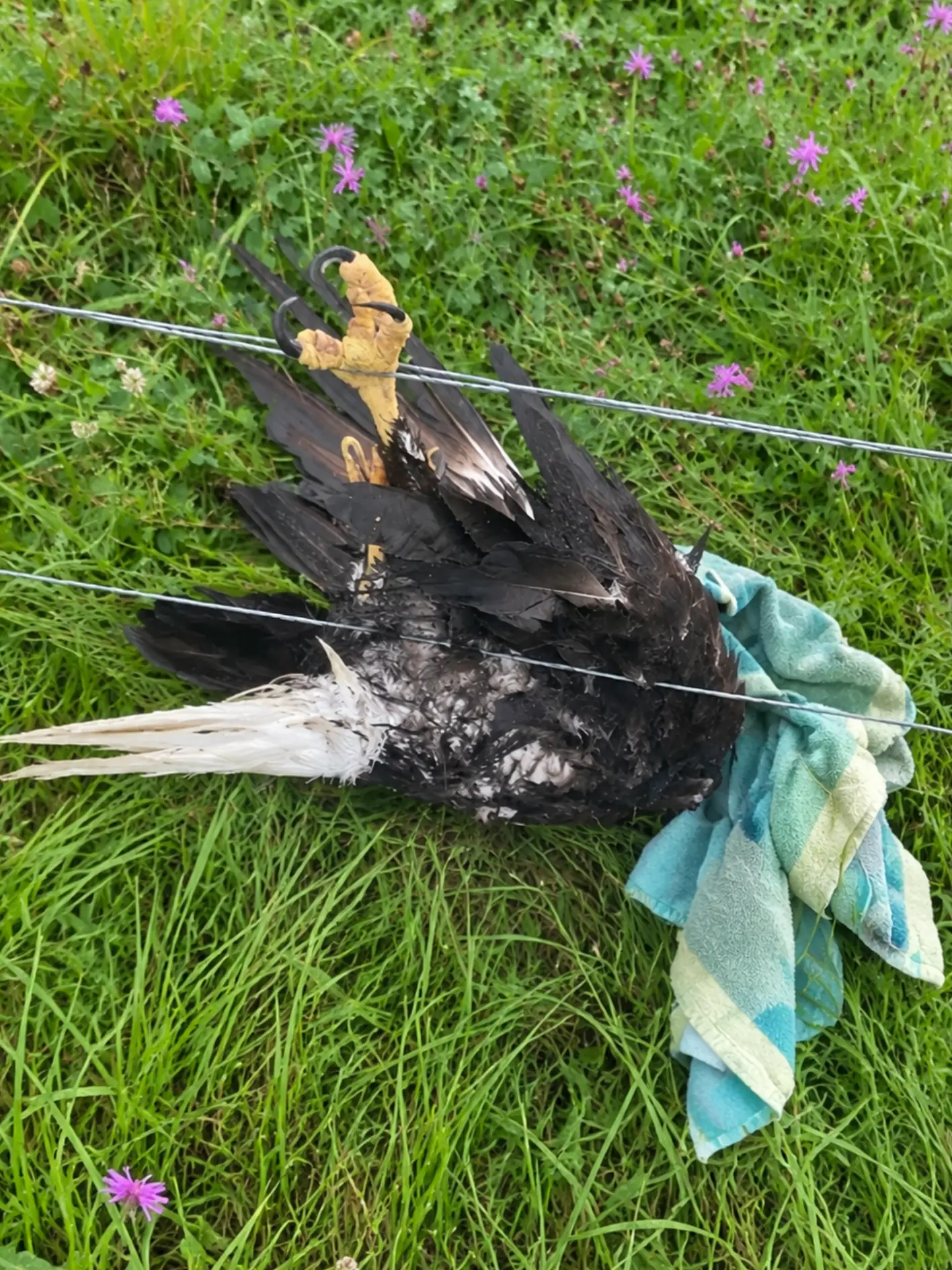
When Daniel Mercer first spotted the eagle, he knew immediately that something was wrong.
The adult bird was lying awkwardly in the grass beside a pasture fence, its body partially inverted and one foot caught over the upper strands. Several wires crossed beneath and around its wings and torso. The eagle made only weak attempts to move.
At first, Mercer started toward it.
Then he realized what kind of fence he was looking at.
It was energized.
Rather than touch the bird or the wire, Mercer stopped and searched for the fence energizer. Only after locating the system, switching the power off and making sure the line was no longer active did he approach the eagle.
What he found was a bird in extremely poor condition.
The eagle’s feathers were wet and disordered. Its wings lay partly open. One foot remained tangled in the wire, and the bird showed little of the defensive behavior normally expected from a healthy Bald Eagle.
Mercer covered the bird with a towel, controlled the powerful feet as carefully as he could and worked the wires loose one at a time.
The eagle barely resisted.
That worried him more than if the bird had fought back.
“At first, I honestly didn’t know if it was going to survive,” Mercer later recalled. “It was breathing, but it seemed completely exhausted.”
He placed the bird into a secure carrier and drove it to a licensed raptor rehabilitation center in western Montana.
During the trip, however, something changed.
The eagle began moving.
Then it tried to sit upright.
By the time the carrier reached the rehabilitation facility, the bird that had seemed almost unresponsive at the fence was beginning to struggle strongly against confinement.
For the rehabilitation team, that was the first encouraging sign.
But with suspected electrical injury, they knew the most dangerous effects might not yet be visible.
The Eagle Was Found in a Position It Could Not Escape
Photographs taken at the scene show the adult Bald Eagle lying on its back in thick grass, with several strands of fence wire running across and around its body.
One foot appears caught above the line.
The wings are partly spread.
The bird is clearly not in a normal resting position.
A healthy Bald Eagle is powerful enough to launch from open ground and normally would not remain helpless on its back while people approached.
The fact that this bird could not free itself indicated that either the entanglement, the electrical exposure or both had already severely compromised its ability to move.
The precise sequence of events is impossible to reconstruct with certainty.
The eagle may have been flying low across the pasture when a foot or wing contacted the fence.
It may have attempted to land on what appeared to be a harmless wire.
Or it may have collided with the structure while pursuing prey or moving through the area.
What is clear is that once the bird became caught, repeated contact with an energized fence created a potentially life-threatening situation.
Electric Fences Are Designed to Deliver Repeated Pulses
Most livestock electric fences do not provide a constant current.
Instead, an energizer sends short electrical pulses through the wire.
The design is intended to discourage livestock from pushing through a boundary rather than continuously electrocute an animal.
For a bird that touches the wire briefly and immediately flies away, a single pulse may cause little or no lasting damage.
A trapped animal is different.
If a wing, foot or body remains in contact with the energized wire while another part of the animal is grounded, repeated electrical pulses can pass through tissue again and again.
The longer the animal remains caught, the greater the concern.
Electrical injuries can affect:
muscle,
skin,
nerves,
blood vessels,
and, in severe cases, cardiac function.
Some damage may be immediately visible.
Other injuries may not become apparent for hours or even days.
That delayed progression was one of the reasons the rehabilitation team treated the eagle as a critical patient despite its improving behavior during transport.
Turning Off the Power Was the Most Important First Step
Mercer’s decision not to grab the eagle immediately was critical.
A person attempting to rescue an animal from an energized fence can become part of the electrical pathway.
Wildlife professionals emphasize that people should never assume a fence is safe simply because an animal appears motionless.
The system must be disconnected first.
In this case, Mercer located the fence energizer and shut the unit down before touching either the eagle or the wire.
That made the rescue possible without exposing himself to the same electrical hazard.
Only then did he begin working to free the bird.
A Bald Eagle’s Talons Remain Dangerous Even When the Bird Is Weak
Another risk was the eagle itself.
Bald Eagles are not dangerous because they are aggressive toward people; they are dangerous to handle because their feet are exceptionally powerful.
The talons are designed to seize fish, waterfowl and other prey.
Even an exhausted bird may strike suddenly when frightened or restrained.
Mercer used thick gloves and a towel to reduce the eagle’s visual stimulation while he worked.
The foot tangled over the wire had to be freed without twisting the leg.
Feathers caught around the lower strands were released carefully.
No one tried to pull the eagle free in one motion.
That could have caused additional damage to the joints, feathers or soft tissues.
Once the final wire was cleared, Mercer supported the bird against the towel and moved it into a ventilated carrier.
The eagle still did not attempt to fly.
During Transport, the Bird Began Fighting Back
At the start of the drive, the carrier was quiet.
Mercer could hear only small movements from inside.
He feared the bird might be deteriorating.
Then, partway through the trip, the sounds changed.
The eagle began shifting its body.
Its feet scraped against the carrier floor.
The bird tried repeatedly to push itself upright.
By the time Mercer arrived at the rehabilitation center, staff needed considerably more control during transfer than he had needed at the fence.
That was good news.
A healthy wild Bald Eagle should resist human handling.
An eagle that is too weak to fight back is usually a more concerning patient than one that is difficult to restrain.
“The fact that it was becoming stronger during transport gave us some hope,” a rehabilitation specialist said. “But with electrical injuries, you still have to be careful. What you see in the first hour does not necessarily tell you what the tissues will look like two or three days later.”
The Initial Examination Focused on More Than Burns
Once the eagle reached the rehabilitation center, the veterinary team began a complete evaluation.
They did not assume that electrical shock was the bird’s only problem.
A struggling eagle caught in wire can injure itself mechanically as well.
The team examined:
both wings,
shoulders,
legs,
feet,
pelvis,
spine,
head,
eyes,
chest,
and skin beneath the feathers.
They looked for abrasions from the fence.
They checked the feet and toes for possible electrical contact points.
They palpated the wings for fractures.
They evaluated grip strength.
The eagle’s neurological responses were observed closely.
The bird was alert, but it remained tired and showed signs consistent with significant physiological stress.
X-Rays Were Used to Rule Out Hidden Fractures
Radiographs were obtained because an animal tangled in a fence can sustain orthopedic injuries while trying to escape.
A wing can twist between wires.
A leg can become trapped while the body rotates.
A bird may fall awkwardly after being released.
The veterinary team needed to know whether the eagle had fractured a wing or leg before making decisions about mobility and housing.
The images did not reveal a major fracture.
There was no catastrophic skeletal injury that would explain the bird’s condition.
That was the first major piece of good news.
The problem appeared to be primarily soft-tissue and electrical rather than orthopedic.
But the team remained cautious.
Electrical Injuries Can Be Deceptive
One of the most difficult aspects of electrical trauma is that visible skin injury does not always reflect what is happening deeper inside.
A bird may have only a small area of abnormal skin at the point of electrical contact while muscles, nerves or blood vessels beneath that area have sustained more extensive damage.
In some cases, tissue initially appears viable and later deteriorates.
That can happen when damaged blood vessels fail to maintain adequate circulation.
The affected tissue may gradually become discolored, swollen or nonviable.
Because of this, the eagle’s feet, legs and wings required repeated examination.
The absence of dramatic burns on day one was encouraging.
It was not an all-clear.
Contact Points Were Examined Carefully
Particular attention was given to the eagle’s feet.
A foot caught across an energized wire could serve as one electrical contact point.
The veterinary team assessed:
skin condition,
toe movement,
circulation,
temperature,
grip strength,
and sensation.
They also examined areas beneath the wing and along the body where the fence had crossed the feathers.
Electrical injuries may leave small areas of damaged tissue where current entered or exited the body.
Sometimes these sites are obvious.
Sometimes they are difficult to identify beneath dense plumage.
Cardiac Effects Were Another Concern
Electrical current can interfere with normal muscle contraction, including the heart.
The team monitored the eagle’s heart rate and overall cardiovascular stability during the early period after admission.
Any abnormal rhythm would have increased concern.
The bird’s breathing was also watched closely.
Stress alone can cause a raptor to breathe rapidly, but severe electrical injury or prolonged struggling may produce additional physiological strain.
For that reason, the bird remained under close observation rather than being moved immediately into a standard rehabilitation enclosure.
Supportive Care Began Immediately
The eagle was placed in a quiet, padded intensive-care space.
Fluids were administered according to its level of dehydration and overall condition.
Pain medication was provided when clinically appropriate.
Any superficial wounds associated with the wire were cleaned.
The bird was allowed to rest at floor level rather than being encouraged to perch immediately.
Low stimulation was important.
A newly rescued eagle is already experiencing substantial stress from capture, transport, handling and the unfamiliar environment.
Unnecessary noise or repeated restraint would only increase that burden.
The First Several Hours Remained Uncertain
Although the bird had become more active during transport, staff did not assume the crisis had passed.
It still spent significant time resting.
Its posture was not yet completely normal.
The eagle appeared fatigued after even brief handling.
The veterinary team continued checking circulation in the feet and monitoring areas where the wire had contacted the body.
The initial prognosis remained guarded.
Electrical trauma can change rapidly.
The bird’s condition could improve.
Or delayed tissue damage could appear.
No one yet knew which direction the case would take.
By the Next Day, the Eagle Was More Alert
The first clear improvement was behavioral.
The eagle began holding its head upright for longer periods.
Its eyes followed staff closely.
The feet gripped more strongly.
When someone entered the enclosure, the bird reacted sooner.
During examinations, it became increasingly difficult to control.
That was exactly what the team hoped to see.
“A wild Bald Eagle fighting us is generally a good sign,” one rehabilitator said. “It tells us the bird has strength and awareness returning.”
The eagle was beginning to behave more like a healthy raptor.
Appetite Began to Return
The bird also showed increasing interest in food.
This mattered for several reasons.
First, voluntary feeding is an indicator of general neurological and systemic improvement.
Second, an animal recovering from trauma needs substantial energy.
Muscles that have been stressed or damaged require protein and calories for repair.
Third, eating independently reduces the need for additional handling.
The eagle began consuming food without assistance and maintained its ability to manipulate it with the feet and beak.
That suggested that coordination remained intact.
The Feet Became a Daily Focus
Because of the way the bird had been entangled, the team continued monitoring the feet even as the eagle looked brighter.
Electrical tissue damage can progress slowly.
A foot that appears normal on the first day may show swelling or tissue changes later.
Staff evaluated whether:
both feet remained warm,
toe movement remained symmetrical,
grip strength stayed strong,
and the eagle could place weight normally.
Any deterioration would have changed the prognosis.
Fortunately, function continued to improve.
The Bird Began Standing Normally
As strength returned, the eagle spent increasing periods upright.
Both feet came beneath the body.
The wings remained folded normally at the sides instead of being used for support.
Balance improved.
The eagle no longer appeared to collapse back onto the padded flooring after short periods of activity.
These changes indicated that the bird was moving beyond the initial shock of the incident.
A Low Perch Was Introduced
The next step was a low perch.
This provided a more demanding test of foot function without exposing the bird to a dangerous fall.
Perching requires active grip.
The toes have to remain flexed around a narrow surface while the bird continually adjusts balance.
The eagle climbed onto the perch and maintained position.
Both feet participated normally.
There was no obvious reluctance to use the previously entangled foot.
That was another encouraging milestone.
Staff Continued Watching for Delayed Burns
Even while the bird improved functionally, repeated examinations of the skin and soft tissues continued.
Electrical injury can create areas of tissue death that become visible only after damaged circulation declares itself.
The team watched for:
darkening skin,
loss of sensation,
swelling,
open wounds,
abnormal odor,
or changes in the feathers overlying the contact areas.
No rapidly progressive tissue damage was identified.
The longer the bird remained stable without delayed deterioration, the more cautiously optimistic the prognosis became.
Wing Function Had to Be Evaluated Too
The eagle’s wings had become entangled across the fence, and the bird likely struggled forcefully while trapped.
That raised concern for muscle strain or shoulder injury even though the radiographs showed no fracture.
As the eagle became stronger, staff observed natural wing stretching.
Both wings extended.
The shoulders appeared symmetrical.
There was no persistent droop.
The bird did not immediately pull one wing back because of pain.
These observations suggested that the mechanical structures required for flight remained intact.
Flight Could Not Be Tested Immediately
The fact that the eagle could stretch its wings did not mean it was ready for release.
A bird recovering from an electrical event may still have subtle neurological or muscular deficits.
The team needed to make sure the bird remained stable over time.
Only after the danger of delayed tissue injury had decreased could the eagle progress to a larger rehabilitation enclosure.
The Move to a Flight Space Was a Major Step
When the veterinary team was satisfied with the eagle’s systemic stability, foot function and wound condition, it was transferred into a larger enclosure.
This allowed the bird to begin using its body more naturally.
The eagle moved between perches.
It stretched.
It flapped.
Then came short flights.
The staff watched from a distance.
They were looking for anything abnormal:
uneven wingbeats,
loss of altitude,
poor balance,
hesitation during landing,
or weakness in either foot.
The first short flights were encouraging.
Takeoff Tested the Bird’s Strength
A Bald Eagle needs considerable power to become airborne from a stationary position.
Takeoff requires both wings to generate strong, coordinated thrust.
The legs also contribute during the initial launch.
The rescued eagle was able to leave the perch with symmetrical wingbeats and gain height normally.
There was no obvious weakness.
The bird did not veer toward one side.
That suggested both flight muscles and neurological coordination were functioning well.
Landing Tested the Feet Again
Landing was equally important.
The eagle had to judge the perch, slow its body, extend the legs and close the talons around the branch.
If the electrical injury had damaged the nerves controlling one foot, landing accuracy could be affected even if flight looked normal.
The bird landed securely.
Both feet gripped.
Repeated landings continued to look appropriate.
The team now had functional evidence that the feet were doing more than simply appearing healthy during a physical examination.
One Good Flight Was Not Enough
Wildlife rehabilitation standards require consistency.
The eagle needed to fly repeatedly.
It had to turn in both directions.
Maintain altitude.
Land accurately.
And recover without abnormal fatigue.
A bird that can perform once under ideal conditions may still fail when exposed to the unpredictable demands of the wild.
The rehabilitation team therefore continued conditioning the eagle over multiple sessions.
Its performance remained strong.
The Bird’s Increasing Dislike of People Was Encouraging
During this period, staff interaction was kept to a minimum.
A releasable Bald Eagle should remain wary of humans.
It should not associate people with food or safety.
This bird showed no signs of becoming habituated.
When personnel approached, it moved away.
During necessary examinations, it resisted strongly.
The quiet, nearly motionless bird Mercer had lifted from the fence was gone.
In its place was an alert adult raptor that clearly wanted distance from its caregivers.
The Rescue Could Have Ended Very Differently
Had Mercer grabbed the bird while the fence was still energized, he could have been injured himself.
Had the eagle remained trapped longer, repeated electrical pulses might have caused greater tissue damage.
Had no one found the bird, it would have remained unable to feed, escape weather or defend itself.
The sequence of events mattered.
First, the danger was recognized.
Then the power was shut off.
Then the bird was freed.
Then it was transported for professional evaluation.
Each step gave the eagle a better chance.
The Case Is Also a Reminder About Electric Fence Safety
Wildlife occasionally becomes entangled in fencing designed for livestock.
In most cases, a person who discovers a trapped animal should contact the property owner, animal control, a state wildlife agency or a licensed rehabilitator.
If the fence is energized, no rescue should begin until the electrical system has been safely disconnected.
People should never test an electric fence by touching it.
And they should not assume that a wire is inactive simply because it looks ordinary.
The priority is preventing a wildlife emergency from becoming a human emergency.
A Grounded Eagle Should Not Be Handled Casually
The same caution applies after the power is off.
A Bald Eagle can cause serious injury with its talons.
An alert bird may strike even while its wing or leg is compromised.
Members of the public should not attempt to capture a large raptor unless directed by trained professionals and equipped appropriately.
Keeping people, pets and traffic away from the animal while waiting for responders is often the safest action.
The Eagle’s Current Condition Is Encouraging
The bird is now far stronger than it was when first removed from the fence.
It is alert.
It stands normally.
Its grip is strong.
It eats independently.
Both wings function symmetrically.
No major fracture was identified.
And, importantly, no progressive electrical tissue injury has so far compromised the feet or wings.
The prognosis has moved from guarded toward increasingly favorable.
But wildlife teams remain cautious until every functional requirement for release has been demonstrated consistently.
Release Depends on More Than Survival
The rehabilitation center’s goal is not simply to keep the eagle alive.
The bird must be capable of living entirely without assistance.
It must:
fly strongly,
turn accurately,
land safely,
grip securely,
feed normally,
maintain its feathers,
and respond appropriately to potential threats.
Any meaningful neurological or tissue deficit could make release unsafe.
That is why even a bird that appears dramatically improved in photographs still requires structured evaluation.
The Best Sign Was the One That Made Handling Harder
When the eagle first arrived, its weakness made it relatively easy to control.
As the days passed, that changed.
It fought restraint.
Its feet became stronger.
Its posture became taller.
Its eyes remained fixed on people.
Those behaviors meant that the wild bird was returning.
For the rehabilitation team, that transformation is one of the most satisfying parts of a successful case.
The goal is always to reach the point where the patient no longer behaves like a patient.
Mercer’s Intervention Bought the Eagle Time
The rescuer did not provide veterinary treatment.
He did not diagnose electrical injury.
He did not need to.
What he did was more immediate.
He recognized the danger.
He shut off the power.
He freed the eagle carefully.
And he transported it to people who could evaluate what the electricity may have done internally.
That chain of actions converted a potentially fatal entanglement into a recoverable medical case.
Electrical Injury Still Requires Respect Even When Recovery Looks Fast
The bird’s relatively rapid improvement should not minimize the seriousness of the original event.
Electrical trauma can be unpredictable.
Some animals develop severe delayed burns.
Others sustain permanent nerve damage.
Cardiac complications can occur.
Tissue that initially appears normal may later die.
The outcome depends on the amount of current, the pathway through the body, the duration of contact and individual physiological factors.
This eagle was fortunate.
The medical findings increasingly suggested that the most severe potential complications had been avoided.
The Final Test Will Be Complete Independence
Before release, the eagle must continue demonstrating normal performance in the flight enclosure.
It will need repeated strong takeoffs.
Controlled turns.
Accurate landings.
Normal foot use.
Appropriate endurance.
No delayed pain.
No tissue deterioration.
Only then can the team return it to suitable habitat.
There is no benefit in releasing the bird simply because it looks better.
The wilderness will not provide a second medical examination if an unseen problem remains.
From a Live Fence to a Second Chance
When Daniel Mercer first approached the pasture, the eagle barely moved.
Its body lay twisted beneath and across the fence wires.
One foot was caught.
The wings were spread through the grass.
The fence was still energized.
For a moment, the situation presented danger to both bird and rescuer.
Mercer found the shutoff.
The electrical pulses stopped.
He freed the bird.
During the drive to professional care, the eagle began fighting to sit upright.
At the rehabilitation center, that strength continued to return.
The radiographs found no major fractures.
The feet remained viable.
The wings regained normal movement.
The bird began eating.
Standing.
Perching.
Flying.
And with each step, the prognosis became a little better.
Wildlife rehabilitation often begins with very small signs.
A head held upright.
A foot that grips again.
An eagle that suddenly becomes difficult to restrain.
Those signs may not look dramatic.
In this case, they meant that a bird found almost motionless on a live electric fence still had a chance to return to the sky.
The eagle is not being considered recovered simply because it survived the shock.
It must prove that its body can once again do everything required of a wild Bald Eagle.
But the bird that arrived critically weak is now alert, strong and increasingly unwilling to tolerate the people who helped save it.
For a wild eagle, there may be no better direction for recovery to take.