One week after an injured Bald Eagle was found unable to fly at a rural farm in Jefferson County, Wisconsin, veterinarians say the bird is showing encouraging signs of improvement but still requires close monitoring as treatment continues at the Wisconsin Wildlife Rehabilitation Center.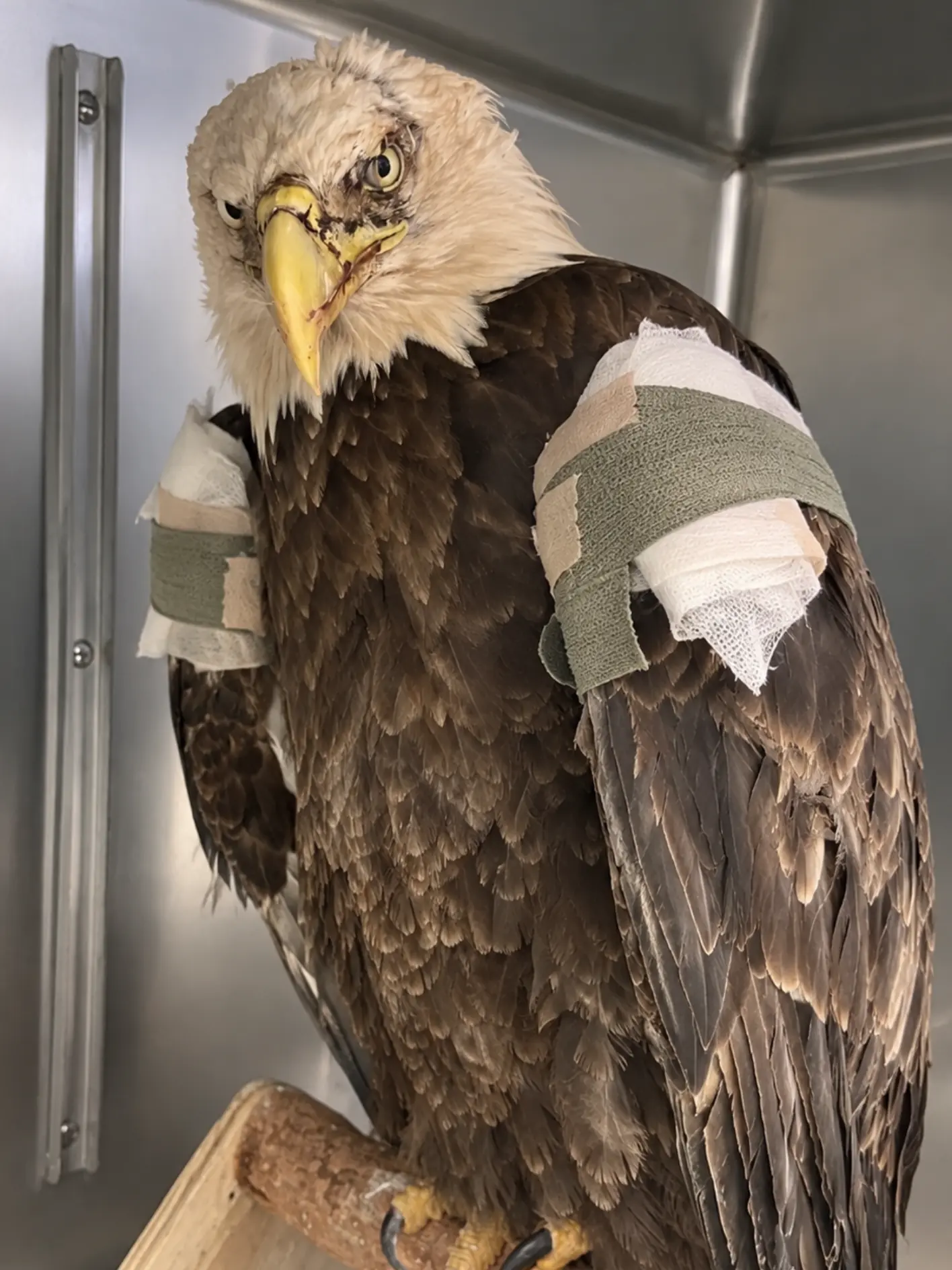
The adult eagle, now referred to by staff as Dakota, was discovered last week by Robert Hayes, a Jefferson County resident who was feeding animals on his property along County Road E when he noticed the bird near a water trough.
“At first, I thought it had just come down for a drink and would fly off when I got closer,” Hayes said. “But it stayed there, and when I moved in a little more, it only tried to walk away. That’s when I realized something was wrong.”
According to Hayes, the eagle appeared alert but could not gain enough lift to leave the ground. Concerned that the bird was injured, his wife, Linda Hayes, contacted Jefferson County Animal Control, which responded to the property and safely captured the eagle for transport.
The bird was then taken to the Wisconsin Wildlife Rehabilitation Center, where an intake examination and diagnostic imaging revealed injuries involving the wings that required stabilization. Veterinarians said the eagle also showed signs of weakness and dehydration consistent with a bird that had likely been struggling in the field for some time before it was found.
Dr. Melissa Grant, hospital director at the rehabilitation center, said the eagle’s first several days in care were focused on stabilization, pain management, hydration, and quiet rest.
“Our immediate goal was to reduce stress, support the bird medically, and better understand the extent of the injuries,” Grant said. “In cases like this, those first 24 to 48 hours are very important.”
During the initial phase of treatment, staff placed supportive wraps around both wings to limit movement and protect the injured areas while the eagle was monitored closely. Grant said follow-up observation over the past week has brought cautious optimism.
“The eagle is now standing more consistently, perching, and eating on its own,” she said. “Those are all encouraging developments. But this is still a patient that needs very close monitoring, and it is too early to predict the final outcome.”
Veterinarians emphasized that visible improvement does not necessarily mean a full recovery is guaranteed. In raptors, the ability to stand or perch is only one measure of progress. Long-term recovery depends on many factors, including healing of the injured wing structures, return of full range of motion, muscle strength, and ultimately the ability to fly well enough to survive in the wild.
Grant said the eagle will continue to undergo repeat evaluations in the coming days, including reassessment of the wing injuries and close observation for complications such as swelling, instability, reduced function, or delayed healing.
“An eagle can look brighter and stronger overall, but the true question is whether those wings will recover enough for sustained flight,” Grant said. “That part takes time.”
If healing progresses as hoped, the bird may later move into the next stage of rehabilitation, which can include gradual reduction in wing support, controlled movement, and eventually testing in a larger enclosure designed to assess strength, balance, and flight ability. For now, however, the eagle remains in the medical phase of care.
Wildlife staff said the case also highlights the importance of public awareness when a large raptor is seen on the ground and unable to fly. While Bald Eagles may occasionally spend time on the ground near a food or water source, a bird that remains in place for an extended period, walks instead of flying, or appears weak should be treated as a possible wildlife emergency.
Experts advise members of the public not to force an injured eagle to fly and not to attempt capture without proper training and equipment. Instead, they should contact animal control, a licensed wildlife rehabilitator, or a wildlife agency for assistance.
In this case, staff said the quick response likely gave the eagle its best chance.
“If this bird had remained out there much longer, it would have faced increasing risk from exposure, starvation, and further injury,” Grant said. “The fact that someone noticed the problem and called for help made a real difference.”
For the Hayes family, the experience was unforgettable.
“It’s not every day you look out and see a Bald Eagle standing at your farm,” Robert Hayes said. “We just knew it needed help.”
Now, one week after it was found unable to fly beside a farm water source, Dakota has cleared the first hurdle: surviving the initial trauma and becoming stable enough to begin healing. Whether the eagle will eventually recover enough to return to the wild is still unknown, but for now, veterinarians say the bird is moving in the right direction.