An adult Bald Eagle found grounded near the Missouri River in southeastern South Dakota is making steady progress after suffering one of the most difficult injuries wildlife rehabilitators routinely face: an open wing fracture associated with a large contaminated wound.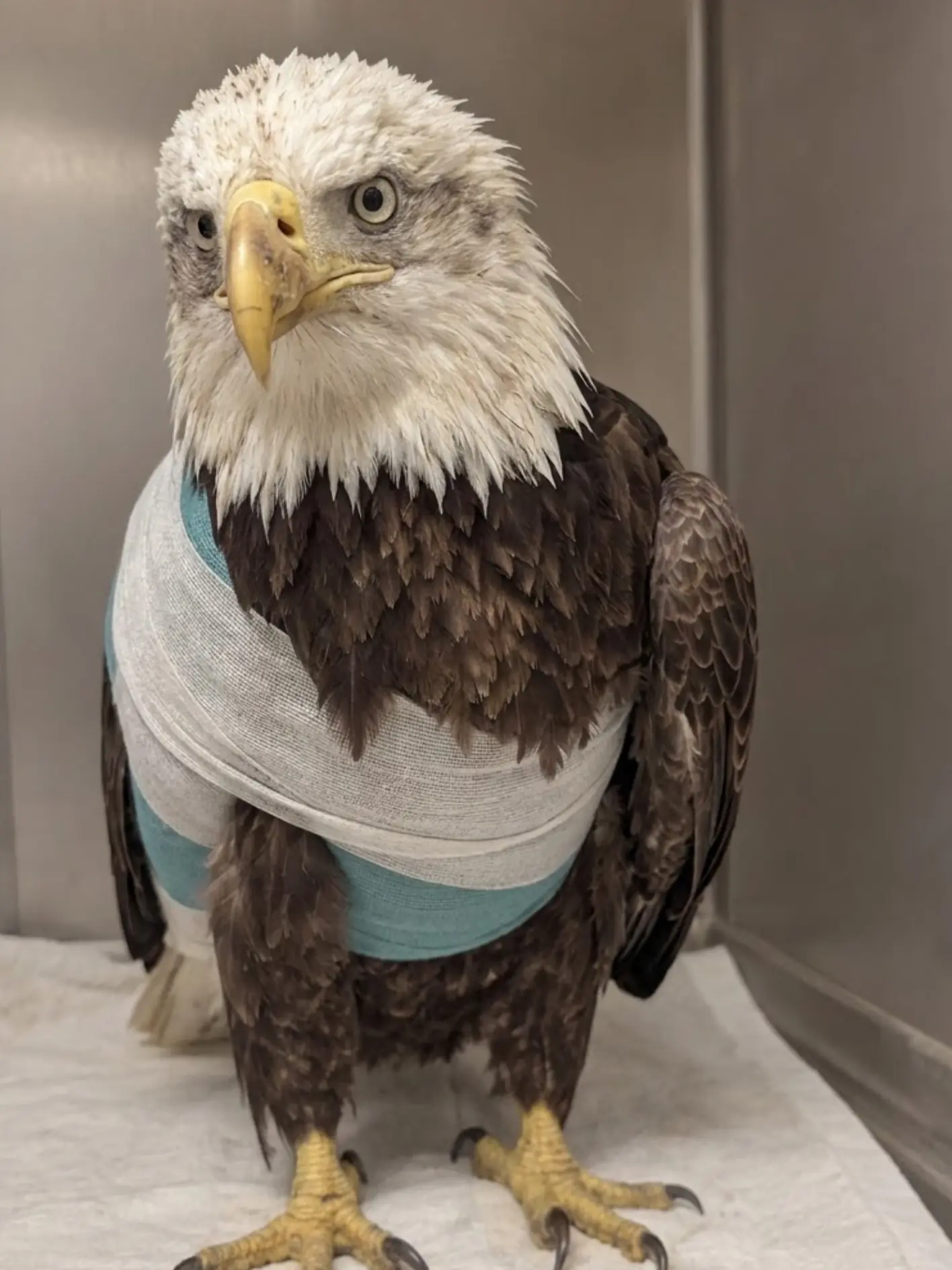
When the bird was first discovered, one wing hung noticeably lower than the other.
The eagle was still conscious and watching its surroundings, but it could not fly. When it attempted to move away, it relied mostly on its legs, dragging the injured wing close to the ground. Beneath the damaged feathers, rescuers could see an open wound involving the injured portion of the wing.
The seriousness of the case was immediately apparent.
This was not simply a fracture hidden beneath intact skin.
The injury had opened directly to the outside environment, exposing deeper tissue to dirt, bacteria, feathers, and debris.
A state wildlife conservation officer responded to the scene, safely restrained the eagle, supported the damaged wing, and began what would become a nearly two-hour drive to a licensed raptor rehabilitation facility capable of providing specialized veterinary care.
By the time the eagle reached the center, it was exhausted and painful but still alert.
Radiographs confirmed a significant fracture involving the wing. The large wound surrounding the injury made contamination and infection an equally serious concern.
Treatment began immediately.
The wound was cleaned extensively. Damaged tissue was evaluated. The fracture was stabilized. The bird received fluids, pain management, and antimicrobial treatment when clinically indicated.
Then came the part of rehabilitation that rarely looks dramatic from the outside but can determine whether a bird ultimately flies again:
daily bandage changes.
Today, the eagle is standing upright, eating independently, and watching rehabilitation staff with increasing suspicion — behavior the team considers encouraging.
Its injured wing remains secured beneath a broad padded wrap.
The bird still has a long recovery ahead.
But the direction, so far, is positive.
“The fracture was serious, but the open wound was just as concerning,” the attending wildlife veterinarian said. “Our first objective was not simply getting the bone to heal. We had to preserve the surrounding tissue and prevent infection from compromising the entire wing.”
The Eagle Was Found Unable to Leave the Ground
The initial report came from a rural area not far from the Missouri River corridor, where Bald Eagles routinely move between open water, agricultural land, and wooded habitat.
A person in the area noticed the eagle remaining on the ground much longer than expected.
Bald Eagles do occasionally descend to feed or rest.
That alone does not necessarily indicate a problem.
But this bird was behaving abnormally.
It remained low.
It did not fly when given space.
One wing appeared to sit at an unusual angle.
When the eagle attempted to reposition itself, it could walk only awkwardly and was unable to become airborne.
A closer look revealed blood and disrupted feathers around the injured wing.
That was enough to prompt a call to wildlife authorities.
The Conservation Officer Immediately Recognized an Emergency
When the responding officer reached the area, the eagle was still alert.
Its eyes followed movement.
It remained capable of defending itself.
But the injured wing was clearly unstable, and the open wound made waiting especially risky.
Open fractures are different from closed fractures.
When the skin remains intact, the broken bone is still protected from the surrounding environment.
When a wound communicates with the fracture, bacteria and debris may have direct access to deeper structures.
That increases the risk of serious infection.
In a bird intended for eventual release, infection involving the bone itself can be devastating.
The officer knew the eagle needed specialized veterinary treatment.
There was one problem.
The nearest facility equipped to manage a severe raptor injury was almost two hours away.
The Bird Had to Be Captured Without Worsening the Damage
Even a badly injured Bald Eagle is dangerous to handle.
The feet are the primary concern.
Bald Eagles use powerful talons to capture and restrain prey, and an injured bird may strike suddenly when frightened.
Heavy protective gloves were used.
The feet were controlled first.
The body was supported next.
The damaged wing was handled as little as possible.
No attempt was made to straighten the wing in the field.
That is an important principle in wildlife rescue.
A person looking at a distorted wing may feel compelled to “put it back into place.”
Doing so without imaging can worsen the injury.
Bone fragments may shift.
Blood vessels may tear.
Nerves can be damaged.
An open fracture can become even more contaminated.
The objective at the scene was simple:
prevent unnecessary movement and get the eagle to professional care.
The Two-Hour Transport Was Part of the Treatment
The eagle was placed in a secure transport carrier with padded flooring.
The injured wing was supported close to the body.
The interior remained relatively dark to reduce stimulation.
Then the conservation officer began the drive.
Nearly two hours can feel like an eternity when transporting a bird with exposed tissue.
Open wounds become increasingly difficult to manage as contamination, swelling, and tissue damage progress.
The officer could not repair the fracture.
But rapid transport reduced the amount of time the eagle spent untreated in the field.
“That drive mattered,” the rehabilitation director said. “When you have a large open wound associated with a fracture, getting the patient into controlled medical care quickly can make a major difference.”
The Eagle Arrived Tired but Responsive
At the rehabilitation facility, the veterinary team performed a rapid assessment before focusing on the wing.
The bird was dehydrated.
It was fatigued.
It showed a clear pain response around the injured area.
Its defensive behavior was weaker than expected for a healthy adult Bald Eagle.
But the bird remained neurologically responsive.
The eyes were alert.
The feet still gripped.
Breathing was monitored closely.
Before treating the obvious wing injury, the team also looked for additional trauma.
A bird capable of sustaining a severe fracture may also have suffered injuries to the head, pelvis, spine, chest, or internal organs.
The opposite wing was examined.
Both legs were checked.
The head and eyes were evaluated.
No additional catastrophic injury was immediately identified.
That allowed the team to concentrate on the open fracture.
X-Rays Confirmed the Seriousness of the Wing Injury
Radiographs provided the first clear view of what had happened beneath the feathers.
The images confirmed a major fracture involving the long bones of the injured wing.
The broken area corresponded with the open wound visible externally.
Veterinarians evaluated several factors:
How far were the bone fragments displaced?
Was the joint involved?
Was the fracture fragmented?
Could acceptable alignment be maintained?
Did the surrounding tissue appear capable of supporting healing?
These questions mattered because the goal was not simply to save the eagle’s life.
The long-term objective, if possible, was release.
That required preserving a wing capable of normal flight.
The initial prognosis was guarded.
The Open Wound Was as Important as the Broken Bone
A fracture can heal.
A severely infected fracture may not.
The wound had been exposed to the outdoor environment before rescue.
Loose soil, plant material, feathers, and microscopic contaminants can enter damaged tissue.
Bacteria can reach bone.
If an infection develops inside the bone, the condition is called osteomyelitis.
For a Bald Eagle, osteomyelitis in a wing can permanently alter the outcome.
Bone healing may slow or stop.
Tissue may become nonviable.
Joints can lose movement.
Even if the bird survives, the wing may never regain the precision required for sustained flight.
That is why the first major treatment focused heavily on wound management.
The Wound Was Cleaned Under Controlled Conditions
Once the eagle was stable enough, it was sedated or anesthetized as necessary to allow a thorough examination and cleaning.
The veterinary team carefully separated damaged feathers from the wound.
The area was flushed repeatedly.
Visible debris was removed.
The condition of the underlying tissue was evaluated.
Clearly nonviable tissue was addressed conservatively.
This process, known as debridement, helps reduce material that can support bacterial growth while preserving healthy structures whenever possible.
The team had to balance two competing goals.
Remove tissue that cannot recover.
Preserve everything that still might.
With a wild bird, every millimeter of functional tissue can matter later.
The Fracture Was Then Stabilized
After the wound was treated, the wing needed mechanical support.
The injured bones cannot heal reliably if they are moving continuously.
A padded wrap was applied to restrict movement.
The wing was positioned carefully against the body.
Additional external support helped protect the injury while still allowing normal breathing.
The broad bandaging visible in later photographs reflects this stage of the eagle’s treatment.
Recent images show the bird standing upright inside its medical enclosure while the injured wing remains secured beneath layers of supportive material.
The wrap is substantial.
That does not mean the eagle is fully immobilized.
It means the damaged wing is being protected from the powerful movements the bird would otherwise attempt.
Pain Control Was Essential
Fractures hurt.
Open wounds hurt.
Wild animals often hide discomfort, but that does not mean the pain is minor.
An eagle may show pain by becoming unusually still, refusing food, guarding a limb, or reacting when the injured area is touched.
Appropriate analgesia was incorporated into the treatment plan.
Anti-inflammatory medication may also be used when clinically appropriate.
Pain control supports more than comfort.
A bird in severe pain may not eat.
It may struggle continuously.
It may hold its body in abnormal positions.
Reducing pain helps the eagle rest and conserve energy for healing.
Antibiotics Were Used When Clinically Appropriate
Because the fracture was open, the risk of bacterial contamination was significant.
Systemic antimicrobial treatment was considered part of the medical plan when indicated by the wound and clinical findings.
But antibiotics alone cannot solve an infected or contaminated open fracture.
The wound still needs cleaning.
Damaged tissue still needs evaluation.
Bandages still need changing.
The fracture still needs stability.
Medication supports those measures; it does not replace them.
Daily Bandage Changes Became the Center of the Case
For the next stage of rehabilitation, the eagle’s progress was measured one dressing at a time.
Each day, staff removed the outer layers and inspected the wound.
They looked at swelling.
They examined the color of the tissue.
They checked for drainage.
They watched for abnormal odor.
They assessed circulation.
They looked for areas of pressure created by the wrap.
They documented whether the injury appeared cleaner or more inflamed than the day before.
Then the area was treated again and a fresh dressing applied.
“Every bandage change tells us something,” the veterinarian said. “You cannot simply wrap an open wound and assume everything underneath is healing.”
The First Few Days Were the Most Uncertain
During the earliest period, the team did not know how the damaged tissue would respond.
An injury may appear reasonably stable immediately after rescue and then deteriorate as swelling increases or damaged tissue loses its blood supply.
Infection can also become more obvious only after time.
The team watched for:
progressive swelling,
darkening tissue,
increasing discharge,
worsening pain,
loss of appetite,
or changes in the eagle’s overall behavior.
Any of those findings could have changed the prognosis quickly.
Fortunately, the wound began moving in the opposite direction.
The First Encouraging Change Was a Cleaner Wound Bed
After repeated cleaning and bandage care, the tissue appeared healthier.
Swelling began to decrease.
There was no evidence of rapidly expanding tissue death.
The wound margins remained viable.
Healthy granulation tissue began developing in areas that had previously looked raw and unstable.
Granulation tissue is part of the normal healing process.
It provides a foundation over which new tissue can gradually form.
That was an important milestone.
It meant the eagle’s body was not merely surviving the injury.
It was beginning to repair it.
The Bird’s Behavior Improved at the Same Time
The eagle also became brighter.
Its posture changed.
It began standing more consistently.
The head remained upright.
The eyes tracked staff closely.
Grip strength improved.
Then the bird started becoming difficult.
It resisted examinations.
It attempted to move away.
It reacted defensively when people entered the enclosure.
To a casual observer, that might appear like a behavioral problem.
To wildlife rehabilitators, it was exactly what they wanted.
A wild Bald Eagle should not become comfortable around humans.
Increasing defensiveness often indicates that strength and normal behavior are returning.
Appetite Returned
Food intake was another important measure.
During the earliest phase, pain and stress can suppress appetite.
The eagle’s nutritional intake had to be monitored closely.
As its condition improved, it began eating voluntarily.
That reduced the need for nutritional assistance.
More importantly, eating provided the protein and energy required for tissue and bone repair.
Healing a fracture is metabolically expensive.
Healing a large open wound at the same time requires even more.
A bird that cannot maintain adequate nutrition will struggle to do either.
The Current Photograph Shows a Very Different Patient
The eagle visible now is standing upright inside the treatment enclosure.
Both feet are planted normally.
Its eyes are open and intensely focused.
The head is held high.
The bird looks far more alert than the exhausted patient that arrived after the long transport.
The injured wing, however, remains heavily supported.
That contrast is important.
The eagle looks better overall.
The fracture is still healing.
External appearance can improve much faster than bone strength.