An adult Bald Eagle found grounded near the Missouri River in southeastern South Dakota is making steady progress after being discovered with a severe open fracture and a large wound involving one of its wings.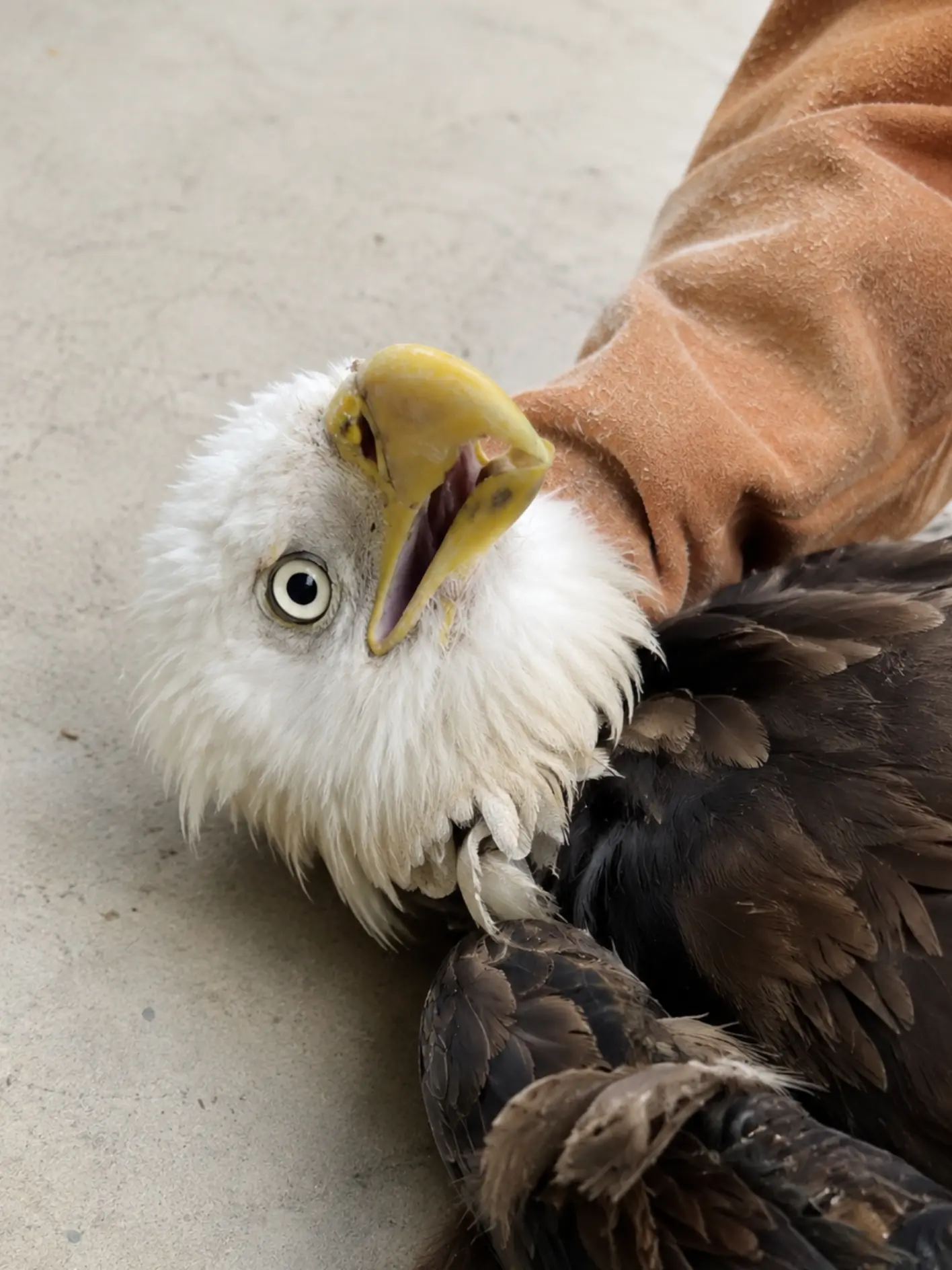
When a conservation officer first reached the bird, the injury was immediately concerning.
The eagle was conscious and still capable of reacting to the responder, but it could not fly. One wing was held abnormally, and beneath the damaged feathers was a substantial open wound associated with the fracture.
Because the injury had broken through the protective barrier of the skin, this was not simply a broken wing.
It was an orthopedic emergency with a significant risk of contamination, infection and permanent loss of flight function.
With no specialized raptor facility nearby, the responding conservation officer from South Dakota Parks and Wildlife safely restrained the eagle, stabilized the injured wing as much as possible and began a drive of nearly two hours to the Prairie Raptor Rehabilitation Center.
The eagle arrived exhausted and painful, but alive.
Since then, the rehabilitation team has been treating the injury intensively, including repeated wound cleaning, fracture stabilization, pain management, antimicrobial therapy when clinically indicated and daily bandage changes that allow staff to inspect the wound directly.
The process has been slow.
But so far, the bird is moving in the right direction.
“The fracture itself was obviously serious, but with an open injury like this, the bone is only part of the problem,” the attending wildlife veterinarian said. “Our immediate concern was whether the surrounding tissue could remain healthy and whether we could prevent infection from becoming established.”
For now, the eagle remains in active treatment.
Its prognosis is still guarded.
But the wound is showing encouraging signs of healing, the bird is becoming stronger, and each successful bandage change is giving the team another reason to continue.
The Eagle Was Found on the Ground Unable to Fly
The initial report came from a rural area near the Missouri River corridor, where Bald Eagles are regularly seen moving between open water, wooded areas and agricultural fields.
A member of the public noticed the eagle remaining on the ground and became concerned when it did not fly away.
Bald Eagles sometimes descend to feed or rest, so a bird on the ground does not automatically require intervention.
This bird was different.
Its posture was abnormal.
One wing did not appear to be held normally against the body.
And when the bird attempted to move, it could not generate normal flight.
Wildlife officials were contacted.
By the time a conservation officer arrived, the eagle was still alert enough to watch the approach, but it appeared fatigued and increasingly vulnerable.
A closer look revealed the seriousness of the situation.
There was a large wound near the injured wing.
The damaged area communicated with the fracture beneath it.
That made immediate transport necessary.
An Open Fracture Changes Everything
A closed fracture occurs when a bone breaks but the skin remains intact.
An open fracture means the damaged bone or deeper tissues communicate with the outside environment through a wound.
That difference is medically significant.
Once the protective skin barrier is lost, bacteria, soil, vegetation, feathers and other environmental material can enter the injured tissue.
The risk is not limited to a superficial skin infection.
Bacteria can reach the bone itself.
If infection develops within bone, a condition known as osteomyelitis can occur.
In a flighted bird, that complication can be devastating.
Even if the fracture eventually heals, infection can damage bone, joints, muscle, tendons and other structures necessary for normal wing mechanics.
For a Bald Eagle, a wing that is simply “mostly functional” may not be enough.
The Officer Had to Restrain the Bird Without Worsening the Injury
Capturing a Bald Eagle is dangerous even when the animal is severely injured.
The primary hazard is the feet.
The talons are powerful enough to cause significant injury, and a bird that appears exhausted can still react suddenly.
The conservation officer used protective equipment and controlled the eagle’s feet before fully securing the bird.
The injured wing was supported carefully.
Importantly, the officer did not attempt to force the wing back into a normal-looking position.
That is not something rescuers should do in the field.
Without radiographs, it is impossible to know exactly where a fracture is located, how displaced it is or whether sharp bone fragments lie close to important blood vessels, nerves or muscles.
Manipulating a fracture unnecessarily can convert an already serious injury into a worse one.
The objective was not to repair the wing beside the road.
The objective was to prevent further damage and get the eagle to veterinary care.
The Nearly Two-Hour Drive Was Part of the Emergency
There was no specialized raptor hospital close to the rescue location.
That meant the eagle had to travel.
The bird was placed inside a secure, ventilated carrier lined with padding to limit unnecessary movement.
The injured wing was supported.
The carrier was kept relatively dark and quiet.
Then the conservation officer began the nearly two-hour drive to the rehabilitation center.
For a routine case, two hours might simply be inconvenient.
For an open fracture, the passage of time matters.
The longer contaminated tissue remains untreated, the greater the opportunity for bacteria to multiply.
Swelling can increase.
Blood supply to damaged tissue can worsen.
The bird can continue struggling and further disrupt the fracture.
“That transport gave the eagle its opportunity,” the rehabilitation director said. “The officer understood that exposed bone and a large open wound could not simply wait until the next day.”
The Eagle Arrived Painful, Exhausted and Dehydrated
When the bird reached the center, staff began with stabilization rather than rushing immediately into orthopedic treatment.
The eagle was conscious, but subdued.
Its defensive responses were weaker than expected for a healthy adult Bald Eagle.
That was not interpreted as calmness.
Wild raptors often become unusually quiet when pain, exhaustion or systemic illness has depleted their reserves.
The eagle was evaluated for dehydration, blood loss, respiratory abnormalities and other trauma.
The opposite wing was checked.
Both legs and feet were examined.
The pelvis, chest and head were assessed for additional injuries.
The open wing injury remained the obvious priority, but trauma severe enough to fracture a wing can sometimes cause problems elsewhere in the body as well.
Radiographs Confirmed the Extent of the Injury
Once the bird was stable enough, radiographs were obtained.
The images allowed veterinarians to see what could not be assessed reliably through feathers and swelling alone.
The fracture involved a major bone of the injured wing and was displaced enough to require careful immobilization.
More importantly, the fracture communicated with the large external wound.
That confirmed the open nature of the injury.
The veterinary team evaluated:
the position of the bone fragments,
the amount of remaining alignment,
whether a joint was involved,
the condition of surrounding structures,
and whether treatment offered a realistic possibility of preserving useful wing function.
The injury was serious.
But there remained enough viable tissue and structural integrity for the team to continue.
The initial prognosis was guarded.
The First Priority Was Cleaning the Wound
With an open fracture, simply immobilizing the wing is not enough.
The contaminated wound must be addressed.
The eagle was sedated or anesthetized as necessary so veterinarians could work safely and precisely without causing additional pain.
The feathers around the injured area were carefully managed to expose the wound.
The tissue was flushed extensively.
Environmental debris was removed.
The team assessed which tissue remained healthy and which areas had been too severely damaged to recover.
Clearly nonviable tissue can become a source of infection and may need to be removed through debridement.
The goal was not to make the wound look cosmetically clean.
It was to preserve as much living tissue as possible while reducing the bacterial burden around the fracture.
Infection Was the Immediate Threat
The fracture itself would require weeks to heal.
Infection could compromise the case much sooner.
That is why the team focused so heavily on the condition of the open wound.
Every day, staff looked for changes that might indicate deterioration:
increasing swelling,
new discharge,
odor,
dark or nonviable tissue,
increasing pain,
or changes around the fracture site.
Systemic signs also mattered.
A bird developing a deeper infection might become less active, lose appetite or show other evidence of declining health.
Antimicrobial treatment was used as clinically appropriate, but medication alone cannot replace proper wound care.
The tissue still had to be inspected directly.
Daily Bandage Changes Became Central to the Eagle’s Recovery
After the fracture was stabilized and the wound dressed, the injured wing was secured in a padded wrap.
The bandage restricted movement at the fracture site while protecting the open wound.
But the bandage could not simply remain untouched for long periods.
Staff began changing it frequently, often daily during the most active phase of treatment.
Each change became both treatment and examination.
The team looked at:
the color of the wound bed,
the condition of the margins,
the amount and character of drainage,
swelling,
circulation,
skin integrity,
and evidence of pressure from the wrap.
They also evaluated whether the fracture remained stable.
“Every bandage change gives us new information,” the veterinarian said. “We need to know what is happening underneath rather than assuming that because the outside of the wrap looks clean, the tissue underneath is doing well.”
The Wrap Itself Has to Be Monitored Carefully
Bandaging a bird presents challenges that differ from wrapping a mammal.
A Bald Eagle’s wing contains long, lightweight bones surrounded by structures that must ultimately move through an enormous range of motion.
The feathers also matter.
Damaging major flight feathers during weeks of treatment could create an additional obstacle to release even after the bone heals.
The wrap must therefore be supportive without crushing feathers, restricting circulation or creating pressure injuries.
Because the wing may swell less as healing progresses, the fit can change from day to day.
Regular adjustment is part of the treatment.
The First Several Days Were the Most Uncertain
During the early phase, the rehabilitation team could not know whether the tissue would remain viable.
Open fractures sometimes look manageable initially and then deteriorate as damaged tissue loses blood supply.
Infection may also take time to become obvious.
The staff watched closely.
Would the wound become increasingly swollen?
Would new areas of tissue die?
Would the fracture become less stable?
Would the bird’s overall condition decline?
Those questions could only be answered through time and repeated examinations.
Fortunately, the first changes were encouraging.
The Wound Began Looking Cleaner
With repeated cleaning and daily bandage care, the injured area gradually showed less inflammation.
The wound bed appeared healthier.
There was no evidence of rapidly spreading tissue death.
The amount of concerning drainage did not increase.
Healthy repair tissue began developing along portions of the wound.
For the medical team, these were important milestones.
They did not mean the injury was healed.
They meant the wound was behaving like tissue that still had a chance to heal.
“Every clean bandage change is a small victory in a case like this,” the rehabilitation director said.
The Eagle’s Behavior Also Began Changing
When the eagle first arrived, it was relatively quiet.
As the days passed, that began to change.
The bird held its head higher.
Its eyes remained open and attentive.
Grip strength improved.
It reacted more strongly when staff approached.
Eventually, the eagle became less willing to cooperate with handling.
For wildlife rehabilitators, this is often welcome behavior.
The goal is not to create a bird that is comfortable around people.
A healthy wild eagle should be wary.
As its strength returns, so should its normal instinct to avoid human contact.
The eagle becoming more defensive was therefore interpreted as another sign that its systemic condition was improving.
Appetite Became Another Measure of Progress
Healing a large open wound and a fractured bone requires substantial energy.
The eagle needs adequate nutrition to produce new tissue and rebuild damaged structures.
During the most critical stage, feeding sometimes needs to be supported.
But voluntary eating is preferable whenever the bird is capable.
As the eagle stabilized, its appetite improved.
It began taking food more normally and showing greater interest in feeding.
That reduced the need for intervention and suggested that the bird was moving beyond the immediate shock of the injury.