Two Bald Eagles were seen engaged in an aggressive aerial confrontation near a wooded river corridor before the encounter abruptly ended with one bird flying away and the other remaining on the ground.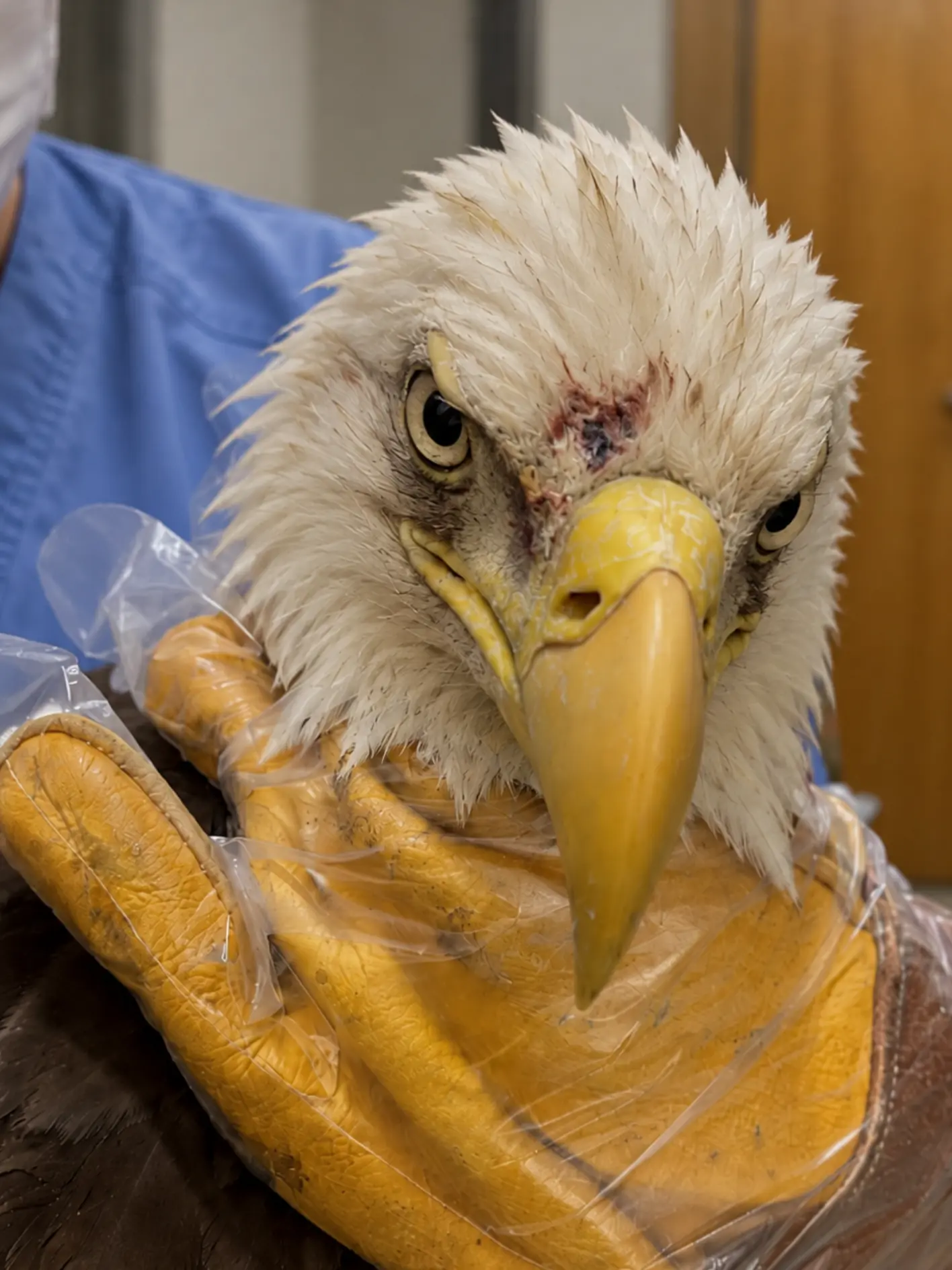
The larger eagle could not be safely approached immediately, but when wildlife responders later reached the site, they found an adult Bald Eagle with several visible injuries around the face and legs.
The bird was alert.
Its wings remained folded normally.
It could move.
But there were abrasions around the face, swelling near one eye and several small wounds around the feet.
The eagle was transported first to a regional wildlife rescue center for overnight stabilization. The following morning, it was transferred to a specialized wildlife hospital for a more complete examination, diagnostic imaging and treatment.
Once the veterinary team began working through the case, the picture became clearer.
The eagle was in surprisingly good overall body condition.
It weighed 4.50 kilograms, or approximately 9.9 pounds.
Based on the bird’s large size, the medical team considered it likely to be female, although sex was not being determined from body size alone.
Most of the visible injuries were relatively superficial.
There were several small abrasions around the feet.
Mild bruising and swelling were present around the left eye.
Two small puncture wounds were identified on the outside of the left leg.
But the most important orthopedic finding was not on the wing, chest or shoulder.
It was a toe.
One digit on the eagle’s right foot was markedly swollen and painful.
Radiographs confirmed that the toe was fractured.
The team also performed routine blood testing, including screening for lead exposure.
Lead was detectable in the eagle’s bloodstream, but the concentration remained below the center’s clinical threshold for chelation therapy and was not considered high enough to explain the bird’s injuries or behavior at admission.
For the rehabilitation team, the initial prognosis was cautiously favorable.
The wings were intact.
The bird remained bright and responsive.
The puncture wounds were small.
But a broken toe in a Bald Eagle is not a minor finding.
For a raptor that depends on its feet to land, perch, secure food and capture prey, successful healing would be essential before release could even be considered.
The Rescue Began With a Fight in the Air
Witnesses first noticed the two Bald Eagles interacting aggressively above the area.
Territorial encounters between Bald Eagles are not unusual.
Adult birds may defend nesting territories, feeding areas or established home ranges.
Most conflicts end without serious injury.
One bird may call.
Another may chase.
There may be several rapid passes before one bird leaves.
But occasionally the confrontation escalates into direct physical contact.
Bald Eagles have powerful feet equipped with long curved talons.
Those feet are designed to seize fish and other prey.
During a close-range confrontation, the same talons can produce puncture wounds within seconds.
Witnesses reported seeing the two birds continue the interaction before separating.
One eagle was able to fly away.
The second remained on the ground.
Because no one had a complete, uninterrupted view of the entire encounter, wildlife staff were careful not to describe the cause as absolutely confirmed.
Instead, the injuries were considered consistent with a suspected territorial fight.
That distinction is important.
The circumstances strongly supported eagle-on-eagle trauma.
But responsible wildlife medicine separates what was witnessed from what is inferred.
The Larger Eagle Was Found With Several External Injuries
When responders reached the grounded bird, they could see that it had sustained trauma.
There were abrasions around the face.
Several areas near the feet appeared irritated.
The eagle remained alert enough to watch the rescuers carefully but did not leave the area normally.
The bird was captured using appropriate raptor-handling techniques.
The feet were controlled first.
That is always essential when handling a Bald Eagle.
Even an injured bird may strike defensively, and the talons are capable of causing severe injury.
The wings were supported against the body.
The bird was then placed into a secure transport carrier.
Because it was already late in the day, the eagle was first brought to a regional wildlife rescue facility, where staff began basic stabilization.
The bird was kept quiet.
Its wounds were assessed.
Hydration was monitored.
Unnecessary handling was minimized.
The plan was to transfer the eagle to a facility with more advanced diagnostic capability the following morning.
Overnight Stabilization Bought the Bird Time
The first center did not attempt to complete every aspect of treatment immediately.
That was appropriate.
Wildlife rehabilitation often happens in stages.
The immediate priorities were:
keep the bird stable,
prevent additional injury,
control pain,
clean obvious wounds,
and reduce stress.
The following morning, the eagle was transferred to a specialized wildlife hospital for full evaluation.
By then, the bird remained alert.
There was no dramatic deterioration overnight.
That was encouraging.
But several important questions remained unanswered.
Were there hidden fractures?
Had the eye been damaged?
Were the puncture wounds deeper than they appeared?
Was the eagle carrying lead exposure or another systemic problem?
The next examination would address those questions one by one.
The Initial Examination Showed a Bird in Good Body Condition
One of the first positive findings was the eagle’s overall condition.
The bird weighed 4.50 kilograms.
Its pectoral muscle condition was appropriate.
There was no strong evidence that it had been starving for a prolonged period.
That made a chronic debilitating illness less likely.
The injury appeared more consistent with an acute event.
The bird’s large body size also led the team to consider it likely female.
Female Bald Eagles are generally larger than males, although body size varies geographically and cannot determine sex with absolute certainty by itself.
The team therefore documented the bird as likely female based on overall size rather than treating sex as definitively established.
The Face Looked Worse Than It Actually Was
Photographs from the examination show the eagle restrained safely while veterinary staff assess the head and body.
A small area of bruising and abrasion can be seen above and around the eye.
The injuries looked concerning externally.
The medical team examined the eye carefully.
They assessed:
the cornea,
pupil responses,
eyelid function,
visual tracking,
and surrounding tissue.
Fortunately, the eye itself did not show evidence of catastrophic injury.
The abrasions were primarily superficial.
There was mild swelling and bruising.
The bird still responded visually.
That was an important finding because a Bald Eagle requires excellent vision for normal flight and survival.
Even if every other injury healed, serious permanent vision loss could affect release eligibility.
In this case, the eye remained functional.
The Left Leg Had Two Small Puncture Wounds
The team also identified two small wounds on the outside of the left leg.
These were consistent with punctures from a sharp object.
Given the reported aerial confrontation, talon trauma was considered a plausible explanation.
Again, the staff described the finding cautiously.
The wounds were not proof by themselves.
But their size, location and the circumstances of rescue made contact with another large raptor a reasonable leading explanation.
Puncture wounds can look deceptively minor.
A small opening at the skin surface may extend much deeper into muscle.
This creates potential for contamination and infection.
The wounds were flushed thoroughly.
Surrounding tissue was examined for swelling, heat or deeper damage.
The eagle was monitored for signs that infection might develop.
Antibiotics were used when clinically appropriate.
The Most Important Injury Was on the Right Foot
The right foot initially drew attention because one toe was much more swollen than the others.
The digit was painful during examination.
The eagle resisted manipulation.
There was concern that the swelling represented more than simple bruising.
Radiographs confirmed a fracture involving one of the bones of the toe.
That finding immediately became a major rehabilitation issue.
To someone unfamiliar with raptors, a broken toe may sound minor compared with a wing fracture.
For a Bald Eagle, that is not necessarily true.
Feet are fundamental to nearly every stage of normal life.
A Broken Toe Can Affect Far More Than Walking
Bald Eagles use their feet for:
landing,
perching,
holding food,
seizing prey,
maintaining balance,
and defending themselves.
The talons function as part of a coordinated system.
When one digit is painful, swollen or mechanically unstable, the bird may alter the way it grips.
That can affect the entire foot.
A compromised grip can create problems during landing.
It can make it difficult to remain secure on a branch.
It can reduce the eagle’s ability to hold carrion or live prey.
It may also shift abnormal loads onto the other toes.
“For an eagle, this isn’t just a walking injury,” the attending veterinarian said. “The foot has to work under considerable force every time the bird lands or grips something.”
That meant the toe needed to heal not just anatomically, but functionally.
The Toe Was Stabilized and Activity Was Restricted
The veterinary team stabilized the injured digit according to the fracture pattern.
The exact method depended on alignment and how much movement could be safely allowed.
The bird was placed on padded flooring to reduce pressure on the foot.
High perches were avoided initially.
Pain management was provided.
The team monitored whether the bird could bear weight evenly on both feet.
The goal was to protect the fracture without allowing unnecessary loss of function.
Too much movement could disrupt healing.
Too much immobilization could create stiffness.
The treatment plan had to balance both concerns.
The Wings Were Surprisingly Intact
Because the bird had reportedly fallen or come down after an aerial fight, full-body radiographs were also important for ruling out more serious skeletal trauma.
The team evaluated both wings carefully.
There was no major humeral fracture.
The radius and ulna appeared intact.
The shoulders remained aligned.
No major pelvic fracture was identified.
There was no obvious spinal injury.
That changed the overall prognosis significantly.
Had the eagle sustained a severe wing fracture or shoulder luxation, rehabilitation could have required many weeks or carried a much poorer chance of successful release.
Instead, the most significant orthopedic injury was confined to the foot.
That gave the team a much clearer path forward.
Blood Testing Revealed Lead Exposure — But Not Lead Poisoning
As part of the standard diagnostic workup, blood was collected.
The team evaluated general health parameters and also screened for lead.
Bald Eagles are frequently tested for lead because they scavenge animal remains and can ingest small fragments of lead ammunition hidden in tissue.
In this case, lead was detectable.
But the level remained below the hospital’s clinical threshold for chelation therapy.
That distinction matters.
Detectable lead does not automatically mean clinically significant lead poisoning.
The result indicated that the eagle had been exposed to lead at some point.
It did not mean that lead explained the current injuries.
The bird did not present with the degree of neurological dysfunction typically associated with severe lead toxicosis.
Its current condition was better explained by trauma from the suspected fight.
Still, the finding was documented.
Low-level exposure remains biologically meaningful from a broader wildlife-health perspective.
The Lead Result Was Not Ignored
Because the concentration was subclinical, the eagle did not require the same aggressive chelation protocol used for severe lead poisoning.
But the veterinary team did not simply dismiss the finding.
Lead exposure in raptors is cumulative evidence of environmental contact with a toxic metal.
A bird may ingest small fragments while feeding on carcasses or animal remains.
Not every exposure produces immediate clinical signs.
That does not make the exposure irrelevant.
The team continued monitoring the bird’s overall condition while focusing treatment on the traumatic injuries.
The First Two Days Were Reassuring
During the first 48 hours after transfer, the eagle remained bright.
It ate.
It stood.
Its wings stayed in normal position.
It showed appropriate defensive behavior around staff.
The puncture wounds remained clean.
The facial swelling did not worsen.
The injured toe remained painful, but there was no evidence that circulation to the digit had been compromised.
These were all favorable signs.
The prognosis shifted from simply guarded to cautiously favorable.
The major question now became whether the right foot would regain full function.
The Eagle Became More Difficult to Handle
As pain decreased and stress from the initial event passed, the bird became increasingly defensive.
It watched staff closely.
It attempted to move away during examination.
Its grip remained strong in the uninjured portions of the feet.
That behavior was exactly what the rehabilitation team wanted.
Wild Bald Eagles should not become comfortable with people.
A bird intended for release must retain appropriate avoidance behavior.
The eagle was doing that.
The Facial Wounds Healed Quickly
The abrasions around the eye and forehead improved over the next several days.
Swelling diminished.
Bruising became less apparent.
The eye remained functional.
There was no evidence of progressive ocular injury.
The bird continued tracking movement normally.
That allowed the team to reduce attention to the face and focus increasingly on the foot.
The Puncture Wounds Required Continued Monitoring
The two wounds on the left leg were checked repeatedly.
Even small talon punctures can become infected.
Staff looked for:
increasing redness,
heat,
swelling,
discharge,
odor,
or pain.
None of those complications progressed significantly.
The wounds gradually closed.
Because the surrounding tissues remained healthy, no aggressive surgical intervention was necessary.