Two months ago, the adult Bald Eagle now standing upright on a rehabilitation perch could barely remain on its feet.
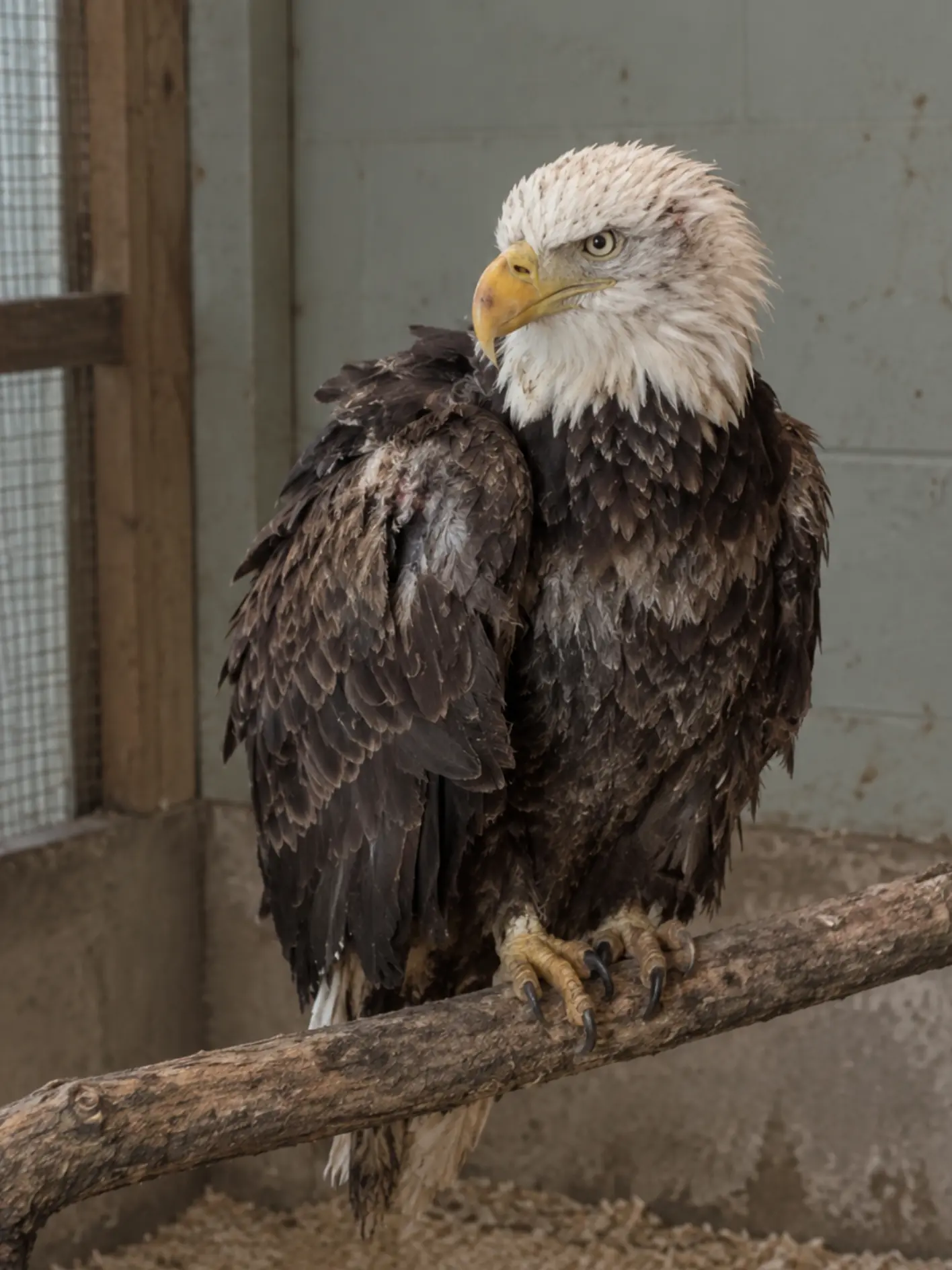
Today, the bird watches staff carefully from across the enclosure, grips the branch with both feet, and moves away when anyone comes too close. Its feathers are still rough in places, and several areas along the body and wing continue to show evidence of the trauma that brought it into care, but its posture is stronger, its eyes are brighter, and its behavior is becoming increasingly typical of a wild adult eagle. For the veterinary team at the fictional Appalachian Raptor Rehabilitation Center in West Virginia, those changes represent progress that once seemed far from certain.
Dr. Sara Whitmore has personally overseen the eagle’s medical care since the day it arrived from Greenbrier County nearly two months ago. The bird had been found on the ground near a creek running through a rural area bordered by forest and open fields. A resident first noticed the eagle because it remained in the same general location for much of the morning. When the person approached from a distance, the bird tried to move away but did not take flight. One wing was carried abnormally, several feathers were damaged, and the eagle seemed unusually weak. Wildlife responders were contacted, and after confirming that the bird was unable to leave on its own, they captured it and transported it to the rehabilitation center for evaluation.
The eagle was conscious and reactive when it arrived, but its condition was concerning. It was moderately dehydrated, underweight for its frame, and unable to maintain normal balance for long periods. Grip strength was reduced, particularly after exertion. The bird showed generalized weakness rather than one obvious neurologic deficit, and although several wounds could be seen beneath disturbed feathers, none appeared severe enough at first glance to explain the degree of debilitation.
Whitmore’s first concern was trauma. A grounded Bald Eagle may have been struck by a vehicle, collided with a structure, become entangled, fought with another eagle, or suffered any number of injuries that are difficult to recognize from the outside. The team examined the wings, legs, head and body carefully. No dramatically displaced fracture was obvious during the physical examination, but several small wounds and areas of bruising suggested that the eagle had experienced significant trauma before it was found.
Radiographs were ordered.
The images changed the case immediately.
Across several views of the bird’s body, multiple small, rounded metallic densities appeared scattered through the soft tissues. Their size, shape and distribution were consistent with shotgun pellets. Some were located near the body wall, while others appeared deeper within soft tissue. Several were associated with older-looking injuries, suggesting that not every pellet had necessarily entered the eagle during the same event.
The X-rays were alarming, but the veterinary team did not assume that every bright object on the image needed to be surgically removed.
“The first reaction when people see a radiograph full of metal is usually, ‘Take all of it out,’” Whitmore said. “But surgery is not automatically safer than leaving a stable fragment alone. Every incision creates additional trauma. We have to decide which fragments are actively causing a problem, which are accessible, and which may be safer to monitor.”
One image raised a more immediate concern.
A small metallic fragment was visible in the region of the gastrointestinal tract, positioned near ordinary mineral material the eagle had swallowed. Birds often ingest small pieces of grit or gravel, and such material can appear as dense objects on X-rays. The neighboring metallic density, however, had a different appearance.
Whitmore said the image was memorable because of how ordinary the two objects looked beside one another.
“One was something a bird might naturally pick up from the environment,” she said. “The other represented something potentially toxic.”
The finding did not prove by itself that the fragment was composed of lead or that it was responsible for the eagle’s clinical condition. Radiographs show density and location; they do not provide a complete chemical analysis. The team nevertheless considered lead exposure a significant possibility, particularly because the bird’s weakness, poor coordination, reduced appetite and gastrointestinal concerns could be compatible with lead toxicosis.
Blood was collected for further evaluation.
Whitmore examined a blood smear under the microscope as part of the workup. A blood smear does not allow a veterinarian to look through the microscope and literally see a piece of lead floating between cells. What it can reveal are cellular abnormalities that may strengthen concern for toxic exposure and justify more specific testing. In this eagle, the microscopic findings added to an already concerning clinical picture.
Confirmatory blood lead testing was then pursued.
The result showed a clinically significant lead burden.
At that point, the case became more complicated. The eagle was no longer simply a trauma patient carrying retained metallic pellets. It was also a toxicology patient whose body had absorbed enough lead to interfere with normal function.
Lead exposure can affect multiple systems in a raptor. Birds may become weak, depressed or poorly coordinated. Gastrointestinal function may be disrupted. Appetite can decline. Neurologic abnormalities may develop in more severe cases. A bird that cannot perch normally or coordinate flight may become unable to hunt, and the resulting dehydration and starvation can further worsen the condition. The severity varies depending on the dose, duration of exposure, the individual animal and where the lead is located.
For scavenging species, the path to exposure may be indirect. A Bald Eagle does not need to encounter a whole bullet or intentionally swallow ammunition to become poisoned. Small fragments can be present in animal remains, carcasses or gut piles. Metallic pieces can also enter the environment through other sources. Once swallowed, lead within the digestive tract can be exposed to acidic conditions that allow some of the metal to dissolve and be absorbed.
Very small fragments can matter.
That was one of the lessons Whitmore wanted the center’s followers to understand.
“People sometimes picture lead poisoning as if the bird would need to swallow an entire bullet,” she said. “That is not how we should think about it. A fragment can be tiny and still become clinically important, especially if it remains where digestive processes can continue to expose the bird.”
The team began chelation therapy.
Chelation is not a single injection that instantly removes all lead from the body. It is a controlled medical treatment in which a chelating agent binds available lead so that the body can eliminate it more effectively. Depending on the compound used, the patient may require repeated doses, careful hydration, follow-up blood testing and close monitoring of organ function. In a severely debilitated wild bird, the process can be demanding.
Whitmore described the treatment as medically necessary but resource-intensive.
“It is expensive, it requires repeated handling, and it is invasive compared with simply giving a bird time to rest,” she said. “But when lead is contributing to severe clinical disease, waiting and hoping is not enough. Without treatment, the bird may continue to deteriorate.”
The eagle received supportive fluid therapy to address dehydration and help maintain circulation during treatment. Pain medication was provided for the traumatic injuries. Nutritional support was introduced carefully as the bird’s condition allowed. The visible wounds were cleaned and monitored, and the team paid close attention to the wing injuries because successful treatment of the lead poisoning would mean little if the eagle could not eventually fly.
The first few days were difficult.
The eagle spent much of its time low in the enclosure rather than on a perch. It ate poorly and tired quickly during even brief examinations. The bird remained aware of people and occasionally attempted to defend itself, but its reactions were much weaker than expected for a healthy adult Bald Eagle. Staff could safely approach only because illness had taken away much of the strength that should have made the bird difficult to handle.
That quiet behavior did not reassure the medical team.
A healthy adult Bald Eagle is not usually an easy patient.
Wildlife staff often consider the return of resistance and avoidance a positive sign because it means the bird is regaining both physical strength and normal wild behavior. In the earliest stage of this case, the opposite was true. The eagle was simply too sick to react strongly.
The center maintained a detailed treatment schedule. Chelation doses were administered according to the medical plan. Blood samples were repeated at intervals rather than taken excessively often, because each capture and restraint represented additional stress. Hydration status, body weight, droppings, appetite, grip strength and neurologic behavior were documented.
The team also monitored the metallic fragment believed to be in or near the gastrointestinal tract.
Serial radiographs helped determine whether the object was moving through the digestive system or remaining in place. If a potentially toxic metallic object remains accessible within the gastrointestinal tract, veterinarians may consider strategies to facilitate passage or, in selected circumstances, physical removal. The decision depends on the object’s location, the stability of the patient and the risks associated with intervention.
In this case, Whitmore did not want to perform an invasive procedure simply because the X-ray contained something concerning.
The eagle was already weak.
The bird already had multiple traumatic wounds.
Chelation had begun.
Every additional procedure had to provide enough benefit to justify the stress and anesthetic risk.
For the moment, the team continued monitoring.
The multiple pellets elsewhere in the body were approached with the same caution.
Some had likely been present long enough for surrounding tissue to stabilize around them. A pellet embedded in muscle is not necessarily equivalent to a fragment actively dissolving in the digestive tract. Lead exposure from retained pellets can be complex, and location matters. The center evaluated each visible fragment in the context of the entire patient rather than treating every metal density on the radiograph as an automatic surgical target.
“The X-rays looked dramatic,” Whitmore said. “But our job was not to chase every white dot with a scalpel. Our job was to determine what was actually threatening the eagle now.”
During the first week, the bird’s appetite remained inconsistent.
Some days it ate independently.
Other days the staff had to provide additional nutritional support.
The eagle could stand, but it occasionally lowered itself after relatively short periods. The feet still gripped, yet the strength was less than what the team expected from an adult raptor. The injured wing also remained guarded.
The staff did not know how much of the weakness came from lead and how much came from trauma, pain, dehydration and the period of poor feeding before rescue.
Wildlife patients frequently arrive with several interacting problems.
A bird weakened by lead may collide with something because its coordination has deteriorated.
A bird injured first may become unable to hunt, then scavenge contaminated food later.
A bird carrying old pellets may experience a completely separate event that finally causes people to notice it.
The hospital could document what it found.
It could not reconstruct every moment that had led to the eagle’s admission.
That scientific restraint remained important throughout the case.
The radiographs established that metallic pellets were present.
The blood testing established clinically significant lead exposure.
The team did not claim to know exactly where, when or how every pellet entered the eagle’s body.
Several could have resulted from one shooting event.
Others may have been older.