An adult bald eagle found unable to stand beside a rural roadway near Olympia, Washington, reached professional wildlife care less than an hour after a nearby resident realized something was seriously wrong.
The bird was conscious and aware of its surroundings, but its body was resting almost entirely on the ground. Both legs were drawn tightly toward the body in an abnormal position, and every attempt to rise failed.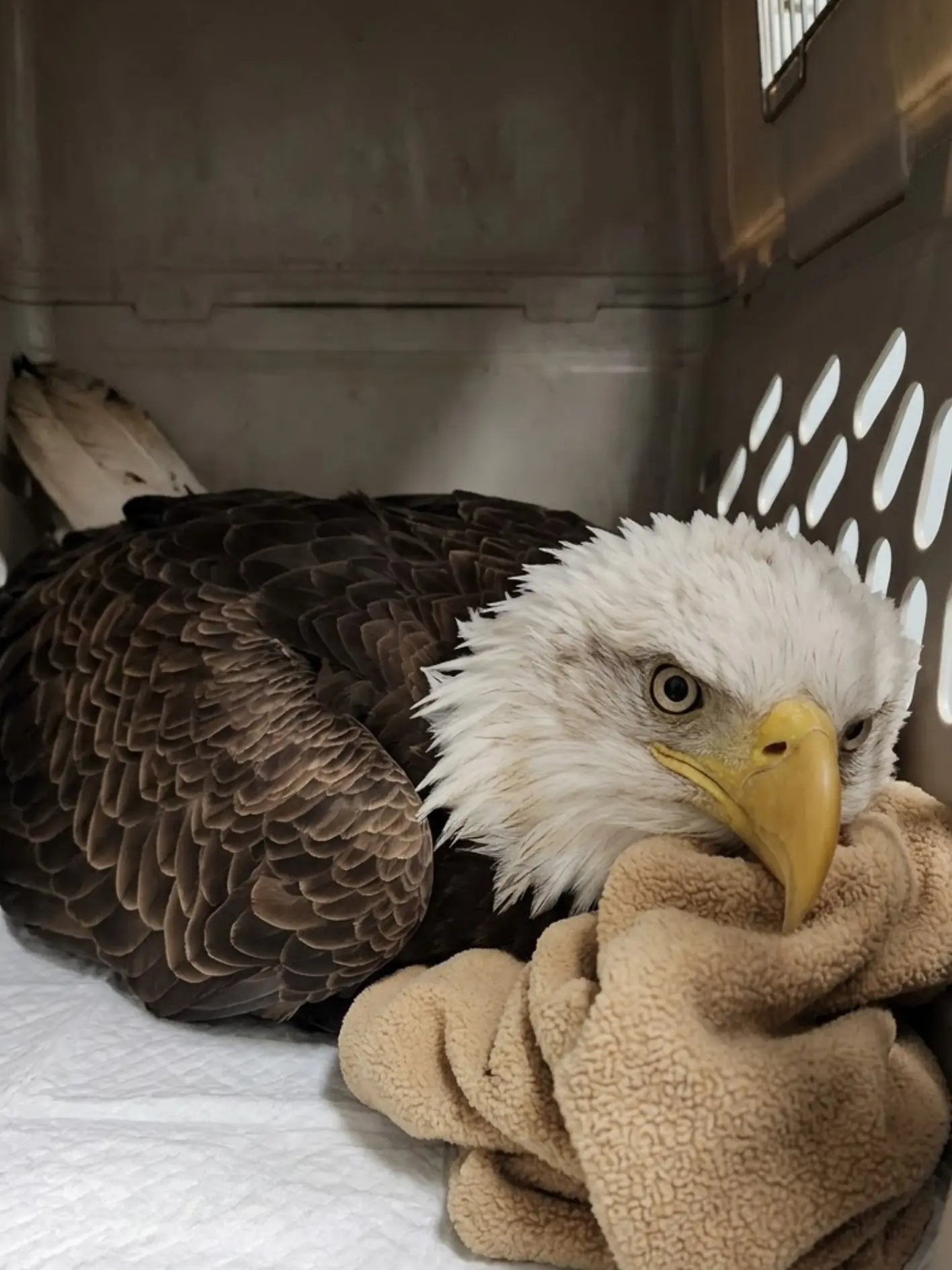
A nearby resident contacted authorities immediately rather than attempting to handle the eagle alone. County sheriff’s deputies helped secure the roadside area and coordinate with a licensed wildlife responder, allowing the bird to be safely contained and transported to an avian and wildlife rehabilitation center in western Washington.
The rapid response was especially important because the eagle appeared to be suffering from neurological trauma.
Veterinarians suspected the bird had been struck by a vehicle, although no one had witnessed the collision. The roadside location, sudden loss of normal leg function, and findings on the initial examination were considered consistent with blunt-force trauma.
At admission, the eagle could not stand.
Its legs remained abnormally flexed.
It had difficulty placing its feet beneath its body.
And while the bird remained alert enough to watch staff, it could not produce the coordinated lower-body movement expected from a healthy adult bald eagle.
Radiographs did not reveal a major fracture of the legs or pelvis that could explain the severity of the weakness. Instead, veterinarians became increasingly concerned about a concussion and traumatic inflammation affecting the spinal cord or surrounding tissues.
The eagle was placed in intensive care on padded flooring and started on supportive treatment, including pain control and anti-inflammatory medication.
Lead testing was also performed because lead exposure can cause weakness and neurological abnormalities in bald eagles. The blood lead concentration was low and was not considered high enough to account for the bird’s inability to stand.
Then, before the first day was over, staff noticed a small but important change.
The eagle’s legs began to relax.
Instead of remaining tightly drawn toward the body, they started extending into a more normal position.
The bird was still unable to stand.
But for a patient with suspected head and spinal trauma, even that subtle neurological improvement offered a reason for cautious hope.
“When she first arrived, both legs were held tightly flexed and she could not position them normally beneath herself,” one veterinarian involved in the case said. “By the end of the day, the legs were beginning to relax and extend. That does not mean we know she will recover completely, but it is an encouraging change.”
A Roadside Discovery That Immediately Looked Wrong
Bald eagles are regularly seen throughout western Washington, where rivers, wetlands, lakes and open agricultural areas provide feeding and roosting habitat.
Seeing one on the ground does not automatically mean the bird is injured.
An eagle may temporarily remain on the ground while feeding.
It may rest after consuming a large meal.
It may be investigating carrion.
But healthy adult bald eagles generally maintain the ability to stand, walk and take flight when necessary.
The resident who discovered this bird quickly realized that was not happening.
The eagle remained low beside the roadway.
It did not move away normally.
When it tried to reposition itself, the legs did not function as expected.
The bird appeared capable of moving the wings, but it could not coordinate the lower body well enough to stand.
That combination was enough to justify an emergency call.
The resident kept a safe distance and contacted local authorities.
That decision mattered.
Even an eagle that appears weak or partially paralyzed can suddenly strike with its talons if frightened.
Attempting to pick up an injured bald eagle without training can injure both the rescuer and the bird.
Sheriff’s Deputies Helped Keep the Rescue Moving Quickly
County sheriff’s deputies responded to the roadside area and helped create a safer environment around the bird.
Traffic was monitored while wildlife personnel prepared for capture.
People were kept from crowding the eagle.
The goal was not to turn the scene into a prolonged rescue operation.
It was to move the bird into professional care with as little additional stress as possible.
A trained responder approached with appropriate protective equipment.
The feet were controlled first.
The wings were supported close to the body.
Because a neurological or spinal injury was possible, unnecessary twisting or repositioning was avoided.
The bird was then placed into a padded transport crate.
From the time the eagle was first reported to the time it reached professional care, less than an hour had passed.
“Getting this bird into care so quickly gave us the opportunity to begin supportive treatment while the injury was still very acute,” the veterinarian said. “With neurological trauma, the first several hours can be particularly important because the clinical picture can change rapidly.”
The Eagle Was Alert — But Could Not Use Its Legs Normally
The first examination produced a confusing contrast.
The bird’s eyes were open.
It followed movement.
Its head remained reasonably controlled.
It was not deeply unconscious.
But the lower body was profoundly abnormal.
Both legs were held tightly flexed.
The feet were difficult for the bird to position beneath itself.
When staff supported the body and attempted to assess weight-bearing, the eagle could not maintain an upright stance.
The bird simply settled back down.
This made orthopedic injury the first major concern.
A pelvic fracture can prevent standing.
A fractured femur or tibiotarsus can cause severe pain and collapse.
Spinal trauma can create an almost identical outward appearance.
The team needed to determine which of those possibilities was most likely.
The Legs Were Examined Bone by Bone
Veterinary staff carefully examined both legs.
The femurs were palpated.
The knees and lower-leg structures were assessed.
The feet and toes were checked for swelling, wounds or abnormal angles.
The pelvis was examined for asymmetry or instability.
There was no obvious displaced fracture.
The legs did not have the gross deformity typically associated with a major long-bone break.
The toes still showed some response.
That was encouraging.
But the abnormal posture remained significant.
The eagle was not simply refusing to stand because one foot hurt.
Both legs appeared neurologically compromised.
That pushed the veterinary team toward additional imaging and neurological assessment.
X-Rays Did Not Show the Catastrophic Fracture Everyone Feared
Radiographs were obtained once the eagle was stable enough for imaging.
The images were reviewed for fractures involving the legs, pelvis and other structures that might explain the inability to stand.
No major fracture or dislocation was identified.
That finding was good news, but it did not solve the case.
If the bones were intact, then something else was interfering with movement.
The bird’s clinical signs were increasingly considered consistent with traumatic neurological injury.
A concussion was suspected.
So was a spinal cord contusion or swelling affecting tissues around the spinal column.
Those conditions can be difficult to confirm with standard radiographs because X-rays show bone far better than they show the spinal cord itself.
The diagnosis therefore depended heavily on the neurological examination and the pattern of improvement or deterioration over time.
The Problem May Have Been Swelling Rather Than Broken Bone
Blunt-force trauma can injure the nervous system even when the skeleton remains intact.
The spinal cord carries signals between the brain and the limbs.
If that tissue is bruised, compressed or affected by inflammation, motor function can change dramatically.
A bird may still feel its feet.
It may still move individual toes.
But it may be unable to coordinate the muscles required to stand.
The same principle applies to concussion.
A forceful impact to the head can produce neurological dysfunction even without a visible skull fracture.
That is why the absence of broken bones did not allow veterinarians to dismiss the severity of the case.
The eagle still had a significant neurological deficit.
The First Hours After Trauma Can Be Critical
Veterinarians are concerned not only about damage that occurs at the moment of impact but also about what can happen afterward.
The initial collision causes the primary injury.
Then inflammation may develop.
Tissues can swell.
Blood flow can change.
Pressure around sensitive neurological structures can increase.
That secondary response can sometimes worsen neurological function hours after the original event.
Treatment therefore focused on supporting the bird while trying to limit additional inflammation.
Pain medication and anti-inflammatory therapy were used as clinically appropriate.
The eagle was handled as little as possible.
The team wanted to avoid placing additional physiological demands on a nervous system that was already under stress.
The Intensive-Care Enclosure Was Kept at Floor Level
Because the bird could not stand safely, there was no question of placing it on a normal perch.
The eagle was kept on padded flooring.
Folded towels supported the body and helped protect the breastbone, wings and feathers.
The head could rest against soft material rather than directly against a hard enclosure wall.
The image taken during the early hospitalization reflects this stage of care.
The adult eagle is alert but resting almost entirely on its body inside a transport-style medical crate, with its head supported against a folded towel.
For a large raptor accustomed to spending much of its life standing or perching, prolonged recumbency can create secondary complications.
Pressure points can develop.
Feathers can become damaged.
Feet may stiffen.
For that reason, padded bedding and careful positioning were not simply comfort measures.
They were part of the medical management.
Lead Exposure Was Checked Despite the Suspected Collision
The veterinary team also collected blood for lead screening.
At first glance, that might seem unnecessary in a case already suspected to involve a vehicle strike.
But bald eagles frequently arrive with more than one medical problem.
Lead exposure can cause:
- weakness,
- poor coordination,
- neurological abnormalities,
- gastrointestinal dysfunction,
- and reduced ability to perch or fly normally.
A bird weakened by lead may also become more vulnerable to secondary trauma.
That means clinicians cannot safely assume that a collision explains every abnormal sign.
The blood result in this case was reassuring.
Lead was detected at a low level, but the concentration was not considered sufficient to explain the severity of the neurological dysfunction.
The primary concern remained trauma.
A Low Lead Result Helped Narrow the Diagnosis
The result did not mean the eagle had never encountered lead.
Background exposure can occur in wild scavenging birds.
What mattered clinically was that the lead concentration was not high enough to account for a bird that could not stand.
That allowed the veterinary team to focus more heavily on the suspected concussion and spinal trauma.
Other blood values were also monitored for clues about hydration, red blood cell status and the bird’s overall physiological condition.
But the most informative changes during the first day came from the eagle itself.
The Legs Began to Change Before the Day Was Over
When the bird first arrived, both legs were held tightly toward the body.
The posture was rigid enough that staff were concerned about significant neurological dysfunction.
Hours later, the position looked different.
The legs began to extend.
They rested farther away from the body.
The abnormal flexion was decreasing.
The eagle still could not stand.
It could not walk.
But the change suggested that at least some motor pathways remained functional.
In neurological medicine, the direction of change can be as important as the severity of the initial signs.
A patient that deteriorates from weak movement to complete loss of movement is concerning.
A patient that begins regaining more normal posture may be moving in the opposite direction.
Leg Extension Was Encouraging — But Not the Same as Recovery
The veterinary team remained careful not to overinterpret the improvement.
A leg resting in a normal position is not the same as purposeful weight-bearing.
The eagle still needed to:
- place the feet beneath the body,
- flex and extend the toes normally,
- produce a strong grip,
- push against the ground,
- balance,
- and eventually stand without assistance.
Those milestones had not yet been reached.
The prognosis therefore remained guarded.
But it was more encouraging than it had been at admission.
“We were not looking at a bird ready to stand,” the veterinarian said. “What we were seeing was an early change in motor posture. In a neurological trauma patient, that is meaningful because it suggests the deficit may not be completely fixed.”
The Next 24 to 72 Hours Became the Most Important Period
Staff increased neurological monitoring.
They repeatedly checked:
- head position,
- pupil responses,
- awareness,
- foot movement,
- toe placement,
- grip,
- withdrawal reflexes,
- and attempts to push upward.
They did not force the eagle to stand.
The nervous system needed time.
Making a compromised bird repeatedly attempt movement could create unnecessary stress and falls.
The team instead waited for purposeful movement to emerge naturally.
The First Real Test Would Be Whether the Feet Could Push
Before a bird can stand, the feet must do more than move.
They must generate force against the surface.
Staff watched for the eagle to plant one foot, then the other.
They wanted to see the toes spread appropriately rather than remain clenched.
A stronger grip on the towel or enclosure floor would be another positive sign.
The chest lifting even briefly away from the bedding would represent another step.
Those changes can seem minor compared with flight.
For this eagle, they would be major clinical milestones.
Food Intake Was Monitored Carefully
A bird recovering from concussion or spinal trauma may not eat normally during the first hours of care.
Stress alone can suppress appetite.
Pain can do the same.
Neurological impairment may also make feeding unsafe if swallowing is not coordinated.
The eagle’s level of alertness therefore determined when and how food could be offered.
Once the bird demonstrated normal enough swallowing and awareness, staff could provide appropriate food and monitor whether it ate independently.
Maintaining body condition would become increasingly important if the neurological recovery required days or weeks.
Rest Was Not Passive Treatment
One of the most important parts of early neurological care is often difficult to see.
Quiet.
Minimal handling.
Stable temperature.
Low stimulation.
A darkened or calm enclosure.
Those measures reduce stress and prevent a debilitated animal from repeatedly exhausting itself.
For a bald eagle, human presence itself can be stressful.
Every examination has to justify the disturbance it creates.
The team therefore balanced the need for neurological information against the need for rest.
The Possibility of Spinal Recovery Depends on the Type of Injury
A spinal cord that has been completely disrupted carries a very different prognosis from tissue that has been bruised or compressed temporarily by swelling.
That distinction is one reason the early return of leg extension mattered.
If the neurological pathways remain structurally intact but impaired by inflammation, function may improve as swelling decreases.
If there is severe permanent damage, recovery may plateau or fail to progress.
At this stage, the team could not know which outcome would occur.
Time and repeated examination would answer more than a single X-ray could.
Standing Would Be the First Major Goal
If the eagle continued improving, the first major functional milestone would be the ability to place both feet beneath itself and support body weight.
That might begin with only a few seconds.
The bird could wobble.
It might quickly sit down again.
That would still represent progress.
Staff would evaluate whether the eagle was using both legs equally.
Persistent weakness on one side could suggest a more localized spinal or peripheral nerve problem.
Symmetrical improvement would be more encouraging.
Walking Would Come Later
There would be no reason to force the eagle to walk immediately after it first managed to stand.
Standing requires strength.
Walking adds coordination.
The bird must shift its center of gravity from one foot to the other.
It must flex and extend joints in sequence.
It must maintain balance while the body moves.
Those are demanding neurological tasks.
The rehabilitation team would allow movement to return gradually.
Food and enclosure design could encourage natural repositioning without turning recovery into a forced exercise session.
Perching Would Be a Much Harder Test
Only after the bird could stand reliably would staff consider introducing a low perch.
Perching requires:
- bilateral grip,
- normal toe flexion,
- balance,
- core strength,
- appropriate head control,
- and continuous neurological adjustment.
The first perch would remain close to the ground.
A bird recovering from spinal trauma should never be placed high enough to suffer another serious injury if balance fails.
If the eagle could grip securely and remain upright without slipping or leaning, the prognosis would improve further.
Returning to a Perch Would Still Not Mean Release
A wild bald eagle must perform far beyond the level required to sit in an enclosure.
Vehicle trauma can produce subtle problems that become visible only during exercise.
The bird would eventually need reassessment of:
- both wings,
- shoulder movement,
- visual function,
- coordination,
- and overall endurance.
Only after normal standing and perching returned could flight rehabilitation become relevant.
Flight Would Be the Final Neurological Examination
Flight is one of the most complex tests of an eagle’s nervous system.
Both wings must move symmetrically.
The tail must adjust continuously.
Vision must guide the bird through space.
The head must remain stable.
The legs and feet must extend at the correct moment before landing.
A bird can appear neurologically normal while sitting quietly and still show deficits when required to fly.
That is why successful rehabilitation would ultimately depend on more than the return of leg movement.
The eagle would eventually have to demonstrate normal flight mechanics.
Landing Might Be the Most Revealing Part
For a patient whose initial neurological problem involved the legs, landing would be particularly important.
A bald eagle approaching a perch must:
reduce speed,
position the wings,
extend both legs,
place the feet accurately,
grip,
and absorb the force of arrival.
A bird with residual spinal weakness may hesitate to extend the feet or may fail to grip securely.
Even a strong flight would not compensate for an unsafe landing.
The rehabilitation center would therefore need repeated evidence of stable, coordinated landings before release.
The Prognosis Remained Guarded, but the First Day Ended Better Than It Began
At admission, the bird could not stand.
Both legs were abnormally flexed.
The cause was uncertain.
A major spinal injury remained possible.
By the end of the day, the legs had begun extending into a more normal resting position.
Lead testing had not revealed a toxic concentration sufficient to explain the signs.
Radiographs had not identified a major fracture.
The clinical picture was still serious.
But several of the worst possibilities had become less likely.
That is why the team allowed itself cautious optimism without calling the eagle recovered.
Early Rescue May Have Helped Preserve Options
No one can prove that reaching care in less than an hour determined the outcome.
Wildlife medicine rarely allows that level of certainty.
But rapid transport meant the bird could be evaluated and treated during the earliest phase of the injury.
Pain could be controlled.
Inflammation could be addressed.
The bird could be placed safely on padded flooring rather than remaining exposed beside a road.
Secondary injury from repeated failed attempts to stand could be reduced.
The value of the rapid response lies in opportunity.
The rescuers gave the medical team time to act while the neurological condition was still changing.
The Resident’s Decision Was as Important as the Police Response
The first person who found the eagle did not attempt to become the rescuer.
That was the correct choice.
They recognized an abnormal situation.
Kept their distance.
Called for help.
And allowed trained responders to manage the animal.
The sheriff’s deputies then helped create a safe environment for that response.
Those actions prevented a dangerous roadside scene from becoming more complicated.
A Disabled Eagle Is Still a Powerful Wild Animal
An eagle that cannot stand should never be assumed harmless.
The feet may still move suddenly.
The talons remain sharp.
A neurological patient may also react unpredictably as consciousness and motor function change.
Anyone encountering an injured raptor beside a road should avoid bare-handed contact.
Do not attempt to carry the bird in a passenger seat.
Do not offer food or water directly into the beak.
Do not stand in active traffic while trying to protect it.
Contact wildlife professionals, animal-control personnel or law enforcement as appropriate.
The Bird’s Current World Is Only a Few Inches High
For now, the eagle does not need the sky.
It does not need a high perch.
It does not need to fly.
Its rehabilitation is happening at floor level.
On towels.
Inside a quiet medical enclosure.
The goals are measured in movements almost too small to notice.
A foot extending.
A toe gripping.
A leg settling into a normal position.
The chest lifting slightly from the bedding.
Eventually, perhaps, both feet moving beneath the body.
Those actions will tell veterinarians far more about the prognosis than the eagle’s appearance alone.
The Most Important Movement Has Not Happened Yet
The eagle’s legs are no longer as tightly contracted as they were at intake.
That is the first meaningful neurological improvement.
But the next milestone will be larger.
Standing.
If the bird can begin supporting its own weight, even briefly, it would suggest that spinal motor function is recovering enough to coordinate the lower limbs.
From there, the rehabilitation questions would expand.
Can it walk?
Perch?
Grip?
Fly?
Land?
Each step would demand more from the nervous system than the one before it.
For Now, the Team Is Watching and Waiting
The adult bald eagle remains under close care.
Pain control and anti-inflammatory treatment continue as clinically appropriate.
The bird remains on padded flooring rather than a perch.
Lead exposure is not considered the primary explanation for its condition.
No major skeletal fracture has been identified to account for the inability to stand.
The working concern remains acute neurological trauma associated with the suspected vehicle collision — including concussion and possible spinal cord contusion or swelling.
The prognosis remains guarded.
But it is not unchanged.
When the eagle entered the center, both legs were drawn tightly against the body and normal weight-bearing was impossible.
By the end of that same day, those legs had begun relaxing and extending.
It was a modest change.
The eagle was still grounded.
Still unable to stand.
Still dependent on intensive care.
But neurological recovery often announces itself in small movements before it produces large ones.
The medical team is now waiting to see whether the next movement will be the one they most want to see: both feet moving beneath the body, the chest lifting from the towels, and the eagle standing again under its own power.