Mark Ellison saw the white head only a second before impact. He was driving along a two-lane highway in central Wisconsin on a cold morning when an adult Bald Eagle lifted suddenly from the grassy shoulder and crossed directly in front of his vehicle.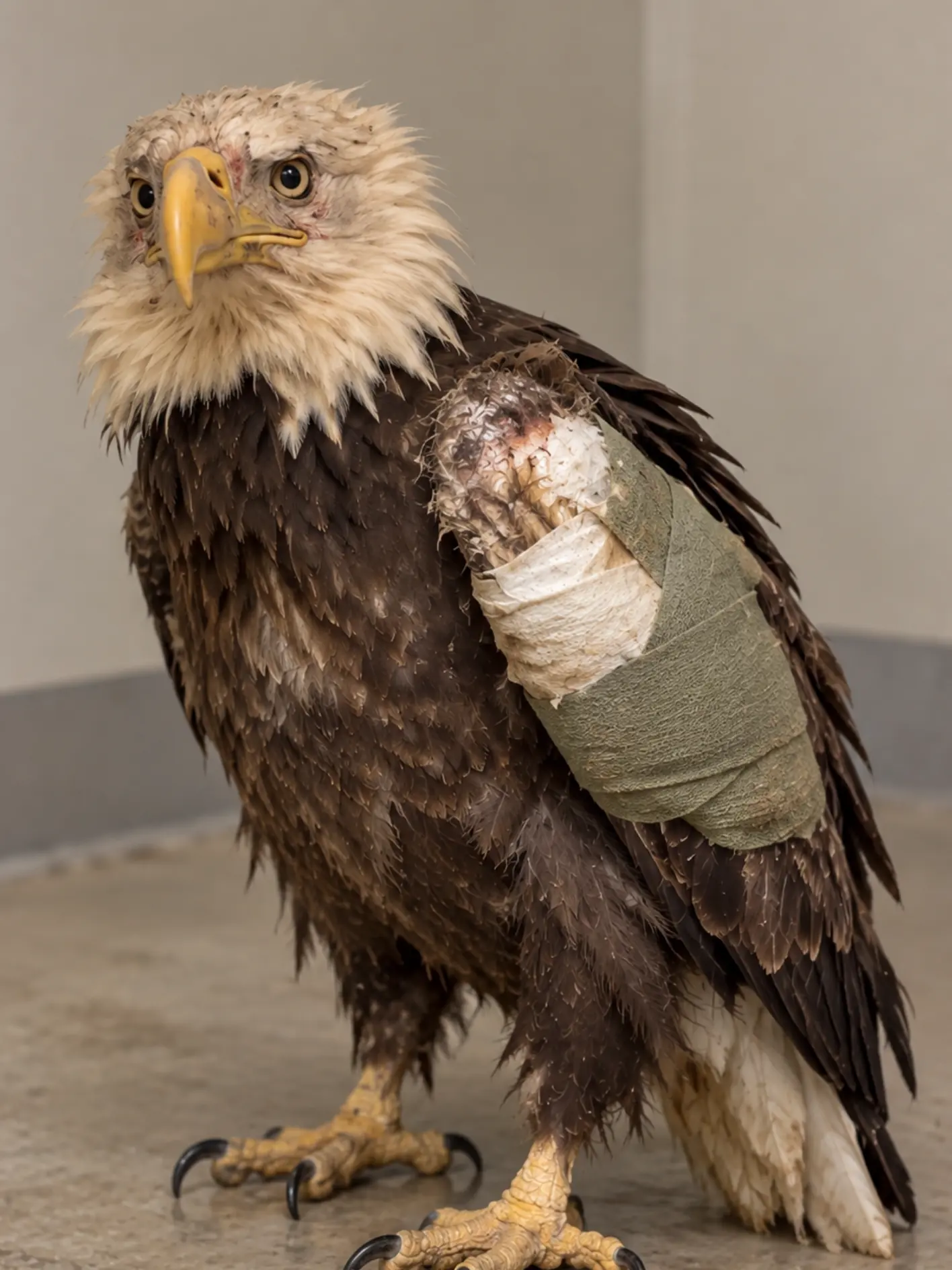
The bird had been low to the ground near what appeared to be the remains of a road-killed animal, and by the time Ellison recognized what was happening, there was almost no distance left between the eagle and the front of his truck. He braked hard and moved toward the center of his lane, but the eagle was already in front of him. There was a dull impact along the passenger side, followed by a flash of dark feathers disappearing below the windshield.
Ellison brought the vehicle to a stop as safely as he could and turned on his hazard lights. For several seconds, he sat behind the wheel trying to process what had happened. He knew immediately that the bird had been a Bald Eagle. He had seen the white head and yellow beak clearly as it rose from the roadside. What he did not know was whether the eagle had survived.
Traffic was light, so Ellison waited until it was safe before stepping from the truck. He did not walk directly toward the bird. About forty yards behind him, on the grassy shoulder near the edge of a drainage ditch, the eagle was still moving.
That was encouraging.
It was also immediately clear that the bird was badly injured.
The eagle was sitting low in the grass with its wings partly open. After a few moments, it tried to stand. Both feet appeared to work, and the bird managed to lift its body upright, but the right wing hung much lower than the left. The eagle turned toward the nearby trees and attempted to move away from the highway.
When another vehicle approached, the eagle reacted instinctively.
It opened both wings and tried to fly.
The left wing came down powerfully.
The right side did not.
The eagle lifted only slightly, traveled a few feet, and dropped back onto the grass.
Ellison stopped where he was.
He understood enough about wild animals to know that approaching could force the bird into another escape attempt. He returned to his truck and called the county sheriff’s office, explaining that he had struck an adult Bald Eagle and that the bird was alive but apparently unable to fly.
The call was transferred to a regional conservation officer, who instructed him to remain at a safe distance, keep traffic from crowding the bird if possible, and not attempt capture himself. A licensed wildlife-response team from the fictional Northwoods Raptor Rehabilitation Center was contacted immediately.
Ellison stayed at the scene.
The next thirty minutes were difficult to watch.
The eagle remained conscious and alert. It repeatedly turned its head toward passing vehicles and toward Ellison’s truck. Several white feathers around the face were stained with dirt and a small amount of blood. The right wing lay at an abnormal angle, and feathers around the shoulder looked disturbed.
Twice the eagle tried to move toward the tree line.
Each time it walked several yards, stopped, and rested.
It made one more attempt to fly.
The result was the same.
The body rose briefly, the injured side failed to provide enough lift, and the bird landed hard on the shoulder.
Ellison later said that was the moment he fully understood how serious the injury was.
“The eagle wanted to leave,” he recalled. “It was not staying there because it was calm around people. It simply could not get off the ground.”
When conservation officer Rebecca Sloan arrived, she first positioned her vehicle to provide greater visibility to passing traffic. The eagle had moved farther from the pavement but remained within the roadside corridor, where another vehicle could easily create a second emergency.
Sloan observed the bird from a distance.
The eagle’s posture was abnormal but stable. It was upright. Both eyes were open. There was no obvious uncontrolled bleeding. The right wing, however, remained low and could not be folded normally against the body.
She advised Ellison to remain near his vehicle while they waited for the rehabilitation team.
The wildlife responders arrived shortly afterward carrying heavy gloves, towels, a soft capture net, and a padded transport crate.
Before approaching, they spoke with Ellison and Sloan about the collision.
Ellison’s account was straightforward. The eagle had been near the edge of the road. It lifted suddenly. He had braked but could not stop in time. The impact occurred against the side of the vehicle rather than directly under the tires.
There was no indication of intentional harm or reckless pursuit.
For the medical team, this information would matter later because the accident had been witnessed. In many raptor trauma cases, the cause of injury is never known. Here, there was direct evidence of a vehicle collision.
The responders approached carefully.
The eagle immediately reacted.
It lowered its body and began running.
Despite the injured wing, the legs remained strong. The bird moved quickly through the grass, opening both wings partly for balance.
When one responder shifted position to prevent it from reaching the highway, the eagle tried once more to take off.
The left wing produced a strong downstroke.
The right wing opened only partially.
The bird rose a few inches and fell back.
The responders stopped advancing until the eagle settled.
They did not want another attempt.
Repeated forceful movement of a fractured wing can worsen displacement, increase internal bleeding, and damage surrounding muscle, nerves, or blood vessels. The goal was to secure the eagle with as little additional movement as possible.
One responder approached with a large towel while the second positioned from the opposite side.
When the distance was short enough, the towel was placed over the eagle’s upper body.
The feet were controlled first.
That step is critical with Bald Eagles because the talons remain capable of causing severe injury even when the bird is otherwise debilitated.
The eagle struck strongly toward the gloves.
Its beak opened.
The healthy wing pushed hard against the towel.
The injured wing was immediately supported and kept close to the body.
Once the legs were secure and the bird could no longer twist, the responders lifted it into the transport crate.
Up close, the injuries looked more serious.
There was a small abrasion near the face and cere, likely associated with the impact or fall after the collision. Feathers around the right shoulder were separated, and a small wound was visible beneath them. The right wing hung noticeably lower than the opposite side.
No bone was exposed.
There was no major external hemorrhage.
The bird remained fully conscious.
The transport team left immediately for Northwoods Raptor Rehabilitation Center.
Dr. Katherine Monroe, the center’s attending wildlife veterinarian, was waiting when the eagle arrived.
The initial examination began with the bird’s overall stability.
The eagle’s breathing was rapid but regular.
Both pupils responded normally to light.
The feet showed strong sensation and grip.
There was no obvious paralysis or major spinal instability.
The bird was moderately dehydrated and showed signs of shock and exhaustion consistent with a recent collision and repeated failed attempts to fly.
The right wing remained the primary concern.
Monroe carefully examined the shoulder, upper arm, elbow, forearm, and wrist.
The eagle reacted strongly when the upper portion of the wing was touched.
There was swelling through the humeral region, and the limb felt unstable.
That raised immediate concern for a fracture.
Radiographs were obtained once the eagle was stable enough for careful positioning.
The images confirmed the diagnosis.
The right humerus was fractured through the shaft.
The fracture was displaced, meaning the broken bone segments had shifted out of normal alignment. The injury was serious, particularly because the humerus carries substantial loads during powered flight.
There was, however, important good news.
The shoulder joint remained intact.
The elbow joint was still aligned.
The fracture had not extended destructively through either joint surface.
The bone was broken, but it was not shattered into numerous tiny fragments.
The blood supply to the distal wing appeared preserved based on clinical examination.
No major spinal fracture was identified.
The chest imaging did not show an obvious catastrophic injury.
Monroe reviewed the images carefully before speaking with the rehabilitation team.
“This is a significant fracture,” she said. “But there are features here that give us a reasonable treatment path. The joints are intact, and the wing still has circulation and neurologic function.”
The prognosis remained guarded.
A humeral fracture in a large flying bird is not a minor orthopedic injury. The bone experiences powerful rotational and bending forces during every wingbeat. Even a fracture that heals completely may leave the bird unreleasable if alignment, range of motion, muscle strength, or feather position are altered enough to compromise flight.
The medical team therefore considered the case in two stages.
First, could the fracture be repaired?
Second, if it healed, could the eagle fly well enough to survive in the wild?
The first answer depended on surgery.
The second would take weeks to determine.
Blood was collected before any major procedure.
The team wanted baseline information about hydration, red blood cell status, organ function, and other abnormalities that might complicate anesthesia.
Because the eagle had apparently been feeding near roadside carrion, a lead screen was also considered appropriate. Scavenging raptors can be exposed to lead through contaminated animal remains, and a bird weakened by poisoning could be at greater risk of a vehicle collision.
In this case, the lead result was not clinically significant.
That allowed the veterinary team to focus on trauma as the primary problem.
The small wound near the shoulder was cleaned and evaluated. It appeared superficial and did not obviously communicate directly with the fracture.
That reduced the risk associated with an open fracture.
Pain medication was administered.
Fluid therapy began.
The wing was temporarily stabilized against the body using a supportive wrap to limit movement while the eagle recovered from the immediate stress of the collision.
The bird was then placed in a quiet enclosure.
For the first several hours, the eagle remained low on towels.
It did not attempt to perch.
It watched staff closely whenever the enclosure was opened but showed little interest in food.
Monroe was not surprised.