The collision lasted only a few seconds.
The recovery would take far longer.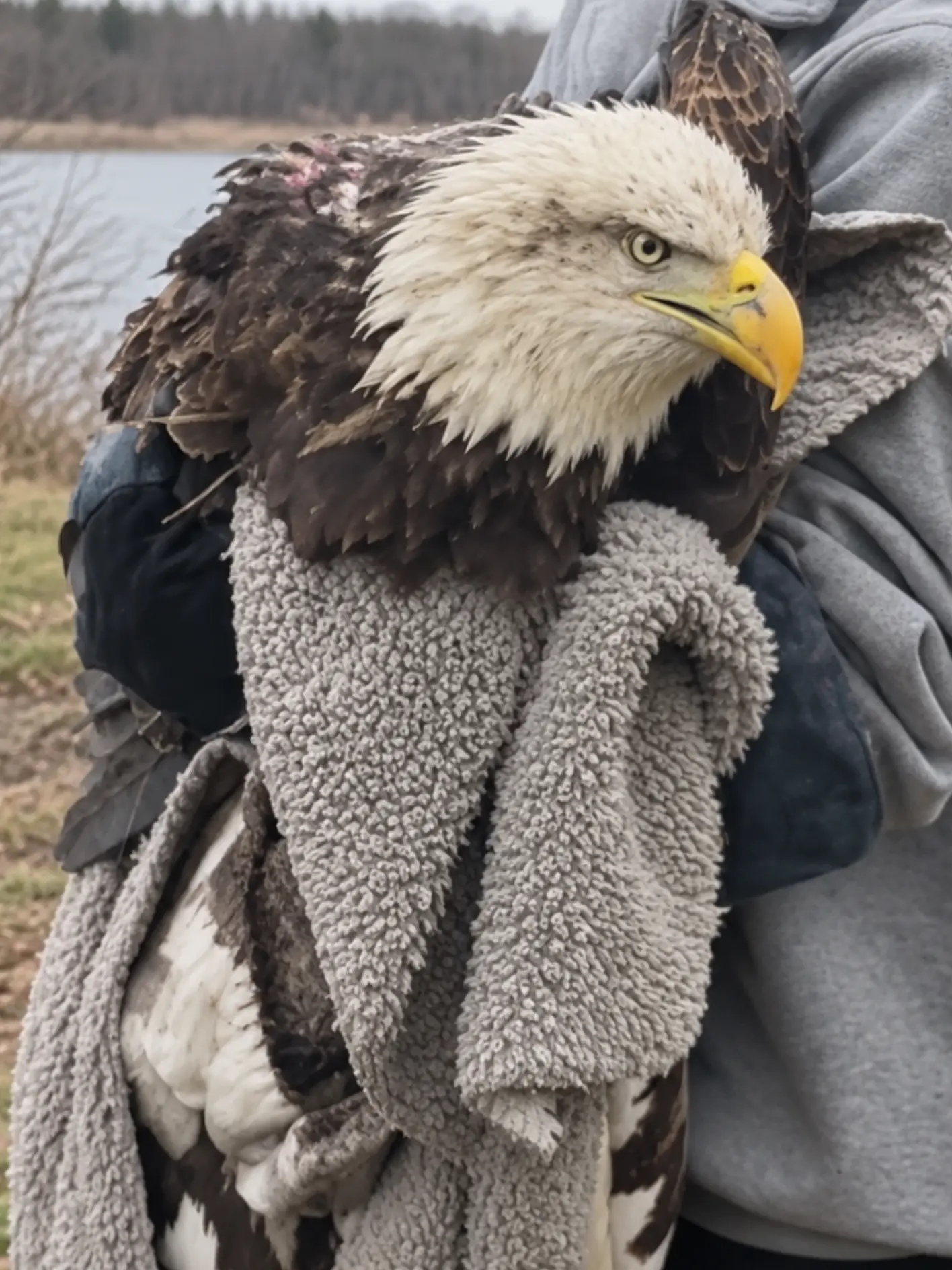
Emily Carter was driving along a rural road near Lake Winnebago, Wisconsin, when she saw a vehicle ahead of her strike a large bird flying low across the roadway.
At first, she could not tell what had been hit.
The bird disappeared into the roadside grass.
Carter slowed, pulled over safely, and looked back.
That was when she saw the white head.
An adult Bald Eagle was lying near the edge of the road.
It was still alive.
The bird lifted its head and watched her, but it did not attempt to fly away. Its wings remained close to the body, and several feathers across the upper back and shoulder appeared disturbed. A small area of exposed tissue and blood was visible beneath the damaged plumage.
Carter stayed back and called for help.
Within a short time, wildlife responder Mark Jensen arrived to assess the eagle and safely remove it from the roadside.
The bird would later receive the temporary rehabilitation name River.
At that moment, however, no one knew whether River had suffered a broken wing, internal injuries, head trauma, or some combination of all three.
The eagle was conscious.
That was encouraging.
But after a high-energy vehicle collision, being awake does not mean being uninjured.
The Eagle Was Alert — But It Could Not Leave
Carter continued observing River from a safe distance while waiting for the responder.
The eagle occasionally shifted position.
Its head remained upright.
The eyes followed movement.
When Carter moved slightly closer, River became visibly more alert.
But there was still no attempt at sustained flight.
That behavior was concerning.
A healthy adult Bald Eagle would normally create distance from people quickly when open space was available.
River had an opportunity to leave.
It did not.
The eagle appeared strong enough to react but not strong enough, comfortable enough, or mechanically able to fly.
Carter resisted the temptation to approach and “see if it could take off.”
That decision mattered.
If a wing, shoulder, pelvis, or spine had been injured, forcing the eagle to escape could make the trauma worse.
A frightened bird could also move directly into traffic.
Instead, Carter kept the area as quiet as possible and waited for professional help.
A Roadside Eagle Can Still Be Dangerous
When Jensen arrived, he first assessed River without immediately attempting to capture it.
The eagle remained responsive.
Both eyes were open.
The head position appeared generally normal.
The wings were not obviously hanging away from the body.
But a patch of feathers over the upper back and shoulder region had been damaged, exposing irritated tissue beneath.
The bird also remained low to the ground.
Jensen knew that an injured Bald Eagle can still strike forcefully with its feet.
The talons remain the primary handling hazard even when the bird appears weak.
“The eagle was clearly compromised,” he later said. “But it was still watching everything we did. That’s when you have to remember that an injured raptor is still a wild raptor.”
Using appropriate protective equipment, Jensen safely contained River.
A heavy towel was used to help support the bird and keep the wings close to the body during handling.
The feet were controlled.
The body was supported.
There was no attempt to extend the injured shoulder or test flight at the roadside.
River was then moved into a secure transport carrier for the trip to the fictional Great Lakes Wildlife Rehabilitation Center.
The Rescue Photograph Captured the First Stage of Care
A photograph taken shortly after the rescue shows River wrapped securely in a thick towel while being held for transport.
The eagle is awake.
Its eyes remain focused.
The beak is closed.
The bird appears tense but responsive.
Over the upper back near the shoulder, however, several feathers are disrupted, and a small area of injured tissue is visible.
The image documents trauma.
It does not show what lies beneath.
A shoulder can be fractured without obvious external deformity.
A lung or air sac may be bruised after blunt impact.
Internal bleeding can occur without a large external wound.
A bird can also experience concussion-like injury while still remaining conscious.
That is why the roadside rescue was only the beginning of River’s evaluation.
Vehicle Collisions Can Produce Injuries That Are Easy to Miss
Blunt-force trauma is particularly difficult because the most serious damage may be internal.
A vehicle strike can affect:
the wings;
shoulder girdle;
chest;
pelvis;
spine;
head;
lungs and air sacs;
or internal organs.
The visible wound does not necessarily indicate the most important injury.
In River’s case, the damaged feathers and exposed tissue near the shoulder immediately drew attention.
But the veterinary team would also need to determine whether the eagle’s inability to fly was caused by pain, fracture, muscle injury, neurologic dysfunction, or internal trauma.
The bird was transported quietly and with minimal stimulation.
No food was given during transport.
No one attempted to make it stand.
The goal was to get River to the center without adding unnecessary stress.
The Initial Examination Focused on the Whole Bird
At Great Lakes Wildlife Rehabilitation Center, fictional wildlife veterinarian Dr. Laura Mitchell began a complete trauma examination.
River was still alert.
That remained a positive sign.
But the eagle was subdued compared with the defensive behavior expected from a healthy adult.
Mitchell evaluated respiratory effort first.
After vehicle strikes, breathing can become abnormal if the chest has been compressed or if internal tissues have been bruised.
River’s breathing was monitored closely for increased effort or asymmetry.
The eyes and pupils were checked.
The beak was examined.
Both feet were tested for grip and response.
The spine and pelvis were palpated cautiously.
Each wing was examined for swelling, abnormal angle, instability, and pain.
The upper back and shoulder wound was cleaned enough to determine its extent.
The Shoulder Wound Looked Serious but Did Not Expose Bone
Several feathers around the injured area had been broken or removed.
There was bruising beneath the plumage.
The skin had been abraded, and a small region of soft tissue was exposed.
No major bone was visible through the wound.
That was encouraging.
But the location remained important.
The shoulder region plays a major role in flight.
Soft-tissue injury there can affect an eagle even when the skeleton is intact.
Muscles, tendons, ligaments, and other structures must all work together for normal wing movement.
The wound was cleaned.
Debris was removed.
The tissue was inspected for viability.
River received appropriate pain management and supportive care while the team prepared for imaging.
Radiographs Were the Next Major Step
Because the collision had been witnessed and River had not flown afterward, the veterinary team wanted to rule out fractures as quickly as possible.
Radiographs were obtained of the wings, shoulders, chest, pelvis, and other areas of concern.
Everyone expected that the inability to fly might be explained by a major break.
The films brought some good news.
No major long-bone fracture was identified.
There was no obvious major dislocation of the shoulder.
The pelvis did not show a catastrophic break.
The spinal structures visible on the study did not reveal a major acute fracture.
For the team, this changed the direction of the case.
The bones appeared substantially better than feared.
But River was still not considered safe.
“The absence of a fracture was encouraging,” Mitchell said. “But it did not mean the eagle had escaped serious trauma.”
A Normal X-Ray Does Not Rule Out Blunt-Force Injury
Radiographs are excellent for evaluating many fractures.
They are less capable of showing all forms of muscle bruising, ligament damage, organ trauma, or concussion-like injury.
A bird may have structurally intact bones and still be unable to fly normally.
River’s shoulder and upper back had clearly absorbed significant force.
Soft-tissue swelling and bruising remained present.
The bird was also unusually reluctant to move.
The veterinary team therefore continued treating the case as significant blunt trauma.
The next 24 hours would be particularly important.
Some injuries become more apparent only after swelling increases or the effects of shock evolve.
The First Night Was About Observation
River was placed in a quiet enclosure with thick padded flooring.
No high perch was offered.
If the eagle became weak or disoriented, a fall could create an entirely new injury.
The room was kept calm.
Handling was minimized.
Supportive fluids were provided as clinically appropriate.
Pain was managed.
The shoulder wound was monitored.
Staff recorded respiratory effort, posture, responsiveness, and ability to stand.
River spent much of the night resting.
The eagle remained alert when staff entered but showed little interest in unnecessary movement.
Appetite was initially limited.
That was not unexpected.
The bird had experienced a vehicle collision, roadside capture, transport, restraint, imaging, and wound care within a short period.
The prognosis at that stage remained guarded but cautiously optimistic.
There were no major fractures.
But the full consequences of the collision were not yet known.
Delayed Internal Injury Was Still a Concern
Vehicle trauma can evolve over time.
An animal may appear relatively stable at first and then develop new problems.
For River, staff continued watching for:
increasing respiratory effort;
weakness;
abnormal posture;
changes in neurologic response;
progressive swelling;
evidence of internal bleeding;
or declining responsiveness.
The veterinary team also monitored fecal output and hydration status.
A bird that begins deteriorating after initial stabilization may be revealing internal trauma that was not obvious on admission.
Fortunately, River did not show a dramatic decline during the first night.
Breathing remained stable.
The eagle maintained consciousness.
Grip strength remained present.
That allowed the team to begin looking for early signs of improvement.
The First Major Improvement Was Stronger Posture
By the following morning, River was standing for longer periods.
The head was held higher.
When staff entered, the eagle turned more quickly to follow them.
Its defensive behavior increased.
That may sound like a minor change.
For a wildlife patient, it can be important.
A healthy Bald Eagle should not be comfortable with human proximity.
Increased avoidance and defensive behavior can indicate improved energy and neurologic function.
“The first thing we wanted to see was whether the bird could become more stable without developing delayed complications from the impact,” Mitchell said. “By the next morning, the posture was stronger, and that was encouraging.”
River still favored rest.
But the eagle no longer looked as if every movement required significant effort.
Appetite Returned Gradually
Food was introduced once the team was satisfied that River could eat safely.
The first meal was small.
The eagle initially watched without approaching.
Later, River began feeding.
The bird gripped the food normally.
The beak worked as expected.
Swallowing appeared normal.
This was another useful indicator.
A bird recovering from major trauma needs energy to repair tissue.
Appetite also provides information about overall neurologic and physiologic recovery.
River continued eating over the following days.
Body condition remained stable.
The eagle became increasingly active in the enclosure.
The Back Wound Began to Heal
The visible injury over the upper back and shoulder was checked regularly.
Swelling gradually decreased.
The exposed soft tissue remained viable.
There was no evidence of rapidly spreading infection.
The surrounding feathers were still damaged, but the wound itself began to close.
Not every feather would return immediately.
Some would remain broken until molt.
But cosmetic appearance was not the primary concern.
The question was whether the shoulder beneath those feathers could move normally.
That became the next focus of rehabilitation.
A Shoulder Can Be Injured Without Being Broken
Although radiographs did not show a major fracture, River had clearly sustained force through the shoulder region.
Bruised muscles and strained soft tissues can cause pain and weakness during flight.
The veterinary team began observing natural wing movements.
At first, River kept both wings close to the body.
Later, the eagle began stretching.
The uninjured side moved freely.
The affected side also extended, but initially with slightly more hesitation.
That finding was not unexpected.
The shoulder had experienced trauma.
The team did not force the wing through aggressive manipulation.
Instead, they watched for gradual improvement.
The important questions were:
Would River extend both wings fully?
Would the shoulder tolerate repeated movement?
Would the affected wing droop after activity?
Would pain return as the bird became more active?
The First Voluntary Stretch Was Encouraging
Several days into care, River performed a full-body stretch.
One wing opened.
Then the other.
The shoulder moved through a much larger range than it had during the first examination.
The eagle folded the wing back normally.
No severe droop followed.
There was no obvious new swelling.
This was one of the strongest signs yet that the injury might be primarily soft tissue rather than structurally disabling.
Still, flight had not been tested.
A voluntary stretch requires far less force than takeoff.
The bird would need to progress carefully.
A Low Perch Came Before a Flight Enclosure
River was first given access to a low perch.
The eagle stepped onto it without difficulty.
Both feet gripped strongly.
Balance appeared normal.
The bird repositioned naturally.
Small wing movements helped maintain stability.
This tested several systems at once:
strength,
coordination,
vision,
grip,
and confidence.
River remained stable.
The perch height could then be increased gradually.
The team continued watching the injured shoulder.
No major deterioration occurred.
The Flight Test Was Deliberately Delayed
It would have been easy to become impatient after learning there were no fractures.
But the veterinary team understood that a prematurely forced flight could reopen the healing soft tissues or lead to another crash.
River was not moved into a large flight enclosure until:
the wound had improved;
the shoulder showed better motion;
general strength had returned;
appetite was stable;
and neurologic observation remained normal.
Only then was the eagle given space to fly.
No one threw the bird into the air.
River was allowed to choose when to launch.
For several minutes, the eagle remained perched.
Then the wings opened.
The body leaned forward.
River pushed away.
The First Flight Was Short but Controlled
The eagle crossed the enclosure and landed on another perch.
Both wings produced lift.
The injured side did not collapse.
The landing was controlled.
There was no obvious loss of balance.
For the rehabilitation team, that was excellent progress.
It was not a release test.
One short flight can hide weakness.
A bird may compensate briefly before fatigue appears.
River would have to fly repeatedly.
The shoulder would need to perform under increasing demand.
Repeated Flight Exposed What Resting Examination Could Not
Over the following sessions, the eagle was encouraged through normal enclosure use to make longer flights.
River moved between elevated perches.
The bird gained altitude.
It turned.
It approached landing points from different angles.
The rehabilitation team watched the shoulder after each session.
Did the wing begin to hang lower?
Did the eagle avoid using that side?
Did breathing remain appropriate?
Did performance deteriorate after several flights?
At first, River tired more quickly than a healthy wild eagle should.
That was expected after days of restricted activity and trauma.
Conditioning continued.
Gradually, the difference became smaller.
Muscle Recovery Was Just as Important as Wound Healing
A healed skin wound does not restore flight strength.
Muscles weakened by trauma and inactivity need time to recover.
River’s rehabilitation therefore moved away from treatment-table medicine and toward active conditioning.
Every takeoff demanded power from the pectoral muscles.
Every turn required controlled wing movement.
Every landing required braking and balance.
Those activities rebuilt the systems the eagle would need after release.
The damaged shoulder feathers remained visible.
But the wing beneath them became stronger.
That was what mattered.
The Collision Site Offered One Possible Clue About Risk
Bald Eagles are commonly seen around lakes, rivers, and road corridors where food is available.
They may fly low when approaching carrion or crossing from one feeding area to another.
Roadside carcasses can also attract scavenging raptors.
However, no one could determine exactly why River was flying low when the collision occurred.
The vehicle strike itself had been witnessed.
The reason the bird was in the roadway had not.
The rehabilitation team therefore avoided claiming that River had been feeding on roadkill.
It remained one possible scenario, not a confirmed one.
That distinction preserved the accuracy of the case.
Drivers and Bystanders Can Make a Difference
River’s survival depended partly on what happened immediately after the collision.
Carter did not drive away.
She also did not put herself or others at additional risk.
She pulled over safely.
Observed from a distance.
Confirmed that the eagle was alive.
Contacted trained responders.
Stayed nearby long enough to direct them to the correct location.
Those actions helped reduce the time River remained exposed beside the road.
A wildlife rescue does not always begin with specialized equipment.
Sometimes it begins with a person recognizing that an animal is still alive and making the right call.
“She didn’t need to know how to treat an eagle,” Jensen said. “She only needed to recognize that this eagle needed help.”
What to Do if You See a Bald Eagle Hit by a Vehicle
The public should not place themselves in traffic to attempt a rescue.
Safety comes first.
If an eagle or other large raptor is struck:
move to a safe location if possible;
do not stand in an active traffic lane;
keep a safe distance from the bird;
keep pets and bystanders away;
note the exact location;
and contact local wildlife authorities, Animal Control, conservation officers, or a licensed wildlife rehabilitator.
Do not attempt to make the bird fly.
Do not approach the feet.
Do not assume a motionless eagle is dead.
And do not offer food or water before professional evaluation.
A bird with head or internal trauma may not be able to swallow normally.
Normal X-Rays Were Only One Part of the Good News
River’s case illustrates an important distinction.
Radiographs ruled out several catastrophic skeletal injuries.
That significantly improved the prognosis.
But they did not establish recovery.
The eagle still had:
a shoulder-area wound;
significant bruising;
damaged feathers;
soft-tissue pain;
and the systemic effects of a high-energy collision.
Recovery had to be demonstrated gradually.
For River, that happened through:
stronger posture;
return of appetite;
normal grip;
improving shoulder movement;
successful perching;
and eventually controlled flight.
Each milestone answered a different clinical question.
Release Would Depend on Repeated Performance
The veterinary team established strict criteria before River could return to the wild.
The wound needed to be healed enough to remain stable.
There could be no significant infection.
Respiration had to remain normal.
The shoulder needed functional range of motion.
Both wings had to beat symmetrically.
The eagle needed to gain altitude.
Turn accurately.
Land precisely.
Repeat those flights without abnormal fatigue.
Body condition had to be appropriate.
And River needed to remain wary of people.
A wild animal can appear healthy in an enclosure and still fail one of these tests.
That is why release decisions are based on function rather than time.
The Eagle Became Increasingly Difficult to Approach
As River regained strength, staff noticed another change.
The bird wanted less to do with them.
It moved away when people entered.
It watched from the far side of the enclosure.
The eagle became more defensive during necessary checks.
For rehabilitation staff, this was welcome.
River had not become habituated to human care.
The bird remained behaviorally wild.
That matters.
A Bald Eagle released with reduced fear of people could be at increased risk after returning to the landscape.
River’s avoidance behavior suggested that the weeks in care had not changed the basic instincts required outside the center.
The Final Flight Assessment Would Matter More Than the Original X-Ray
By the later stages of rehabilitation, the shoulder wound looked much less dramatic.
The exposed tissue had healed.
Damaged feathers remained, but the injury no longer appeared acute.
More importantly, River was flying strongly.
The eagle completed repeated passes.
It maintained altitude.
The wings appeared symmetrical.
Turns were controlled.
Landings were accurate.
There was no persistent droop of the injured side after exercise.
That functional performance carried more weight than the visual appearance of the wound.
The initial X-ray had answered:
Is there a major fracture?
The flight enclosure answered:
Does the eagle actually work normally again?
The second question was ultimately more important.
The Final Perspective
River’s story began on a rural Wisconsin road.
A vehicle ahead of Emily Carter struck a large bird flying low over the pavement.
The bird fell into the grass.
Carter stopped safely and discovered an adult Bald Eagle still alive but unable to fly.
There was visible damage over the upper back and shoulder.
The eagle remained alert enough to watch her.
It could move.
But it could not leave.
Wildlife responder Mark Jensen arrived and safely contained River in a thick towel, protecting the wings and controlling the feet during transport.
At Great Lakes Wildlife Rehabilitation Center, veterinarians began looking for the injuries that a roadside photograph could not reveal.
The initial examination documented soft-tissue trauma.
Radiographs brought encouraging news:
no major wing fracture;
no major shoulder dislocation;
no catastrophic pelvic injury.
But the absence of broken bones did not erase the effects of the collision.
River still needed close observation for internal trauma.
The shoulder wound needed care.
The bruised tissues needed time.
The first night was quiet.
Then the improvements began.
Stronger posture.
More defensive behavior.
Appetite.
Healing tissue.
Voluntary wing stretching.
A low perch.
Then flight.
The vehicle impact had taken only seconds.
The bird’s body required weeks to demonstrate that those seconds had not permanently taken away its ability to fly.
That distinction is what wildlife rehabilitation is built around.
Surviving an accident is not the same as recovering from it.
A Bald Eagle cannot return to the wild simply because the bleeding stops or an X-ray looks normal.
It must function.
River needed to show that the shoulder could withstand powerful wingbeats.
That both wings could generate equal lift.
That the eagle could climb, turn, land, and repeat the process without pain or weakness.
Only then could the rehabilitation team consider the bird ready.
And none of those opportunities would have existed if the person driving behind the collision had simply continued down the road.
Carter could not diagnose River.
She could not treat the shoulder.
She could not perform radiographs.
She could not predict whether the eagle would fly again.
She did something much simpler.
She noticed that the bird was still alive.
She stopped.
And she called someone who could help.
Sometimes that is where an entire wildlife recovery begins.