For weeks, the adult Bald Eagle wanted almost nothing to do with the people trying to save its broken wing.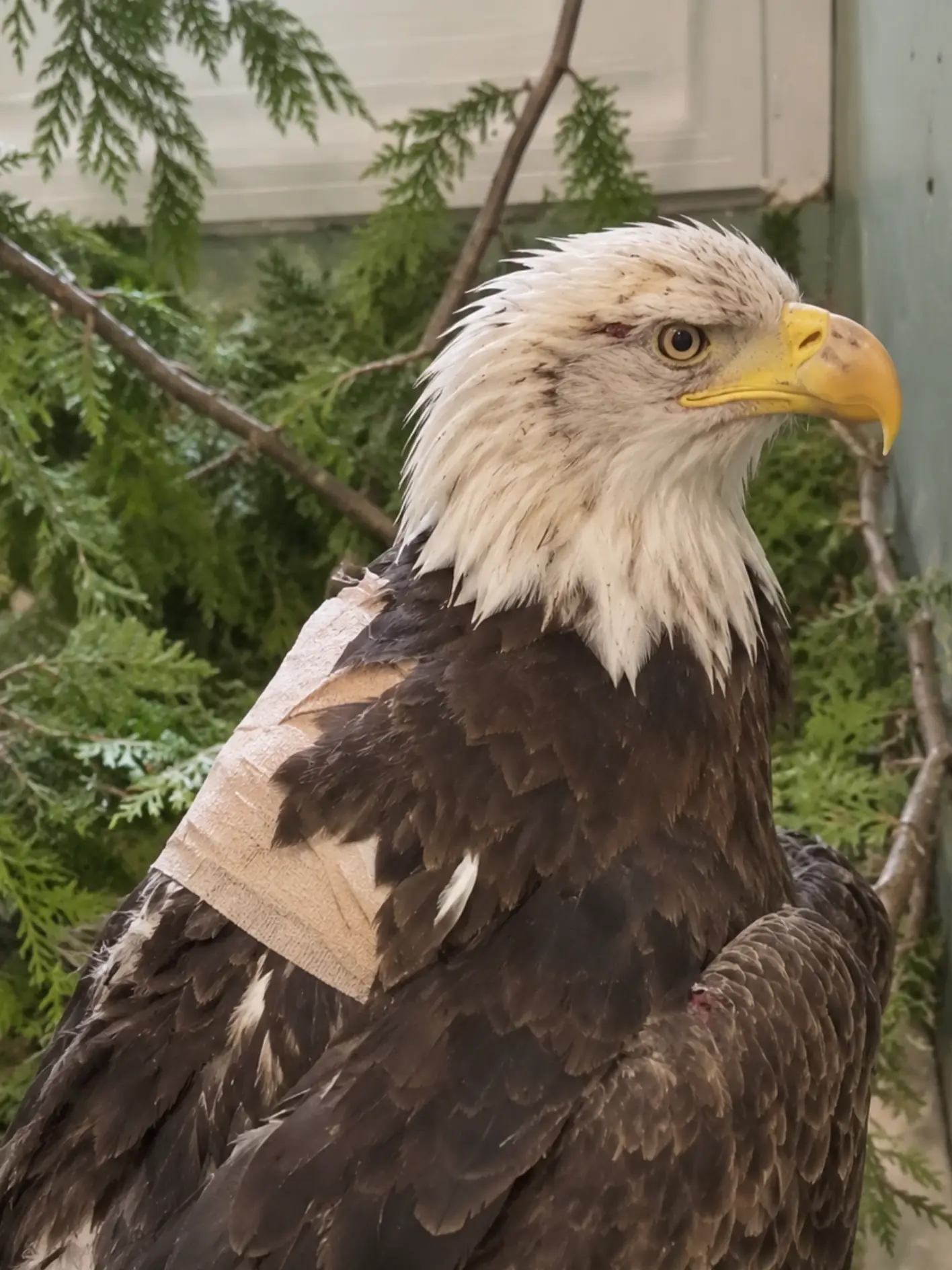
It struck at heavy gloves whenever handlers came too close. It turned its head sharply toward every movement in the treatment room. During bandage changes, its powerful feet had to be controlled before anyone could safely examine the injured wing. As strength returned, the bird became more difficult to handle rather than easier.
For the rehabilitation team at the fictional Northwoods Raptor Rehabilitation Center in Wisconsin, that was exactly what they wanted.
A wild Bald Eagle should not become comfortable with people simply because it spends several weeks in a hospital. The objective of wildlife rehabilitation is not to create a relationship between patient and caregiver. It is to restore an animal to the point where human help is no longer needed.
Yet during one of the eagle’s final examinations, only days before release, something unusual happened.
Dr. Emily Carter had been involved with the bird from its first night at the center. She had examined the damaged wing, reviewed the radiographs that confirmed the fracture, helped plan the operation, monitored the surgical repair, changed bandages, evaluated new bone formation, and eventually watched the eagle make its first uncertain flights inside a rehabilitation enclosure.
During that final examination, the eagle was restrained in the same careful way it had been many times before. Its feet were protected by experienced handlers, and Carter examined the wing one last time.
The bird was tense at first.
Then it became still.
For several seconds, the eagle looked directly at Carter. When her gloved hand moved close to the side of its head, the bird did not strike or pull away. Instead, it lowered its head slightly and remained quiet against the glove.
No veterinarian could scientifically say that the eagle was expressing gratitude in the human sense. The behavior might have reflected temporary fatigue after restraint, familiarity with the examination routine, or simply a moment when the bird did not perceive the hand as an immediate threat.
Carter understood that.
Even so, after weeks spent watching the eagle fight through pain and rehabilitation, the brief pause affected everyone in the room.
“I know we have to be careful about assigning human emotions to wildlife,” Carter later said. “But for a few seconds, this eagle stopped fighting, looked straight at me, and rested quietly beside the glove. After everything it had been through, it felt like the closest thing to a thank-you I will probably ever receive from an eagle.”
A few days later, the bird offered the team a far more important response.
The carrier opened.
The eagle stepped forward.
It spread both wings, including the one that had once been broken, and flew away.
It did not look back.
For a wildlife veterinarian, there may be no better thank-you than that.
The Eagle Was Found With One Wing Hanging Too Low
The case had begun several weeks earlier, when a resident in northern Wisconsin noticed an adult Bald Eagle on the ground near a wooded road.
At first, the bird appeared alert. Its head was upright, and its eyes followed passing vehicles and people from a distance. Bald Eagles sometimes spend time on the ground while feeding, so the sight alone did not necessarily indicate an emergency.
The problem became obvious when the eagle tried to leave.
It spread both wings and attempted to launch.
One wing opened normally.
The other did not.
The bird managed only a short, awkward movement before returning to the ground.
The injured wing remained lower than the opposite side and did not fold tightly against the body afterward.
The resident moved away and watched from a distance rather than approaching the eagle repeatedly.
That decision was important.
A bird with a broken wing may still be capable of running, striking with its talons, or making short escape attempts. Forcing those movements can increase pain or cause additional damage around a fracture.
A local wildlife rescue organization was contacted.
By the time responders arrived, the eagle had moved only a short distance.
It remained conscious and defensive.
That was encouraging from a general neurologic standpoint, but the wing abnormality was unmistakable.
The bird needed professional care.
Rescuers Had to Protect Themselves Before They Could Protect the Wing
Large raptors present a unique challenge during rescue.
The beak attracts attention because it is large and visible, but the feet are usually the greater handling risk.
An adult Bald Eagle can close its talons with tremendous force. Even an injured bird may react explosively when a person comes within reach.
The rescuers approached with heavy protective gloves and a large towel.
When they moved closer, the eagle opened its wings and attempted to defend itself.
The injured side moved poorly.
The healthy side worked well enough to make restraint difficult.
Once the towel was positioned over the bird, the responders controlled the feet first. The body was then supported carefully so that the damaged wing would not swing freely.
No one attempted to straighten the wing in the field.
A fracture that is manipulated unnecessarily can become more displaced, damage surrounding muscle, compromise blood vessels, or injure nerves.
The eagle was placed inside a secure, padded transport container and driven to the Northwoods Raptor Rehabilitation Center.
Staff were already preparing the examination room when the vehicle arrived.
The First Examination Suggested a Serious Wing Fracture
The eagle was alert when the carrier was opened.
Its eyes were responsive.
Its grip remained strong.
There was no obvious paralysis or major neurologic deficit.
The injured wing, however, was painful and unstable.
The veterinary team minimized manipulation until diagnostic imaging could show what had happened internally.
There were several small areas of superficial trauma elsewhere on the body, but none appeared immediately life-threatening.
The primary concern was the left wing.
After the eagle was stabilized and safely restrained, radiographs were obtained.
The images confirmed what the team had suspected.
The humerus, the large upper-wing bone extending from the shoulder toward the elbow, was fractured and displaced.
The injury was serious.
A Bald Eagle depends on extraordinary symmetry between its wings. Even modest permanent shortening, rotation, or abnormal angulation can change the mechanics of flight.
For an animal living permanently under human care, some physical limitations can sometimes be accommodated.
For a wild eagle expected to hunt, travel, turn in strong wind, and land safely in trees, those compromises may be unacceptable.
The medical team therefore had two goals.
The first was to heal the bone.
The second was far more demanding.
The bone had to heal in a position that still allowed the wing to function almost normally.
A Broken Wing Is Not Simply a Broken Bone
It is easy to imagine fracture repair as a straightforward mechanical problem.
Align the pieces, keep them stable, and wait.
In a flying animal, the requirements are much stricter.
The bones of the wing must work as part of a larger system involving joints, muscles, tendons, ligaments, feathers, nerves, and precise coordination between both sides of the body.
The humerus also participates directly in the powerful motion that generates lift.
If it heals with substantial rotation, the rest of the wing may not open in the correct plane.
If it heals too short, feather position and wing geometry can change.
If the shoulder or elbow loses range of motion during recovery, the bird may never produce a full wingbeat even if the bone itself becomes solid.
That meant Carter and the surgical team were not trying merely to produce an X-ray that looked better.
They were trying to preserve flight.
Surgery Offered the Best Chance of Restoring Alignment
The displacement seen on radiographs made conservative treatment less attractive.
Some avian fractures can be managed with external support alone, depending on the location and stability of the injury.
This fracture required more precise control.
The surgical team decided to stabilize the bone internally while protecting the surrounding soft tissues as much as possible.
Before the operation, the eagle underwent additional assessment to make sure it was stable enough for anesthesia.
Hydration was addressed.
Bloodwork was reviewed.
The bird was examined for additional injuries that might complicate surgery.
Once the team was satisfied that the eagle could tolerate the procedure, it was anesthetized and positioned carefully.
Carter knew that even technically excellent surgery would not answer the most important question.
The repaired bone would still have to survive weeks of healing and eventually tolerate the forces of flight.
The operation was only the first step.
The Fracture Was Realigned and Stabilized
During surgery, the damaged portions of the humerus were returned as closely as possible to normal alignment.
The stabilization method was selected to maintain that position during healing while minimizing unnecessary interference with the surrounding tissues.
The veterinary team worked carefully because excessive disruption around the fracture can affect blood supply and delay healing.
Once the repair was secure, the surgical site was closed and the eagle was recovered from anesthesia under close observation.
The procedure itself had gone as planned.
That was encouraging.
No one called the case a success yet.
The eagle still had weeks of healing ahead.
The Bird Woke Up Still Very Much a Wild Eagle
When the eagle became fully conscious, its personality returned quickly.
It watched staff closely.
It reacted to movement.
When handlers later needed to reposition it, the feet remained dangerous enough that everyone in the room treated them with respect.
For Carter, that defensive behavior was reassuring.
A badly compromised raptor may become unusually passive.
This bird was hurt, but it still possessed the alertness and aggression expected from a wild adult.
The repaired wing was protected with a carefully applied supportive bandage.
The goal was to restrict damaging movement while avoiding unnecessary stiffness elsewhere.
The eagle was housed in a quiet medical enclosure with low environmental demands.
There would be no flight for some time.
The Photograph Shows the Stage Between Surgery and Recovery
A photograph from the rehabilitation period shows the Bald Eagle upright inside a controlled enclosure surrounded by natural branches and greenery.
A broad protective bandage crosses the injured shoulder and wing.
The bird’s head is raised.
Its eye is clear and focused.
The posture is far stronger than that of an eagle in immediate postoperative crisis, but the image captures an important middle stage.
The bird was alive.
It could stand.
The fracture had been repaired.