A man traveling along a river outside Coeur d’Alene, Idaho, thought at first that he was watching a piece of debris being carried downstream.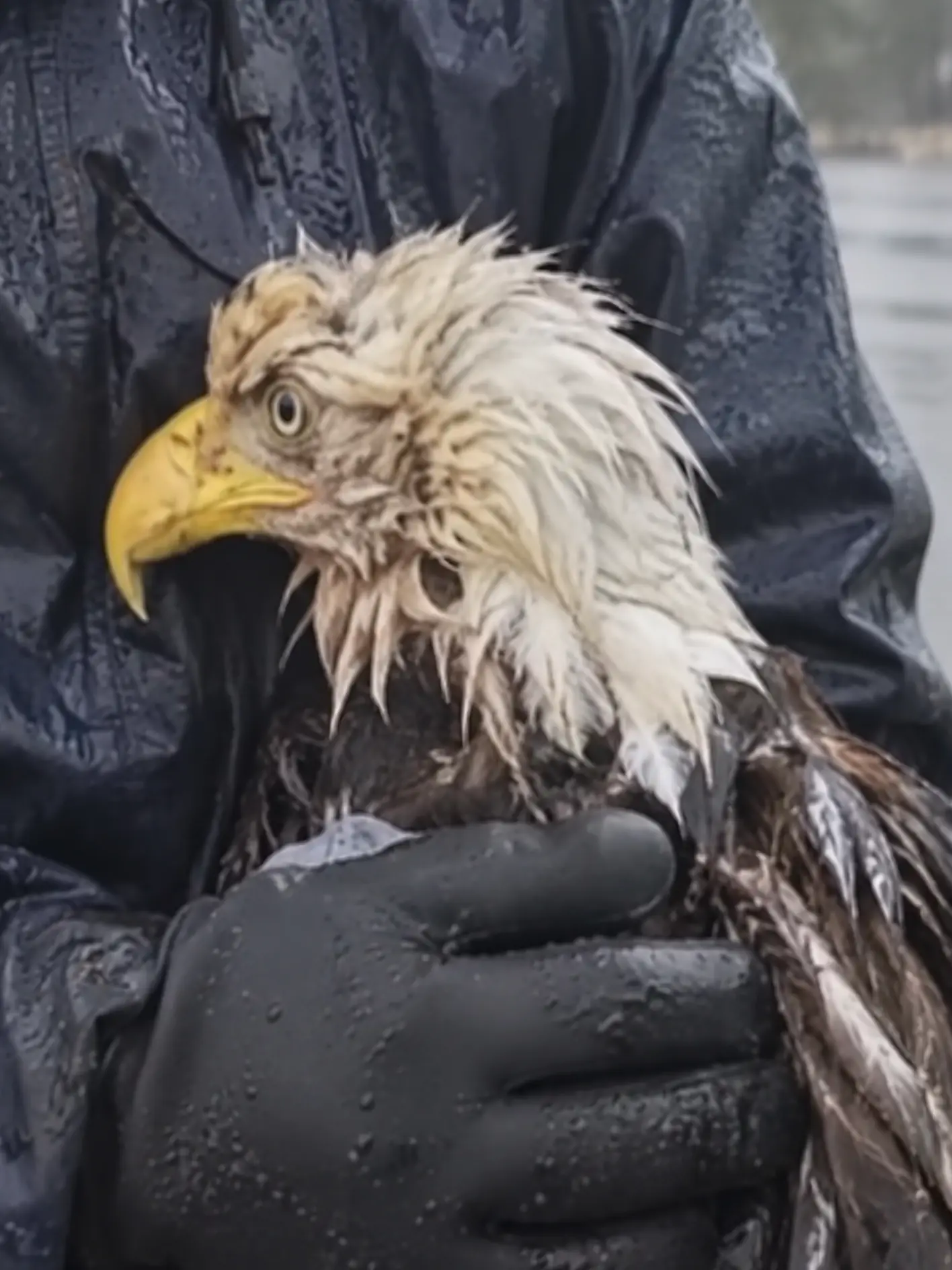
Then it moved.
A white head briefly appeared above the dark water, disappeared behind a small wave, and surfaced again several yards farther downstream.
It was an adult Bald Eagle.
The bird was alive, but it was clearly losing its fight against the current.
Its feathers were completely saturated. One wing appeared to move unevenly, and every attempt to reach the riverbank seemed to end with the eagle being pushed back into deeper water.
The man stopped and watched for only a few moments before realizing the bird might not have much time.
He moved closer to the river, waited until the eagle drifted within reach, and managed to pull it from the water.
What happened next surprised him.
The eagle did not immediately struggle.
It did not attempt to strike with its talons or force its way out of his arms.
Instead, the soaked bird remained unusually still against his chest, breathing heavily while rainwater continued dripping from its feathers.
For a wild adult Bald Eagle, that behavior was alarming.
A healthy eagle would normally resist close human contact aggressively. This bird seemed too exhausted to do so.
Only after getting it out of the river did the rescuer notice another problem.
One wing was being held differently from the other.
The eagle seemed reluctant to move it, and the feathers along that side did not sit normally.
Wildlife officials were contacted, and the bird was transferred into professional care.
Later that day, radiographs provided the answer to why the eagle had become trapped in the current in the first place.
The bird had a fractured wing.
The river had not caused the original problem.
The broken wing had left the eagle unable to escape the river.
“The fact that this bird was still alive when it was pulled from the water was significant,” the attending wildlife veterinarian said. “By the time a large raptor becomes completely saturated and is being carried downstream, exhaustion and hypothermia can progress very quickly.”
The eagle is now receiving treatment at a licensed raptor rehabilitation center in northern Idaho.
Its wing has been stabilized.
Its body temperature has returned closer to normal.
Its strength is improving.
And the bird that initially sat almost motionless in its rescuer’s arms is becoming increasingly alert and defensive again.
Whether it will eventually return to the wild, however, will depend on one thing the veterinary team cannot rush:
how well the fractured wing heals.
The Eagle Was Being Carried by the Current
The initial rescue unfolded in wet, difficult conditions.
The river was moving fast enough that the eagle could not simply stand in the shallows and wait.
Each time the bird tried to reposition itself, the current carried it farther.
A Bald Eagle is an exceptionally powerful flier, but that power depends on the wings functioning together.
If one wing is injured, the bird may not be able to generate the lift needed to escape the water.
Wet feathers make the situation even worse.
Healthy contour and flight feathers trap air, shed water, and help maintain insulation.
Once completely soaked, those same feathers become heavy.
The bird must use more energy simply to keep its head above the surface.
For an eagle already dealing with a broken wing, the combination can become life-threatening.
Getting the Bird Out of the Water Was Only the First Step
Once the man pulled the eagle onto safer ground, he realized how exhausted it was.
The bird remained conscious.
Its eyes were open.
It watched what was happening.
But it did not behave like a normal adult Bald Eagle.
Instead of struggling continuously, it rested quietly against the rescuer.
That stillness could easily have been mistaken for calmness.
Wildlife professionals interpret it differently.
A wild eagle that allows itself to be held closely by a human is usually not comfortable.
It is compromised.
Severe exhaustion, pain, hypothermia, shock, or neurological impairment can all reduce normal defensive behavior.
“The bird was not being cooperative because it trusted people,” the rehabilitation veterinarian said. “It was simply too depleted to respond the way a healthy Bald Eagle normally would.”
The Rescuer Noticed the Wing Was Not Normal
As the eagle rested, one side of the body began to draw attention.
One wing appeared to sit lower.
The bird did not extend it normally.
There was no obvious open bone visible from a distance, but the asymmetry was enough to suggest a significant injury.
At that point, the rescuer did something important.
He did not try to straighten the wing.
He did not attempt to make a splint.
He did not pull on the limb to see whether it was broken.
He contacted people trained to handle injured wildlife.
That decision may have prevented additional damage.
Why an Injured Wing Should Not Be Manipulated in the Field
A wing fracture can involve several different bones and joints.
Without radiographs, a person cannot know:
where the fracture is located,
whether multiple fragments are present,
whether a joint is involved,
or whether nearby nerves and blood vessels have been damaged.
Attempting to force the wing back into position can turn a relatively stable fracture into a displaced one.
A bone fragment may tear surrounding muscle.
A sharp edge may damage blood vessels.
A closed fracture can even become open if bone penetrates the skin.
For rescuers, the appropriate goal is stabilization — not repair.
Repair belongs in a veterinary hospital.
Wildlife Officers Took Over the Transport
When wildlife personnel arrived, the eagle was transferred using protective equipment.
The feet were controlled first because the talons remain dangerous even in a weak bird.
The injured wing was supported close to the body without unnecessary extension.
Dry towels were used to remove some surface moisture and help reduce heat loss.
The eagle was placed into a padded, ventilated transport carrier.
The carrier was kept quiet and dim.
Stress reduction is particularly important in raptors after major trauma.
A frightened eagle can repeatedly throw itself against the walls of a carrier, potentially worsening an injury that has not yet been diagnosed.
The priority was simple:
keep the bird still, warm, and alive long enough to reach the rehabilitation center.
The Eagle Arrived Cold, Wet, and Exhausted
At intake, the medical team had two problems to address.
The first was obvious:
the suspected wing injury.
The second was the physiological stress created by prolonged immersion.
The eagle’s feathers were heavily saturated.
Its body temperature required close assessment.
The bird was dehydrated and exhausted.
It had spent significant energy trying to remain above water while lacking normal use of one wing.
In a situation like this, veterinarians cannot immediately focus only on the fracture.
The whole patient must be stabilized first.
Warming Had to Be Gradual
A severely chilled animal should not always be heated as quickly as possible.
Controlled warming allows the cardiovascular system to adjust.
The eagle was dried carefully and placed in a warm, protected environment.
Fluids were administered according to its clinical condition.
Supplemental oxygen could be provided if respiratory function required additional support.
Handling was minimized.
The bird needed rest.
Only after circulation, temperature, and breathing were considered sufficiently stable could the team proceed with a more detailed orthopedic examination.
The Wing Was Painful and Abnormal on Examination
During palpation, one section of the wing showed swelling and abnormal movement.
The eagle reacted when that region was examined.
The veterinarian compared the injured side with the opposite wing.
The shoulder was assessed.
Then the humerus.
The radius and ulna.
The wrist and distal wing.
The pattern strongly suggested a fracture, but palpation alone could not determine the exact configuration.
Radiographs were necessary.
The X-Ray Revealed the Hidden Injury
Diagnostic imaging confirmed a fracture involving the left ulna, one of the major bones in the forearm portion of a bird’s wing.
The ulna works alongside the radius and supports important flight structures.
The fracture explained much of what rescuers had observed.
The eagle may still have been able to flap.
But a fractured wing cannot reliably generate or control the forces required for flight.
In the river, that meant the bird had almost no practical way to escape.
“The fracture itself was serious, but the alignment gave us a reason to attempt treatment,” the veterinarian said. “The most important thing initially was preventing further displacement and giving the bone a chance to heal in an appropriate position.”
The Exact Cause of the Fracture Remains Unknown
No one witnessed the injury happen.
The fracture could potentially have resulted from several kinds of trauma.
A collision with a vehicle.
Impact with a tree or structure.
A territorial encounter with another eagle.
A fall.
Another unknown event.
The rehabilitation team does not have enough evidence to identify the exact cause.
What is clear is that the fracture almost certainly occurred before the eagle became trapped in the river.
A healthy adult Bald Eagle would ordinarily have been capable of leaving the water.
This bird could not.
The Water Turned a Serious Injury Into an Immediate Emergency
A fractured wing is dangerous on land.
In moving water, it becomes much more urgent.
The eagle could not lift itself above the current.
Its feathers became saturated.
The extra weight increased the amount of energy required for every movement.
Cold water accelerated heat loss.
The bird became progressively weaker.
Eventually, even keeping the head above water can become difficult.
Had the eagle remained in the river much longer, the likely complications would have included:
severe exhaustion,
hypothermia,
aspiration of water,
and drowning.
That is why the man’s decision to intervene when he did may have changed the outcome.
The Fracture Was Stabilized
Once imaging was complete, the injured wing was immobilized.
A padded wing wrap was used to hold the limb in a controlled position and limit movement at the fracture site.
The wrap also helps prevent the eagle from repeatedly extending the wing and disrupting early healing.
Applying a wrap to a bird requires precision.
Too loose, and it fails to stabilize the fracture.
Too tight, and it can interfere with circulation, damage feathers, or restrict breathing.
The bird’s wrap therefore has to be checked and adjusted regularly.
Pain Management Became Part of the Treatment Plan
A wing fracture is painful.
Wild raptors often hide pain remarkably well, particularly when people are nearby.
They may become still rather than vocalizing.
That does not mean discomfort is minor.
Appropriate analgesia was provided to reduce suffering and help the bird rest.
Controlling pain also supports other aspects of recovery.
A bird in severe pain may refuse food.
It may adopt an abnormal posture.
It may repeatedly struggle against the wrap.
Reducing pain makes normal healing more likely.
The First Night Remained Guarded
The eagle was placed in a quiet intensive-care enclosure with padded flooring.
No high perch was offered initially.
A bird recovering from cold exposure, exhaustion, and a fracture does not need the additional risk of falling.
Staff monitored:
body temperature,
breathing,
hydration,
alertness,
grip strength,
and the condition of the injured wing.
The prognosis remained guarded.
The bird had survived the river and reached the hospital.
That was significant.
But several potential complications could still emerge.
The Eagle Began Looking More Alert
During the following day, staff noticed gradual changes.
The bird held its head higher.
Its eyes remained open more consistently.
It followed movement around the enclosure.
Its grip became stronger.
Most encouragingly, it began showing more resistance when people approached.
For wildlife rehabilitators, that is often exactly what they want to see.
A recovering wild eagle should become less tolerant of human contact, not more.