An adult Bald Eagle admitted to a wildlife rehabilitation center in central Iowa arrived in the condition rescuers have learned to fear.
The bird was alive and conscious, but profoundly weak.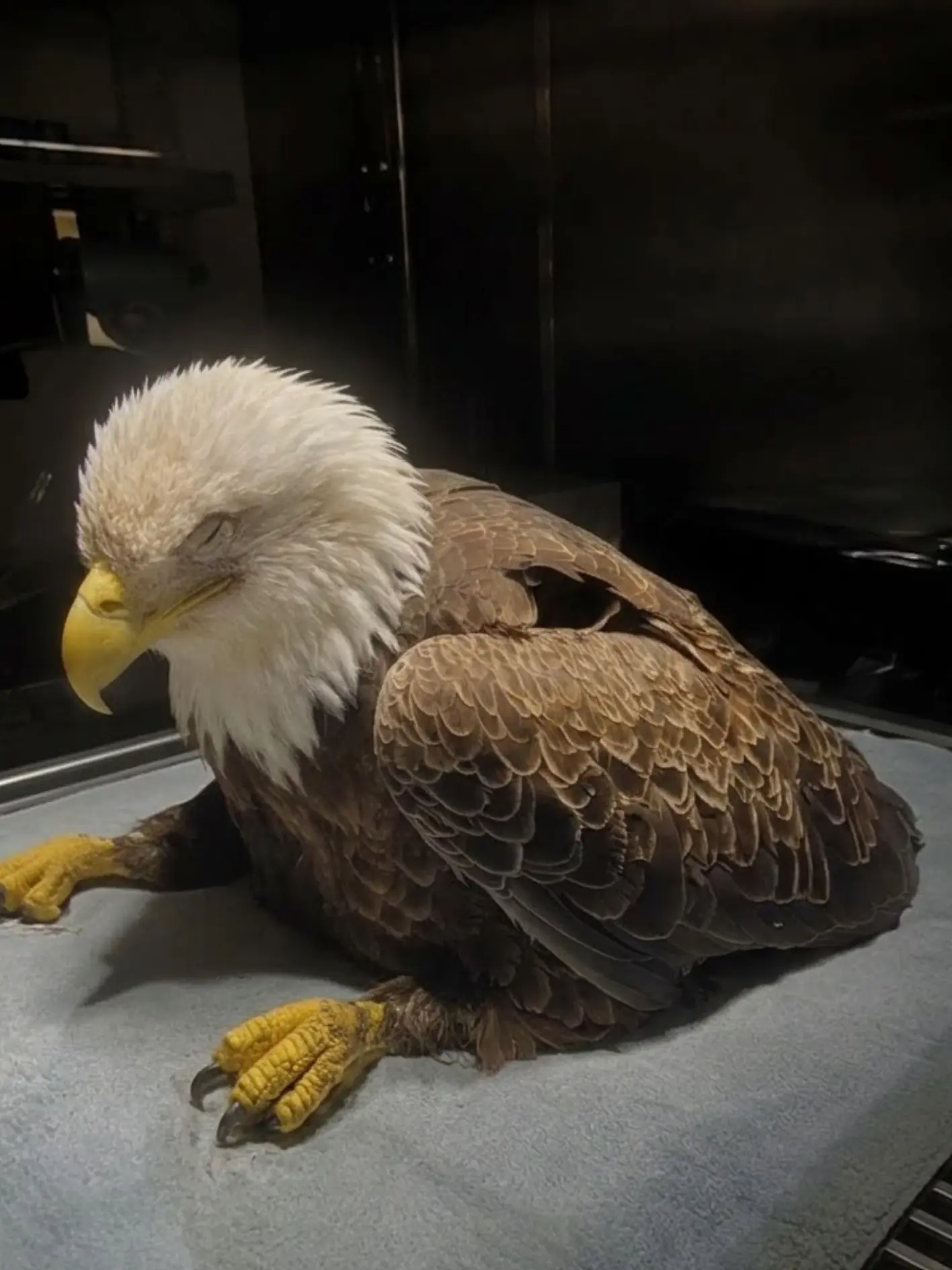
Instead of standing upright or attempting to climb onto a perch, the eagle remained low on padded bedding, its eyes closing for long periods and its wings resting heavily against its body. It showed little of the defensive behavior normally expected from a healthy wild Bald Eagle.
There was no dramatic open fracture.
No obvious gunshot wound.
No single external injury that immediately explained why such a powerful bird had deteriorated so severely.
Blood testing provided the answer.
The eagle had a markedly elevated concentration of lead in its bloodstream, high enough for veterinarians to consider lead toxicosis a major contributor to its clinical condition.
For the rehabilitation staff, however, the diagnosis was not unusual.
That may be the most troubling part of the case.
According to the rehabilitation director at the central Iowa facility, approximately 70 to 80 percent of the Bald Eagles treated by the program have shown elevated blood lead concentrations, although the severity varies considerably between individual birds.
Some arrive with relatively low-level exposure and recover with treatment.
Others arrive unable to stand, unable to perch, profoundly anemic, neurologically impaired, or so debilitated that even aggressive medical care cannot reverse the damage.
“Some of these birds die,” the director said. “And often they come in with signs that are already extremely severe. They’re weak, they’re neurologically compromised, and sometimes they are in such poor condition that humane euthanasia is the only responsible option.”
The percentage reflects the experience of this rehabilitation program and should not be interpreted as a statewide or nationwide prevalence estimate.
But for the staff caring for injured and sick Bald Eagles in this part of the Midwest, lead exposure has become something they routinely consider whenever an eagle arrives grounded, weak, or behaving abnormally.
“The hardest part is that we’re not surprised by a positive lead test anymore,” the director said. “When a Bald Eagle comes in weak and unable to fly during certain times of year, lead is one of the first things we check.”
A Federally Protected Bird Facing an Invisible Threat
Bald Eagles are among the most recognizable wildlife species in the United States.
Their recovery from historic population declines is widely considered one of the country’s most significant conservation achievements.
Yet individual eagles continue to encounter hazards that are difficult to see from a distance.
Vehicle collisions.
Power-line injuries.
Territorial fights.
Fishing tackle.
Disease.
And lead exposure.
Unlike a broken wing, lead poisoning often gives rescuers no obvious external clue.
An affected bird may simply appear weak.
It may sit beside a road.
Remain under a tree.
Fail to fly when approached.
Lose its ability to grip a perch.
Or allow people to come far closer than a healthy wild eagle normally would.
By the time those signs become obvious, the exposure may already be medically serious.
The adult eagle currently undergoing treatment followed that pattern.
It was subdued.
Its posture was abnormal.
It was capable of moving its head and responding to activity, but it did not have the strength or coordination expected from a healthy adult raptor.
Photographs from the early treatment period show the bird resting low on a padded surface with its eyes closed.
That posture alone cannot diagnose lead poisoning.
Many illnesses and injuries can cause a Bald Eagle to behave that way.
But in this case, blood testing confirmed that lead exposure was part of the clinical picture.
Why Veterinarians Test Grounded Eagles for Lead
When an eagle arrives at a rehabilitation hospital, clinicians cannot assume that the most visible problem is the only problem.
A bird may have been struck by a vehicle and also carry a toxic concentration of lead.
An eagle with a fractured wing may have been weakened before the collision occurred.
A bird found apparently “just exhausted” may actually have neurological impairment caused by a toxin.
That is why lead screening is often included in the diagnostic workup of debilitated Bald Eagles.
The evaluation may also include radiographs, a complete blood count, packed cell volume, blood chemistry, physical and neurological examinations, and other tests based on the bird’s condition.
Lead toxicosis can affect multiple body systems simultaneously.
The nervous system is particularly important.
Affected birds may develop poor coordination, reduced grip strength, tremors, abnormal head movements, weakness, or difficulty remaining perched.
The gastrointestinal system can also be affected.
Some birds stop eating.
Others become progressively debilitated.
Lead can interfere with processes involved in normal red blood cell production, contributing to anemia and further reducing the bird’s ability to deliver oxygen efficiently throughout the body.
That combination can be devastating in an animal whose survival depends on intense muscular performance.
A Bald Eagle must be able to launch into flight, maintain altitude, maneuver, land precisely, and grip securely.
Even a relatively subtle neurological deficit can become life-threatening outside captivity.
Some Eagles Arrive Awake but Almost Unable to Function
One of the most difficult aspects of lead poisoning is that a severely affected eagle may still be conscious.
The eyes may open.
The bird may follow a person moving through the room.
It may still flex its talons.
To someone unfamiliar with raptor medicine, that can make the bird appear less sick than it really is.
But a wild eagle that cannot stand or perch normally is in serious trouble.
Rehabilitation staff evaluate how the bird positions its feet, whether it can support body weight, how strongly it grips, whether the head remains stable, and whether both sides of the body function symmetrically.
They also look at behavior.
A healthy Bald Eagle generally does not want prolonged contact with people.
As a sick bird improves, becoming more defensive can actually be a positive sign.
A patient that initially allows handlers to work with minimal resistance may later begin backing away, watching staff carefully, striking defensively, or refusing close approach.
In a rehabilitation setting, those behaviors can indicate that strength and normal wild responses are returning.
Where the Lead May Come From
In individual cases, the exact source of exposure is often impossible to determine.
Bald Eagles travel widely.
They may feed at one location and become visibly ill somewhere else.
A recognized pathway involves scavenging animal remains containing fragments of lead ammunition.
When a lead projectile strikes an animal, it may fragment into much smaller pieces.
Those fragments can remain in tissue.
If portions of a carcass, gut pile, or unrecovered animal are later consumed by an eagle, the bird may unknowingly ingest lead.
The eagle has no way to distinguish contaminated tissue from uncontaminated meat.
To the bird, both are food.
The rehabilitation center emphasized that this does not mean every poisoned eagle can be traced to a particular hunting event.
In most cases, it cannot.
No one knows exactly what the bird ate.
No one knows where.
No one knows when.
By the time clinical signs appear, the feeding event may have occurred days earlier and many miles away.
That uncertainty is why clinicians generally describe this as a recognized exposure pathway rather than claiming a specific source without evidence.
Roadside Feeding Can Compound the Risk
Carrion creates another problem for Bald Eagles.
Road-killed animals are an easily available food source, particularly during winter.
But feeding near roads exposes large raptors to moving vehicles.
An eagle already weakened by lead may have even less ability to react quickly enough to traffic.
This can create a complicated sequence in which poisoning and trauma overlap.
A bird may arrive at a hospital after being struck by a vehicle.
Radiographs may reveal fractures.
But blood testing may also show clinically significant lead exposure.
In that situation, the visible collision is only part of the medical problem.
The bird may have been compromised before it ever encountered the vehicle.
That possibility is one reason rehabilitators test broadly rather than stopping after finding an obvious injury.
Seasonal Patterns Raise Concern
The rehabilitation team reports seeing many lead-positive Bald Eagles during periods when carrion and discarded animal remains are particularly available.
Late fall and winter can be especially important because eagles frequently scavenge when other food sources are less predictable.
The center’s estimate that 70 to 80 percent of treated eagles show elevated lead reflects its own patient population and geographic context, not every Bald Eagle in Iowa or the United States.
Wildlife hospitals see a highly selected group of animals: birds that are already sick or injured enough to be captured.
That means rehabilitation-center percentages cannot be applied directly to the healthy wild population.
Even so, the repeated clinical pattern is meaningful to the people treating these birds.
Another grounded eagle arrives.
Another blood sample is taken.
Another elevated lead result appears.
And sometimes the bird has already deteriorated beyond the point where treatment can reasonably restore normal function.
Treatment Begins With Stabilization
When a lead-affected eagle arrives profoundly weak, the immediate goal is not flight.
It is stabilization.
The bird may be placed on padded flooring because it cannot safely use a perch.
Fluids may be administered to correct dehydration and support circulation.
Body temperature is monitored.
Nutrition is addressed carefully.
Pain or concurrent injuries are treated when present.
The environment is kept quiet and low-stimulation because unnecessary handling increases stress and energy expenditure.
If lead concentrations and clinical findings warrant it, veterinarians may begin chelation therapy.
Chelating medications bind lead and help the body eliminate it.
But chelation should not be understood as an instant antidote.
A bird can begin clearing lead from its bloodstream while remaining severely weak.
Neurological function may take longer to improve.
Anemia may persist.
Gastrointestinal problems may continue.
And in severe cases, some damage may not be reversible.
Repeat Testing Is Essential
One blood test provides a snapshot.
It does not necessarily show the entire course of the illness.
Rehabilitation teams may repeat lead testing after treatment to evaluate whether levels are declining.
They may also monitor packed cell volume and other blood parameters.
Clinical function is assessed at the same time.
Can the eagle stand?
Can it use both feet?
Is grip strength improving?
Is the bird eating voluntarily?
Can it perch?
Those observations matter because a laboratory value alone cannot determine whether an eagle is ready to return to the wild.
“A lower lead level is only one part of recovery,” the attending veterinarian said. “For release, a Bald Eagle eventually has to demonstrate normal neurological function, a strong grip, sustained flight, and the ability to land safely. We have to treat the blood result and evaluate the whole bird.”
Lead Can Affect the Blood as Well as the Nervous System
One important laboratory value is packed cell volume, commonly abbreviated PCV.
It reflects the proportion of blood composed of red blood cells.
Because lead can disrupt normal red blood cell production and contribute to anemia, PCV may be followed carefully in affected birds.
Severe anemia adds another layer of weakness.
Even if an eagle’s nervous system is improving, inadequate oxygen-carrying capacity can limit endurance.
A bird might stand.
It might even fly a short distance.
But it may fatigue too quickly to survive independently.