An adult Bald Eagle found grounded along the Upper Mississippi River in Wisconsin arrived at a wildlife rehabilitation center profoundly weak, unable to fly and struggling to remain upright.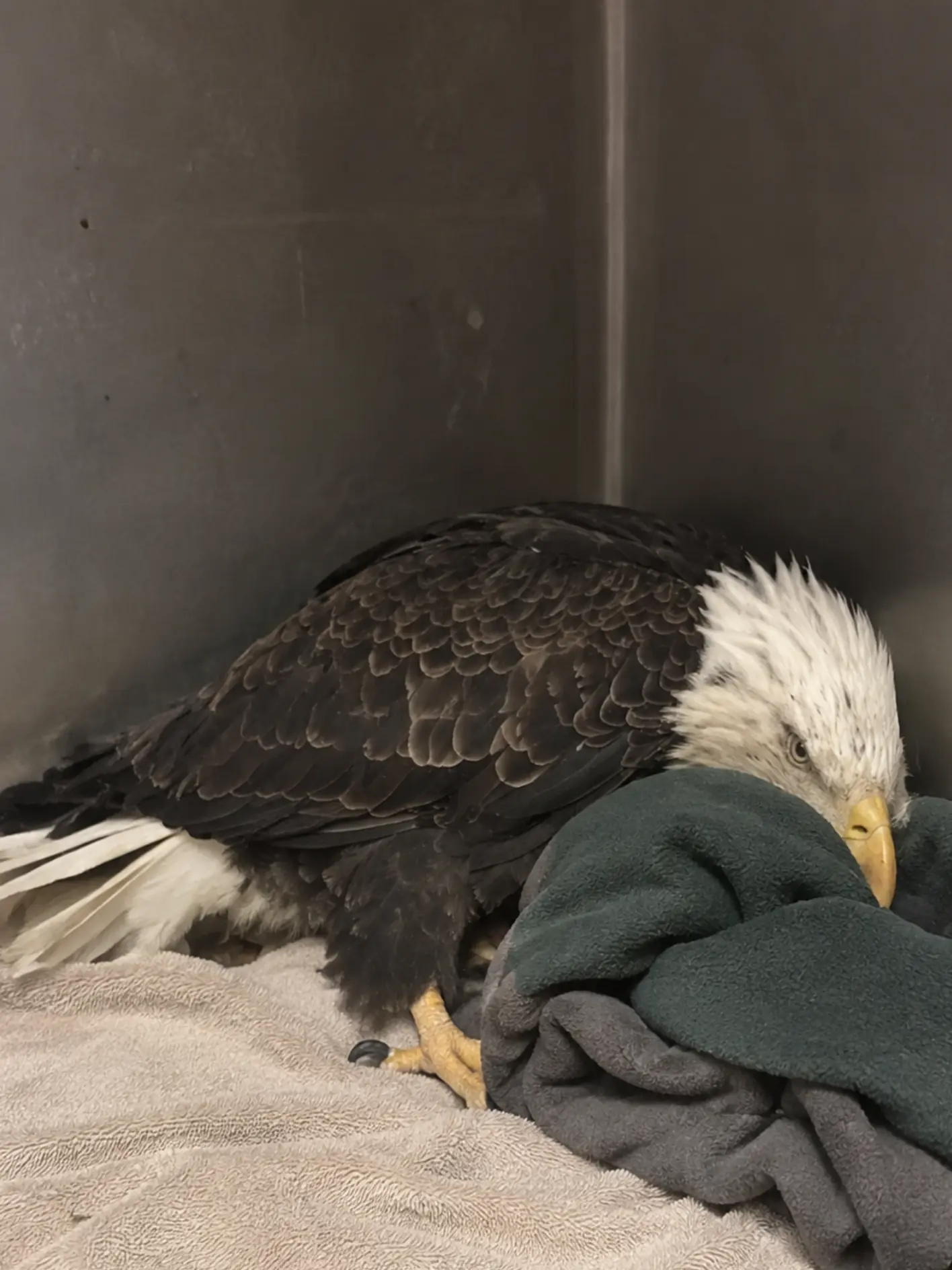
There was no obvious wing fracture.
No major external wound explained why a bird capable of crossing miles of open water could barely support its own weight.
Instead, the eagle sat low on the padded floor of its intensive-care enclosure, frequently resting its head against a folded blanket. Its grip was weak. Its responses were slow. Even the presence of people nearby produced far less resistance than wildlife rehabilitators would normally expect from a healthy adult Bald Eagle.
Blood testing eventually shifted the focus away from trauma.
The eagle had a markedly elevated blood lead concentration, making lead toxicosis the leading explanation for its severe neurological and muscular weakness.
For the rehabilitation team, the presentation was familiar.
Bald Eagles have made one of the most celebrated recoveries in American conservation history. More than five decades have passed since the Environmental Protection Agency banned most uses of DDT in the United States in 1972, a step that helped reverse reproductive losses associated with DDE-induced eggshell thinning in Bald Eagles and other birds of prey.
But recovery from one environmental contaminant did not make the species immune to another.
Today, lead remains an important source of toxic exposure for Bald Eagles across North America, particularly when birds consume ammunition fragments embedded in animal carcasses, unrecovered game or discarded remains left in the field.
A large 2022 study involving 1,210 Bald and Golden Eagles from 38 U.S. states found evidence of unexpectedly widespread lead exposure. Chronic exposure was detected in roughly 46 to 47 percent of the eagles examined, and researchers estimated that lead poisoning at those levels suppressed Bald Eagle population growth by about 3.8 percent.
The numbers describe a population-level problem.
Inside a rehabilitation hospital, however, the consequences are seen one bird at a time.
A Bald Eagle That Could No Longer Stand
The Wisconsin eagle was first noticed near the river after remaining on the ground for an unusually long period.
Bald Eagles routinely descend to the ground to feed, particularly where fish, carrion or other food is abundant. What concerned the observer was not simply that the bird was grounded.
It was the way it behaved.
The eagle made little effort to leave.
Its posture remained low.
When it tried to shift position, its legs appeared weak.
Eventually, the bird seemed unable to stand for more than brief periods before lowering its body again.
A healthy wild Bald Eagle normally maintains considerable distance from people. Even an injured eagle may defend itself aggressively with its feet.
This bird barely responded.
Wildlife responders captured it carefully and transported it to a rehabilitation facility for emergency evaluation.
At admission, its subdued behavior immediately raised concern.
A wild eagle that suddenly becomes easy to handle is rarely becoming tame.
It is often becoming dangerously ill.
There Was No Major Injury to Explain the Collapse
Veterinary staff first looked for the obvious possibilities.
The wings were examined.
The shoulders were palpated.
The legs and feet were evaluated.
The chest, pelvis and spine were checked for evidence of traumatic injury.
No major skeletal injury was identified that could account for the degree of weakness.
The eagle could move both wings.
Its body showed no catastrophic trauma.
Yet the bird remained profoundly debilitated.
That discrepancy pushed the medical team toward other explanations, including toxin exposure.
Blood was collected.
Lead testing became particularly important.
When the results showed a markedly elevated concentration, the clinical picture began making much more sense.
Lead Can Disable a Bird Without Breaking a Single Bone
Lead poisoning can affect multiple systems at once.
The nervous system is particularly important in severely affected raptors.
An eagle may develop weakness, poor coordination or abnormal neurological responses.
Grip strength can decline.
The bird may become unable to maintain normal posture.
Gastrointestinal function and appetite can also be affected.
Blood formation may be disrupted.
In advanced cases, a bird with structurally intact wings may simply lack the neurological and muscular function necessary to fly.
That is one reason lead toxicosis can initially be mistaken for trauma.
Someone finds an eagle beside a road, beneath a tree or on a riverbank.
The assumption may be that the bird collided with something.
Sometimes it did.
But in other cases, the event that placed the eagle on the ground may be secondary to poisoning that had already weakened it.
A neurologically compromised eagle is more vulnerable to collisions, falls and other injuries.
The Source May Be Smaller Than Anyone Can See
An eagle does not need to swallow an entire bullet to become exposed.
When lead ammunition strikes an animal, it can fragment within tissue.
Some fragments may be large enough to see.
Others can be very small.
If pieces remain in portions of a carcass, an unrecovered animal or discarded remains, scavengers may ingest them while feeding.
Bald Eagles are particularly relevant because they are highly opportunistic.
They fish.
They hunt.
They steal prey from other birds.
And they scavenge carrion whenever it provides an efficient source of calories.
A deer carcass or discarded remains left in the field can therefore become a feeding site for multiple scavenging species.
An eagle does not recognize a tiny piece of metal inside tissue as hazardous.
It simply swallows the food.
The Connection Between Ammunition and Scavenging Matters
The 2022 North American eagle study did more than document occasional poisoning.
Researchers examined samples from more than a thousand eagles across a broad geographic range and found evidence that lead exposure was widespread rather than confined to a few isolated locations.
The study also found variation associated with age, season and geography.
That makes ecological sense.
Exposure opportunities change depending on where an eagle lives, what food is available and when carcasses or remains containing ammunition fragments become accessible.
For Bald Eagles, scavenging can be especially important during colder months when open water and live prey may be less predictable.
The issue therefore is not that every carcass contains lead.
It is that fragments in some carcasses create a recurring pathway of exposure across landscapes where eagles and other scavengers feed.
DDT and Lead Harm Eagles in Very Different Ways
The comparison with DDT is useful, but the two contaminants should not be treated as identical threats.
DDT and its breakdown product DDE became famous in bird conservation because of their effects on reproduction, including eggshell thinning that contributed to reduced breeding success in Bald Eagles and other raptors. EPA banned most U.S. uses of DDT in 1972, and eagle populations subsequently recovered as multiple conservation efforts took effect.
Lead presents a different mechanism.
Instead of primarily preventing successful reproduction through eggshell thinning, lead can directly poison individual birds that ingest it.
An eagle may encounter the contaminant while feeding.
The resulting illness may affect neurological function, blood production, gastrointestinal activity and overall strength.
Some birds recover with treatment.
Others arrive too late.
The broader conservation lesson is similar:
environmental contaminants can affect wildlife through pathways that are not obvious until their consequences become widespread.
Treatment Begins With Stabilizing the Bird
For the Wisconsin eagle, there was no immediate attempt to place it into a flight enclosure or test whether it could fly.
The bird was too weak.
It was housed on a padded surface with easy access to support so that it did not have to perch.
Fluids were provided according to its condition.
Body temperature, hydration and neurological status were monitored.
Nutritional support was introduced carefully.
When lead poisoning is sufficiently severe and the clinical picture supports treatment, veterinarians may use chelation therapy.
Chelating medications bind lead and help the body eliminate it.
This treatment must be managed by a veterinarian because the bird's clinical condition, organ function and exposure severity all influence the medical plan.
Treatment is not an instant reversal.
Removing circulating lead does not immediately undo neurological or organ damage that has already occurred.
That is why timing matters.
The First Goal Is Survival, Not Flight
During the first days of treatment, seemingly small changes can become important.
The eagle holds its head upright a little longer.
Its eyes remain open.
It follows a person moving across the room.
The toes grip slightly harder.
It begins repositioning itself without assistance.
Those behaviors may indicate that neurological function is improving.
For wildlife staff, one of the most encouraging developments can be the return of resistance.
A healthy Bald Eagle should not passively tolerate handling.
As a poisoned eagle becomes stronger, it may begin pulling away, raising its feet or reacting defensively again.
That “bad attitude” is often good medicine.
It means the bird is behaving more like a wild eagle.
Blood Lead Levels Must Be Rechecked
Visual improvement alone is not sufficient.
Veterinarians may repeat blood testing to determine whether lead concentrations are declining and whether other blood abnormalities are improving.
Kidney function may also require monitoring because both lead exposure and some aspects of treatment can create additional physiological stress.
A bird that looks brighter but still carries a dangerous toxic burden is not ready to leave care.
Treatment may need to continue through multiple cycles.
The medical team also watches appetite and body weight closely.
A poisoned eagle that stops eating can rapidly lose condition.
Healing requires calories.
Eventually, voluntary feeding becomes an important milestone.
Some Eagles Arrive Too Late
Not every lead-poisoned eagle reaches a rehabilitation center early enough to recover.
Severely affected birds may arrive unable to stand.
Some are minimally responsive.
Others have profound neurological impairment or serious organ damage.
In those cases, veterinarians must determine whether treatment offers a realistic chance of restoring acceptable function and welfare.
If irreversible damage has progressed too far and the bird is suffering, humane euthanasia may be necessary.
That decision is not a failure to value the animal.
It is a recognition that keeping a wild bird alive is not the same as restoring a life it can functionally live.
Wildlife rehabilitation has to consider the quality of the outcome, not only survival.
The National Research Shows Why Individual Cases Matter
A single sick eagle in an intensive-care enclosure may appear to be an isolated event.
The broader data suggest otherwise.
The 2022 Science study found chronic lead exposure in approximately 46 to 47 percent of Bald and Golden Eagles sampled, while acute exposure was also detected at substantial frequencies depending on species and tissue examined.
Researchers then modeled what those exposure levels meant for eagle populations.
For Bald Eagles, the estimated effect was a 3.8 percent suppression of population growth.
That does not mean Bald Eagles are again approaching extinction.
Their recovery has been substantial.
It means lead is imposing an additional, measurable source of mortality on a species whose population could otherwise be growing faster.
The distinction matters.
A conservation success can still face preventable mortality.
Bald Eagle Recovery Should Not Be Confused With Invulnerability
Few American wildlife stories are as recognizable as that of the Bald Eagle.
The species endured decades of pressure from habitat loss, persecution and contaminants.
The removal of DDT from most U.S. uses helped address a major reproductive threat, and eagle numbers rose substantially over subsequent decades.
That recovery can create an understandable impression that the problem has been solved.
From a population standpoint, Bald Eagles are unquestionably in a far stronger position than they were during the worst years of the DDT era.
But abundance does not make individual birds resistant to toxins.
Lead remains neurotoxic whether there are a few thousand eagles or many more.
A poisoned bird still loses coordination.
It still becomes weak.
It can still die.
Hunters Are Part of the Solution
A responsible discussion of lead exposure should not reduce the issue to blaming hunters.
Hunters provide enormous amounts of conservation funding and play important roles in wildlife management across the United States.
The concern is specific:
lead fragments that remain available in animal tissue can subsequently be consumed by scavenging wildlife.
That pathway can be reduced.
Non-lead ammunition, including copper-based alternatives, can reduce the amount of lead deposited into carcasses when suitable options are available.