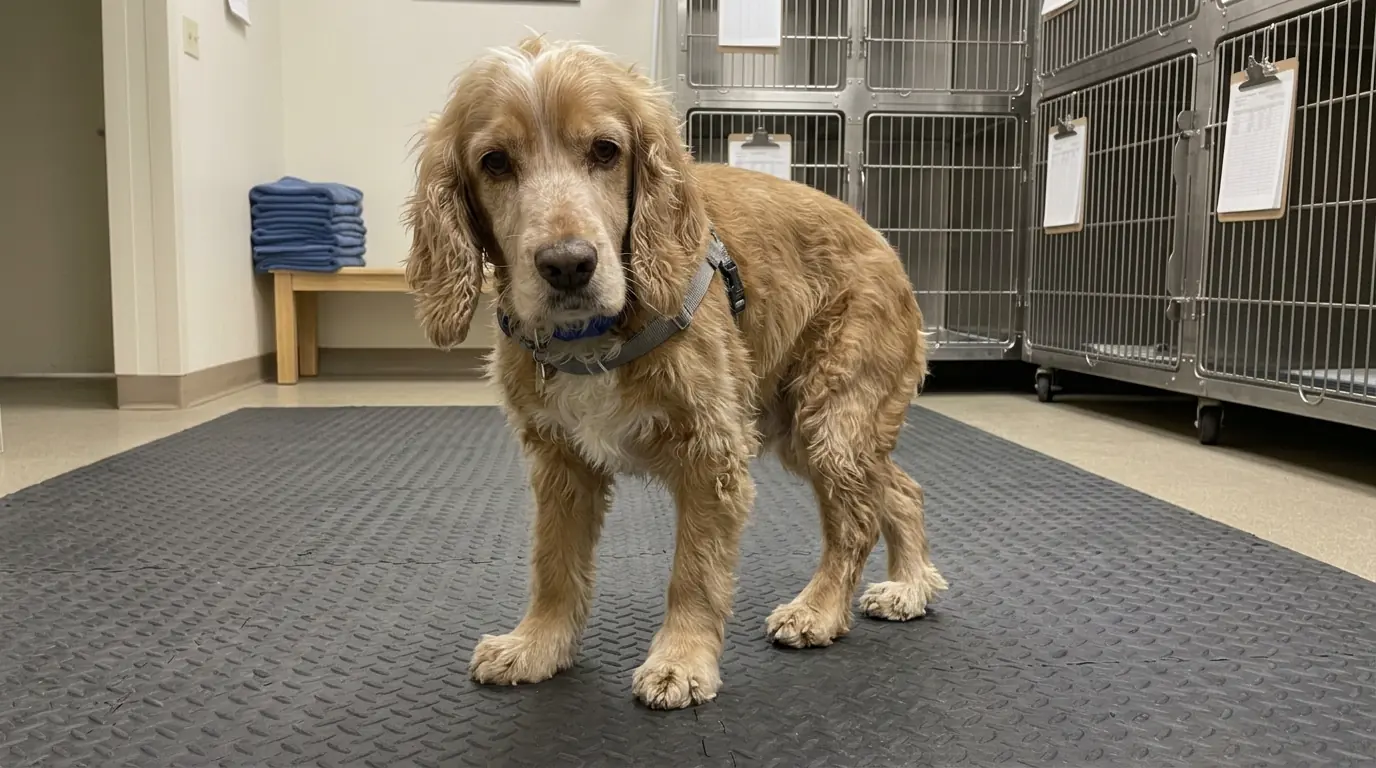
Benny can walk forward across the traction mat.
His steps are not perfectly smooth, but the seven-year-old Cocker Spaniel can keep his body moving in the direction he is facing.
Then the exercise changes.
He is asked to take a few careful steps backward.
One hind paw moves.
The other follows—but instead of staying on its own side, it crosses toward the opposite leg.
Benny's rear feet end up almost tangled beneath him.
His body tilts sharply sideways.
For a moment, he tries to recover.
Then he lowers himself onto the mat exactly where he is.
The exercise is over.
Walking forward has started to return.
Backing up exposes just how much coordination Benny is still missing.
Forward Movement Hides Part of the Problem
Benny is recovering after a severe episode of vestibular disease that affected his balance and coordination.
The vestibular system plays a major role in helping the body understand orientation and maintain balance. When it is significantly disrupted, dogs can develop dramatic problems with stability and movement.
The exact underlying cause of vestibular signs can vary, and Benny's behavior alone cannot explain the original cause of his disease.
What can be seen now is the effect it has left on his movement.
Going forward is becoming manageable.
Benny can look ahead and advance one foot after another across a surface designed to provide reliable traction.
But reverse the direction and his movement changes.
His hind legs no longer stay organized as reliably.
One crosses behind or toward the other.
His base of support becomes narrow.
Then his entire body starts leaning.
Backing Up Requires Something Different
Walking backward is not simply forward walking played in reverse.
It asks Benny to coordinate his body without moving toward what he can easily see in front of him.
His limbs must step into space behind him.
Weight has to shift from one leg to another.
His hind feet need to remain separated enough to support his body.
His trunk has to stay controlled while those feet reposition.
For a dog whose balance and coordination have been significantly affected, that combination can be much harder than taking several forward steps.
Benny demonstrates the difference almost immediately.
Forward, his hind feet generally find usable positions.
Backward, one can cross toward the other.
Once that happens, he has far less room to correct the next weight shift.
The Crossing Is More Important Than the Distance
It would be easy to count Benny's backward steps.
One.
Two.
Three.
But distance is not the useful measure if his legs are crossing underneath him.
A dog that moves three feet backward with poor coordination has not necessarily performed a better rehabilitation exercise than a dog that completes one controlled step and stops.
For Benny, the quality of each movement matters.
Where does the paw land?
Does it remain on the correct side?
Can he transfer weight without a large sideways lean?
Can he recover his stance?
Does the next step become less organized?
Those details determine whether continuing is useful.
The goal is not to find out how far Benny can back up before he falls.
His Legs Are Not Necessarily Weak
Benny's difficulty also demonstrates an important neurological distinction.