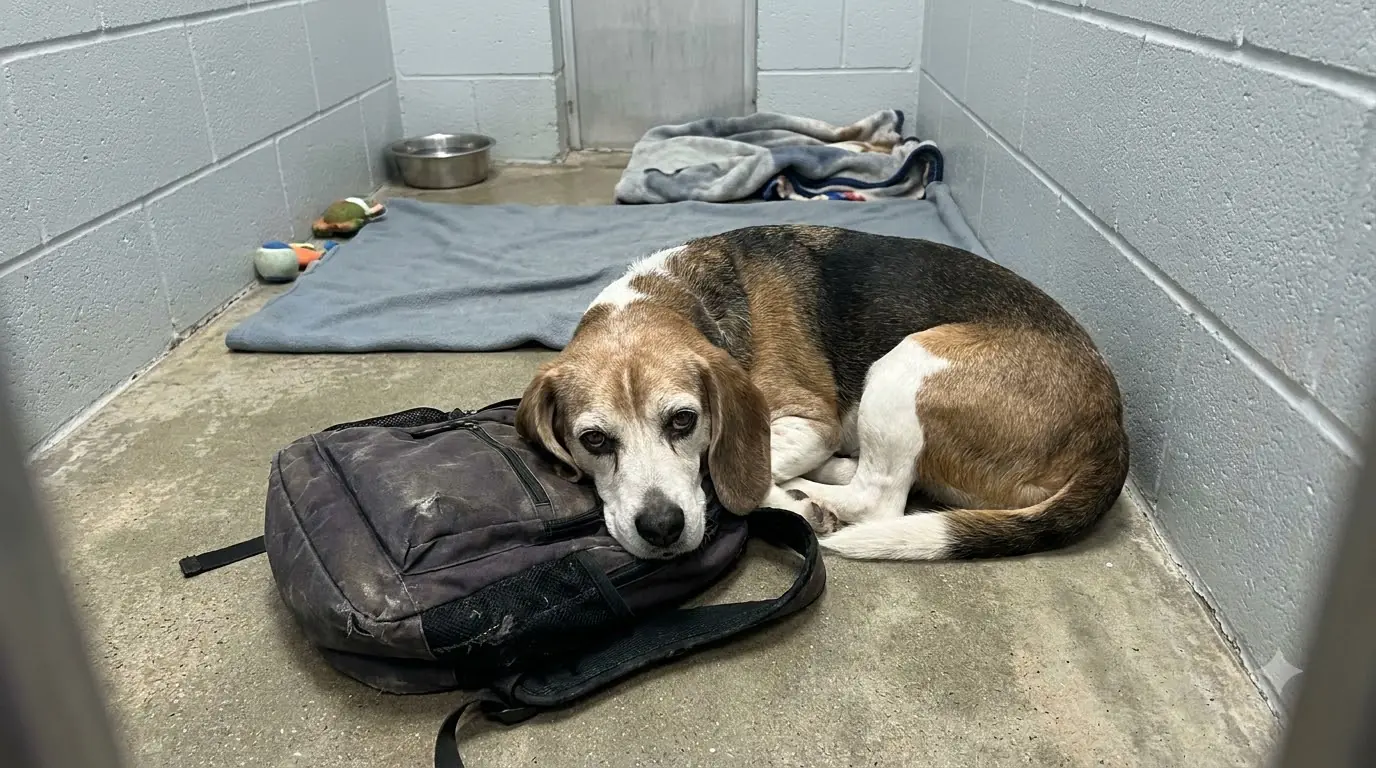
Every night, Benny does almost exactly the same thing.
The 8-year-old Beagle walks past the toys in his rescue kennel and circles his bed once or twice. Then he turns toward an old backpack resting nearby.
He takes part of the bag in his mouth and pulls.
Sometimes it moves easily. Other times, the worn fabric catches against the floor and Benny has to reposition his grip.
But he keeps going until the backpack is beside his mattress.
Only then does he lie down.
Benny curls his body around the bag, lowers his head, and rests his muzzle across one of its straps.
By morning, staff often find him in nearly the same position.
At first, the backpack seemed like just another belonging that had come into the rescue with him.
Then staff learned how Benny had arrived.
The Backpack Was Sitting Beside Him at a Veterinary Clinic
Benny had not originally been brought directly to the rescue.
He had been left in the lobby of a veterinary clinic.
Beside him was the old backpack.
Inside were some of the things someone had apparently packed for him: food and medication.
There was enough to suggest that Benny had been cared for in some capacity before that moment.
But there was no explanation that could tell staff everything they wanted to know about how his life had changed so abruptly.
The clinic could deal with his immediate needs.
What Benny needed next, however, was somewhere safe to go.
Arrangements were eventually made for him to enter rescue care.
And when Benny was transferred, the backpack came with him.
Nobody expected it to become the one object he seemed unwilling to leave behind.
At First, Staff Tried Giving Him Better Things
A rescue kennel was a major environmental change for an older dog.
There were unfamiliar smells.
Dogs he didn't know.
Footsteps outside his kennel.
Doors opening and closing.
Different people handling his meals and care.
Staff gave Benny the things they normally use to help a dog settle in.
Clean bedding.
A comfortable place to sleep.
Toys.
A predictable routine.
Benny used some of them, but he showed little enthusiasm for the toys.
The backpack was different.
When it was nearby, he repeatedly returned to it.
And at bedtime, his routine became particularly obvious.
He didn't simply sleep near the bag because someone happened to leave it beside his mattress.
If it wasn't close enough, Benny moved it himself.
He Kept Pulling It Back to His Bed
Staff began noticing the pattern during evening rounds.
Benny would take the backpack by an edge or strap and drag it toward his sleeping area.
Then he would circle down beside it.
Sometimes his shoulder pressed against the fabric.
Other nights, he curled around part of the bag.
But the position staff noticed most was his muzzle resting across the old strap.
It happened again.
And again.
The rescue could not know exactly what the backpack represented to Benny.
Dogs cannot explain why one familiar object matters more than another, and staff did not want to invent an emotional story that Benny himself could never confirm.
But they could observe something simpler.
The backpack had come from his previous environment.
Its fabric carried familiar smells.
And in a place where nearly everything around Benny had suddenly changed, it was one of the few things that had not.
That made staff reluctant to take it away.
Then They Noticed It Wasn't Just a Bedtime Habit
During the day, Benny could move around his kennel without staying glued to the backpack.
He ate.
He responded to routine care.
He watched activity outside the kennel.
But certain moments repeatedly sent him back toward the bag.
When the rescue became quieter in the evening, Benny tended to settle beside it.
If staff moved the backpack while cleaning, he often investigated where it had gone.
And when it was returned, he would sniff it before settling again.
That detail made staff look at his behavior differently.
Benny wasn't refusing every new thing offered to him.
He was using his new environment while continuing to return to one very old thing.
So instead of trying to replace the backpack, staff began working around it.
They Let the Backpack Stay
There was no reason Benny needed to give it up simply because he now had a cleaner bed.
As long as the bag remained safe for him to have, it could stay near his sleeping area.
Staff made sure Benny still had appropriate bedding and a comfortable place to rest.
But the backpack remained part of the setup.
That small decision also meant Benny no longer had to drag it as far each night.
His bed and the bag could simply remain close together.
The rescue focused on giving him something else the backpack could not provide: predictability.
Meals arrived on a routine.
The same basic rhythms repeated each day.
People approached him calmly.
He was given opportunities to sniff, explore and interact without being pushed.
For an 8-year-old Beagle adjusting to an unfamiliar shelter environment, progress did not need to look dramatic.
And for a while, it wasn't.
Then staff started finding Benny in places they hadn't before.
He Began Leaving the Backpack Behind
Not permanently.
But for longer stretches.
Benny started becoming more interested in what was happening outside his immediate sleeping area.
He would come forward when familiar staff approached.
He spent more time sniffing around.
On some occasions, he settled elsewhere for a while instead of immediately returning to the bag.
The change was small enough that someone seeing Benny for the first time probably wouldn't have noticed it.
The people caring for him did.
During his earliest days, the backpack had seemed to define where he settled.
Now Benny could move away from it and remain relaxed.
At night, however, the old routine remained.
He still wanted the bag beside his bed.
And staff decided that was okay.
Nobody Wanted to Turn Progress Into a Test
There would have been little value in removing the backpack just to see whether Benny could sleep without it.
The goal wasn't to force him to abandon something familiar.
It was to help him become comfortable enough that his world gradually contained more than that one object.
So the backpack stayed.
Meanwhile, Benny's new routine continued growing around it.
There were familiar voices now.
Familiar feeding times.
Familiar footsteps.
Familiar places to sniff.
Even some of the toys he had initially ignored began receiving an occasional investigation.
The old backpack was no longer the only recognizable part of his day.
But every evening, Benny still returned to it.
His Bedtime Routine Hasn't Disappeared
Benny is still in rescue care while his next step is determined.
Staff continue watching how he adjusts rather than assuming that one behavior tells them everything about him.
He is an older dog who experienced an abrupt transition from whatever life he knew before to a veterinary clinic and then into rescue care.
That kind of change can take time.
There are encouraging signs.
Benny can engage with the environment around him.
He can leave his sleeping area.
He can settle without constantly touching the backpack.
But when the activity dies down and it is time to sleep, he still seems to prefer having that familiar object close.
So staff leave it there.
Every Night Still Ends Almost Where This Story Began
The rescue has better bedding than the old backpack.
It has toys Benny never arrived with.
It has people learning his routines and trying to make his days predictable.
But none of those things came through the veterinary clinic door with him.
The backpack did.
And most nights, Benny still pulls it close before curling onto his mattress.
Then the 8-year-old Beagle lowers his head until his muzzle reaches the worn strap.
The difference is that the bag is no longer the only familiar thing in Benny's world.
Little by little, the place around it is becoming familiar too.