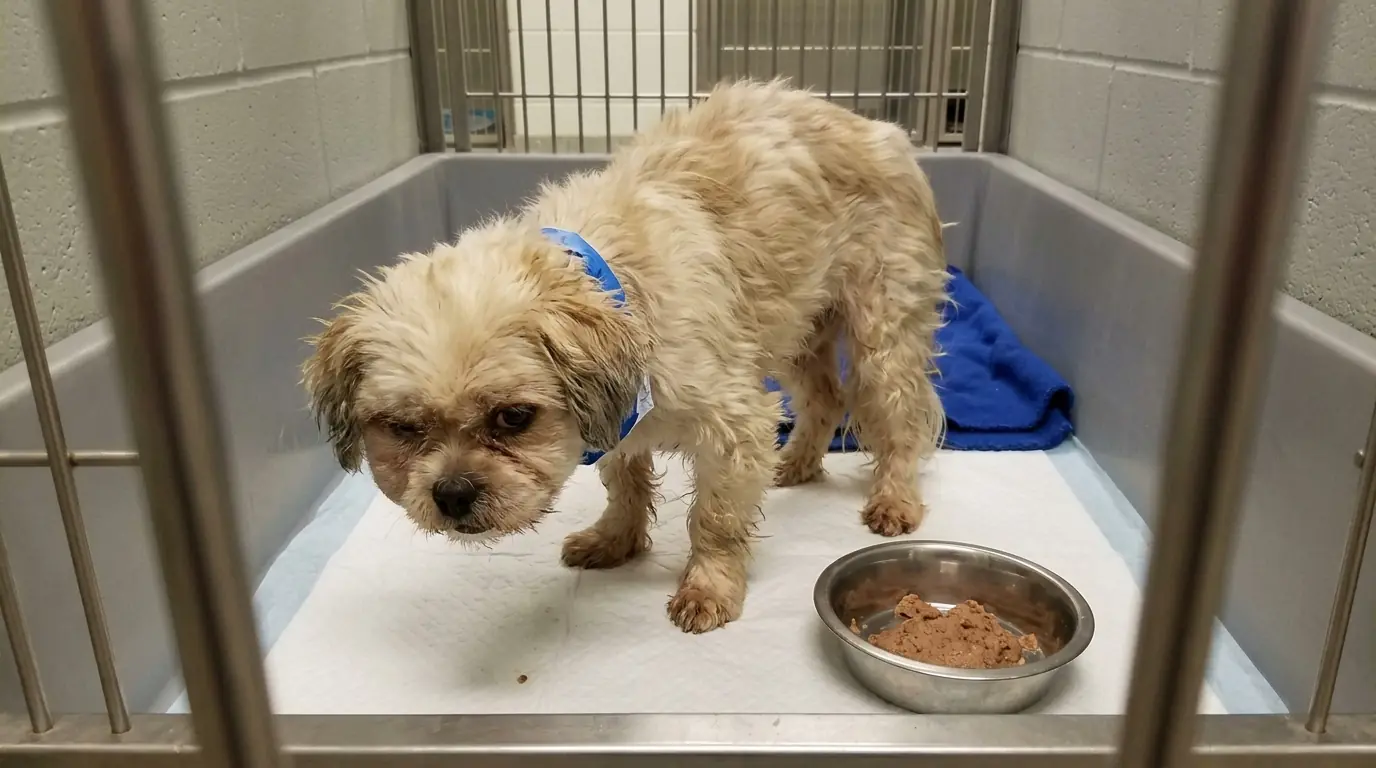
Benny can still see his food.
At least, part of him can.
The seven-year-old Shih Tzu mix stands inside his recovery kennel with one side of his face so swollen that the eye on that side is nearly closed. His other eye remains his clearest way to orient himself toward what is in front of him.
A food bowl sits within reach.
Benny starts toward it.
He lowers his head.
His muzzle moves forward.
And then it stops beside the bowl instead of inside it.
For a few seconds, Benny simply stands there.
His small, thin body begins to tremble.
The food is close enough that another tiny adjustment should solve the problem. But Benny does not immediately make it. He lifts his muzzle slightly, tries to reorient himself using the side of his face that can still see more clearly, and begins searching again.
The bowl has not moved.
Benny has.
And something as ordinary as finding where to put his muzzle has become one of the hardest parts of his recovery.
The Bowl Is Right in Front of Him
There is something particularly difficult about watching a dog struggle with an object that is already within reach.
Benny does not have to cross a large room.
He does not have to climb onto anything.
He does not have to chase food that is moving away from him.
The bowl is there.
Benny approaches it because he is still attempting to eat.
But his face is no longer functioning like the face he is accustomed to navigating with.
He arrived at the shelter with a serious infection around his face following an untreated wound. One cheek is markedly swollen, and the eye on that same side is nearly unable to open.
The exact original wound, how it occurred, how long it went untreated, and what organisms are involved in the infection were not provided.
Those details should not be invented.
What can be seen is the result.
One side of Benny's face has changed dramatically.
His field of vision is affected.
His muzzle approaches the bowl at the wrong angle.
Then he has to figure out where the food actually is.
He Tries to Navigate From One Side
Dogs do not need perfect vision to locate food.
Smell, memory, whisker contact, touch, and other sensory information can all contribute to navigating the immediate environment.
But Benny is not simply dealing with reduced vision.
He is also dealing with significant facial swelling and an active infection.
That makes his situation more complicated than closing one eye and trying to eat.
As Benny approaches the bowl, he appears to orient primarily from the side where the eye remains more functional.
He gets close.
He lowers his head.
His nose reaches forward.
But sometimes the angle is wrong.
Instead of arriving over the center of the food, Benny's muzzle passes beside it.