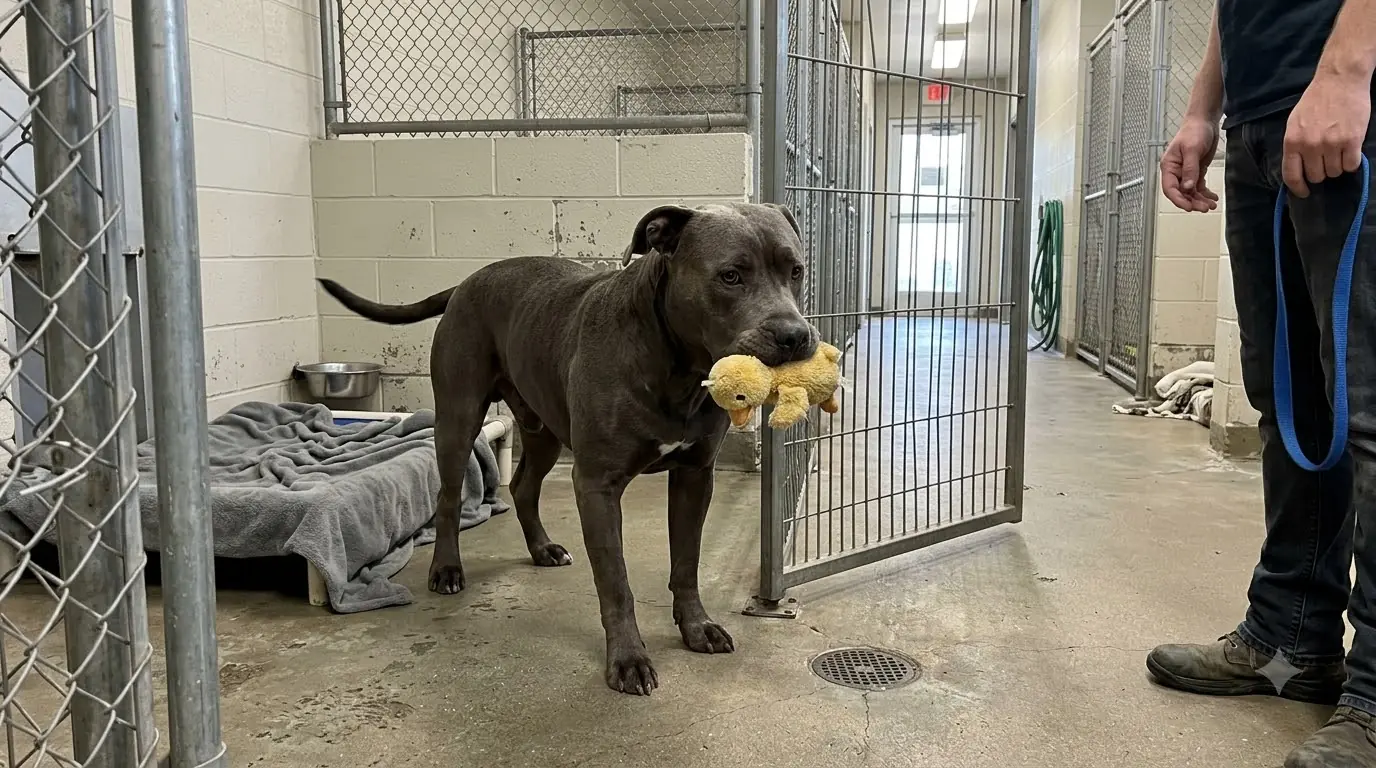
Moose has never had a problem being noticed.
At 92 pounds, he is almost impossible to miss.
The problem is what people think they see in the first few seconds.
Behind a kennel door, Moose looks enormous.
His chest fills much of the opening. His head is broad. When he sits near the front, he seems even larger because there is nothing around him to provide much sense of scale besides the metal gate.
Visitors walking through the shelter often slow down when they reach him.
Some stop.
Some look at his kennel card.
Some keep moving.
And while we can never know exactly what every person is thinking, we do know that Moose's size narrows the number of homes that are realistically able or willing to take him.
What those few seconds rarely show is the tiny yellow stuffed duck he usually carries in his mouth.
How Moose Came Into Care
Moose came into the shelter as an owner surrender after a change in his previous household made it impossible for him to remain there.
We were given some basic information about his routine, but not every detail of his history.
There is no dramatic backstory that needs to be added.
Moose did not arrive as a medical emergency.
He was not brought in after some extraordinary rescue.
He simply became a shelter dog.
That distinction matters because Moose's challenge has never been surviving the shelter.
He has done relatively well here.
His challenge is leaving it.
At intake, Moose was understandably alert to everything happening around him.
A shelter is a loud, unfamiliar place for any dog, and for a large dog like Moose, even ordinary movements can look exaggerated when he is behind bars.
If he shifted his weight, his whole body seemed to fill the space.
If he stepped forward, visitors noticed.
If he sat directly against the kennel gate, his face was suddenly very close to theirs.
Nothing about that behavior was aggressive.
But appearance shapes first impressions.
And Moose has been working against that first impression ever since.
His First Days
The first few days gave staff a much better understanding of him.
Moose ate normally.
He went outside willingly.
He accepted handling.
He was interested in toys and quickly developed a preference for one in particular.
A tiny stuffed yellow duck.
Compared with Moose, the toy looks almost absurdly small.
It fits easily in his mouth.
He carries it gently.
At night, he often brings it to his bed and curls around it.
Sometimes it disappears almost completely beneath his chest.
Other times, the yellow fabric is the only bright thing visible against his blanket when staff walk past during evening checks.
The duck became part of Moose's routine so quickly that people began noticing when he did not have it.
Most of the time, it was somewhere nearby.
What Happens When Visitors Arrive
Moose has another routine with the duck.
Footsteps begin in the hallway.
Moose lifts his head.
If the footsteps continue toward his section, he gets up.
Then he looks for the toy.
He picks it up, walks to the front of the kennel, and sits.
That is usually all he does.
He doesn't launch himself at the door.
He doesn't bark for attention.
He doesn't paw at the gate.
He simply sits there holding the duck while people move from kennel to kennel.
Sometimes a visitor smiles.
Sometimes someone comments on the contrast between the huge dog and tiny toy.
Sometimes a family stops for a minute.
Then they continue.
Moose watches them go.
Eventually, if the hallway becomes quiet again, he stands, turns around, and carries the duck back to his bed.
That repeated moment has become one of the clearest pictures of his time here.
Why Moose Keeps Being Passed Over
Moose's main adoption challenge is not mysterious.
He is big.
Very big.
At 92 pounds, he is not a practical fit for every household.
Some rentals have weight restrictions.
Some landlords or insurance policies place additional limits on certain breeds or sizes.
Some people simply are not physically comfortable handling a dog his size.
Families with limited space may reasonably decide they need a smaller dog.
Older adopters, people with mobility concerns, or households with specific physical limitations may also decide that a 92-pound dog is more than they can manage safely.
Those are legitimate concerns.
The difficulty for Moose is that size can overshadow everything else before anyone learns who he is.
He looks powerful because he is powerful.
That does not mean he spends his day using that power recklessly.
Outside the kennel, he is much more measured.
What Visitors Don't See
In the exercise yard, Moose changes the scale of the interaction.
There is space around him.
He no longer appears to take up an entire room.
You can see how he moves.
You can see that he knows how to walk with a person rather than dragging them from one end of the yard to the other.
Moose walks gently.
He likes to stop and investigate smells, but he is not constantly pulling.
When asked to sit, he usually knows exactly what is expected.
He lowers himself carefully and looks up.
With people he trusts, he becomes surprisingly tender in ways that do not match the image many visitors form at the kennel door.
The most obvious example is the duck.
If Moose trusts someone, he sometimes carries the tiny yellow toy over and places it in their lap.
Not throws it.
Not shoves it.
Places it.
Then he waits.
The first time a staff member sees it, the moment usually produces the same reaction.
A 92-pound dog has just approached with the gentlest possible offering.
That is the side of Moose most people never reach.
The Duck Is Not a Trick
It would be easy to turn the toy into a symbol and assign Moose all kinds of human meanings.
We don't do that.
We cannot say Moose believes the duck represents safety, home, or anything else.
We can say that he chooses it often.
He sleeps with it.
He carries it when visitors approach.
He brings it outside sometimes.
And he offers it to familiar people.
Those are observable behaviors.
They are enough.
The toy does not make Moose sadder.
It does not make him more deserving than another dog.
It simply reveals something about the way he moves through his day.
He likes familiar things.
He likes gentle interactions.
And despite his size, he is not a dog who spends every moment pushing his body into the center of attention.
Health and Veterinary Care
Moose received a routine intake veterinary examination and has continued to receive appropriate preventive care.
At 6 years old, he is a mature adult rather than a senior.
His size does make long-term weight and joint health particularly important.
Large dogs benefit from maintaining a healthy body condition because excess weight can place additional stress on joints.
For Moose, that means portion control, appropriate exercise, and regular veterinary monitoring all matter.
His mobility is currently good.
He is able to walk comfortably, sit on cue, lie down, and move around the exercise yard without obvious difficulty.
His veterinary care includes routine attention to body condition, skin and coat, ears, eyes, teeth, heart and lungs, parasite prevention, and vaccination status.
There is no major medical condition driving his adoption difficulty.
His challenge is largely practical.
He is a large, strong dog who needs a home prepared for a dog his size.
That is not the same thing as being difficult.
But it does require honesty.
Life While Moose Waits
Moose's shelter routine has become predictable.
Morning comes.
Kennels are cleaned.
Breakfast arrives.
Moose gets his first trip outside.
He stretches.
He walks.
He sniffs the perimeter of the yard.
Sometimes he sits when asked.
Then he returns inside.
Later, depending on the day, he may receive enrichment, another walk, time with staff, or an opportunity to spend time away from the busiest part of the building.
When adoption hours begin, his row changes.
Voices carry.
Doors open.
People pause.
Moose notices.
Most days, he brings the duck forward at least once.
Some days, several different groups pass him.
He sits through all of them.
Sometimes someone asks about him.
Sometimes nobody does.
Then evening comes.
The building quiets down.
Moose goes back to his bed.
The duck usually goes with him.
The Problem With Looking Huge Behind Bars
Kennels distort the way people perceive dogs.
A dog pressed close to a kennel door can seem larger, louder, more intense, or more energetic than that same dog appears in an open room.
For Moose, the effect is especially strong.
A 92-pound dog in a confined space looks like a lot of dog.
And he is.
There is no reason to minimize that.
Anyone considering Moose should be comfortable with his size.
They need to think about leash handling, transportation, furniture, stairs, doorways, veterinary visits, and the physical logistics of living with a large dog.
But size alone doesn't describe behavior.
That is why we try to move serious adopters beyond the kennel as early as possible.
Meet Moose outside.
Walk with him.
Ask him to sit.
Watch him carry the duck.
Those experiences provide information a kennel door cannot.
Helping Moose Get Noticed Differently
Our staff has worked to make sure Moose's adoption profile reflects the dog we actually know.
Photos inside his kennel are rarely enough.
The camera exaggerates his size in tight spaces.
So we try to show him outside.
We show him walking on leash.
We show his calm sit.
We show him beside familiar people so viewers get a more realistic sense of scale and behavior.
And yes, the yellow duck appears in many of those photos.
Not because we are trying to turn Moose into a gimmick.
Because the toy is genuinely part of his daily life.
When someone asks about Moose, we explain both sides.
He is 92 pounds.
He is strong.
He needs someone able to handle a large dog.
He also walks more gently than his appearance suggests.
He knows basic cues.
And once he trusts someone, he tends to interact quietly rather than explosively.
The Meet-and-Greets That Haven't Worked
Moose has had interest before.
Not every conversation turned into a meeting.
Not every meeting turned into an application.
And not every application turned into the right match.
In some cases, housing restrictions ended the conversation.
In others, people decided his size did not fit their household.
A few potential adopters were looking for a smaller dog because of their own physical limitations.
Those decisions are understandable.
Responsible adoption is not about convincing someone to accept a dog they cannot safely manage.
The shelter's role is not to create guilt.
It is to create good matches.
For Moose, that means finding someone who sees his size clearly, accepts it, and then looks beyond it.