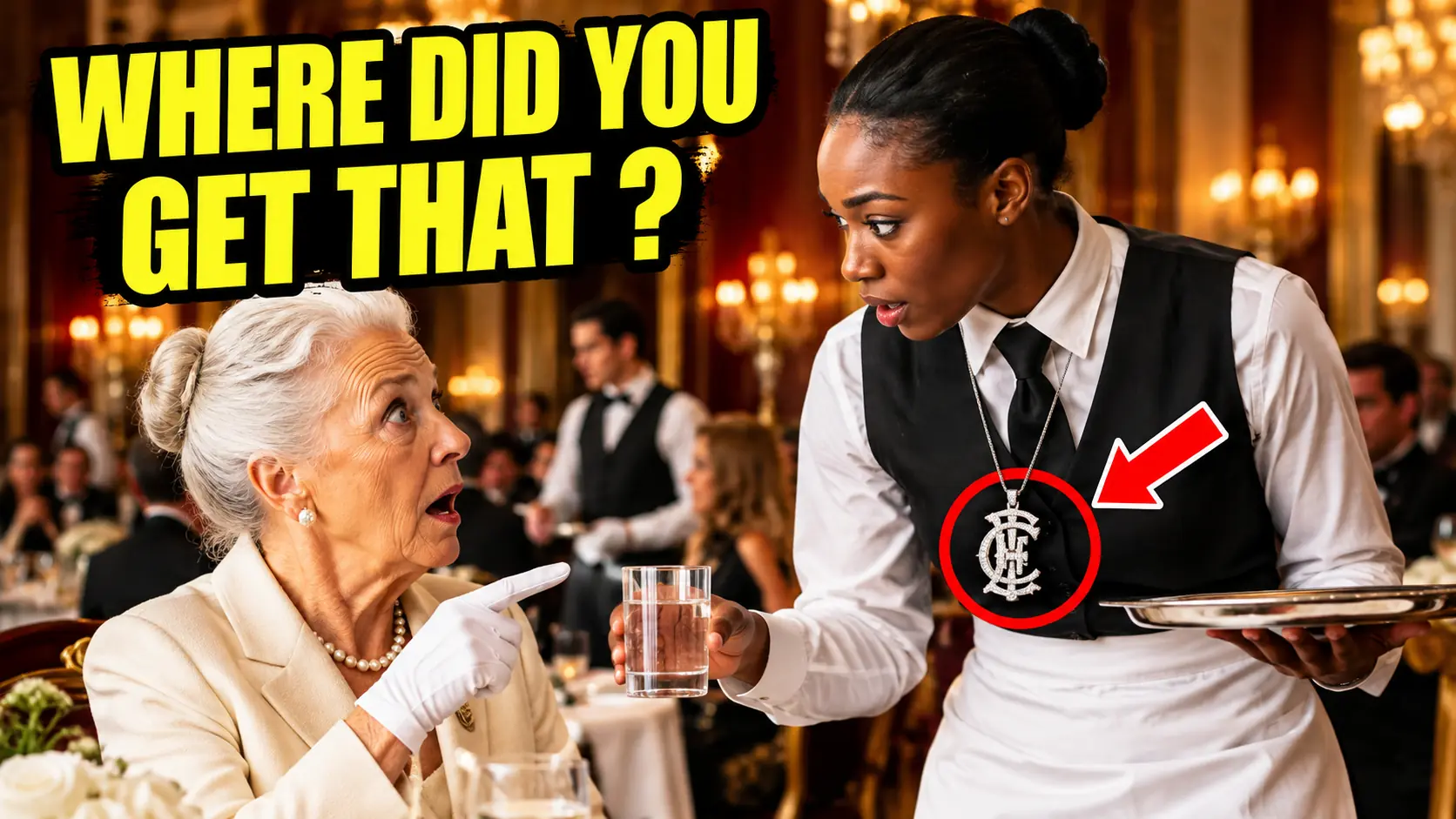
The crystal chandeliers cast dancing shadows across marble floors. Designer gowns sweep past polished shoes. This is the Hartford Museum spring gala where New York’s elite gather to celebrate wealth disguised as charity. Twenty-three-year-old Amara Bennett moves through the crowd in a black uniform and white apron, invisible the way servers always are. She balances a tray with the practiced grace of someone who has worked three jobs since high school.
Against her dark skin, a silver necklace catches the light: a crescent moon intertwined with a compass rose, weathered, old, and beautiful. A woman’s voice cuts through the murmur. “Isn’t it inappropriate for the help to wear jewelry, especially something so ostentatious?” Heads turn. Whispers ripple. Amara’s hand instinctively touches the necklace, the only possession from a past she cannot remember.
Then everything stops. Eighty-one-year-old Eleanor Whitmore stands frozen. Her champagne glass slips and shatters. Her face drains of color as she stares at the necklace. Her lips form silent words: “Victoria.”
Three days earlier, Amara’s apartment in the Bronx measures four hundred eighty-two square feet with peeling paint and a window that will not close all the way, but it is hers. Nursing textbooks cover every surface—anatomy, pharmacology, patient care. Finals are in two weeks. Between double shifts at prestige events catering and studying, sleep is a luxury she cannot afford. On her makeshift desk sits a worn manila folder containing her entire history.
She opens it. The same documents she has read a thousand times: birth certificate, Baby Girl Bennett, ward of the state. Date found: June 15th, 2002. Location: Roosevelt Medical Center, New York. A single photograph of the necklace. A handwritten note attached: “This was pinned to your blanket when they found you. I kept it safe.” Mrs. Carter—Judith Carter, her foster mother from age twelve to sixteen, the only person who ever felt like family—dead seven years now from cancer.
Amara traces the compass rose with her finger. Four directional points—north, south, east, west—and beneath them, engraved in tiny script: May 29th, 2002. Two weeks before she was found abandoned. Her roommate, Tessa Rodriguez, appears in the doorway. Fellow nursing student, best friend, the sister she chose. “You’re doing it again,” Tessa’s voice is gentle. “The necklace thing.”
“It means something, Tess,” Amara does not look up. “This engraving, it’s custom work. Expensive. Someone cared enough to have this made.” “Maybe your birth mom was rich and had a breakdown. Or maybe she was running.” Amara closes the folder. “Either way, I need to focus. Finals won’t pass themselves.” But the necklace stays around her neck. It always does. Twenty-one years. She has never taken it off. Not once.
Two days earlier, at Prestige Events Catering, a cramped office that smells like coffee and stress. Greg Pollson, Amara’s supervisor, mid-fifties, perpetually exhausted, three ex-wives but decent enough, waves her in. “Big event tomorrow night.” He slides a file across his desk. “Hartford Museum Spring Gala. Eleanor Whitmore is making some massive announcements. Five hundred million to children’s charities.”
Amara knows the name. Everyone does. Eleanor Whitmore, banking dynasty, widow of Charles Whitmore, foundation work that has reshaped child welfare across three states. Childless, notoriously private, ruthlessly generous. “We need reliable people.” Greg taps the file. “It’s double pay. Tips from these folks could be a month’s rent in one night.” Amara calculates. Double pay covers next semester’s books. Maybe even catches her up on electricity. “I’m in.”
“Professional attire only.” Greg’s expression turns serious. “No jewelry except simple studs. These people notice everything. They judge everything.” Amara’s hand moves to her necklace. “This is—” “No exceptions.” Greg cuts her off. “I’m serious, Amara. One complaint and we lose the contract.” She nods, but her fingers stay wrapped around the silver crescent. She has never taken it off. Not for gym class, not for hospital clinicals, not for anyone. Tomorrow will not be different.
Same time across Manhattan, the Whitmore estate: fifteen thousand square feet of history and grief. Eleanor Whitmore sits in her private study. Lawyers and financial advisers crowd the room. Tomorrow’s announcement: five hundred million. Her life’s work. But her attention keeps drifting. Above the fireplace hangs a portrait of a young woman with auburn hair and laughing eyes. Around her neck, a silver crescent moon necklace. Victoria Whitmore, 1980 to 2002. Her daughter, dead twenty-three years.
Patrick Hayes, Eleanor’s assistant, thirty-seven, sharp, loyal, been with her a decade, notices her distraction. “Mrs. Whitmore. The speech revisions.” Eleanor blinks. “Victoria would be forty-five now.” Her voice is soft, distant. “She would have loved this work, helping children.” Patrick’s expression softens. “She’d be proud of you.” “Would she?” Eleanor touches the compass rose brooch pinned to her lapel that matches the necklace in the portrait. “I couldn’t save her. I couldn’t even save her baby.”
The room goes quiet. Everyone knows the story. The tragedy that broke Eleanor Whitmore. Victoria, seven months pregnant, car accident, brain dead by morning. The baby did not survive the emergency surgery. Eleanor buried them both, mother and child, June 2002. The necklace disappeared that night. Victoria’s personal effects at Roosevelt Medical Center. Gone despite private investigators. Despite a fifty-thousand-dollar reward. Gone like her daughter. Like her grandchild. Gone.
Patrick clears his throat. “The gala tomorrow. It’s about moving forward.” “Is it?” Eleanor looks at the portrait, at the necklace frozen in oil paint. “Or is it about pretending the past doesn’t haunt us?” She commissioned that necklace in Florence, May 2001. Mother-daughter trip. Two matching pieces: one necklace for Victoria, one brooch for herself, both engraved with the date they would return to collect them—May 29th, 2002. They never made that trip. Victoria died June 12th, 2002. Two weeks after the engraving date.
The necklace was around her neck when the paramedics brought her in. By morning, it was gone. Eleanor has spent twenty-three years wondering who took it, why. Was it a simple theft or something darker? Tomorrow night she will stand before New York’s elite and talk about hope, about giving children a future. She will smile. She will inspire. She will pretend her heart is not a graveyard. Because that is what you do when you are Eleanor Whitmore. You survive.
Two women, two lives, one lost object. Tomorrow night, fate will force them into the same room, and nothing will ever be the same. The gala. Moments after the champagne glass shatters. Security moves fast. Two men in black suits appear beside Eleanor. Patrick rushes through the crowd, but Eleanor does not move. Cannot move. Her eyes stay locked on Amara, on the necklace. The ballroom falls silent. Five hundred of New York’s wealthiest holding their breath, watching a billionaire stare at a server.
Eleanor’s voice breaks the silence. Barely a whisper, but it carries. “Where did you get that necklace?” Amara’s heart hammers. Every eye on her, judging, assuming. She has been in this position before. Always an outsider. Always suspected. “It’s mine.” Her voice is steadier than she feels. “I’ve had it since I was a baby.” “That’s impossible.” Eleanor takes a step forward, her hands trembling. “I had that necklace made. Custom in Florence. There’s only one.”