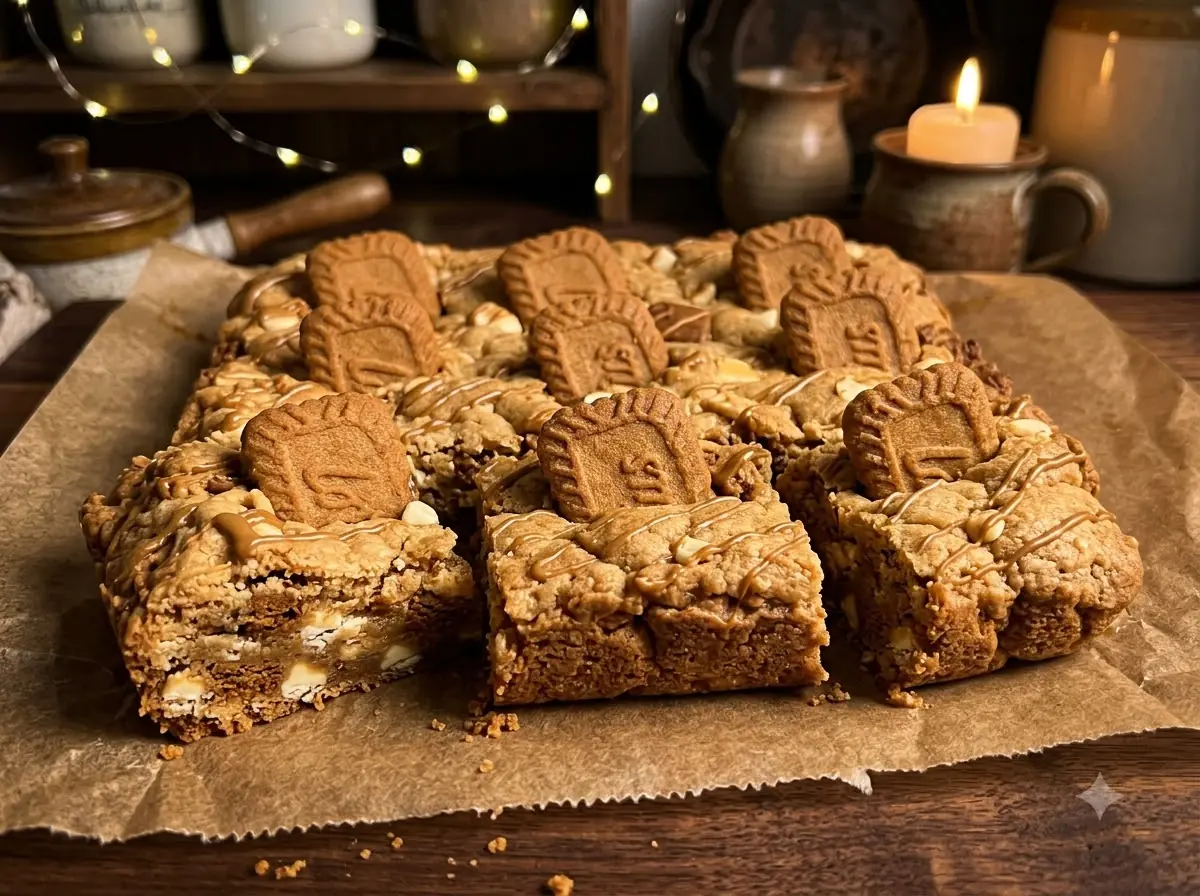
These Biscoff Cookie Bars are thick, soft-centered, and packed with everything that makes cookie butter so addictive: caramelized spice, buttery brown sugar flavor, creamy Biscoff spread, white chocolate, and crunchy pieces of Lotus Biscoff biscuits.
Instead of baking individual cookies, the dough is layered into an 8-inch square pan with generous dollops of Biscoff spread hidden through the center. As the bars bake, the outside turns lightly golden while the middle stays soft and chewy. White chocolate melts into creamy pockets, and the cookie butter creates rich caramelized swirls that make every square a little different.
The final touch is what gives these bars their bakery-style look: half Biscoff biscuits pressed into the warm surface, extra white chocolate chips, and a thin drizzle of melted Biscoff spread. They are rich enough for dessert but simple enough for an easy weekend bake.
In This Recipe
- Why You Will Love These Biscoff Cookie Bars
- Ingredients You’ll Need
- Ingredient Notes and Why They Matter
- Expert Tips for Best Results
- How to Make Biscoff Cookie Bars
- The Secret to Thick, Gooey Cookie Bars
- The Secret to Keeping the Biscoff Center Soft
- How to Know When the Bars Are Done
- Delicious Variations
- Frequently Asked Questions
- What to Serve With Biscoff Cookie Bars
- Make-Ahead Tips
- Storage
- How to Reheat
- Recipe Card
Why You Will Love These Biscoff Cookie Bars
They Have Biscoff in More Than One Form
The flavor does not come from a token spoonful of cookie butter.
Biscoff spread is mixed directly into the dough, more is added in dollops between the layers, and extra melted spread is drizzled over the finished bars.
Roughly chopped Biscoff biscuits add another layer of caramelized flavor and a little crunch.
They Stay Thick and Soft
The dough contains one whole egg plus an extra egg yolk.
That extra yolk adds richness and chew without introducing as much additional liquid as another whole egg would, helping the bars stay dense rather than cakey.
White Chocolate Balances the Spice
Biscoff has a deep caramelized, lightly spiced flavor.
White chocolate adds a creamy sweetness that rounds it out beautifully, especially when some of the chocolate remains in larger melted pockets.
No Scooping Individual Cookies
You get the flavor and texture of a thick bakery cookie without portioning and baking multiple trays.
Everything goes into one 8 x 8-inch pan.
They Look Impressive With Very Little Decorating
Pressing Biscoff halves and white chocolate into the warm surface instantly gives these bars that abundant bakery-counter appearance.
Ingredients
For the Biscoff Cookie Dough
- ½ cup (113g) unsalted butter, softened and cubed
- ¼ cup (50g) granulated sugar
- ⅓ cup (70g) packed light brown sugar
- 8 teaspoons (about 55–60g) Biscoff cookie butter spread
- 1 large egg
- 1 large egg yolk
- 1 teaspoon vanilla bean paste or vanilla extract
- ¼ teaspoon fine salt
- 1½ teaspoons baking powder
- ¼ teaspoon baking soda
- 2 cups (240g) all-purpose flour
- ½ cup (85–90g) white chocolate chunks or chips
- 5–6 Lotus Biscoff biscuits, roughly chopped
For the Biscoff Center
- About ⅓ cup Biscoff spread, for dolloping between the cookie dough layers
For Decorating
- 4–6 Lotus Biscoff biscuits, broken in halves
- Extra white chocolate chips
- 2–3 tablespoons Biscoff spread, gently warmed for drizzling
Ingredient Notes and Why They Matter
Butter
Use softened butter rather than melted butter.
The butter should be soft enough to whisk but should not be greasy or partially melted.
Soft butter helps produce a thick cookie dough that stays structured in the pan.
Light Brown Sugar
Brown sugar adds moisture and caramel flavor.
That deeper molasses note pairs naturally with the caramelized biscuit flavor of Biscoff.
Biscoff Spread
Biscoff spread is doing double duty.
Inside the cookie dough, it flavors the entire bar. In the middle, larger dollops create concentrated pockets of soft cookie butter.
For the cleanest center, regular smooth Biscoff spread works particularly well.
Egg + Egg Yolk
The whole egg gives structure.
The extra yolk adds fat and emulsifiers, creating a richer, chewier bar with a softer center.
Baking Powder and Baking Soda
The combination gives the bars just enough lift without turning them cake-like.
Baking powder provides some rise, while the small amount of baking soda supports browning and spread.
White Chocolate
White chocolate softens the spiced caramel flavor of the cookies and creates creamy pockets throughout the dough.
Chunks melt more irregularly than chips, so use chopped white chocolate if you want larger pools.
Biscoff Biscuits
Roughly chopped biscuits give visible pieces throughout the bars.
Do not grind them too finely for the dough; you want actual cookie texture.
Expert Tips for the Best Biscoff Cookie Bars
Use Properly Softened Butter
If the butter is too cold, it will not mix evenly.
If it is melted, the dough may become too loose and the bars can spread differently.
Aim for butter that dents easily when pressed but still holds its shape.
Don’t Overmix the Dough
Once the flour goes in, mix gently.
Too much mixing develops gluten and can make cookie bars tough instead of soft and chewy.
Keep the Biscoff Dollops Thick
Do not completely swirl the center layer into the dough.
Distinct spoonfuls give you visible pockets of cookie butter after baking.
Leave Some Dough Uneven on Top
The second layer does not need to look perfectly smooth.
Slightly craggy cookie dough creates a more natural bakery-style surface and gives the Biscoff drizzle places to settle.
Don’t Overbake
The center should remain soft when the bars come out.
If you wait until the entire middle looks firm, the bars can become dry once cooled.
Cover With Foil if Necessary
Biscoff and white chocolate can cause the top to color before the center has finished baking.
If the surface looks deeply golden while the middle is still very raw, loosely tent the pan with foil and continue baking.
Add the Decorations While Warm, Not Piping Hot
If you insert the Biscoff biscuits immediately when the bars are extremely hot, they can soften too quickly.
Let the bars sit for a few minutes, then add the toppings while the surface is still warm enough to hold them in place.
How to Make Biscoff Cookie Bars
Step 1 – Prepare the Pan and Oven
Preheat a fan/convection oven to 350°F (175°C).
Line an 8 x 8-inch square metal baking pan with parchment paper, leaving enough overhang on two sides to lift the bars out later.
If using a conventional non-fan oven, 350°F (175°C) still works well; just begin checking the bars toward the end of the baking window.
Step 2 – Cream the Butter
Place the softened cubed butter in a large mixing bowl.
Whisk until slightly creamy and smooth.
You do not need to whip a lot of air into the butter.
Step 3 – Add the Sugars
Add the granulated sugar and brown sugar.
Whisk until evenly combined.
The mixture should look creamy and cohesive.
Step 4 – Add the Biscoff Spread
Add the 8 teaspoons of Biscoff spread.
Mix until the cookie butter is completely blended into the butter and sugar mixture.
At this stage, the mixture should smell strongly caramelized and spiced.
Step 5 – Add the Egg and Yolk
Add the whole egg and extra egg yolk.
Whisk until fully incorporated and smooth.
Add the vanilla bean paste.
Mix again briefly.
Step 6 – Add the Leaveners and Salt
Add the baking powder, baking soda, and salt.
Mix gently until distributed.
Step 7 – Add the Flour
Add the flour.
Switch to a rubber spatula and fold gently.
Stop while the dough still has a few faint streaks of flour.
Step 8 – Add the White Chocolate and Biscuits
Add the white chocolate chunks and roughly chopped Biscoff biscuits.
Fold just until evenly distributed and the final streaks of flour disappear.
The finished dough should be thick and soft, not pourable.
Assemble the Biscoff Cookie Bars
Step 9 – Add the First Dough Layer
Take about half of the cookie dough and distribute it across the bottom of the parchment-lined pan.
You can place it down as small dough balls or rough pieces first, then press them together gently.
Spread into an even layer.
Do not compact the dough excessively.
Step 10 – Add the Biscoff Center
Spoon random dollops of Biscoff spread over the cookie dough.
Leave a small border around the outside edge so the cookie dough layers can meet and seal around the filling.
Do not spread the Biscoff into one perfectly smooth layer.
Keeping it in irregular pockets creates a much better gooey center.
Step 11 – Add the Remaining Cookie Dough
Place pieces of the remaining dough over the Biscoff layer.
Gently press them together until most of the filling is covered.
A few small gaps are fine, but large exposed pools of Biscoff can brown too aggressively.
Smooth the top only lightly.
Bake the Biscoff Cookie Bars
Step 12 – Bake
Place the pan in the preheated oven.
Bake for approximately 30–35 minutes.
The top should be lightly golden and set, while the center remains soft.
The exact bake time can vary depending on the pan material and how thick the Biscoff filling is.
Step 13 – Tent With Foil if Needed
If the top becomes nicely golden but the middle is still clearly raw, loosely tent the pan with aluminum foil.
Continue baking until the center has set enough to hold together.
Step 14 – Check for Doneness
Insert a toothpick into a cookie dough section rather than directly through a Biscoff pocket or melted white chocolate.
You want:
- moist crumbs,
- no raw cookie dough,
- golden edges,
- and a center that still feels softer than the outside.
A perfectly clean toothpick is not necessary.
Decorate the Bars
Step 15 – Add the Biscoff Biscuits
Remove the pan from the oven.
Let it sit for about 5 minutes.
Press Biscoff biscuit halves gently into the top.
Space them according to where you plan to cut the bars so each large square can have a visible cookie piece.
Step 16 – Add White Chocolate
Press a few extra white chocolate chips or chunks into the warm surface.
They should soften slightly but remain visible.
Step 17 – Add the Biscoff Drizzle
Warm a few tablespoons of Biscoff spread for about 10–15 seconds, just until fluid enough to drizzle.
Drizzle lightly over the top.
Do not completely cover the surface; the golden cookie top, white chocolate, and Biscoff pieces should all remain visible.
Step 18 – Cool
Let the bars cool completely in the pan.
For very gooey pieces, you can slice once they are just slightly warm.
For clean bakery-style squares, cool for at least 1½–2 hours before cutting.
The Secret to Thick, Gooey Biscoff Cookie Bars
The texture depends on three things: an extra egg yolk, gentle mixing, and slightly underbaking the center.
The extra yolk adds richness without increasing the water content too much.
Gentle mixing prevents excessive gluten development.
And pulling the bars from the oven before the center becomes completely firm allows residual heat from the pan to finish setting them gradually.
That is what gives you chewy edges and a soft, dense center rather than a dry cookie cake.
The Secret to Keeping the Biscoff Center Soft
Do not spread the cookie butter into an extremely thin layer.
Thin streaks can simply bake into the surrounding dough.
Thicker dollops retain more of their creamy consistency and give you visible caramelized pockets when you cut the bars.
It is also important to surround those dollops with cookie dough.
That protects the Biscoff from direct oven heat and helps keep it softer.
How to Know When Biscoff Cookie Bars Are Done
The outside will always cook faster than the middle, especially in a thick 8-inch pan.
Look for several signs together:
- the edges are lightly golden,
- the top looks set,
- the center no longer looks wet,
- a toothpick shows moist crumbs,
- and the middle is still slightly softer than the perimeter.
Do not judge by color alone.
If the bars brown too quickly, use foil rather than continuing to expose the top to direct heat.
Delicious Variations
Biscoff White Chocolate Overload
Increase the white chocolate to ¾ cup and reserve plenty for pressing into the surface after baking.
Dark Chocolate Biscoff
Swap the white chocolate for dark chocolate chunks.
This produces a less-sweet bar and emphasizes the caramelized spice.
Milk Chocolate Biscoff
Use milk chocolate for a sweeter, creamier version.
Biscoff Cheesecake Bars
Add spoonfuls of sweetened cream cheese between the cookie dough layers alongside the Biscoff spread.
Keep the amounts modest so the bars still bake evenly.
Salted Biscoff
Finish the warm bars with a tiny pinch of flaky sea salt.
The salt balances the sweetness of the cookie butter and white chocolate.
Biscoff Oreo Bars
Fold roughly chopped Golden Oreos or regular Oreos into the dough along with the Biscoff biscuits.
Frequently Asked Questions
Can I Use Crunchy Biscoff Spread?
Yes.
Crunchy Biscoff gives the filling extra biscuit texture.
Smooth spread creates the creamiest center, but both work.
Can I Use Melted Butter?
Softened butter is preferable for this recipe.
Melted butter changes the dough consistency and can make the bars spread and bake differently.
Why Are My Bars Dry?
The most likely causes are too much flour or overbaking.
For the most accurate result, weigh 240g flour rather than packing flour into measuring cups.
Remove the bars while the center still looks slightly soft.
Why Is My Center Raw?
A soft center is good; liquid cookie dough is not.
If the top has already browned, cover loosely with foil and continue baking in short increments.
Can I Skip the White Chocolate?
Absolutely.
The bars will have a stronger pure Biscoff flavor without it.
You can replace it with milk or dark chocolate if preferred.
Can I Add More Biscoff Filling?
Yes, but too much can make the center unstable and difficult to bake.
Around ⅓ cup for the hidden filling is a good starting point.
Can I Use a 9 x 9-Inch Pan?
Yes.
The bars will be thinner and will generally finish sooner.
Start checking several minutes earlier.
An 8 x 8-inch pan gives the thickest, gooey texture.
What to Serve With Biscoff Cookie Bars
These bars are rich, so simple pairings work especially well:
- Hot coffee
- Espresso
- Cold milk
- Vanilla ice cream
- Caramel ice cream
- Fresh strawberries
- Fresh raspberries
- Lightly whipped cream
For dessert, warm one square slightly and serve it with vanilla ice cream and a small extra drizzle of Biscoff spread.
Make-Ahead Tips
These bars can easily be baked 1 day ahead.
Once completely cool, cover the pan tightly or transfer the sliced bars to an airtight container.
The texture becomes slightly denser and chewier overnight.
You can also make the cookie dough several hours ahead and refrigerate it.
Let it soften slightly before pressing into the pan if it becomes very firm.
Storage
Room Temperature
Store completely cooled Biscoff cookie bars in an airtight container for up to 3 days.
Refrigerator
For longer storage, refrigerate for up to 5 days.
The Biscoff filling and white chocolate will become firmer when cold, so let the bars sit at room temperature before serving.
Freezer
Wrap individual bars tightly and freeze for up to 2 months.
Thaw at room temperature.
For the best presentation, add the final Biscoff drizzle after thawing.
How to Reheat
Microwave one bar for approximately 8–12 seconds.
This softens the center, white chocolate, and Biscoff filling.
For several bars, warm them in a 300°F (150°C) oven for about 5–7 minutes.
Avoid overheating because the bars can dry out.
Biscoff Cookie Bars Recipe Card
Prep Time: 20 minutes
Bake Time: 30–35 minutes
Cooling Time: 1½–2 hours
Yield: 9 large or 16 smaller bars
Pan: 8 x 8-inch square pan
Oven: 350°F (175°C)
Ingredients
Cookie Dough
- ½ cup (113g) unsalted butter, softened
- ¼ cup (50g) granulated sugar
- ⅓ cup (70g) packed light brown sugar
- 8 teaspoons (about 55–60g) Biscoff spread
- 1 large egg
- 1 large egg yolk
- 1 teaspoon vanilla bean paste or vanilla extract
- ¼ teaspoon salt
- 1½ teaspoons baking powder
- ¼ teaspoon baking soda
- 2 cups (240g) all-purpose flour
- ½ cup (85–90g) white chocolate chunks
- 5–6 Biscoff biscuits, roughly chopped
Center
- About ⅓ cup Biscoff spread
Topping
- Biscoff biscuit halves
- Extra white chocolate chips
- 2–3 tablespoons warmed Biscoff spread
Instructions
- Preheat the oven to 350°F (175°C) and line an 8 x 8-inch square pan with parchment.
- Whisk the softened butter until creamy.
- Add the granulated sugar and brown sugar and mix until well combined.
- Add the Biscoff spread and mix again.
- Add the egg, egg yolk, and vanilla and whisk until smooth.
- Mix in the baking powder, baking soda, and salt.
- Fold in the flour until almost combined.
- Add the white chocolate and chopped Biscoff biscuits and fold just until incorporated.
- Press half of the cookie dough into the prepared pan.
- Add random dollops of Biscoff spread over the surface, leaving a small border around the edges.
- Cover with the remaining cookie dough and smooth lightly.
- Bake for 30–35 minutes, until the top is lightly golden while the center remains soft.
- If the top browns before the middle is baked, tent loosely with foil and continue baking.
- Cool for about 5 minutes, then press Biscoff biscuit halves and extra white chocolate into the surface.
- Drizzle with slightly warmed Biscoff spread.
- Cool completely before slicing for neat bars.
Notes
- Yield: 9 generous or 16 smaller cookie bars.
- Pan: An 8 x 8-inch metal square pan gives the thickest result.
- Butter: Use softened, not melted, butter.
- Biscoff filling: Keep it in thick dollops rather than spreading it too thin.
- White chocolate: Chopped white chocolate creates larger melted pockets than standard chips.
- Biscuits: Roughly chop the biscuits going into the dough; save neat halves for decorating.
- Doneness: The center should remain soft, but there should be no liquid raw dough.
- Foil: Tent the pan if the surface browns before the interior is ready.
- Cooling: Wait until fully cool for the cleanest slices.
- Presentation: Leave the surface slightly craggy and abundant, with visible half Biscoff biscuits, white chocolate, and a light cookie-butter drizzle so the main flavor is immediately obvious.