France, during the First World War.
Across the country, millions of families were being torn apart.
Men were sent to the front.
Letters arrived from trenches.
Women waited months for news.
Some became widows almost overnight.
Others lived alone for the first time in their lives, trying to manage homes, money, businesses and children while Europe consumed an entire generation of young men.
In newspapers, the casualty lists seemed endless.
But among the war reports, ration notices and advertisements, another kind of message appeared.
A matrimonial advertisement.
It was short.
Respectable.
Almost painfully ordinary.
A serious gentleman, financially secure, wished to meet a widow or lonely woman of suitable age and circumstances.
Nothing about the wording suggested danger.
In fact, in wartime France, it offered exactly what many lonely women desperately wanted.
Companionship.
Security.
Marriage.
A future after loss.
The man behind some of those advertisements called himself by different names.
Sometimes Dupont.
Sometimes Fremyet.
Sometimes another identity entirely.
He changed names so often that investigators would later associate him with dozens upon dozens of aliases.
But beneath all those identities was one man.
Henri Désiré Landru.
And the women who answered him had no idea that they were entering what would become one of the strangest murder investigations in French history.
Because years later, when police finally put Landru on trial, they faced an extraordinary problem.
They had women who had vanished.
They had their possessions.
They had Landru's meticulous records.
They had suspicious train journeys.
They had witnesses.
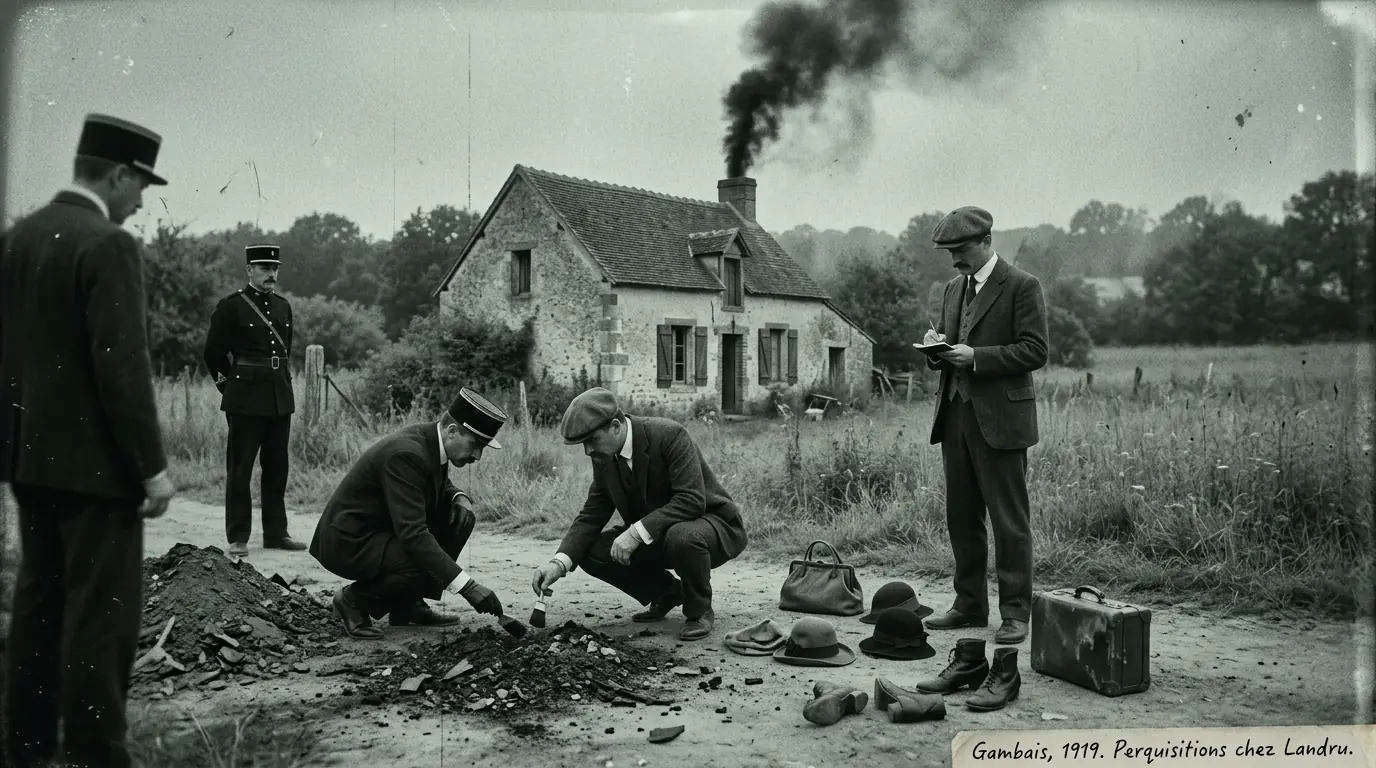
They had a country house whose chimney had repeatedly attracted attention because of terrible smells.
They had hundreds of fragments of burned human bone.
They even had a stove that investigators believed could destroy parts of a human body.
What they did not have were eleven intact bodies.
Landru understood that weakness.
And from the moment police arrested him until the moment a jury decided his fate, he returned to essentially the same question:
Where were the bodies?
If the prosecution could not answer that, he believed they could not prove murder.
For more than two years, the entire case would revolve around whether a man could be convicted of killing eleven people when almost nothing recognizable remained of the dead.
Before the Women
Henri Désiré Landru was born in Paris on April 12, 1869.
Nothing in his childhood announced the legend that would eventually surround his name.
His family was modest.
His father worked as a chauffeur.
His mother was a seamstress.
Landru received an ordinary education and later completed military service.
He married Marie-Catherine Remy in 1893 after they had already had a daughter together.
The couple eventually had four children.
From the outside, there was little to suggest that Landru would one day become known across France as the "Bluebeard of Gambais."
But there was already one important trait developing.
Landru was an extraordinarily persistent fraudster.
He tried different occupations.
Clerk.
Businessman.
Mechanical entrepreneur.
Bicycle manufacturer.
Civil engineer, at least according to himself.
Again and again, he found ways to convince strangers that something valuable existed when it did not.
A job.
A factory.
An investment.
A profitable business.
A future marriage.
His early crimes followed a recognizable formula.
Create credibility.
Ask for money.
Disappear.
Around 1900, Landru established what appeared to be a business operation and advertised employment positions.
Applicants were told they needed to provide a financial deposit as security.
They paid.
The jobs did not exist.
Landru disappeared with the money.
Police pursued him.
He changed identities.
When arrested, investigators found something that would later become almost symbolic of his criminal personality.
A notebook.
Landru kept records.
Names.
Addresses.
People he had targeted.
People he had successfully deceived.
People he still intended to approach.
He was not a careless criminal.
He catalogued people.
That habit survived everything that came afterward.
Prison did not reform him.
After release, he returned to fraud.
More aliases.
More schemes.
More convictions.
Then he discovered that romance itself could become a business.
In 1909, using the name Paul Morel, Landru placed a matrimonial advertisement.
A woman answered.
Letters followed.
He met her.
She introduced him to her family.
They became engaged.
Eventually she trusted him enough to give him access to her savings under the pretext that the money was needed for their marriage arrangements.
Then "Paul Morel" disappeared.
The woman realized she had been deceived.
Landru was caught again.
The scam had failed.
But the method had revealed something important.
A woman could give a convincing fiancé far more than money.
She could give him access to her home.
Her documents.
Her relatives.
Her finances.
Her confidence.
And most importantly, she might willingly go somewhere alone with him.
Landru had learned how powerful a marriage promise could be.
By 1914, his criminal record had become dangerous even for him.
On July 20 of that year, he was sentenced in absentia to four years in prison and relegation, a punishment that could ultimately mean exile to the penal colony in French Guiana.
Landru did not surrender.
He disappeared.
A few weeks later, Europe went to war.
For a wanted fraudster with experience using false names, the timing was extraordinary.
The First World War transformed France.
It also created exactly the social conditions Landru could exploit.
A Country of Lonely Women
War changed the matrimonial market almost overnight.
Young men vanished into the army.
Families were separated.
Widowhood became common.
Middle-aged women who had expected conventional family lives found themselves alone.
Financial uncertainty increased.
Social structures weakened.
Newspaper advertisements became one way isolated people tried to rebuild their lives.
Landru began using matrimonial advertisements systematically.
The wording changed, but the basic image remained consistent.
A respectable man.
Some capital.
Serious intentions.
Looking for a widow or lonely woman.
He did not advertise as a glamorous seducer.
That would have been less convincing.
He advertised stability.
He portrayed himself as a man who had also suffered.
A widower.
A businessman.
Someone displaced by the war.
Someone seeking companionship rather than excitement.
The details depended on the woman.
Landru adapted.
That adaptability was one of his greatest strengths.
He did not need hundreds of women to fall in love with the same fictional man.
He could create a different man for each woman.
The investigation would later show the extraordinary scale of the operation.
Authorities identified approximately 283 women who had entered into some level of contact with Landru through his matrimonial activities.
He used scores of pseudonyms.
The French Ministry of Justice has described more than 90 aliases associated with his operations.
Landru kept notes on the women.
Physical details.
Family circumstances.
Financial position.
Whether they seemed promising.
Whether they had money.
Whether relatives might interfere.
Some women were rejected.
One notation might mean there was no fortune.
Another might criticize the woman's home.
Another her voice.
One reportedly dismissed a woman's irritating white fox terrier.
Behind the language of romance was something closer to a commercial sorting system.
Landru was evaluating inventory.
Out of hundreds of contacts, most survived.
That fact matters.
Landru did not simply kill every woman who answered an advertisement.
He corresponded.
Evaluated.
Selected.
Some had too little money.
Some had too many relatives.
Some relationships went nowhere.
Others were useful only for fraud.