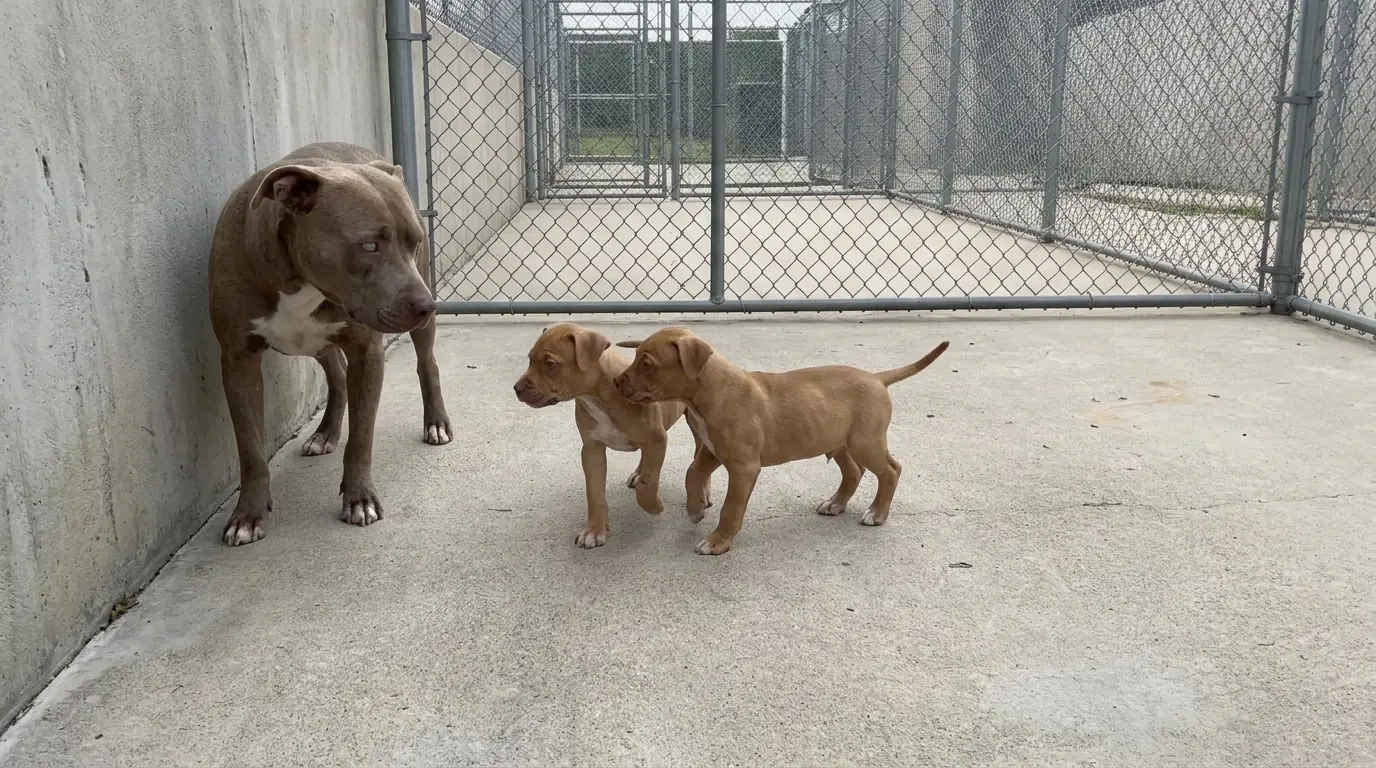
Atlas Had Learned to Keep One Side of His Body Against Something Solid
When Atlas first entered our care, he moved through unfamiliar spaces by staying close to walls.
He was a young Pit Bull mix, physically strong in many ways, but his world had changed after an injury left him without useful vision.
The loss appeared permanent.
By the time he reached us, the immediate injury had already been stabilized, but the behavioral consequences were only beginning to show.
Atlas could hear.
He could smell.
He could feel surfaces under his paws.
He could locate people by voice when they spoke consistently.
What he could not do was look across a room or yard and decide where it was safe to go.
So he created his own solution.
He hugged the perimeter.
In his kennel, he traced the walls.
In hallways, he stayed close to one side.
Outside, he followed fences.
If the path opened into a large area, he often stopped at the edge.
He was not incapable of walking through open space.
He simply did not yet trust it.
That distinction shaped almost every part of his rehabilitation.
His Veterinary Workup Confirmed That This Was More Than Temporary Disorientation
Atlas received a full medical examination after intake.
Because his blindness followed trauma, our veterinary team reviewed the available history and examined his eyes for ongoing pain, inflammation, infection, or complications that still needed treatment.
The goal was not simply to label him blind.
It was to determine whether his eyes were comfortable and whether any remaining issue could threaten his overall health.
Additional ophthalmic evaluation confirmed that meaningful vision was unlikely to return.
That was difficult news in one sense, but it also gave us clarity.
We were no longer waiting for Atlas to suddenly begin seeing again.
We could focus on helping him build a safe life using the senses he still had.
His neurologic examination did not suggest a broader loss of coordination or awareness.
He could place his feet normally.
He responded to touch.
He oriented well to sound.
His joints and muscles were appropriate for a young dog who had been moving less because of uncertainty rather than physical weakness.
That meant Atlas did not need to relearn how to walk.
He needed to relearn how to trust walking without sight.
Blind Dogs Do Not Need to Be Protected From Every Experience
The easiest mistake with a newly blind dog is to do too much for him.
Carry him everywhere.
Guide every step.
Prevent him from exploring.
Constantly redirect him before he can make a mistake.
Those choices often come from kindness, but they can also prevent a dog from building the skills he needs.
Atlas needed structure.
He did not need his world reduced to a bed and a leash.
His caregivers began creating predictable routines.
His food and water stayed in the same places.
Furniture and kennel equipment were not moved unnecessarily.
Staff used consistent verbal cues before touching him.
They spoke before opening doors.
They gave him time to investigate new surfaces.
On leash, they avoided pulling him forward whenever he hesitated.
Instead, they allowed him to sniff, listen, and make choices.
Progress was slow.
Atlas could navigate his kennel well within several days.
The hallway took longer.
The outdoor play yard was hardest.
The Play Yard Felt Too Big
The yard was safe.
It was enclosed.
The surface was level.
There were no loose obstacles left in his path.
To a sighted dog, it was a simple open area.
To Atlas, it may as well have had no edges.
On his first visits, he stayed along the fence.
He moved carefully with one shoulder close to the perimeter.
When the fence changed direction, Atlas followed it.
When a caregiver stood several feet into the yard and called him, he often turned his head toward the voice but remained where he was.
Treats could encourage a few steps.
A familiar person could sometimes bring him farther.
But once he reached open space, his body changed.
His steps shortened.
His head lowered.
He paused frequently.
Then he returned to the fence.
Nobody forced him farther.
We wanted the yard to become something he understood, not something he endured.
Then Came Pip
Pip arrived at animal control with a visible difference.
He was a young mixed-breed puppy with a congenital deformity affecting one front leg.
The limb had not developed normally, and after veterinary evaluation, it was clear that it would never function like a typical front leg.
What mattered more was how Pip was using his body.
He was active.
He moved independently.
He played.
He adapted naturally to his balance.
His unusual limb did not appear to be causing severe ongoing pain, and there was no immediate reason to assume that removing it would improve his quality of life.
The veterinary team chose a conservative plan.
Pip would be monitored as he grew.
His skin would be checked for rubbing or pressure sores.
His weight would be kept appropriate.
His gait would be reassessed over time.
If the limb began causing pain or interfering with mobility, the plan could change.
For now, he was a puppy who happened to move differently.
Pip Was Not Brought in to "Fix" Atlas
The two dogs met because their exercise schedules overlapped, not because anyone expected a cinematic outcome.
Pip needed safe socialization with appropriate adult dogs.
Atlas needed controlled opportunities to move in open spaces without overwhelming pressure.
Before introducing them, staff assessed both dogs separately.
Atlas had shown appropriate social behavior.
Pip was energetic but not especially rough.
Their first meeting took place in a neutral area with two handlers and plenty of room.
Atlas heard Pip before he touched him.
Pip trotted forward, then slowed.
Atlas turned toward the sound.
Pip approached from the side and sniffed.
Atlas sniffed back.
There was no instant friendship.
No dramatic reaction.
They simply spent a few quiet minutes gathering information about each other.
That was enough for the first session.
Pip Had a Very Specific Way of Moving
Because of his front-leg difference, Pip's gait had a recognizable rhythm.
His steps were light and quick.
He tended to move in short bursts rather than long, straight lines.
Run a few steps.
Pause.
Turn.
Run again.
Atlas noticed.
Blind dogs can become exceptionally attentive to sound, but that does not mean they automatically understand every noise around them.
Pip's movement, however, was easy to track.
His nails tapped the ground.
His body made small changes in direction.
He panted when excited.
He stopped frequently.
During the second play-yard session, Atlas spent most of his time near the fence while Pip explored farther out.
Then Pip ran back.
He bumped Atlas lightly at the shoulder.
Atlas turned toward him.
Pip moved away again.
A few moments later, the same thing happened.
Run out.
Turn back.
Touch Atlas.
Move away.
Nobody had trained Pip to do it.
We Started Watching the Pattern
At first, staff treated the shoulder touches as ordinary puppy behavior.
Pip was social.
Atlas was familiar.
Puppies bump into other dogs all the time.
But the pattern became consistent.
Pip would move several feet ahead.
Then he would turn around.
He would return close enough to brush Atlas's shoulder or chest.
Then he would move forward again.
Atlas began orienting toward him faster.
On one session, Pip touched him and ran several feet toward the center of the yard.
Atlas took two steps after him.
Then three.
He stopped.
Pip came back.
Another touch.
Atlas followed again.
He still returned to the fence after a short distance.
But the distance was farther than before.
That was the first time staff noted that Pip's movement might be doing something verbal encouragement had not accomplished as naturally.
The Sound Was Becoming a Reference Point
We were careful not to describe Pip as a trained guide dog.
He wasn't.
He had no formal task training.
He was a puppy.
What he was providing Atlas was simpler.
A predictable moving sound.
A familiar body.
A social reason to orient forward.
For a blind dog, open space can feel difficult because there are fewer physical landmarks.
The fence was easy for Atlas to understand.
It was always there.
Pip became another kind of landmark.
Unlike the fence, he moved.
Atlas began learning that the movement in front of him could be followed safely.
That did not happen all at once.
Some sessions were better than others.
On quiet mornings, Atlas followed farther.
On busy days, when kennel sounds were louder or wind carried unfamiliar smells, he sometimes returned to the wall quickly.
We did not treat those days as failures.
Confidence is not linear.
Atlas Still Needed Independent Skills
It would have been easy to simply put Pip with Atlas every time Atlas went outside.
We intentionally did not do that.
Atlas needed to learn how to function whether Pip was present or not.
His caregivers continued individual sessions.
They used consistent voice cues.
They placed textured mats near important transitions.
They introduced verbal markers for steps, doors, and changes in surface.
Atlas practiced walking through short open sections without touching a wall.
At first, he managed only a few feet.
Then he turned back.
Later, he crossed the same area more confidently.
Pip was helping, but he was not allowed to become Atlas's only strategy.
That mattered for both dogs.
Pip deserved to grow as a normal puppy rather than carry responsibility for another dog's independence.
Atlas deserved skills that belonged to him.
Pip's Own Medical Needs Remained Important
Because Pip's front leg was visibly different, many people assumed his care must revolve around disability.
In reality, most of his needs were ordinary puppy needs.
Vaccinations.
Parasite prevention.
Nutrition.
Growth monitoring.
Socialization.
Safe play.
Training.
His abnormal limb was checked regularly for pressure points and irritation.
As he grew, the team watched whether his movement placed unusual strain on his shoulders or spine.
Keeping him lean was especially important.
Extra weight can increase stress on joints and on the limbs that are doing more work.
Pip was not fragile.
He also was not medically invisible.
His body had adapted, and our role was to support that adaptation responsibly.
Atlas Took His First Long Walk Across the Yard by Accident
The breakthrough did not happen during a formal training session.
It happened during an ordinary morning turnout.
Pip was energetic.
Atlas was relaxed.
The yard was quiet.
Pip trotted away from the fence.
Atlas remained near it.
Pip turned and came back.
He touched Atlas near the shoulder.
Then he moved off again.
Atlas followed.
Pip ran several more steps.
Atlas kept going.
Staff stayed quiet.
No cheering.
No repeated calling.
No attempt to make the moment bigger while it was happening.
Pip looked back, returned briefly, and bumped him again.
Atlas continued.
By the time he stopped, he was much farther from the perimeter than he had ever walked voluntarily.
He stood in the middle of the yard.
For several seconds, he did nothing.
Then Pip moved ahead.
Atlas turned toward the sound.
And followed.
He crossed almost the entire play area before drifting back toward a familiar edge.
That was the first time anyone had seen him use so much open space by choice.
We Did Not Try to Recreate It Immediately
When a dog has a successful session, there can be a temptation to push for more.
Atlas had already done enough.
He returned to his kennel, drank, and rested.
The next day, his session was shorter.
He followed Pip partway across the yard, then chose the fence.
We let him.
A single long crossing did not mean his fear of open spaces had vanished.
It meant his understanding had expanded.
That was more useful than pretending he was cured.
Atlas Began Leaving the Wall Before Pip Touched Him
Over the next two weeks, Atlas's behavior changed in small ways.
He stopped keeping constant physical contact with the fence.
Sometimes he walked a foot away from it.
Then two.
He began moving toward Pip after hearing the puppy without waiting for a shoulder touch.
If Pip stopped, Atlas stopped too.
If Pip changed direction sharply, Atlas sometimes needed a moment to relocate him.
But his recovery was no longer limited to tracing boundaries.
The wall had gone from a requirement to a backup.
That distinction meant a lot to his caregivers.
The Puppy Learned to Adjust His Energy
Pip changed too.
He remained playful, but his interactions with Atlas became less chaotic.
When they first met, he occasionally bounced around him in tight circles.
That made sound localization harder.
Staff redirected that behavior gently and rewarded calmer movement.
Over time, Pip seemed to develop his own preference for the short-run-and-return pattern.
He would move ahead.
Pause.
Come back.
Touch.
Move again.
We cannot know whether he understood that Atlas could not see him.
We do know that he repeated behavior that made it easier for Atlas to follow.
That was enough.
Their Relationship Was Built Around Movement
Some bonded dogs sleep pressed together.
Some share toys.
Some become distressed when separated.
Atlas and Pip developed something different.
They seemed most connected while moving.
Inside, Atlas often rested independently.
Pip played with toys, investigated blankets, and tried to convince anyone nearby that every pocket contained treats.
They did not spend every minute together.
In the yard, however, the dynamic changed.
Pip became a source of motion.
Atlas became attentive.
The puppy's footsteps gave the blind dog a reason to leave the safe edge.
Atlas Started Building a Mental Map
Repeated exposure helped Atlas learn the yard itself.
There was a textured patch near one gate.
A drainage grate made a particular sound when stepped near.
The surface felt slightly different close to the building.
A shaded section smelled different in the morning.
Atlas began using these cues.
We could tell because he made fewer unnecessary corrections.
He no longer had to rediscover the whole space every time.
That independence was exactly what we wanted.
Pip might have opened the route.
Atlas was learning the route.
A Setback Came During a Windy Afternoon
One day, strong wind made the yard unusually noisy.
Leaves moved along the ground.
A nearby gate rattled.
Smells shifted rapidly.
Pip ran ahead.
Atlas followed at first.
Then a sudden sound came from the side.
He froze.
His body lowered slightly.
He turned in the wrong direction.
Pip ran back and touched him.
Atlas did not move.
The handler stepped closer and used a familiar cue.
Atlas turned toward the voice.
He chose to return to the fence.
We ended the session shortly afterward.
That response reminded us that blindness was not the only variable.
Environment mattered.
Confidence mattered.
Some days required less.
The Next Morning Was Different Again
The weather was calm.
Pip trotted into the yard.
Atlas followed.
This time he left the wall almost immediately.
No hesitation.
No waiting for a touch.
Pip ran several yards ahead.
Atlas tracked the sound.
When Pip returned, Atlas sniffed him briefly and continued forward.
Progress had returned.
Not because the bad day had been erased.
Because the bad day had not undone everything he had learned.
Foster Placement Required Thoughtful Matching
Eventually, both dogs reached the point where foster placement could help us evaluate them outside the rescue environment.
Atlas needed a home willing to accommodate blindness without restricting his independence.
Furniture needed to stay relatively consistent.
Stairs needed safe management.
Verbal cues needed to be predictable.
Pip needed a home prepared for a young dog with an unusual gait and ongoing orthopedic monitoring.
We initially considered separate fosters.
Then an experienced family offered to take both dogs temporarily.
That gave us an opportunity to observe whether their play-yard dynamic continued in a household setting.
A House Was Harder for Atlas Than the Yard
The foster home was prepared carefully.
Rugs marked pathways.
Sharp corners were blocked where practical.
Food and water stayed in fixed locations.
Furniture was not rearranged after Atlas arrived.
Even so, his first day was difficult.
A house contains many obstacles.
Tables.
Door frames.
Chairs.
Different floor surfaces.
Narrow passages.
Atlas moved slowly.
He used walls again.
That was expected.
Pip explored almost everything within minutes.
Then he returned to Atlas.
A familiar tap.
A few quick steps.
Atlas followed.
Not far.
But enough.
Pip Began Leading Him From Room to Room
Within several days, a familiar routine emerged.
Pip would move through the living room toward the kitchen.
Atlas would hear him.
Sometimes Pip returned.
Sometimes he didn't need to.
Atlas began following the sound of his paws over the floor.
The foster family did not rely on Pip alone.
They continued verbal cues and independent practice.
But the puppy often made transitions easier.
Doorways became less intimidating when Atlas heard Pip pass through them first.
New rooms became more interesting when there was a familiar dog moving inside.
Atlas Learned the House Faster Than Expected
By the end of the first week, Atlas knew the main paths.
Bed to water.
Living room to back door.
Back door to yard.
Kitchen to bed.
He still bumped objects occasionally.
Blind dogs do.
The goal was never perfect navigation.
The goal was confident recovery after small mistakes.
Atlas became good at that.
If he contacted a chair leg, he stopped.
Sniffed.
Shifted direction.
Continued.
He no longer reacted to every bump as proof that movement was unsafe.
That may have been one of the biggest changes of all.
Pip's Front Leg Continued to Be Monitored as He Grew
Pip's growth required regular reassessment.
His weight increased appropriately.
His altered gait remained functional.
There were no persistent sores from the malformed limb.
He continued using the other three limbs strongly and did not show ongoing signs of pain during ordinary activity.
The veterinary team continued to avoid unnecessary intervention.
Surgery remained an option only if future discomfort or mechanical problems justified it.
That responsible wait-and-monitor approach suited Pip well.
He had no idea anyone considered him unusual.
He ran.
Played.
Rested.
And occasionally became Atlas's most reliable moving landmark.
Adoption Planning Raised a Difficult Question
Should they stay together?
By this point, Atlas and Pip clearly enjoyed each other's company.
Pip had played a meaningful role in Atlas's rehabilitation.
But that did not automatically make them inseparable.
Pip was young.
Atlas was learning independence.
We did not want to manufacture a bonded-pair label simply because their story was emotionally appealing.
So we observed carefully.
They tolerated separation.
Atlas could navigate without Pip.
Pip could play and settle without Atlas.
Neither showed panic when the other left for veterinary appointments.
That told us something important.
Their relationship was supportive, not dependent.
Then Their Foster Family Asked About Keeping Both
The family had watched the same dynamic we had.
They had seen Atlas walk farther when Pip moved ahead.
They had seen Pip return to touch him.
They had also seen them function separately.
That balance made the decision easier.
The family was interested in adopting both, provided the final medical and behavioral evaluations supported the match.
We reviewed Atlas's blindness management.
We reviewed Pip's orthopedic monitoring.
We discussed long-term costs.
We discussed training.
We made sure the family understood that Pip was not responsible for guiding Atlas for life.
If his behavior changed as he matured, Atlas would still need to function confidently.
That was already happening.
The Yard Became the Place Where We Could See the Difference Most Clearly
Before finalizing the placement, the family brought both dogs back for a follow-up visit.
Atlas entered the familiar play yard.
Months earlier, he had immediately searched for the fence.
This time, he stopped near the gate and listened.
Pip ran ahead.
Atlas turned.
Then he walked forward.
Not along the perimeter.
Straight into the open yard.
Pip ran back, tapped his shoulder, and moved off again.
Atlas followed.
He covered most of the yard.
There was no cheering.
No dramatic music.
Just two dogs moving across ordinary ground.
One could not see.
One had a front leg that had never developed normally.
Neither moved through the world in the standard way.
But both had learned how to use what they had.
Pip Did Not Give Atlas His Independence
That distinction matters.
The puppy did not cure blindness.
He did not restore vision.
He did not teach Atlas every skill he needed.
Veterinary care mattered.
Behavioral planning mattered.
Predictable environments mattered.
Caregivers mattered.
Repetition mattered.
Atlas himself did the work of learning.
But Pip gave him something valuable at a point when the open yard still felt uncertain.
A sound worth following.
A small body that kept coming back.
A touch at the shoulder.
Then a few steps forward.
Atlas No Longer Needs the Wall
In his permanent home, Atlas still uses environmental cues.
His family keeps furniture consistent.
They speak before approaching.
They use verbal markers at doors and steps.
He knows where his water stays.
He knows the route outside.
If something changes, he slows down and investigates.
Pip has grown.
His gait is still distinctive.
His front leg still requires monitoring.
He is no longer the tiny puppy who arrived at animal control.
But one habit remains.
In the yard, Pip often runs ahead.
Then he turns around.
Sometimes he comes all the way back and bumps Atlas lightly near the shoulder.
Other times Atlas is already following.
That is the part that changed.
The blind young Pit Bull who once refused to leave the security of the perimeter now crosses the yard without needing a wall against his side.
He hears quick footsteps moving ahead.
He turns toward them.
And he goes.