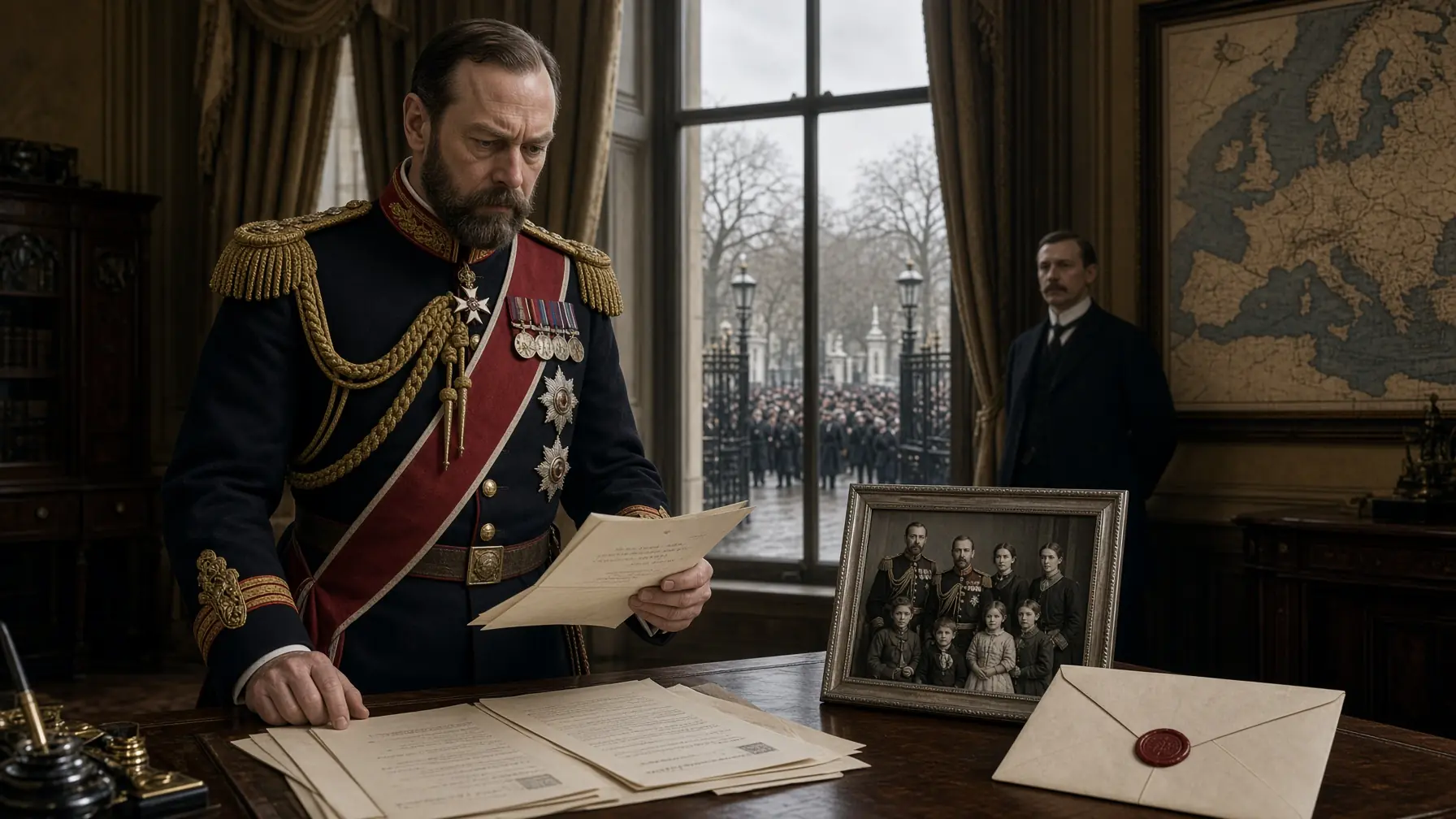
In March 1917, only days after Tsar Nicholas II lost the Russian throne, an escape route appeared to open for him and his family.
It led to Britain.
Nicholas was not some distant foreign monarch to King George V. The two men were first cousins, connected through their Danish mothers, and their physical resemblance was so striking that photographs of them together can look almost uncanny. Nicholas’s wife, Alexandra, was also a granddaughter of Queen Victoria.
On March 22, the British Foreign Office instructed its ambassador in Petrograd that Britain was prepared to offer asylum to the former emperor and empress. The surviving telegram stated that the king and government “readily offer asylum” in England.
For a moment, therefore, the possibility was real.
Nicholas, Alexandra and their five children might leave revolutionary Russia and live in Britain.
Then something changed.
Less than three weeks later, George V’s private secretary was telling the Foreign Secretary that the king feared the Romanovs’ presence would be strongly resented by the British public and could “compromise the position of the King and Queen.” The message urged the government to withdraw the consent it had already given.
The Romanovs never came.
Sixteen months later, Nicholas, Alexandra, Olga, Tatiana, Maria, Anastasia and Alexei were taken into a basement in Yekaterinburg and killed by their Bolshevik captors.
That sequence created one of the most painful questions surrounding the modern British monarchy:
Had George V helped close an escape route that might have saved his cousin and his cousin’s children?
The surviving documents reveal that the answer is more complicated than the popular story—but also more uncomfortable.
Nicholas and George Were More Than Royal Cousins
The closeness between Nicholas II and George V was not invented after the Romanovs died.
Their families were deeply intertwined.
Nicholas’s mother, Empress Maria Feodorovna, had been born Princess Dagmar of Denmark. George’s mother, Queen Alexandra, had been born Princess Alexandra of Denmark.
The two women were sisters.
That made Nicholas and George first cousins.
Their resemblance became famous. Both wore similar beards and mustaches, and when photographed together in military uniforms they could be mistaken for brothers.
The connection went further.
Nicholas’s wife, Alexandra Feodorovna, had been born Princess Alix of Hesse and by Rhine. Her mother was Princess Alice, daughter of Queen Victoria.
European royalty before the First World War was an astonishingly interconnected family network.
But by 1917, those family connections were colliding with something much larger.
Revolution.
Nicholas was no longer simply Cousin Nicky.
He was the former autocrat of an empire collapsing in wartime.
And Britain was beginning to worry about revolution at home.
The Russian Monarchy Collapsed With Stunning Speed
Russia entered the First World War in 1914 under enormous pressure.
By early 1917, military losses, food shortages, inflation, political discontent and hostility toward the imperial government had created a crisis the monarchy could no longer control.
Demonstrations and strikes erupted in Petrograd.
Soldiers began joining the unrest rather than suppressing it.
Nicholas’s authority disintegrated.
In March 1917 by the modern Gregorian calendar, Nicholas abdicated.
More than three centuries of Romanov rule came to an end.
A Provisional Government attempted to govern Russia.
Nicholas and his family were placed under guard.
Initially they remained at the Alexander Palace at Tsarskoye Selo, outside Petrograd. The British Library notes that they were later transferred to Tobolsk and eventually, under Bolshevik rule, to Yekaterinburg.
But in those first weeks after the abdication, their ultimate fate was far from certain.
Execution was not yet inevitable.