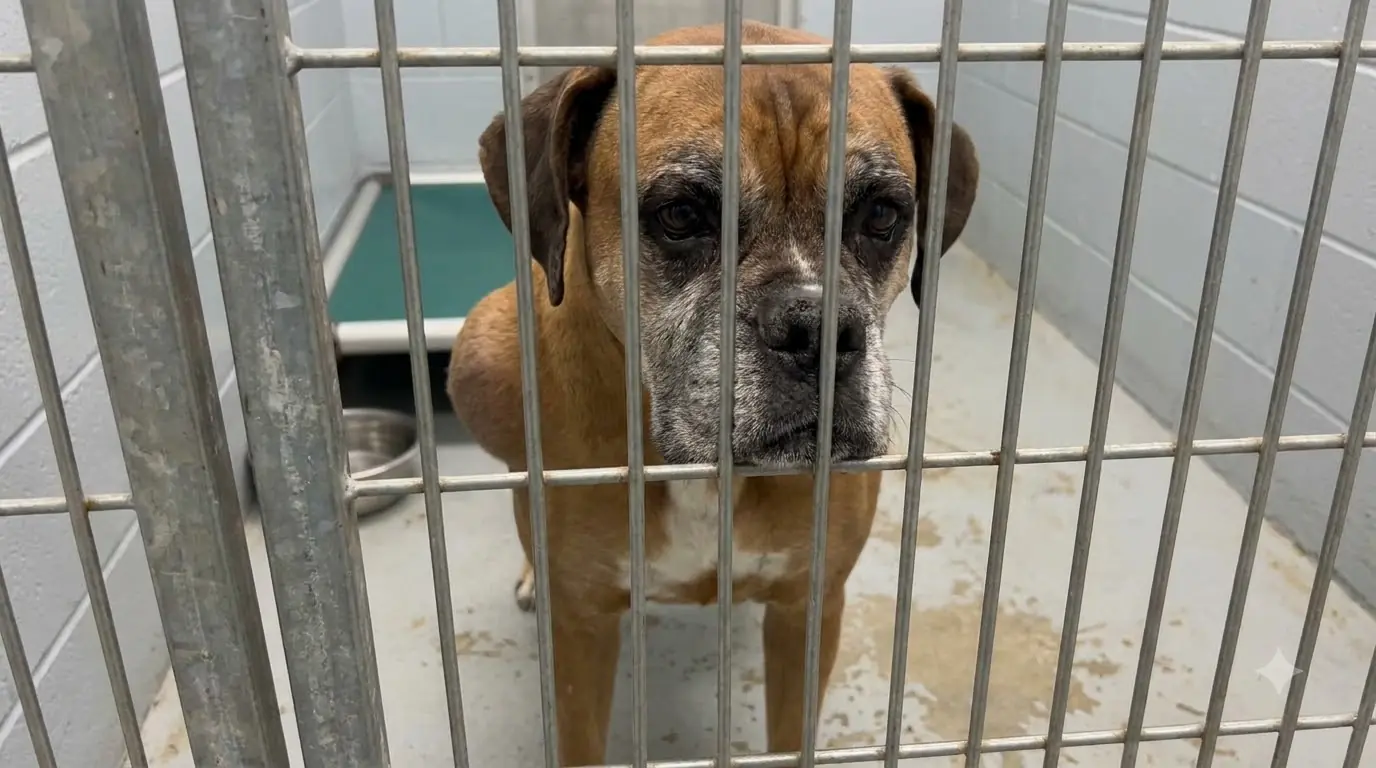
Bruno does not spend much time standing anymore.
At nine years old, the senior Boxer’s body has been weakened by progressive disease, and the large mass protruding from one shoulder makes the change impossible to miss.
Most of his day happens on the medical bed.
He sleeps there.
Eats close to it.
Drinks close to it.
Staff have rearranged the kennel so he does not need to make unnecessary trips across the floor.
Standing costs too much now.
But there is one thing that still gets Bruno up.
Someone stopping outside his kennel.
It can be a volunteer.
A shelter employee.
A family moving slowly through the medical row.
Bruno hears the footsteps stop.
His eyes open.
His head comes up.
Then his front paws move beneath his chest.
The first part is always the strongest.
His shoulders lift.
His chest rises from the mattress.
Then the rest of his body follows more slowly.
The hind legs straighten.
Bruno pauses.
For a moment, he is standing.
Then he starts toward the gate.
Only a few steps.
That is usually all he has.
By the time his nose reaches the bars, the weakness is already visible.
His rear legs begin to tremble.
His posture lowers.
The shoulder carrying the large mass shifts awkwardly as he tries to redistribute his weight.
Bruno does not immediately lie down.
Instead, he moves another inch forward.
Then presses his chest against the kennel bars.
The metal takes some of his weight.
His front legs remain underneath him.
His hind legs keep shaking.
And Bruno stays there.
Just a little longer.
Staff Initially Thought He Was Simply Leaning Forward to Smell People
That would have been normal.
Dogs routinely press close to kennel gates.
They put noses between bars.
Lean their shoulders against the door.
Try to get closer to whoever is standing outside.
But Bruno’s position was different.
The longer someone stayed, the heavier his chest seemed to become against the metal.
When the person left, he did not spring backward.
He slowly peeled himself away from the gate.
Sometimes he made it back to the bed.
Sometimes he lowered himself almost immediately.
That was when staff realized the bars were doing more than bringing him closer to people.
They were helping hold him up.
The Shoulder Mass Was the First Thing Everyone Saw
It was large.
Prominent.
Impossible to hide beneath the short Boxer coat.
The shape altered the outline of one side of Bruno’s body even from several feet away.
Naturally, visitors asked about it.
Was it cancer?
Could it be removed?
Was it painful?
How long had it been there?
The shelter could not answer those questions from appearance alone.
A large mass in an older dog can arise from different tissues and have very different implications.
So the veterinary team evaluated what they could.
Location.
Texture.
Mobility.
Skin condition.
Pain.
How deeply it appeared attached.
Whether it affected shoulder movement.
Whether additional sampling or imaging would meaningfully change the treatment plan.
The Tumor Was Only Part of Bruno’s Decline
The visible mass drew attention.
His general weakness concerned the medical team just as much.
Bruno had less muscle than before.
Less endurance.
Longer recovery after movement.
A dog can have one visually dramatic problem and several quieter ones beneath it.
Staff did not assume the shoulder explained everything.
Progressive systemic disease.
Pain.
Age.
Deconditioning.
Potential cancer-related effects.
All could contribute.
The whole dog had to be evaluated.
His Standing Time Became a Useful Measure
Not because staff wanted Bruno to stand longer.
Because changes in how long he could support himself told them something about function.
Earlier in his stay, Bruno could rise and remain upright for several minutes.
Later, that became shorter.
Then shorter again.
Soon, the trip from the bed to the gate was enough to use most of his reserve.
That pattern mattered.
He Could Still Walk
This distinction was important.
Bruno was not completely immobile.
He could get up.
Take short steps.
Turn.
Position himself.
That remaining function gave him some independence.
The shelter wanted to preserve it.
But being able to walk a few feet did not mean he should repeatedly be asked to.
Social Interest Was Outlasting Physical Endurance
That was the hardest part of watching him.
Bruno still noticed people.
Still reacted when someone stopped.
Still chose to approach.
The mind and social behavior had not withdrawn at the same speed as the body.
So every greeting became a mismatch.
He wanted several minutes at the gate.
His legs had several seconds.
The Bars Became His Compromise
Walk.
Reach gate.
Lean.
Stay up a little longer.
That was the sequence.
It looked determined.
Staff did not romanticize it.
A dog bracing against metal because his legs cannot keep him upright is not a behavior that should be encouraged simply because it is emotional to watch.
It is information.
The body needs less demand.
The First Change Was Moving His Bed Closer
The medical bed came forward.
Now Bruno did not have to cross the full kennel.
If someone stopped, the distance was smaller.
That helped.
He still stood.
Still approached.
But fewer steps meant less fatigue before he reached the gate.
Then Staff Started Going to Bruno Instead
That changed much more.
If someone wanted to interact, staff encouraged them to crouch close to where he was already resting.
No calling him forward.
No waiting at the opposite end of the bars.
No making the dog prove he wanted company by standing.
A visitor could come down to his level.
Bruno could lift his head.
Sniff.
Maybe move one front paw.
That was enough.
The Best Visits Became Almost Motionless
Bruno lying on the medical bed.
Person sitting outside.
Head near gate.
Nose forward.
No standing.
No shaking.
No chest pressed into metal.
Those quieter interactions were less dramatic.
They were far kinder.
Bruno Did Not Stop Trying Immediately
Someone unfamiliar would appear.
His head came up.
The old sequence began.
Front paws underneath.
Chest rising.
Staff moved closer quickly.
Sometimes Bruno stopped midway and settled again.
Sometimes he completed the stand anyway.
The instinct or habit to approach remained strong.
Staff Stopped Encouraging the Stand
No excited voices.
No calling his name repeatedly from the hallway.
No extending treats just out of reach.
No cheering when he managed to get up.
That distinction mattered.
For a healthy dog, standing at the gate can be ordinary.
For Bruno, every stand had a physical cost.
The Shoulder Mass Affected His Balance
When one side of a dog’s body carries additional weight or discomfort, posture changes.
Bruno shifted his front end differently.
Certain turns were slower.
Certain lying positions were avoided.
Staff watched which side he preferred.
The bedding was arranged to reduce pressure on the mass.
Skin Over the Mass Needed Monitoring
Large tumors can create secondary problems.
Stretching.
Irritation.
Ulceration.
Bleeding.
Infection.
The shelter checked the area regularly.
If the surface changed, that could alter the entire medical plan.
Comfort mattered more than appearance.
Bruno Spent More Time Lying Down
That was expected as the disease progressed.
The shelter increased padding.
Elbows.
Hips.
Chest.
All needed protection.
A large senior dog who rests for long periods is vulnerable to pressure-related skin problems even without the tumor.
The bed needed to support his entire body.
Water Came Closer
Food too.
No reason to ask Bruno to spend limited standing time on basic resources.
The bowl was positioned where he could reach from or near the bed.
Meals could be eaten without crossing the kennel.
That left what strength he had for bathroom care and voluntary movement.
He Sometimes Ate Lying Down
At first, Bruno preferred standing.
Later, standing through an entire meal became difficult.
So the bowl position was adjusted.
If he wanted to remain chest-down, he could.
The task was eating.
Not standing.
His Appetite Became Part of Quality-of-Life Monitoring
A dog with progressive disease can still eat well.
That is encouraging.
It is not the whole picture.
Bruno’s team looked at appetite alongside pain, mobility, sleep, breathing, ability to eliminate, and social engagement.
One preserved function could not erase deterioration everywhere else.
Short Bathroom Trips Became More Difficult
These were among the few movements Bruno still had to make.
A support harness was introduced when necessary.
The front legs could contribute.
A caregiver helped the rear.
Short route.
Pause.
Return.
No extra walking.
The Harness Was Not Used to Keep Him Standing at the Gate
That would have defeated the purpose.
Assist necessary function.
Do not artificially extend a social posture that exhausts him.
The interaction could happen while Bruno remained down.
His Weakness Progressed
There was no simple rehabilitation story.
Bruno’s underlying disease was not something the shelter could exercise away.
Some strengthening and controlled movement might preserve function.
But a progressive illness changes the goal.
At some point, maintaining comfort becomes more important than increasing activity.
The Veterinary Team Reassessed the Mass in Context
Could additional diagnostics help?
Would surgery be realistic?
Could Bruno tolerate anesthesia?
Would removal meaningfully improve comfort or survival?
What would recovery demand from a dog who could barely stand for long?
Those are difficult questions.
A tumor being technically removable does not automatically make surgery the kindest option.
Palliative Care Became Increasingly Important
Pain control.
Comfortable positioning.
Skin care.
Accessible food and water.
Short necessary movement.
Low-stress social contact.
Bruno’s days became organized around preserving comfort rather than chasing normal function.
He Still Reacted to People
That never stopped quickly.
A familiar technician appeared.
Bruno’s eyes lifted.
Sometimes the tail moved.
Sometimes he began the effort to stand.
That social response remained one of the strongest parts of his day.
The Shelter Learned to Answer It Differently
Not by waiting at the bars.
By entering.
Sitting.
Bringing a hand close.
Letting Bruno remain supported.
That reduced the number of times he reached the shaking stage.
The Gate Was Moved Closer to His World
Not physically.
Functionally.
His bed came forward.
His resources came forward.
People came forward.
The amount of space Bruno needed to cross became smaller and smaller.
That was exactly what his body needed.
One Afternoon, He Could Not Reach the Gate
He tried.
Front end up.
Rear legs following.
Two slow steps.
Then the trembling started earlier than usual.
Bruno stopped.
The bars were still several feet away.
A staff member moved toward him immediately.
Bruno lowered himself.
The person sat beside him.
His muzzle moved toward their hand.
The greeting happened there.
That moment changed expectations again.
From Then On, Nobody Waited for Him to Complete the Trip
If Bruno started moving toward someone, the person closed the rest of the distance.
That simple rule prevented repeated exhaustion.
His Medical Bed Became the Center of Social Life
Not a place where he was isolated.
A place where interaction came to him.
Volunteers sat nearby.
Staff gave medications there.
Gentle attention happened there.
Bruno did not need to leave comfort to remain included.
Foster Placement Became a Priority
A medical kennel can provide care.
A hospice-style home can provide a quieter environment.
Bruno needed fewer noises.
Shorter routes.
More continuous padding.
People nearby without a gate separating them.
A foster experienced with senior and palliative dogs offered to take him.
The Foster Home Was One Level
No stairs.
Large orthopedic mattress.
Rugs.
Water beside the bed.
Short path outside.
A support harness ready.
That layout matched Bruno’s limitations.
The First Day Was Almost Entirely Rest
Transport used a large share of his energy.
Bruno was helped inside.
Placed on the bed.
Water close.
He slept.
The foster did not try to make him explore.
A seriously weak dog does not need a tour.
The First Visitor Triggered the Old Behavior
Someone entered the room.
Bruno heard the voice.
His front paws moved.
Chest lifted.
The foster crossed the space immediately.
Sat beside the bed.
Bruno stopped trying.
That confirmed the shelter strategy would work at home too.
There Were No Bars to Lean Against
That was important.
In the shelter, the gate had physically allowed him to overextend his standing time.
At home, if he rose and became weak, there was no reason to remain upright.
The person was already close.
He could lower himself.
The interaction did not end.
Bruno Began Standing Less Often
Not because he had lost all social interest.
Because he learned that people came to him.
A familiar voice entered.
Head up.
Person approaches.
Bruno stays down.
Tail movement.
Nose into hand.
That became the new greeting.
His Energy Lasted Longer on Days With Less Unnecessary Standing
That mattered.
He could use what remained for a short bathroom trip.
A few minutes outside.
Eating.
Repositioning.
Every avoided stand preserved something.
The Foster Learned His Best Hours
Some parts of the day were stronger.
Others weaker.
Necessary movement was scheduled around his better windows when possible.
Meals too.
No rigid human timetable if Bruno’s body was clearly saying otherwise.
His Shoulder Mass Continued to Affect Comfort
The foster checked it daily.
Skin.
Heat.
Sensitivity.
Positioning.
The bed was arranged so Bruno could rest without constant pressure on that side.
Small changes in pillow or blanket placement made a difference.
He Began Choosing One Side More Often
That was documented.
Any new avoidance of a position could indicate increasing discomfort.
Palliative care depends on noticing those changes early.
The Disease Continued Progressing
There was no cure hidden in the foster home.
Bruno remained seriously ill.
Standing became rarer.
Then shorter.
The support harness became more common for essential trips.
That was expected.
The Goal Changed Again
Earlier:
Help Bruno walk comfortably.
Later:
Help Bruno stand when necessary.
Later still:
Reduce how often standing is necessary.
That progression was honest.
He Still Wanted to Greet
Only the form changed.
First, walking to the gate.
Then leaning against the bars.
Then lifting his chest from the bed.
Later, only lifting his head.
The social behavior became smaller as the body became weaker.
People met every version.
The Foster Did Not Measure His Spirit by Mobility
That was important.
A dog who does not stand is not automatically emotionally absent.
Bruno could remain interested through his eyes.
Nose.
Ear movement.
Tail.
Small changes mattered.
The body did not have to perform a full greeting.
His Quality of Life Was Reviewed Frequently
Can he rest comfortably?
Is pain controlled?
Is breathing easy?
Can he eat and drink?
Can he eliminate without intolerable strain?
Can he be repositioned safely?
Does the mass interfere with rest?
Does he still engage with people in ways that seem comfortable?
Are good periods still outweighing difficult ones?
The entire pattern mattered.
One Evening, Bruno Tried to Stand for the Foster
He had been lying quietly.
The person came home.
Spoke his name.
Bruno’s eyes opened.
Front paws underneath.
Chest up.
For a moment, the back legs tried to join.
They could not.
The foster sat beside him before he tried again.
Bruno stopped.
Lowered his chest.
Then pushed his muzzle into the person’s palm.
No gate.
No shaking.
No failed walk.
That became one of the clearest signs that the environment was doing its job.
Shelter Staff Received Updates
One photo showed Bruno asleep on the medical-style bed.
The shoulder mass still obvious.
Body thinner.
A human hand resting nearby.
No bars.
That was not a recovery picture.
It was a comfort picture.
There is a difference.
His Condition Eventually Worsened Further
Harder rises.
Longer recovery.
Less comfortable repositioning.
The mass became increasingly burdensome.
The veterinary team adjusted treatment where possible.
The foster watched carefully for the point where supportive care could no longer maintain adequate comfort.
End-of-Life Planning Had Already Happened
That mattered.
No waiting for a catastrophic emergency before discussing options.
The foster knew which changes would matter.
Persistent pain despite medication.
Inability to rest.
Breathing difficulty.
Loss of appetite that could not be managed.
Tumor complications.
Necessary care becoming too distressing.
Planning ahead protected Bruno from a crisis.
He Still Had Social Moments Near the End
A familiar voice.
Eyes opening.
Head turning.
Muzzle moving several inches.
Those moments remained meaningful.
They did not erase physical decline.
They existed alongside it.
The Hardest Part Was That Bruno Still Wanted to Participate
That had always been true.
His social interest lasted longer than his legs.
That mismatch created the original gate behavior.
It also made the final decisions emotionally difficult.
The Foster Never Used One Greeting as Proof That Everything Was Fine
That would have been unfair to Bruno.
One tail movement does not cancel hours of discomfort.
One good meal does not erase inability to rest.
One head lift does not reverse progressive disease.
The whole dog had to remain at the center.
When Comfort Could No Longer Be Maintained Reliably, the Decision Was Made Before a Crisis
No forcing one more trip outside.
No making Bruno stand for a farewell.
No waiting for total physical collapse.
His body had already communicated enough.
His Final Greetings Happened From the Bed
People came to him.
That was appropriate.
Bruno did not have to leave the mattress.
Did not have to push himself upright.
Did not have to find something to brace against.
A hand came close.
His muzzle moved toward it.
That was enough.
The Shelter Staff Still Remember the Gate
The old Boxer rising.
Large mass on one shoulder.
Slow steps.
Rear legs beginning to shake.
Chest pressing into metal.
Trying to remain there because someone had stopped outside.
That was the image that made his condition impossible to ignore.
But the Better Part of the Story Happened After People Understood What the Lean Meant
It was not proof he could stand.
It was proof he was reaching his limit.
Once staff recognized that, the response changed.
Come closer.
Shorten the distance.
Let Bruno lower himself.
Keep the greeting.
Remove the strain.
The Bars Had Been Holding Him Up
Later, the bed did.
That was the physical transformation.
Not stronger legs.
Better support.
Bruno Never Needed to Stand Longer to have a meaningful life
He needed people willing to meet him at the level his body could manage.
His Tumor Remained
His disease progressed.
His time remained limited.
That is the honest ending.
What changed was how much pain and effort connection required
At the shelter, someone stopped several feet away.
Bruno rose.
Walked.
Shook.
Leaned.
Eventually collapsed.
In foster care, someone entered.
Walked to Bruno.
Sat.
The dog lifted his head.
That was enough.
The Senior Boxer Never Stopped noticing people
His body simply kept reducing the size of the response.
A walk became a stand.
A stand became a head lift.
A head lift became a shift of the muzzle toward a hand.
The people around him learned to recognize all of those as greetings.
And That Is What Bruno’s Story Became
Not a dog defeating a tumor.
Not a miraculous recovery.
Not a Boxer whose weak legs suddenly became strong enough to stay at the gate.
A dog whose physical limitations were finally allowed to matter.
He No Longer Had to Press His Chest Into Metal Just to Stay Near Someone for Another Few Seconds
The person could stay near him instead.
In the end, that was the kindest change anyone could give him
When Bruno’s legs could no longer hold the greeting, the greeting did not have to disappear.
The distance did.