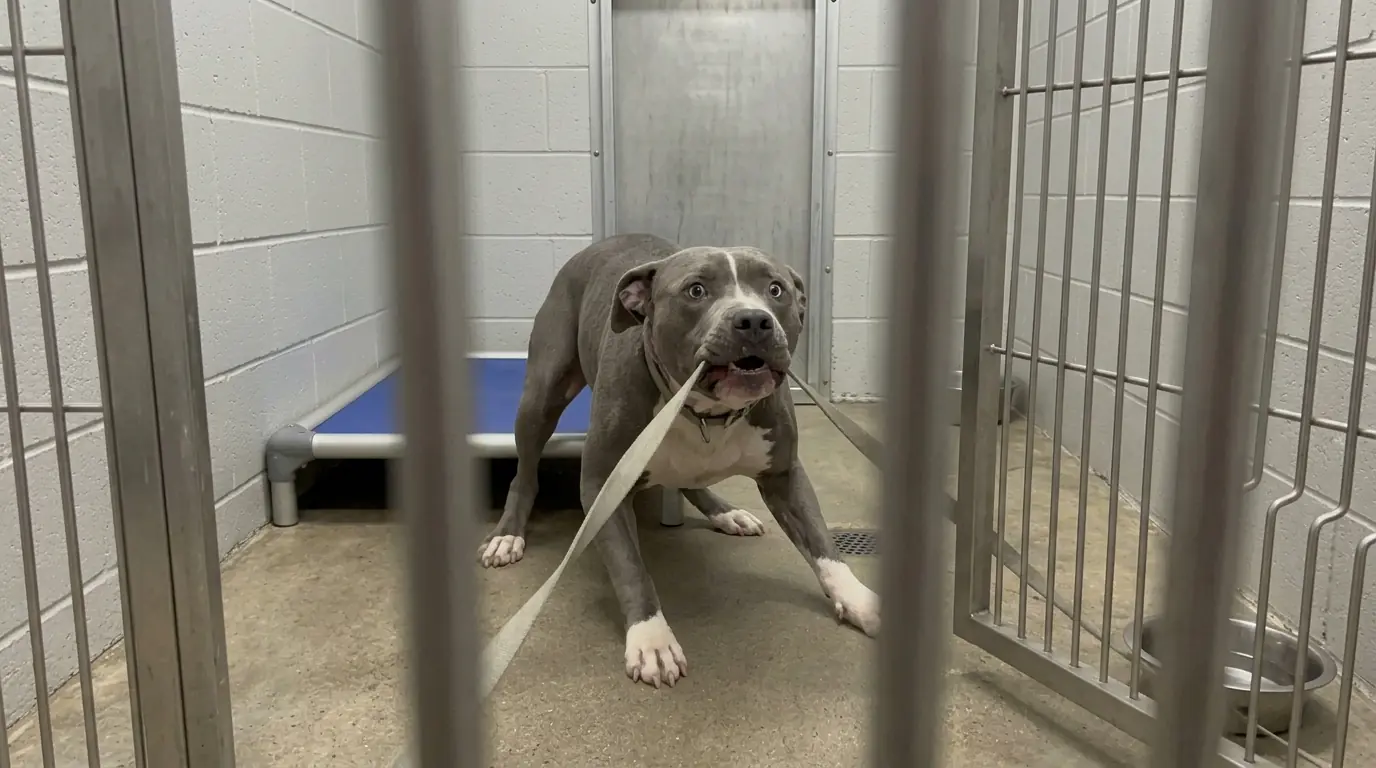
With the kennel door closed, Bruno can stand quietly.
The five-year-old American Staffordshire Terrier mix watches the hallway through the gate. He may follow footsteps with his eyes or lift his head when someone approaches, but his body remains under control.
Then the leash appears.
A staff member clips it on.
Bruno stiffens.
The kennel door begins to open.
Everything changes.
He backs away until there is nowhere left to go.
His body presses against the wall.
He barks sharply toward the opening.
Then Bruno spins his head toward the leash attached to his own collar and grabs it between his teeth.
He pulls.
Hard.
The leash goes taut.
Bruno bites again, twisting and tugging as though the thing connecting him to the doorway has suddenly become something he has to fight.
Staff stop immediately.
The door closes.
Nobody drags him through it.
And slowly, Bruno releases the leash.
The hallway has not changed.
The leash has not changed.
But something about being attached to it while that narrow doorway opens sends Bruno from stillness into a reaction intense enough that he could hurt himself.
The Old Scars Around Bruno’s Neck Make the Behavior Harder to Ignore
Bruno arrived with multiple healed scars around his neck.
They are old enough that they cannot tell the shelter exactly when or how they happened.
A scar can reveal that tissue was injured.
It cannot reconstruct the event.
That distinction matters.
It would be easy to look at Bruno’s neck, watch him panic on a leash, and build a specific story connecting the two.
The shelter does not have enough information to do that.
But the combination does give staff a reason to be especially careful about anything that places pressure around Bruno’s neck.
The Leash Alone Is Not Always the Problem
That becomes clear through observation.
When Bruno sees a leash outside the kennel, he may watch it without reacting dramatically.
A leash can sometimes be clipped on while the kennel remains closed.
Bruno becomes more alert, but he may still stay relatively still.
The biggest change comes when several things happen together.
Leash attached.
Door moving.
Narrow opening ahead.
That combination appears much harder for him.
The Doorway Seems to Change the Meaning of Everything
The latch moves.
The gate begins opening.
Bruno immediately creates distance.
One step backward.
Then another.
His rear end reaches the wall.
He cannot retreat farther.
That is when the barking intensifies.
Then he turns toward the leash.
Biting the Leash Does Not Necessarily Mean Bruno Is Trying to Attack Anything
Leash biting can occur for different reasons.
Dogs may grab a leash during excitement, frustration, play, conflict, or distress.
Bruno’s behavior has to be understood in its full context.
His body is already retreating.
His escape space has disappeared.
His barking has intensified.
Then he grabs the object physically preventing completely free movement.
That pattern makes the behavior important to treat as a distress and safety issue rather than simply labeling Bruno “bad on leash.”
He Can Pull Hard Enough to Put Himself at Risk
Bruno is a powerful dog.
Once the leash is between his teeth, his entire body can become involved.
He braces.
Pulls backward.
Twists his head.
Repositions his bite.