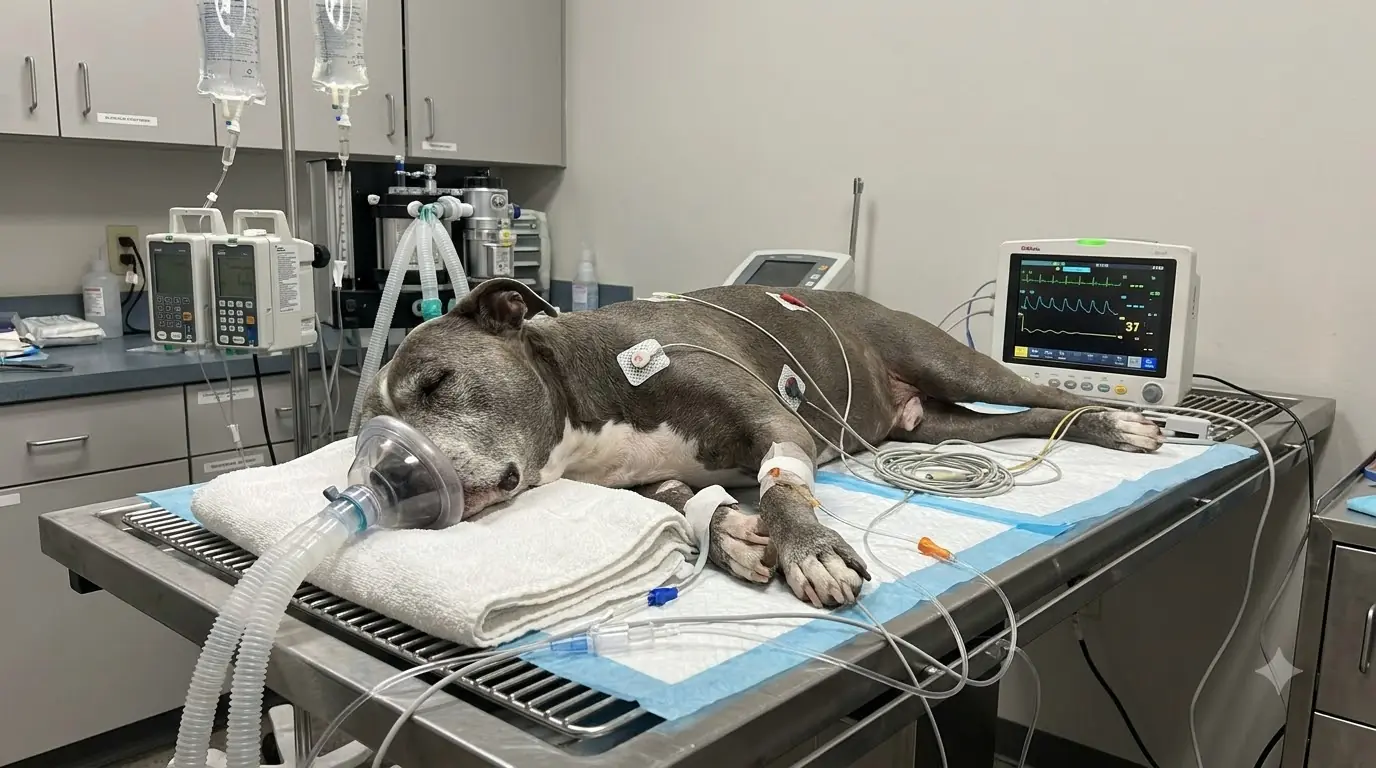
At first, Bruno was just walking in circles.
The 10-year-old American Pit Bull Terrier would slowly move around his kennel, sometimes completing several loops before stopping.
Then he would stand in one corner.
And stare.
Shelter staff noticed the behavior, but Bruno was a senior dog in an unfamiliar environment. One strange afternoon did not explain what was happening.
So they watched him more closely.
Then one morning, a worker found Bruno standing completely still.
His forehead was pressed firmly against the kennel wall.
Not his chin.
Not the side of his face.
His forehead.
Bruno wasn't sleeping.
He wasn't rubbing his face against the surface.
He simply stood there with his head pushed forward into the wall.
When the worker called his name, Bruno barely responded.
Then his body swayed.
That was the moment the behavior stopped looking merely unusual.
Something could be seriously wrong.
The Circling Had Started First
Before the head pressing appeared, Bruno's movements had already begun changing.
He would walk around the kennel.
Circle.
Pause.
Then begin again.
At other times, he stopped near a corner and stared into it for longer than staff expected.
There can be many reasons a dog moves repetitively in a shelter.
Stress can influence behavior.
Pain can alter movement.
Older dogs may experience changes in cognition or sensory function.
But abnormal neurological behavior can also appear as changes in orientation, awareness, balance, or movement patterns.
Staff could not tell which explanation applied simply by watching Bruno circle.
The behavior was a clue.
Not a diagnosis.
Then the Pattern Escalated
Bruno wasn't merely staring at the wall anymore.
He was pressing into it.
His head remained forward while the rest of his body stood behind him.
Sometimes his stance looked slightly unstable.
His weight shifted.
His body swayed.
A caregiver called him.
“Bruno.”
Normally, his name would at least produce some acknowledgment.
During these episodes, his response could be noticeably diminished.
That combination was much harder to dismiss.
Head Pressing Is Different From Resting Against Something
Dogs sometimes sleep with their heads against walls, furniture, kennel panels, or bedding.
That alone is not what concerned Bruno's caregivers.
The context mattered.
Bruno was awake.
He was standing.
His forehead was deliberately and persistently pushed against the wall.
And the behavior appeared alongside circling, staring, swaying, and periods of reduced responsiveness.
Those additional signs changed the picture.
Staff weren't looking at a dog who had chosen an unusual sleeping position.
They were looking at a senior dog showing a cluster of abnormal behaviors.
Nobody Tried to Pull His Head Away Repeatedly
The first instinct might be to redirect him.
Call his name louder.
Move him.