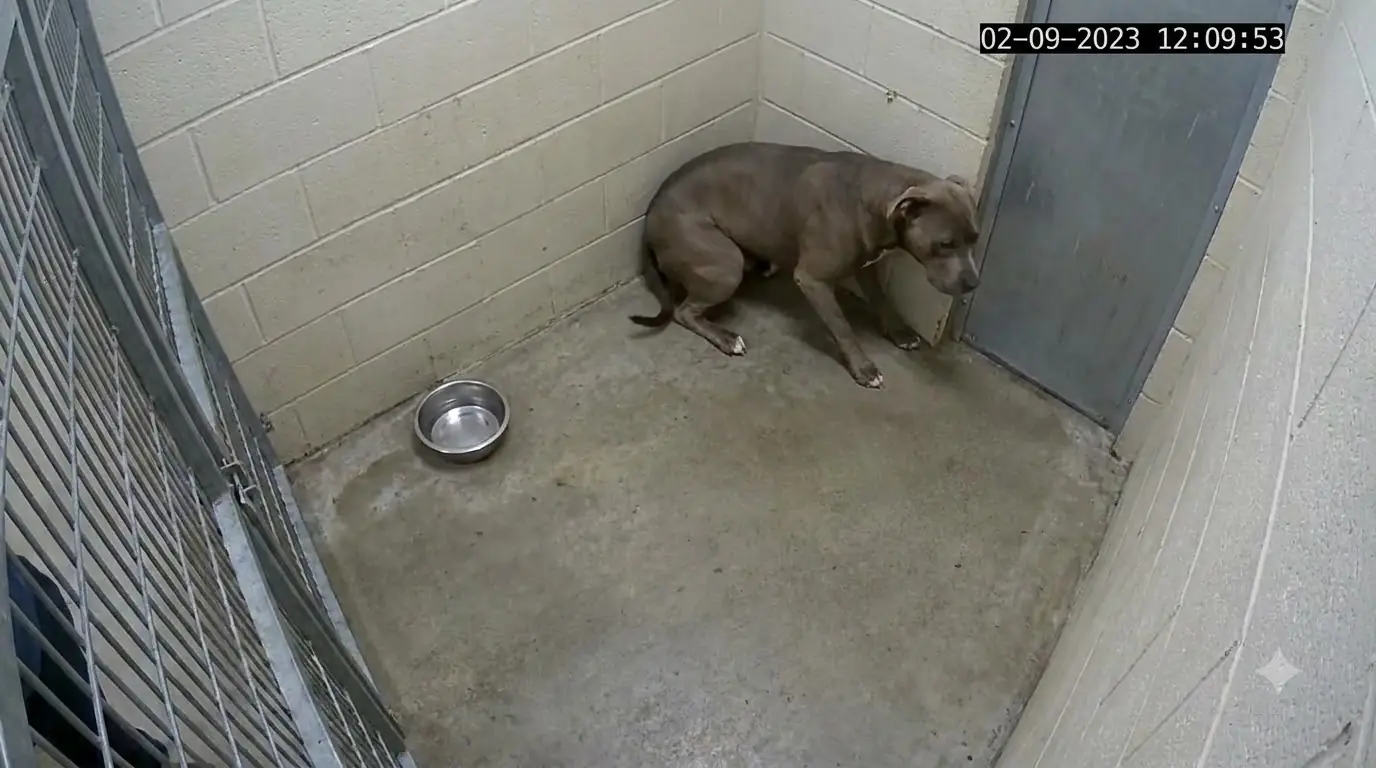
Bruno had been inside the shelter for only a short time when staff realized he was spending almost every hour in the same place.
The corner.
The 6-year-old American Pit Bull Terrier pressed himself tightly against the kennel wall, making his body as compact as he could.
And he shook.
Not an occasional tremble.
Bruno's entire body quivered hard enough that when one of his paws touched the stainless-steel bowl beside him, the bowl rattled against the floor.
People walked through the hallway.
Bruno stayed in the corner.
Someone spoke softly to him.
He looked away.
Then one shelter worker tried something different.
They opened the kennel door, stepped inside and stopped several feet away.
No reaching.
No leash.
No attempt to pull Bruno out of the corner.
The worker simply sat down on the floor.
For several minutes, nothing happened.
Bruno kept shaking.
Then he lowered his body even closer to the ground.
One paw moved forward.
Then another.
Slowly, Bruno began crawling toward the person.
Staff Had Already Learned That Approaching Him Didn't Help
Bruno's reaction to the shelter environment had been obvious from intake.
His posture stayed low and tight.
His muscles remained tense.
He avoided sustained eye contact.
When someone came too close, he tried to make himself smaller rather than moving forward to investigate.
Staff did not know enough about Bruno's life before intake to explain exactly why.
There was no reason to invent a history of abuse or claim that a specific person had frightened him.
The shelter could only work with what Bruno was showing them now.
And right now, he was overwhelmed.
Even the Food Bowl Showed How Hard He Was Trembling
Bruno's stainless-steel bowl had been placed near him so he would not have to cross the kennel unnecessarily.
Sometimes his rear paw or foreleg touched its edge.
The vibration traveled into the metal.
A faint rattling followed.
That small sound made the severity of the trembling impossible to miss.
Staff needed to consider Bruno's physical condition too.
Shaking can have multiple causes, including fear and stress, but also pain, illness and other medical problems.
So the behavior could not simply be labeled anxiety without making sure his health was being appropriately evaluated.
But his body language around people also gave caregivers useful information about how to interact with him.
Forcing contact was unlikely to help.
One Worker Entered Without Asking Bruno for Anything
The kennel door opened.
Bruno noticed immediately.
His body pressed harder toward the corner.
The worker stepped inside.
Then stopped.
Instead of walking directly toward Bruno, the person sat on the floor several feet away.
They did not reach out.
They did not pat the floor repeatedly.
They did not stare at him.
They simply stayed.
Bruno continued shaking.
A minute passed.
Then another.
Nothing dramatic happened.
And that was exactly the point.
Bruno Was Allowed to Make the Next Move
For several minutes, he remained where he was.
His eyes occasionally moved toward the person.
Then away.
His ears shifted with sounds from the hallway.
The trembling continued through his shoulders and legs.
The worker stayed seated.
Eventually, Bruno changed position.
His chest lowered toward the floor.
At first it looked as though he might simply lie down.
Instead, one front paw stretched forward.
Bruno stopped.
Waited.
Then moved the other.
His belly remained low.
He crawled only a few inches.
Then froze again.
Nobody Reached for Him
That detail mattered.
Bruno had moved closer, but moving closer was not automatically permission to touch him.
So the worker remained still.
Bruno watched.
Another few inches.
Pause.
Another movement.
His body continued trembling the entire time.
This was not a dog who had suddenly become relaxed.
He was still visibly struggling.
He was simply choosing to reduce the distance.
Then Bruno Reached the Worker's Legs
He stopped just short of them.
For several seconds, his nose remained low.
The person did not lean over him.
Bruno shifted forward.
His chin rose slightly.
Then, with the rest of his body still trembling, he placed his chin on the worker's knee.
Nothing else happened.
No dramatic embrace.
Nobody wrapped their arms around him.
Nobody tried to lift him.
Bruno simply stayed there.
His chin on a person's knee.
His body still shaking.
The Trembling Didn't Instantly Stop
That was important.
It would have made a cleaner story if Bruno had suddenly relaxed the moment he reached someone.
That isn't what happened.
His muscles continued to quiver.
His legs still trembled.
He remained low to the ground.
Whatever was making Bruno feel unsafe had not disappeared because of one interaction.
But something had changed.
Earlier, Bruno had been trying to keep as much distance as possible.
Now he was the one maintaining contact.
Staff Didn't Treat the Moment as Proof That Bruno Was “Fixed”
One positive interaction does not erase severe fear.
A dog can approach someone today and retreat tomorrow.
Shelter noise can change.
Different people can produce different responses.
A medical issue can also affect behavior and tolerance.
So caregivers did not immediately decide that Bruno was ready for everyone to enter his kennel and pet him.
Instead, they paid attention to what had worked.
Distance.
Low pressure.
Time.
Choice.
The Next Interaction Started the Same Way
Someone entered quietly.
Bruno was back in his corner.
He was shaking again.
The caregiver sat down.
No immediate approach followed.
Bruno watched from the side without turning his whole head.
Several minutes passed.
Then he shifted.
This time, the first movement came a little sooner.
He crawled forward.
Stopped.
Then continued.
He did not immediately place his chin on the person's knee.
He simply settled several feet closer than where he had started.
Staff accepted that too.
Bruno did not have to repeat yesterday's behavior for today's interaction to count.
His Kennel Routine Became More Predictable
Caregivers tried to reduce unnecessary surprises.
Meals arrived consistently.
Cleaning and handling were done as calmly as practical.
People approaching Bruno paid attention to his body language rather than assuming he wanted contact.
His resting space remained available.
Nobody repeatedly pulled him from the corner simply because they wanted him somewhere more visible.
The shelter could not eliminate every bark, door or unfamiliar person.
But it could make Bruno's direct interactions more predictable.
Staff Also Watched for Physical Reasons Behind the Shaking
Bruno's fear-like posture was striking, but caregivers could not ignore medical possibilities.
Was he painful?
Was there an underlying illness?
Was the trembling present even during deep rest?
Did it worsen only when people approached?
Was he eating and drinking?
Could he walk normally when he chose to move?
Those observations helped separate what could be seen from what people merely assumed.
Bruno deserved both behavioral patience and appropriate medical attention.
The Corner Remained His Default Place
For a while, little changed when the kennel area was busy.
Bruno still went back there.
His body pressed near the wall.
A person walking past could make him tense.
Sudden shelter noise could bring the trembling back more strongly.
But caregivers began seeing something new.
Bruno was watching familiar people.
Not always approaching.
Just watching.
When one of the workers who regularly sat with him entered the hallway, Bruno sometimes lifted his head.
That was different from trying to disappear into the corner.
Then He Approached Without Crawling the Entire Way
One quiet afternoon, a familiar worker entered and sat down.
Bruno remained in the corner.
The person waited.
Eventually, Bruno stood.
His legs still trembled.
But instead of flattening himself completely against the floor, he took several cautious steps.
He stopped midway.
Then continued.
It was not confident walking.
His posture remained low.
But he had crossed the kennel on his feet.
When he reached the worker, Bruno stood beside them briefly.
Then lowered himself to the floor.
His shoulder rested near the person's leg.
Nobody asked for more.
Progress Was Measured in Inches
For Bruno, improvement was not suddenly wagging his tail at every visitor.
It was a body that became slightly less compressed.
A shorter delay before approaching.
Eating with someone farther down the kennel.
Watching a familiar caregiver instead of immediately turning away.
Walking a few steps instead of crawling.
Choosing to stay near someone for another minute.
Those changes could easily look insignificant from outside the shelter.
Inside Bruno's kennel, they mattered.
Some Days He Still Shook Just as Hard
Progress was not linear.
A loud day could send Bruno back toward the corner.
An unfamiliar person might make him unwilling to approach at all.
Sometimes a caregiver who had sat with him before entered and Bruno still kept his distance.
Nobody punished that.
Nobody tried to prove he remembered them.
Fear does not disappear according to a schedule.
The shelter's job was to keep giving Bruno experiences that did not require him to defend his space or endure more interaction than he could handle.
The Person on the Floor Became Part of a New Pattern
At first, someone sitting inside the kennel had been unusual.
Eventually, it became familiar.
A person entered.
Sat down.
Waited.
Bruno decided what happened next.
Sometimes he approached.
Sometimes he didn't.
When he did, caregivers allowed him to sniff and remain nearby without immediately turning the interaction into petting or restraint.
That distinction gave Bruno something valuable inside an environment where much of his daily routine was outside his control.
A choice.
One Evening, the Bowl Stayed Quiet
A worker sat several feet away.
Bruno was near the wall.
His leg touched the stainless-steel bowl.
But this time, there was no constant metallic rattling.
He was still tense.
Still cautious.
Yet the trembling was lighter.
Bruno looked toward the person.
He lowered his head.
Then walked forward.
Slowly.
He stopped beside the worker's knees.
For a moment, he remained standing.
Then he lay down.
His chin came to rest on the same familiar place.
The worker's knee.
Bruno Is Still Not a Dog Who Should Be Rushed
A quieter evening does not erase what staff saw during his first days.
Bruno's comfort still has to guide interactions.
His behavior still needs to be monitored.
Any medical concerns still need appropriate attention.
And unfamiliar situations may remain difficult for him.
The goal is not to force Bruno to tolerate everything happening around him.
It is to help him develop safer, more manageable ways to respond while giving him enough predictable experiences to build confidence.
Staff No Longer Measure Success by Whether Bruno Comes All the Way Over
Sometimes the kennel door opens.
A caregiver sits.
Bruno stays on his bed.
But he doesn't retreat into the corner.
That can be enough.
Another time, he may cross halfway and lie down.
Enough again.
If he eventually approaches, that is his decision.
The interaction does not have to end with physical contact to have value.
For Bruno, simply discovering that a person can enter his space and ask nothing from him may be part of what makes the next approach possible.
The First Moment Still Says the Most
Bruno was pressed into the corner.
His entire body was shaking.
The metal bowl beside his paw rattled against the floor.
A shelter worker entered.
Bruno expected something—or perhaps he simply did not know what would happen.
The person didn't come closer.
They sat down several feet away.
Minutes passed.
Bruno kept trembling.
Then one paw moved.
His body lowered.
He crawled forward.
Stopped.
Crawled again.
Until finally there was no empty floor left between them.
Bruno lifted his head.
And placed his chin on the worker's knee.
His body was still shaking.
That is the detail staff remember.
Because Bruno did not have to stop being afraid before he moved closer.
Nobody pulled him from the corner.
Nobody forced him into someone's arms.
Someone simply made themselves smaller, stayed still and gave him the choice.
And eventually, Bruno chose to cross those few feet himself.