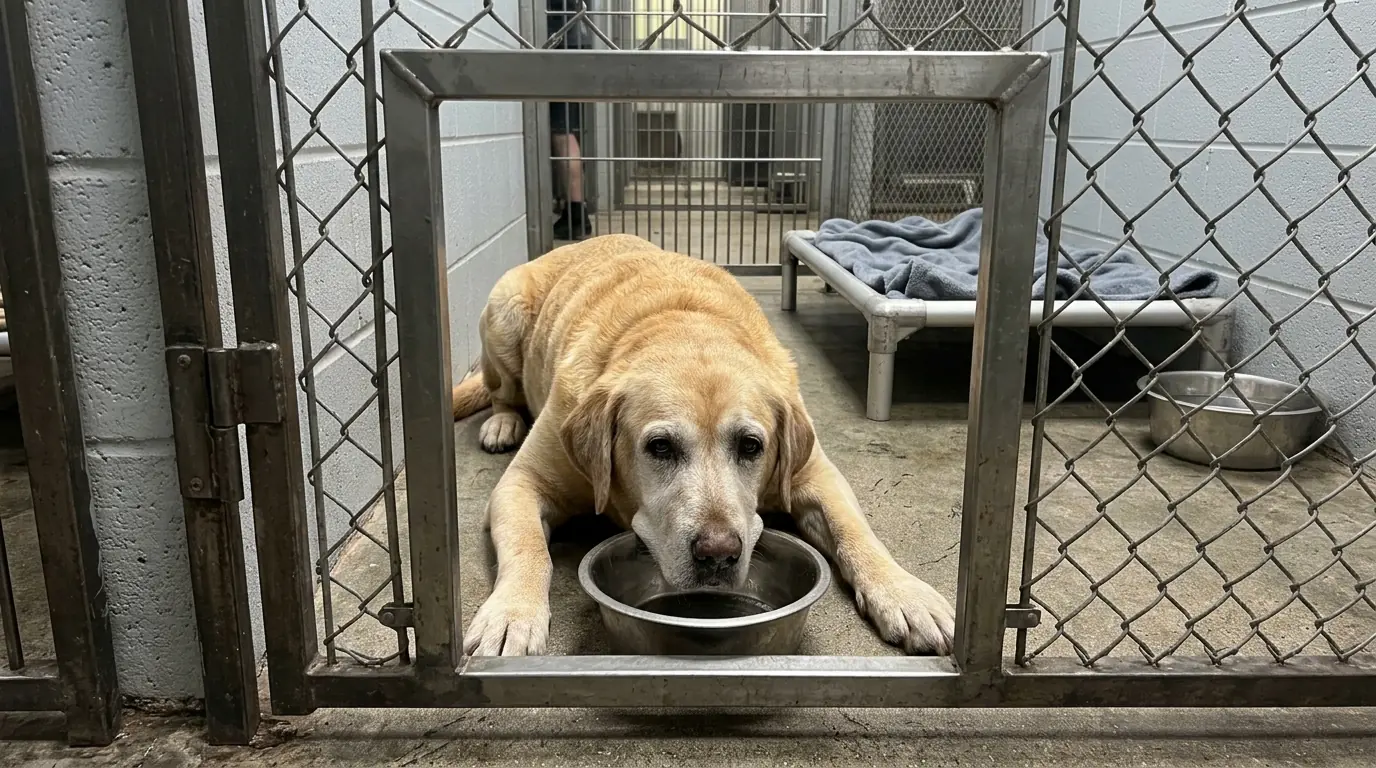
Buddy is a 10-year-old senior Labrador Retriever who has already spent months inside a municipal shelter.
During that time, no adoption or rescue placement has been secured.
Now his remaining placement window is short.
Buddy is approaching a euthanasia deadline.
The exact date and time have not been provided, so they should be confirmed directly with the shelter.
But while that deadline gets closer, staff have another reason to pay attention to Buddy.
He is eating less.
And after every meal, he has developed a quiet routine with his empty stainless-steel bowl.
Buddy picks it up.
He carries it to the kennel door.
He carefully lowers it between his front paws.
Then he lies down directly behind the bars and rests his head on the rim.
That is where he stays.
Buddy Still Carries the Bowl Even When He Barely Eats
The change in Buddy's appetite is important.
He has started eating less and less.
No medical reason for the decline was provided.
But even after a small meal, Buddy continues the same routine.
When he finishes, he lowers his muzzle toward the stainless-steel bowl.
His teeth close around its edge.
Then the senior Labrador lifts it from the floor.
He turns toward the front of the kennel.
Buddy carries the empty bowl with him.
The destination is almost always the same.
The kennel door.
He Places It Between His Paws
Buddy does not simply drop the bowl somewhere near the gate.
He carries it all the way to the front.
Then he lowers it onto the floor.
The empty bowl ends up between his two front paws.
Buddy lowers his body beside it.
Then his head comes down.
Instead of using a bed or resting his muzzle directly on the floor, Buddy places his head against the edge of the stainless-steel bowl.
His eyes may close.
The bowl remains underneath his muzzle.
Buddy remains beside the kennel door.
Meal after meal, the same object ends up in the same place.
It Is an Unusual Routine With No Confirmed Explanation
Why does Buddy carry his empty bowl to the door?
There is no verified answer.
It would be tempting to say he is bringing it to people because he wants someone to notice him.
It would be equally tempting to describe the bowl as his way of asking for another meal or trying to communicate that he is still waiting.
None of those interpretations can be established from the behavior alone.
Dogs move bowls for many reasons.
Objects can become part of routines.
Kennel environments can also produce behaviors that are difficult to interpret from a human perspective.
What matters is what Buddy actually does.
He eats very little.
He picks up the empty bowl.
He carries it to the gate.
He places it between his paws.
Then he lies down with his head resting against it.
His Declining Appetite Needs Attention
The bowl may be the detail people remember.
Buddy eating less may be the more important medical detail.
A significant appetite change in a senior dog should not automatically be dismissed as sadness, age, or shelter stress.
Stress can affect appetite.
But so can dental problems, pain, gastrointestinal illness, kidney or liver disease, infection, medication effects, cancer, and many other conditions.
None of those diagnoses have been provided for Buddy.