Then he turned around and stood at the kennel door.
He remained there through most of the afternoon.
When staff offered food, Buddy smelled it but did not eat. The meal had been softened exactly as his owner described, yet Buddy pushed his nose past the dish and looked down the hallway.
At closing time, the building became quieter.
Buddy began pacing.
He walked from the kennel door to the blanket, turned in a slow circle and returned to the door. His stiff hind legs occasionally slipped, but he continued moving.
A small lamp was left on for him.
Just as the handwritten note had promised, the light helped.
Buddy finally lowered himself onto the blanket shortly after midnight. He did not curl into the center of it. He lay near the front of the kennel with his nose pointing into the hallway.
The next morning, he was still in the same position.
A caregiver opened the kennel and attached his leash for a bathroom break.
Buddy immediately walked toward the lobby.
He ignored the nearest exit to the shelter yard and pulled toward the intake room instead. His pace was slow, but his direction was certain.
When he reached the closed door, he stopped and waited.
The caregiver allowed him to stand there for a moment before gently leading him outside.
Buddy completed a short walk but showed little interest in the grass, smells or other dogs. As soon as he returned indoors, he headed toward the lobby again.
For the next three days, the same behavior continued.
Buddy waited at doors.
He raised his head whenever an older man spoke in the hallway. If keys jingled near the lobby, he struggled to his feet.
At mealtimes, he ate only a few bites unless someone sat beside him. Even then, he frequently stopped and stared toward the sound of opening doors.
The shelter contacted Buddy’s owner through a family member.
The man had reached the nursing facility safely but was struggling with the separation as well. He asked repeatedly whether Buddy had eaten and whether he was sleeping on his blanket.
Staff reassured him that Buddy was receiving care, but they did not hide the fact that the dog was grieving.
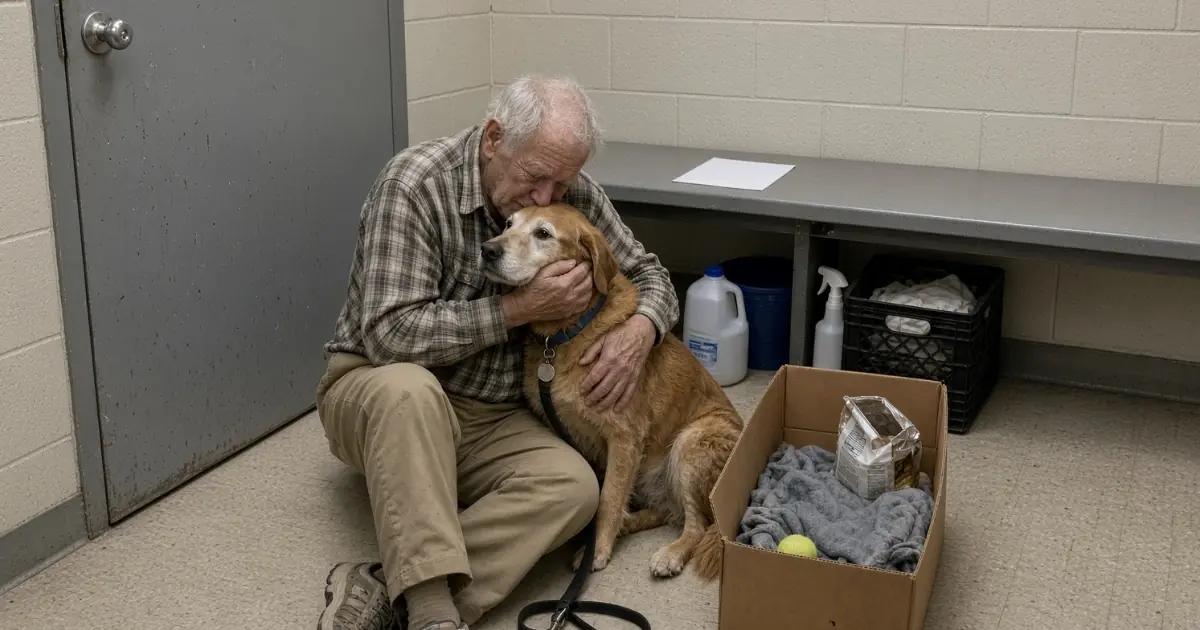
A return home was not possible.
The man’s condition required continuous care, and the facility would not make an exception to its pet policy.
The shelter began searching for a foster home experienced with senior dogs.
A traditional kennel environment placed additional stress on Buddy’s heart and joints. He needed somewhere quiet, with few stairs and someone home often enough to help him adjust.
Until such a home became available, staff tried to make the medical ward feel predictable.
Buddy was fed at the same times he had eaten at home. His blanket was never removed except for washing, and the small lamp remained on at night.
The same two caregivers handled most of his walks.
Slowly, Buddy began responding.
On his fourth morning, he ate half of his breakfast while a caregiver sat inside the kennel. After finishing, he rested his chin against her shoe.
Later that day, he walked past the intake-room door without stopping.
He took three more steps before looking back.