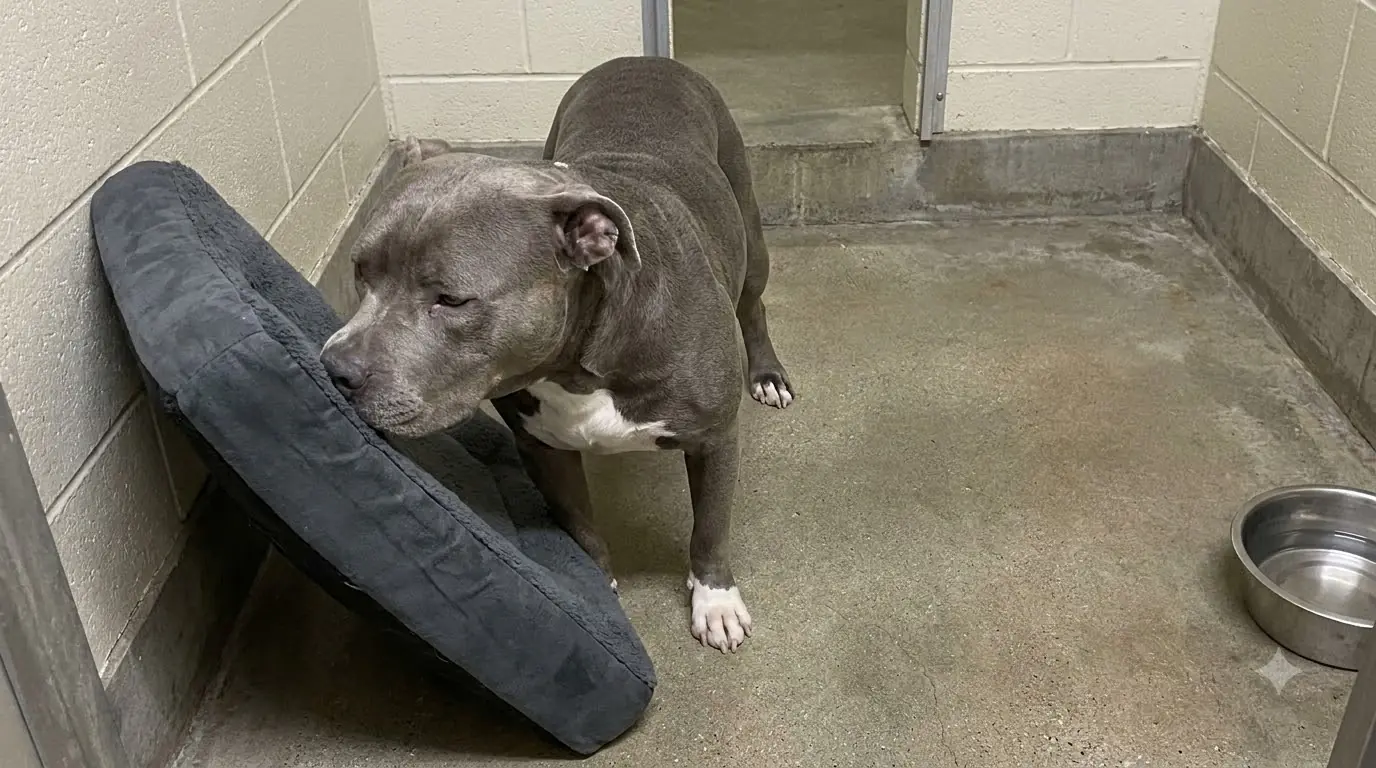
Every evening, shelter staff prepare the same thing for Buster.
A thick orthopedic bed is placed inside his kennel.
For a 9-year-old American Pit Bull Terrier with severe arthritis in both hips, the reason is obvious. A supportive surface can make resting easier on an aging, painful body than spending hours on hard concrete.
But Buster rarely leaves the bed where staff put it.
Once the kennel grows quiet, he lowers his nose to its edge.
Push.
The bed slides several inches.
Buster adjusts his position and pushes again.
Little by little, he moves the entire thing toward the wall.
Then he turns around.
And lies down on the empty patch of concrete he just created.
By morning, staff find the same scene.
The expensive orthopedic bed is pressed against the wall.
Buster is curled tightly on the bare floor beside it.
So they pull the bed back.
The next morning, Buster has moved it again.
At First, Staff Thought the Bed Might Be Uncomfortable
That possibility had to be considered.
A dog refusing a particular resting surface does not automatically have an emotional explanation.
Maybe Buster disliked its texture.
Maybe stepping onto it was difficult because of his hips.
Maybe the height or softness made him feel unstable.
So staff watched how he interacted with it.
Buster was physically capable of getting onto the bed.
He would sometimes step across it.
He could stand beside it without appearing frightened.
But when it was time to settle for a long period, he consistently preferred the floor.
The pattern became especially clear overnight.
Bed against wall.
Buster on concrete.
Again.
And again.
Buster Had Spent Years Sleeping Differently
Before entering the shelter, Buster had lived for years in a cramped home.
He had been surrendered rather than arriving as an unknown stray, so staff had at least some background about the environment he came from.
One detail stood out.
Buster had spent much of his life sleeping on hard flooring.
That did not prove why he rejected the orthopedic bed now.
Dogs cannot explain their preferences, and staff were careful not to turn a repeated behavior into a story they could not verify.
But it did provide context.
The shelter had given Buster something objectively softer.
Buster kept choosing something familiar.
The Problem Was That His Hips Needed More Support Now
At nine years old, Buster's body was no longer able to tolerate everything it once had.
Both hips were severely arthritic.
Arthritis can make ordinary movements—standing, lowering the body, turning around, getting up after rest—painful and stiff.
Long periods on a hard surface can also put pressure on elbows, hips and other prominent areas of the body.
Buster's sleeping preference therefore created an unusual challenge.
Staff wanted to respect where he felt comfortable settling.
But they also wanted to protect the body that had to get back up from that floor the next morning.
And getting up was becoming increasingly difficult.
The Morning Told Them More Than the Night Did
When Buster first lay down on the concrete, he could appear comfortable.
He curled his legs underneath himself.
His breathing slowed.
Eventually he slept.
The consequences became more noticeable after hours of rest.
In the morning, Buster did not simply spring to his feet.
His front half usually rose first.
Then came the harder part.
He shifted his weight forward while trying to bring his hind legs underneath him.
His hips remained low.
Sometimes he paused.
Then he pushed again.
Once standing, his first steps could be stiff and careful before his body loosened enough to move more comfortably.
That was why staff kept returning the bed.
They weren't trying to win an argument with Buster.
They were trying to make resting easier on the body he had now.
But Moving the Bed Back Wasn't Working
Every night produced the same result.
Eventually, staff stopped treating the situation as though Buster simply needed to learn where he was supposed to sleep.
The question changed.
Instead of:
How do we make Buster use this bed?
It became:
How do we make the place Buster chooses safer for his hips?
That distinction changed his kennel setup.
They Started Experimenting With the Surface, Not With Buster
Rather than repeatedly placing one large orthopedic bed in the center of the kennel and expecting Buster to adapt, caregivers began paying attention to exactly where he preferred to settle.
Buster liked a particular open area of floor.
He liked being able to turn around there.
He seemed comfortable lowering himself without stepping over a thick raised edge.
So the solution had to work around those preferences.
A lower-profile padded surface could provide cushioning without feeling like the bulky bed Buster kept moving.
Blankets could be arranged so he still had room to position himself the way he wanted.
The goal was not to trap him on something soft.
He still needed choices.
But bare concrete did not have to be the only alternative to a thick bed.
Buster Immediately Noticed the Difference
He investigated the changed area.
He sniffed.
Walked across it.
Turned.
Then left.
That first night, staff did not expect anything dramatic.
And they were right.
Buster still pushed the orthopedic bed.
He worked it toward the wall exactly as he had before.
Then he went to his usual sleeping spot.
But this time, the surface beneath him was not completely bare.
Buster circled.
Lowered himself.
And stayed.
By morning, he was still there.
The orthopedic bed was still against the wall.
But for once, Buster was not sleeping directly on cold concrete.
That Didn't Mean He Suddenly Loved Bedding
On another night, Buster managed to bunch part of the softer material aside.
He created a small exposed patch and placed part of his body on it.
The behavior could have been frustrating.
Instead, staff treated it as useful information.
Buster was showing them what he preferred.
They continued adjusting.
A senior dog's environment does not have to look perfectly arranged in order to work.
If the bed ended up crooked but Buster rested comfortably, that was more important than having a neat kennel.
If he wanted one surface for part of the night and another later, he could have both.
His Arthritis Was Managed Beyond the Bed
Buster's sleeping surface was only one part of his care.
Severe arthritis requires attention to the dog's overall comfort and mobility.
Veterinary guidance could determine appropriate pain management and other supportive measures.
His body condition mattered because excess strain can make already painful joints work harder.
Movement needed to be appropriate to what Buster could comfortably tolerate.
Staff also watched practical things.
How difficult was it for him to stand?
Did he hesitate before sitting or lying down?
Did his gait change after resting?
Was he slipping?
Could he reach food and water without unnecessary effort?
Was he able to reposition himself comfortably overnight?
Those observations mattered more than whether Buster slept in the bed humans had chosen for him.
Then Something Unexpected Happened
One morning, a caregiver entered and stopped.
The orthopedic bed had not been pushed completely against the wall.
It had moved only slightly.
And Buster was lying partly on it.
His front half rested on the mattress.
His hindquarters were closer to the edge.
It was not the position staff had imagined when they first gave him the bed.
But Buster was using it.
Nobody repositioned him.
Nobody tried to move his back legs farther onto the mattress.
They let him sleep.
It Happened Again Days Later
This time Buster stepped onto the bed in the evening.
He turned slowly.
His hind legs adjusted beneath him.
Then he lowered himself.
For a while, his entire body remained on the orthopedic surface.
Later in the night, he moved back to his preferred area.
By morning, he was no longer on the bed.
That did not erase what had happened.
Buster had chosen it himself.
For staff, that was more useful than physically placing him there and hoping he stayed.
Familiar Does Not Always Mean Best for an Aging Body
Buster's behavior raised a problem common in senior animal care.
An older dog may have routines developed over years.
Then the body changes.
Joints become painful.
Muscle strength decreases.
Balance changes.
A position or surface the dog has used for years may no longer provide the support the aging body needs.
Humans can understand why a different option might help.
Buster only knows what feels acceptable enough to settle on.
So his caregivers have to work between those two realities.
Protect the body.
Respect the dog.
Nobody Knows Exactly What Buster Associates With the Floor
Staff do not claim he lies there because he misses his previous home.
They do not say the orthopedic bed frightens him.
They cannot know whether years of sleeping on hard surfaces created a preference, a habit, or simply one part of a larger routine.
They know only what they can see.
Buster arrived with severe arthritis.
He was offered a thick bed.
Night after night, he pushed it away.
And when given more choices instead of repeated correction, he gradually began experimenting with softer places on his own terms.
That is enough.
The Biggest Change Is Visible When Buster Wakes Up
Some mornings are still difficult.
He is an arthritic 9-year-old dog, and better bedding cannot make damaged joints young again.
But staff watch closely for mornings when his body seems less stiff after a more supported night.
They also notice when he chooses a padded area without first moving everything away.
Those are small changes.
There is no miracle in them.
Buster still needs ongoing management for his hips.
He may always have preferences that seem strange to the people caring for him.
The shelter does not need to erase those preferences.
It needs to make them safer.
Buster Still Moves His Bed
Night settles over the kennel area.
Buster looks at the orthopedic mattress.
He walks toward it slowly, his arthritic hips making each turn deliberate.
Then his nose touches the edge.
Push.
The mattress slides.
Buster pushes again.
Eventually, he has opened the familiar space beside it.
But now that space is different.
There is cushioning where there used to be only concrete.
Buster circles slowly.
Then lowers himself.
Some nights he lies beside the orthopedic bed.
Some nights part of him ends up on it.
And every once in a while, the bed barely moves at all.
Staff used to come in each morning, pull the mattress back into place and try again.
Now they understand that helping Buster was never about teaching him where he was supposed to sleep.
After years of choosing the hard floor, his body needs something softer.
So instead of forcing Buster onto the bed, they are slowly bringing comfort to the place he already chooses.