Rescuers Found Her Lying on Her Side Because Standing Was Almost Too Much
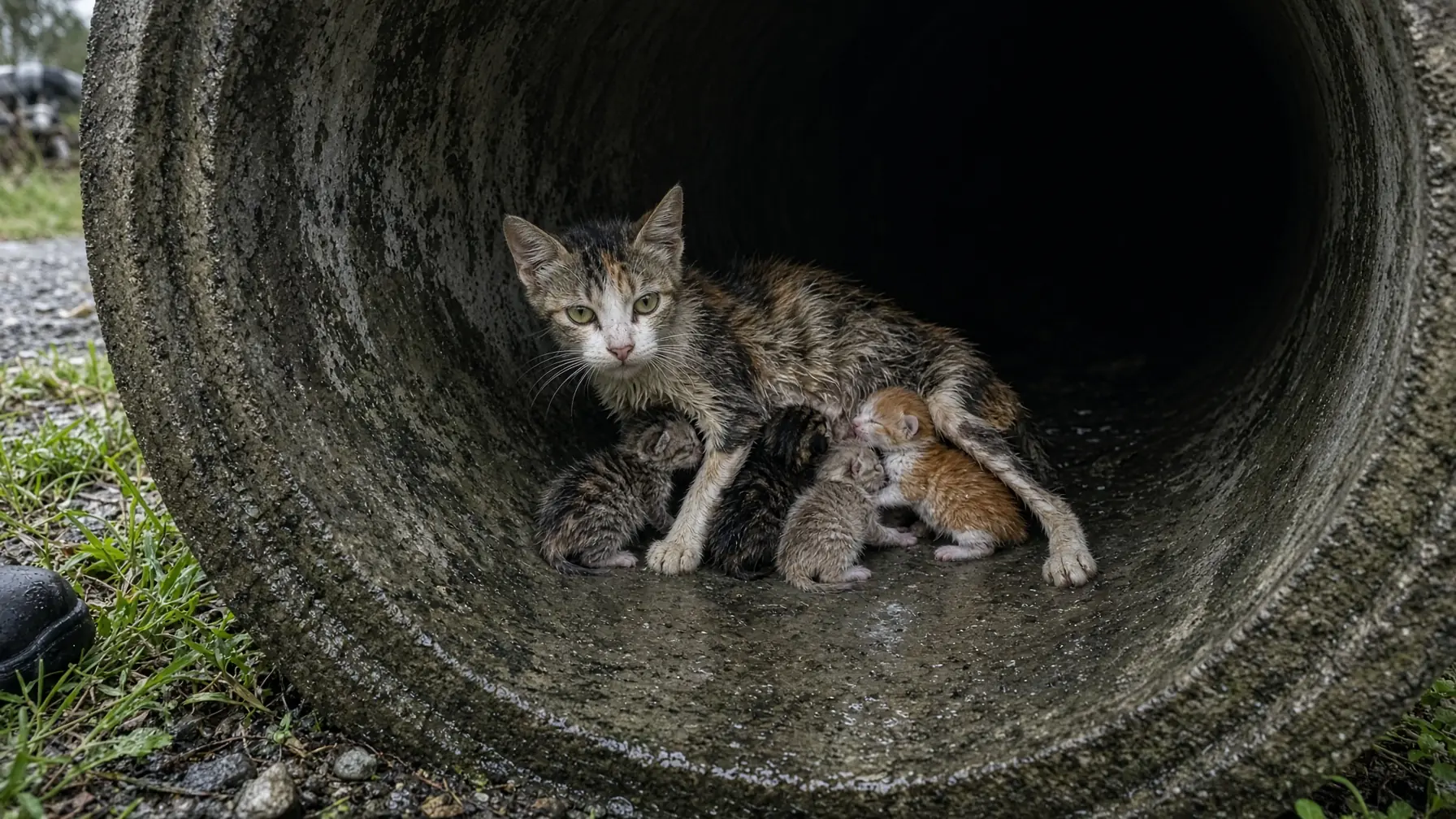
Maisie was found inside a roadside drainage pipe with four nursing kittens pressed tightly against her.
She was an adult calico cat, painfully thin beneath a coat that was wet, dirty, and stuck close to her body.
One hind leg was barely being used.
When rescuers first shined a light into the drainage opening, Maisie did not immediately retreat farther inside.
She was lying on her side on the cold concrete.
The kittens were nursing.
For several moments, she simply watched the people outside while her body remained curved around them.
Then she tried to stand.
She pushed herself upright, kept most of her weight off one hind leg, managed only a few seconds, and lowered herself again.
That was when the situation became more urgent.
This was not simply a mother cat hiding a litter in a drainage pipe.
Maisie was physically depleted enough that even standing had become difficult.
And she was still producing milk for four kittens.
We Could See Her Condition, but We Could Not Reconstruct Her History
The circumstances suggested that Maisie and the kittens had been left in or near the drainage area.
However, we did not have reliable information showing exactly how they arrived there.
We could not verify how long Maisie had been living outdoors.
We did not know when her hind leg had been injured.
We could not say how consistently she had been able to find food or water.
Responsible rescue work requires separating what is emotionally tempting to assume from what can actually be documented.
What rescuers could document was serious enough.
Maisie was emaciated.
Her fur was saturated.
She was reluctant to bear weight through one rear limb.
Her kittens were still dependent on her.
And despite her own weakness, she remained lying in a position that allowed all four kittens to nurse.
Getting Five Cats Out of a Drain Required Patience
The drainage pipe was too narrow for someone to simply climb inside.
The team first needed to determine how far back the kittens were and whether there were any additional openings.
Flashlights were used from both sides of the drainage system.
Only one accessible section contained the family.
Maisie stayed near the kittens.
Food was placed close enough for her to smell but far enough outside that she would need to move toward the opening.
She lifted her head.
She sniffed.
But she did not immediately leave the kittens.
Nobody reached in and dragged her out.
A frightened, injured mother cat in a confined space can panic quickly, and forcing the situation could have driven her deeper into the pipe or caused her to injure herself further.
Instead, the rescuers worked slowly.
A humane carrier was positioned near the opening.
A towel was prepared.
The team reduced noise and movement.
After several minutes, Maisie shifted forward.
She stood briefly.
Her injured hind leg barely touched the floor.
She took two uneven steps.
Then she lowered herself again.
The kittens immediately moved toward her belly.
The scene made something clear.
If Maisie would not leave easily, the kittens would need to be brought out first.
The Kittens Were Removed One at a Time
The smallest kitten was closest to the opening.
A rescuer reached in carefully and brought it forward.
Maisie reacted immediately.
She lifted her head and tried to rise.
Her hind leg folded beneath her.
She steadied herself with the other three legs and moved closer.
The kitten was placed into a warmed carrier lined with towels.
Maisie sniffed toward it.
The next kitten was removed.
Then the third.
Then the fourth.
Each time, Maisie watched.
She attempted to reposition herself after nearly every movement, despite obvious weakness.
Once all four kittens were together in the carrier, they began vocalizing.
Maisie responded.
She moved toward the sound.
That gave rescuers the opportunity they needed.
With a towel and careful support under her body, she was transferred into a second carrier placed directly beside the kittens.
She did not struggle aggressively.
She was simply exhausted.
The Ride to the Clinic Was Quiet
The carriers were kept close together during transport.
Maisie could hear and smell the kittens.
The kittens settled after they were warmed and contained.
Staff monitored Maisie's breathing and responsiveness.
She remained alert but subdued.
Because of the severity of her body condition and the apparent hind-limb injury, she was taken for veterinary evaluation immediately rather than being placed into a standard shelter kennel.
The first question was not whether she could continue nursing.
The first question was whether her own body was medically stable.
Her Veterinary Examination Started With Stabilization
Maisie's temperature was checked first.
Cats found wet and depleted outdoors can become dangerously cold, particularly when they are thin and have very little body fat for insulation.
She was dried carefully and warmed gradually.
Her hydration was assessed.
Her gums were pale pink but not alarmingly white.
Her heart and lungs were examined.
Her abdomen was palpated gently.
Her mammary glands were checked for excessive heat, firmness, pain, abnormal discharge, or other evidence of mastitis.
Despite nursing four kittens while severely underweight, there was no obvious severe mammary infection on the first examination.
That was reassuring.
Her body condition, however, was extremely poor.
There was very little fat covering her ribs and spine.
Muscle over her hips and hindquarters had been lost.
The injured leg needed a separate orthopedic assessment.
Pain Control Came Before a Detailed Leg Examination
Maisie did not want to put meaningful weight on one rear leg.
That could indicate several possibilities.
A fracture.
A dislocation.
A soft-tissue injury.
A bite wound.
An abscess.
A painful joint problem.
Or an older injury worsened by weakness.
The veterinary team did not assume the most dramatic explanation.
They also did not repeatedly manipulate the limb while she was painful and exhausted.
Maisie received appropriate analgesia first.
Once she was more comfortable, the leg was examined more thoroughly.
There was swelling around part of the lower limb but no large open wound.
Because she remained markedly non-weight-bearing, radiographs were warranted.
Imaging Gave Us a More Manageable Answer
X-rays showed no major displaced fracture.
There was no catastrophic break requiring emergency orthopedic surgery.
Instead, the findings were more consistent with a significant soft-tissue injury and inflammation around the joint, possibly from trauma that had occurred before she was found.
There was no way to determine exactly how the injury happened.
The plan was conservative treatment.
Pain control.
Strict activity restriction.
Supportive care.
Close monitoring for improvement.
If she failed to begin using the leg or if swelling worsened, additional imaging or orthopedic consultation could be considered.
That was medically appropriate.
Not every limping rescue animal needs surgery.
Sometimes rest and time are the correct treatment.
Bloodwork Was Necessary Because Thinness Alone Does Not Explain Everything
Maisie's severe weight loss could not responsibly be attributed only to nursing without further evaluation.
Bloodwork was performed.
The team looked at kidney and liver values, glucose, electrolytes, red and white blood cells, protein levels, and other indicators of systemic illness.
A fecal sample was also collected.
She was tested for common feline infectious diseases according to rescue protocol.
The initial results showed dehydration and nutritional depletion but did not reveal a severe organ crisis.
Her protein levels needed monitoring.
That was not surprising in a lactating cat who had lost substantial body condition.
Fecal testing identified a mild intestinal parasite burden that required treatment, but the veterinarian did not believe it was severe enough to explain her entire condition.
In other words, there was no single dramatic disease hiding behind the obvious.
Maisie was simply running out of physical reserves.
Four Nursing Kittens Could Not Continue Taking Everything From Her
The kittens were examined individually.
Each was weighed.
Their hydration, temperature, gums, eyes, ears, abdomen, skin, and general development were assessed.
They were young enough to still benefit from nursing, but old enough that supplemental nutrition could become part of their care.
That distinction was critical.
Maisie needed relief from unrestricted nursing.
The kittens needed calories.
Both needs could be met.
The veterinary team began an age-appropriate supplemental feeding plan.
Nursing continued during controlled sessions.
But the kittens were not allowed access to Maisie around the clock.
That reduced the constant nutritional demand on her body.
Maisie's First Meal Was Not Large
Anyone looking at Maisie might have wanted to fill a bowl to the top and let her eat until she stopped.
Her veterinary team took a more measured approach.
She was severely underconditioned.
Her digestive system needed to tolerate increasing nutrition gradually.
She received small, frequent meals of nutritionally complete, calorie-dense food.
Staff recorded how much she ate.
They monitored for vomiting.
They watched her stool.
They tracked hydration.
The amount was adjusted based on tolerance and veterinary guidance.
Maisie ate.
Not frantically.
But consistently.
That was one of the first good signs.
She Still Tried to Get to the Kittens
The family was housed in a quiet medical recovery area.
Maisie had her own padded enclosure with soft bedding and enough room to reposition without walking far.
The kittens were placed in a secure pen immediately beside her.
They could hear and smell one another.
During supervised nursing, the kittens were brought to her.
Afterward, they returned to their own warm space.
At first, Maisie did not seem satisfied with the arrangement.
When one kitten cried, she stood.
Or tried to.
She would rise on three legs, hold the injured hind limb off the ground, and move toward the barrier.
After only a few steps, she often lowered herself.
The veterinary team did not want her repeatedly doing this.
Her leg needed rest.
Her entire body needed rest.
So the environment was changed.
Her Bed Was Moved Right Against the Kitten Pen
Maisie's bedding was repositioned so that one side rested directly beside the kittens' enclosure.
Now, she did not need to walk toward them.
She could lie down and still smell them through the barrier.
The effect was immediate.
When they vocalized, Maisie lifted her head.
Sometimes she shifted a few inches.
But she no longer tried to cross the enclosure every time.
The kittens also settled more easily when they could smell her nearby.
That arrangement gave the family proximity without forcing Maisie's body to keep doing more than it could handle.
The First Deep Sleep Took Several Days
During the first two nights, Maisie rested lightly.
She changed position frequently.
She lifted her head at hallway sounds.
When the kittens moved, she responded.
Part of that vigilance could have been maternal behavior.
Part could have been pain.
Part could have been the stress of an unfamiliar environment.
We did not need to assign one explanation.
We simply worked on each factor we could control.
Pain medication continued.
The room remained quiet.
Handling was minimized.
Food and water stayed close.
The kittens were secure.
On the third night, a caregiver found Maisie stretched on her side with her head fully down.
The kittens were sleeping in the pen beside her.
Maisie did not immediately wake when the door opened.
That was one of the first times staff felt she was getting real restorative sleep.
Her Hind Leg Improved Slowly
Soft-tissue injuries can be frustrating because improvement is not always dramatic.
Maisie did not wake up one morning and suddenly walk normally.
For several days, she continued keeping most of her weight off the injured limb.
Then staff began seeing brief toe-touching.
A few steps where the paw contacted the floor.
Then slightly more weight.
Her progress was documented carefully.
The veterinarian reassessed the leg.
Swelling was improving.
There was no new instability.
Her pain response was reduced.
That supported continuing the conservative plan rather than escalating to surgery or more invasive intervention.
Activity remained restricted.
Her Weight Was Even Slower to Change
Maisie's body condition did not improve visibly overnight.
The first goal was stabilization.
Then gradual weight gain.
Her meals increased as tolerated.
The kittens' supplemental feeding reduced the amount of milk they needed from her.
That helped.
Each week, caregivers looked for more than numbers on a scale.
Her spine remained prominent at first.
Her hips remained sharp.
But slowly, the hollows around them began to fill.
Her coat started looking less dull.
She groomed more.
Her eyes looked brighter.
Her energy became more consistent.
Recovery showed up in small places before it showed up in photographs.
One Kitten Needed Extra Support
Routine weighing showed that one of the four kittens was not gaining as efficiently as the others.
The kitten was still active.
It still nursed.
But the trend was slower.
That was enough to justify closer observation.
The kitten was reexamined.
No major congenital abnormality or acute illness was found.
Its supplemental feeding plan was adjusted.
Staff made sure it was not being pushed away by larger littermates during nursing.
Within several days, the weight curve improved.
This was not a dramatic emergency.
It was simply the kind of detail that matters when caring for young kittens.
Maisie Began Grooming Herself Again
For much of the first week, Maisie's grooming was minimal.
That was not surprising.
Pain, exhaustion, dehydration, and nutritional depletion can all reduce normal grooming behavior.
As she became stronger, staff began noticing small changes.
She licked one front paw.
Then her chest.
Later, she cleaned one of her sides.
Her coat was still uneven and rough.
But she was beginning to perform normal cat behavior that had nothing to do with eating or nursing.
That was meaningful.
The Kittens Began Becoming Less Dependent
As the kittens grew, their supplemental meals became more substantial.
They learned to eat more efficiently.
Nursing sessions became shorter and less frequent.
Maisie tolerated this transition well.
Her mammary glands were monitored closely for swelling, heat, firmness, or discomfort as milk production gradually decreased.
There was no evidence of mastitis.
That allowed the weaning plan to continue.
The kittens became busier.
They played.
They climbed over one another.
They chased small toys.
They began interacting with caregivers independently of Maisie.
The family dynamic was changing.
For the First Time, Maisie Walked Away From Them
During one supervised visit, all four kittens crowded around Maisie.
Two tried to nurse.
Another climbed across her back.
The fourth investigated her tail.
Maisie remained still for several minutes.
Then she stood.
By this point, she was using the injured hind leg more consistently.
She took several slow steps away.
The kittens followed.
Maisie continued toward the opposite side of the enclosure, climbed onto a low bed, and settled.
Staff redirected the kittens.
Maisie stayed where she was.
That moment mattered.
At the drain, her body had remained available to them despite having almost nothing left.
Now she could choose rest.
Her Follow-Up Examination Was Encouraging Without Being Perfect
At the next veterinary recheck, Maisie's weight had increased modestly.
Her hydration was normal.
Her appetite was reliable.
Repeat examination of the hind leg showed continued improvement.
She was bearing weight more consistently, though her gait was still mildly uneven.
There was no indication that surgery was necessary.
Her bloodwork was also trending in the desired direction as nutrition and hydration improved.
The plan remained simple.
Continue controlled feeding.
Continue reducing nursing.
Maintain activity restriction until the leg was stronger.
Recheck as needed.
There was no miracle.
There was progress.
A Medical Foster Home Became the Next Step
Once Maisie no longer required intensive daily monitoring, the rescue arranged a foster home experienced with nursing mothers and recovering cats.
The kittens moved with her initially.
The foster room was intentionally simple.
Low litter boxes.
Soft bedding.
Food and water close together.
No high furniture that might encourage Maisie to jump before her leg was ready.
The kittens had a separate contained area that could be opened for supervised interaction.
Maisie was given hiding options.
She used one immediately.
For the first day, she spent much of her time in a covered bed.
Her foster caregiver did not pull her out.
Food was placed nearby.
The room stayed quiet.
By evening, Maisie emerged on her own.
Foster Care Revealed a More Social Cat
Once the environment became familiar, Maisie's behavior changed quickly.
She began greeting her foster caregiver near the door.
She did not immediately climb into a lap.
Instead, she approached, sniffed a hand, and rubbed one cheek against it.
Over the next week, she became increasingly comfortable.
She enjoyed gentle head scratches.
She purred during quiet interaction.
She also began choosing exposed sleeping places instead of always remaining under cover.
The physical and behavioral changes were developing together.
The Leg Needed Time Even After She Looked Better
By several weeks into recovery, Maisie was walking on all four legs.
That did not mean the injury was fully healed.
Her foster caregiver was instructed to continue limiting high jumps and chaotic activity.
Cats are notoriously difficult to convince that rehabilitation plans exist.
Maisie began feeling well enough to test furniture.
A low step was provided to help her reach a preferred resting spot without leaping.
Her gait was watched for renewed limping after activity.
If she became sore, activity was reduced.
The improvement held.
The Kittens Were Fully Weaned Gradually
The four kittens continued becoming independent.
Their nursing interest decreased.
Solid food became their primary nutrition.
Their weights remained appropriate.
Maisie's milk production reduced naturally.
Once the kittens were fully weaned, they began spending more time apart from her.
The transition did not appear to cause significant distress.
Maisie checked on them when they were nearby.
But she also spent long stretches resting elsewhere.
For the first time since intake, she was no longer responsible for providing their nutrition.
Her Calorie Needs Changed Too
Maisie's feeding plan needed adjustment after lactation ended.
During nursing and early recovery, she required substantial nutritional support.
Once her kittens were weaned and her body condition improved, continuing the same intake indefinitely would have been inappropriate.
Her portions were gradually adjusted toward a maintenance plan.
She was still gaining needed weight, but at a slower rate.
The goal was healthy body condition.
Not simply making her as heavy as possible.
She Was Finally Strong Enough for Routine Surgery
Maisie's spay was postponed while she was severely depleted, nursing, and recovering from the leg injury.
Elective surgery can wait when an animal's body is under significant physiologic stress.
Once she had regained sufficient weight, finished nursing, and was medically stable, her veterinarian reassessed her.
Pre-anesthetic testing was appropriate.
Her condition supported moving forward.
The surgery was uncomplicated.
She received pain medication and postoperative monitoring.
Her foster caregiver restricted activity during healing.
Even though Maisie felt brighter quickly, the incision still needed the normal recovery period.
No one treated surgery as the finish line.
The Kittens Continued Their Own Preventive Care
Each kitten followed an age-appropriate vaccination and parasite-prevention schedule.
They were weighed regularly.
Their behavior and development were monitored.
The kitten that had initially gained more slowly eventually caught up appropriately.
As they reached the proper age and medical status, their spay or neuter procedures and adoption preparation were scheduled.
Each kitten was evaluated as an individual.
Some were bolder.
Some were quieter.
Some adjusted to new people quickly.
Others needed more time.
Their futures no longer depended on Maisie lying still so they could nurse.
Maisie Started Playing
The first time her foster caregiver saw Maisie bat at a toy, it lasted only a few seconds.
A small wand moved across the floor.
Maisie watched.
Her pupils widened.
She reached out with one paw.
The toy moved again.
She followed it two steps.
Then she stopped.
That was enough.
Over the following days, play sessions became slightly longer.
They were kept low to the ground to avoid stressing the recovering hind leg.
Maisie began chasing soft toys.
Sometimes she carried one a short distance.
Play was a new use of energy.
At intake, every calorie had been directed toward basic survival and milk production.
Now some of that energy could become curiosity.
Adoption Planning Focused on Maisie, Not Just Her Kittens
Young kittens often attract attention quickly.
Mother cats do not always receive the same interest.
We wanted to make sure Maisie was not treated as background to her own litter.
Her adoption profile described the cat she had become in foster care.
Gentle.
Observant.
Increasingly social.
Comfortable with calm handling.
Interested in play.
Able to walk normally in routine household activity, though her previous hind-limb injury remained part of her medical history.
She had no need for a special dramatic home.
She needed a stable one.
We Did Not Claim She Had Been Abused
People who saw her intake photographs often asked what had happened to her.
The honest answer remained incomplete.
We knew she had been found in a roadside drainage pipe.
We knew she was severely underweight.
We knew her coat had been soaked.
We knew one hind leg was painful.
We knew she was nursing four kittens.
We did not have evidence proving intentional cruelty or explaining the exact mechanism of her injury.
So we did not invent one.
Her condition deserved compassion without speculation.
The Family Who Chose Her Understood the Difference
Maisie's eventual adopter met her in foster care.
They did not expect her to behave like a fearless kitten.
They sat quietly.
Maisie watched from several feet away.
After a while, she approached.
She sniffed.
She rubbed her cheek against one hand.
During a later visit, she climbed onto the couch beside them.
Not onto their lap.
Beside them.
That was enough to show that trust was developing on her terms.
The family reviewed her medical history carefully.
They understood that her leg had improved with conservative treatment rather than surgery.
They understood the importance of maintaining a healthy weight.
They understood that the past could not be fully reconstructed.
Her First Night Without Kittens Was Uneventful
By adoption time, Maisie had already been separated gradually from the kittens.
Even so, the first night in a permanent home marked a major change.
No kitten pen.
No nursing.
No feeding schedule built around four growing babies.
Her adopter prepared one quiet room.
Food.
Water.
Litter box.
Bed.
Hiding space.
Maisie explored slowly.
She ate.
She used the litter box.
Then she chose a padded chair and curled into it.
She slept there most of the night.
She Still Has a Slightly Different Gait When She First Gets Up
Maisie's hind leg recovered well, but her family continues to watch it.
After a long sleep, she occasionally takes several shorter steps before moving normally.
Her veterinarian is aware of the history.
If lameness returns or worsens, reassessment will be appropriate.
That is what realistic long-term rescue care looks like.
An animal can recover without pretending an injury never happened.
The Kittens Grew Into Their Own Lives
All four kittens eventually reached adoption readiness.
They completed age-appropriate veterinary care.
They entered homes suited to their individual personalities.
The litter that once fit against Maisie's thin belly inside a drainage pipe became four active young cats.
Maisie did not go with them.
She did not need to.
Her role as their sole source of nutrition was over.
Her own life could finally expand.
The Image We Remember Is Still the First One
There are many happier photographs of Maisie now.
Maisie on a blanket.
Maisie watching birds through a window.
Maisie batting at a toy.
Maisie sitting beside her adopter.
But the image that defined the beginning is much simpler.
A wet calico cat on cold concrete.
Four kittens pressed against her.
One hind leg too painful to support properly.
A body so depleted that standing lasted only seconds.
And still, she lay on her side long enough for them to eat.
We do not have to describe what she was thinking.
We do not need to call it sacrifice.
We only need to describe what rescuers saw.
She was barely able to stay on her feet.
The kittens were still nursing.
And she remained available to them.
She No Longer Has to Give Them What Her Body Cannot Spare
Maisie has reached a healthy body condition.
Her coat is clean and full again.
She uses all four legs.
She eats measured meals appropriate for an adult cat rather than the high-calorie recovery diet that once kept her going.
She sleeps wherever she chooses.
Sometimes that is a covered bed.
Sometimes the couch.
Sometimes a patch of afternoon sun.
She still likes being near people once she knows them.
But she is no longer lying still because four kittens need access to her body.
There is no concrete drain beneath her.
No wet coat.
No roadside noise.
No reason to push herself upright on a painful leg just because someone approaches the kittens.
The most meaningful part of her recovery is not that she can stand now.
It is that most days, she doesn't have to.
She can eat.
Walk away.
Curl up somewhere warm.
And sleep.