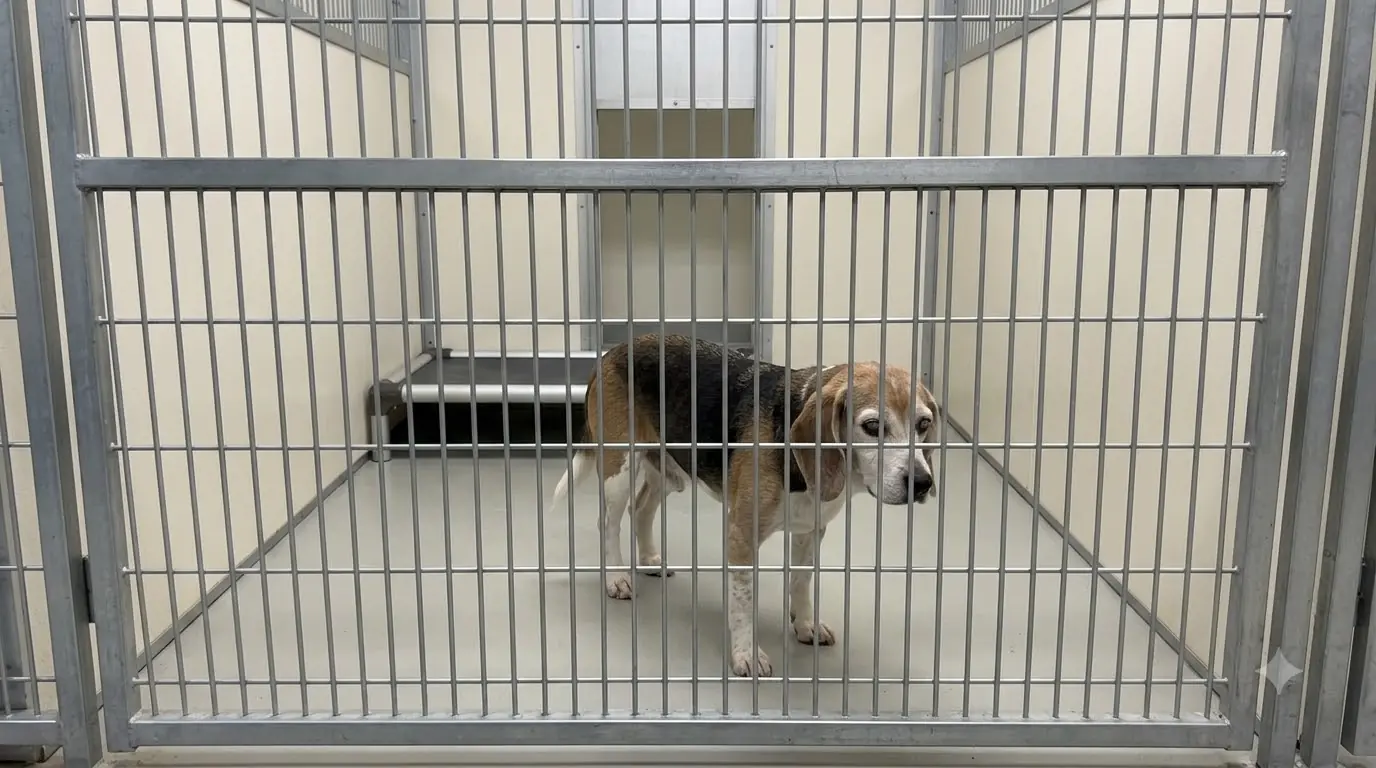
Chester is 12 years old, a senior Beagle who has lost nearly all of his hearing and vision.
When people walk through the shelter, Chester rarely reacts the way they expect a dog to react.
He does not hurry toward the kennel door.
He does not immediately turn when footsteps approach.
Most of the time, Chester stands facing a corner with his back toward the hallway.
Visitors see an elderly dog who appears completely uninterested in them.
Then they keep walking.
But there is something many of them never get to see.
When a shelter employee creates a gentle vibration through the kennel floor, Chester realizes someone is there.
He turns around.
He carefully finds his way to the bars.
And sometimes, by the time his tail starts wagging at the gate, the person who stopped to look at him is already gone.
Chester Often Doesn't Know Someone Has Stopped
For most dogs in a shelter kennel, the hallway provides constant information.
They hear footsteps approaching.
They hear voices.
They see movement through the bars.
Before a visitor even reaches the kennel, many dogs already know someone is coming.
Chester does not have those advantages anymore.
With nearly all of his hearing and vision gone, he can miss the signs that someone is standing only a few feet away.
So Chester often remains where he is.
His face points toward the corner.
His back faces the kennel gate.
A visitor stops and looks inside.
Chester does not turn.
After a few seconds, the visitor moves on.
From the hallway, it can look as though Chester simply did not care that anyone was there.
The reality is much simpler.
Chester may not have known.
Staff Have Found a Way to Tell Him Someone Is There
Shelter employees have learned that Chester can respond to another kind of signal.
They gently create a vibration through the floor.
Chester notices.
His body changes almost immediately.
The old Beagle turns away from the corner.
Because he cannot rely on normal sight and hearing to orient himself, he does not race toward the front.
He begins searching.
One careful step.
Then another.
Chester slowly works his way toward the kennel gate.
Eventually, he reaches the bars.
Then his tail begins to wag.
Sometimes the hallway is already empty.
The person who had paused outside Chester's kennel has continued to the next dog without ever seeing that response.
His Tail Starts Wagging After the Visitor Is Gone
That delay is what makes Chester's situation especially difficult.
He is not necessarily ignoring the people who stop.
He simply needs a different way to realize they are there.
A visitor may give Chester five or ten seconds.
Chester continues facing the corner.
They see his back.
They leave.
A staff member then signals him through the floor.
Chester turns.
He carefully approaches the gate.
His nose searches near the bars.
His tail begins moving.
But there may be nobody left on the other side.
There is no need to invent what Chester thinks when that happens.
No one can know whether he expected to find someone there or whether he understands why the hallway is empty.
What can be observed is heartbreaking enough.
Chester responds.
He just responds too late for many visitors to see it.
Nearly Losing Two Senses Changes How Chester Experiences the Kennel
Chester has lost almost all of both his hearing and vision.
No underlying medical diagnosis was provided for either impairment.
It is unknown whether the losses are entirely age-related or connected to specific eye or ear conditions.
His remaining level of functional hearing and sight has also not been precisely described.
Those details should come from his veterinary records.
What is clear is that Chester experiences the shelter differently from a dog who can clearly hear and see.
Someone approaching the kennel may be obvious to every dog around him while remaining almost undetectable to Chester.
That can influence everything from how he greets people to how he navigates unfamiliar spaces.
It can also create a misleading first impression.
A dog standing with his back toward visitors may appear withdrawn or uninterested.
For Chester, his sensory limitations provide crucial context.
Chester Needs Time to Find the Gate
Even after Chester realizes someone is nearby, reaching them is not instantaneous.
He is 12 years old.
He has very limited vision.
He turns and begins feeling his way forward.
His steps are deliberate.
He searches for the kennel front rather than charging toward it.
Then he reaches the bars.
That is when visitors could see a very different Chester from the one facing the corner.
His tail moves.
He responds to the presence of someone nearby.
The problem is that shelter visitors rarely know they need to wait for that second version of the interaction.
Many have already walked away.
His History Before the Shelter Is Unknown
No information was provided explaining how Chester entered the shelter.
It is unknown whether he arrived as a stray, was surrendered by an owner, transferred from another organization, or entered under different circumstances.
His history before intake is unknown.
There is also no information about how long Chester has lived with his hearing and vision loss.
Nothing provided establishes neglect, abuse, abandonment, or another specific cause for his disabilities.
Those details should not be invented.
What matters for Chester now is that his sensory limitations are affecting how people perceive him during the very short amount of time they spend outside his kennel.
Chester Is Easy to Misunderstand
A shelter kennel gives dogs only a small window to make an impression.
Chester's first impression is often his back.
He does not hear someone calling his name.
He may not see a hand moving outside the bars.
He does not realize he is being watched.
Then the person leaves.
That makes Chester's disability more than a medical issue.
It affects whether visitors ever see him respond to them.
Someone who understands his limitations can approach the interaction differently.
They can allow more time.
They can follow shelter staff's guidance for safely signaling their presence.
They can watch what Chester does once he actually realizes someone is nearby.
That is when his quiet trip from the corner to the gate begins.
Chester's Exact Risk Status Needs to Be Confirmed
Chester is being presented in the context of a senior shelter dog who is repeatedly being passed over.
However, no exact euthanasia deadline or explicit confirmation that he is currently on a euthanasia list was provided.
Those details should not be added without evidence.
The shelter name, city, state, and Animal ID were also not supplied.
Anyone interested in Chester should therefore contact the shelter directly for his current status and determine whether there is a deadline affecting his placement.
His senior age and profound sensory limitations are important considerations, but they should not automatically be described as reasons for euthanasia unless the shelter confirms that.
A Home Would Need to Account for Chester's Disabilities
Anyone considering Chester should request his complete medical and behavioral information.
A nearly deaf and nearly blind senior dog may need an environment designed around predictability and safety.
Potential helpers should ask how well Chester navigates unfamiliar spaces, whether he manages stairs, how staff safely wake or approach him, and which tactile or vibration cues he already understands.
They should also ask about his general mobility, medications, pain management, appetite, and any additional age-related medical conditions.
No information was provided about Chester's compatibility with dogs, cats, children, or other household situations.
Those things must be confirmed individually.
His sensory impairment alone does not provide those answers.
The Saddest Part Happens After People Walk Away
The scene at Chester's kennel can happen without the visitor ever realizing what they missed.
Someone approaches.
Chester is standing with his face toward the corner.
They wait briefly.
He does not react.
They see an old Beagle's back and continue down the hallway.
Then a staff member gently signals through the floor.
Chester feels it.
He turns.
Slowly, he searches his way toward the gate.
By the time he reaches it, there may be nothing in front of him except an empty hallway.
But Chester's tail starts wagging anyway.
The dog who appeared uninterested only moments earlier is finally standing at the bars.
He was not necessarily refusing to come.
He simply needed to know someone was there.
And too often, Chester figures that out only after they are already gone.
DOG INFORMATION
Name: Chester
Breed: Beagle
Age: 12 years old
Current condition: Nearly complete hearing and vision loss
Observed kennel behavior: Frequently faces the kennel corner and does not notice visitors; responds to gentle floor vibrations by turning and carefully approaching the gate, where he wags his tail
Deadline: No euthanasia deadline provided
Current status: Senior shelter dog being repeatedly passed over; exact current placement and risk status should be confirmed directly with the shelter
HOW TO HELP
Anyone interested in Chester should contact the shelter directly to confirm his current availability, placement options, medical condition, and whether any deadline applies to his case.
Potential adopters, fosters, or rescues should request Chester's veterinary records and ask shelter staff to demonstrate the safest ways they communicate with him. His remaining hearing and vision, mobility, medications, navigation needs, and behavior in environments outside the kennel should all be discussed.
Sharing Chester's case may also help people understand what visitors walking past his kennel often do not: the old Beagle facing the corner may not be ignoring anyone at all. He may simply need a little longer to realize someone came to see him.
Please contact the shelter directly for the most current information. Shelter status can change quickly, and Chester's current availability should always be confirmed before making plans.