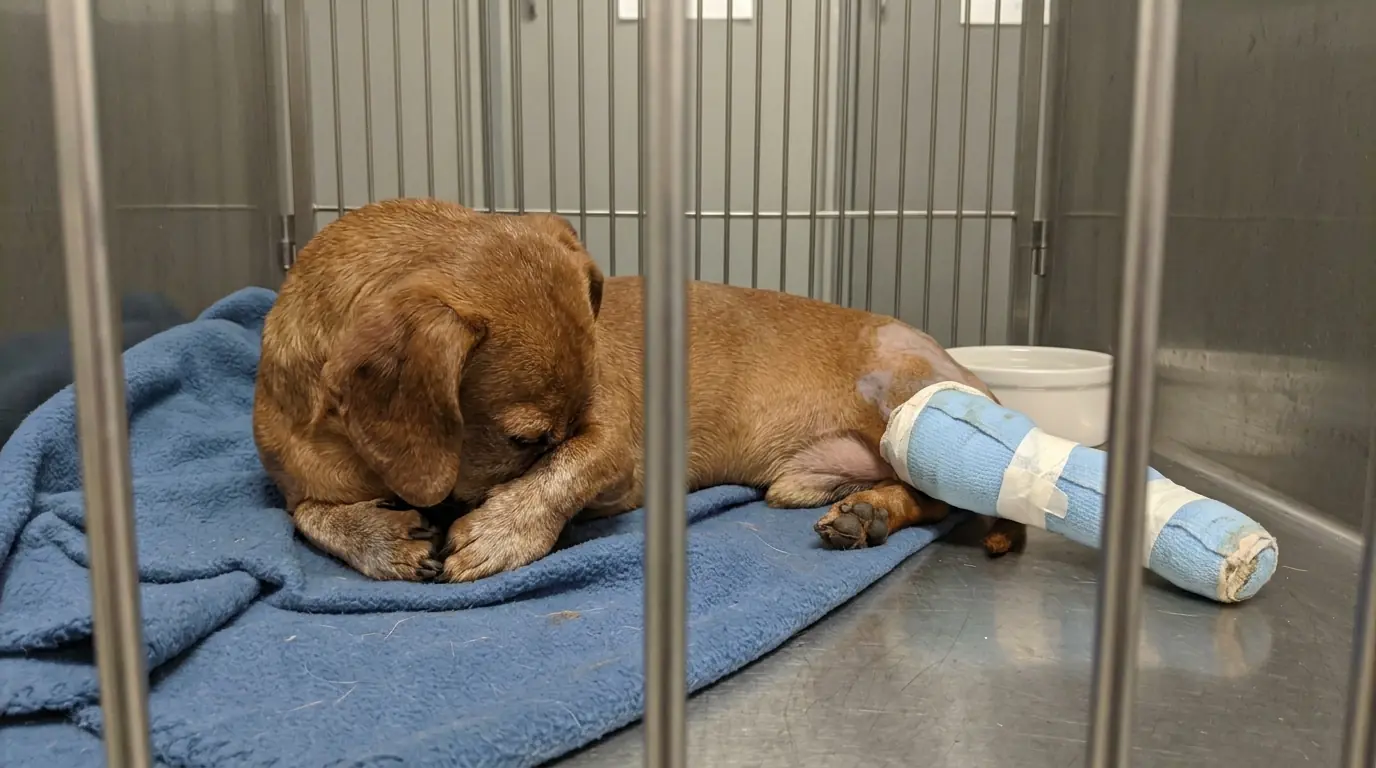
Chip remembers how he wants to sleep.
His body just cannot make that shape anymore.
The six-year-old Miniature Dachshund lies inside his recovery kennel after a vehicle accident left his pelvis injured and one hind leg fractured badly enough to require stabilization in a splint.
A blanket is tucked beneath him.
The room is quiet.
Chip is exhausted.
He lowers his head, turns toward his chest, and begins doing what he has probably done thousands of times before.
He tries to curl up.
His front half folds easily.
His nose turns inward.
His shoulders round.
Then his hips need to follow.
They do not.
The splinted hind leg remains extended behind him.
Chip shifts.
Tries again.
His body trembles.
He stops.
A few minutes later, he attempts the same movement from another angle.
Again, his head curls toward his chest.
Again, the injured half of his body refuses to follow.
Eventually, Chip gives up.
His front half remains tucked into the beginning of a familiar sleeping position.
Behind him, the splinted leg sticks straight beyond the blanket.
His eyes finally close.
It is the closest his injured body can get to curling up.
The Accident Changed One of His Most Ordinary Movements
Chip did not arrive with a mysterious limp.
His injuries followed significant trauma.
A vehicle accident had damaged his pelvis and fractured one of his hind legs.
For a long-backed, short-legged dog, either injury could make movement difficult.
Together, they affect almost everything involving the rear half of his body.
Standing.
Turning.
Squatting.
Changing sides.
And, unexpectedly, sleeping.
Curling Up Requires More Movement Than It Appears To
A sleeping dog tucked into a small circle looks completely relaxed.
But getting there requires coordinated movement.
The spine bends.
The pelvis rotates.
The hips and knees flex.
The hind legs draw underneath or alongside the body.
The front end curves toward the rear.
Chip can still perform much of that sequence with his front half.
The problem begins when his pelvis and fractured leg are asked to participate.
The Splint Has a Job
Chip's splinted leg is not supposed to bend normally right now.
The stabilization helps protect the injured limb according to his veterinary treatment plan.
That necessarily limits motion.
Chip cannot simply tuck the leg tightly beneath himself because that would defeat the purpose of keeping the injured area protected.
So even if his instinct says, “pull this leg inward,” the physical structure around it says otherwise.
His Pelvis Creates Another Limitation
Pelvic injuries can make changes in posture uncomfortable.
Turning the hindquarters may hurt.
Shifting weight from one side to another may hurt.
Trying to draw the rear legs toward the abdomen can place forces through injured structures.
The exact restrictions depend on the nature of Chip's injuries.